# OmniResearchHub – English
> AI-written research on personal topics and interests.
About & Methodology: https://omniresearchhub.com/about/
---
## Comprehensive Ethnobotanical, Phytochemical, and Agronomic Analysis of Tarragon (*Artemisia dracunculus*)
URL: https://omniresearchhub.com/tarragon-ethnobotany-phytochemistry-agronomy/
Published: 2026-11-16
Updated: 2026-11-16
Tags: tarragon, herbs, ethnobotany, phytochemistry, Georgian cuisine
> Tarragon (Artemisia dracunculus): origins and etymology, French versus Russian chemotypes, agronomy, nutrition, culinary traditions from France to Georgia, the Lagidze Tarkhun soda, and EU seed import rules.
### Historical Origins and Etymological Trajectory
Tarragon (*Artemisia dracunculus* L.) is a perennial herbaceous member of the Asteraceae family, residing within an ecologically diverse genus of aromatic plants that encompasses common mugwort (*Artemisia vulgaris*) and absinthe wormwood (*Artemisia absinthium*) [1, 2, 3]. The species originated in the continental steppe ecosystems of Central Asia and Siberia, progressively colonizing temperate latitudes across Eurasia and western North America [1, 3, 4]. The dissemination of tarragon into the Western European gastronomic and medical lexicon occurred during the late medieval period, primarily propelled by Islamic commercial exchange and Mongolian migrations across Eurasian trading corridors during the thirteenth century [3, 4].
The morphological attributes and medicinal folklore surrounding the herb directly shaped its classical nomenclature. The specific epithet *dracunculus* serves as a Latin diminutive of *draco*, translating literally to "little dragon" [2, 5, 6]. Early natural historians, including Pliny the Elder, associated the plant with serpentine qualities due to the tortuous, twisting architecture of its fibrous root system and rhizomes [2, 5]. Under the doctrine of signatures, this physical resemblance underpinned medieval therapeutic assertions that the herb was capable of neutralizing the venom of reptiles, rabid beasts, and stinging insects [2, 5, 7].
Linguistic transmission into contemporary Western languages illustrates an intricate trail of phonetic shifts across regional borders. The Ancient Greek designation *drakóntion* was absorbed into the Classical Arabic lexicon as *ṭarḵūn* (طَرْخُون), reflecting the plant's medicinal deployment throughout the medieval Islamic world [8, 9, 10]. During the Moorish administration of the Iberian Peninsula and extensive trade interactions across the Mediterranean basin, the Arabic term was incorporated into Medieval Latin as *tarchon* or *tragonia* [10]. As the plant entered broader European cultivation, the term split along distinct phonetic tracks: the Arabic loanword yielded *tarragon* in the English vernacular, while romance languages combined the root with the Latin "dragon" etymology, establishing *estragon* in Old French and *estragón* in Castilian Spanish [8, 10, 11]. Monastic scriptoria and medicinal physic gardens preserved the plant throughout the Renaissance as an essential carminative, appetite stimulant, and topical odontalgic agent [3, 12, 13].
### Botanical Divergence and Chemotaxonomy: French vs. Russian Tarragon
Although traditionally classified under the unified taxon *Artemisia dracunculus*, the species exhibits a fundamental botanical and horticultural bifurcation into two distinct cultivated varieties: French tarragon (*Artemisia dracunculus* var. *sativa*) and Russian tarragon (*Artemisia dracunculus* var. *inodora*, frequently referenced in historical literature as *Artemisia dracunculoides*) [14, 15, 16, 17]. These varieties diverge sharply in cytogenetic configuration, reproductive viability, agronomic habit, and volatile oil biosynthesis [14, 16, 17].
French tarragon represents an advanced horticultural selection that underwent extensive polyploidization, manifesting predominantly as a sterile tetraploid cytotype with a somatic chromosome number of 2n = 4x = 36 [17]. Because its reproductive florets are completely sterile, French tarragon is incapable of setting viable seed [1, 5, 15]. Consequently, the preservation of this culinary variety relies entirely on vegetative propagation via rhizome division, basal softwood cuttings, or micropropagation [1, 5, 15]. The metabolic machinery of French tarragon is defined by an essential oil yield of 0.5% to 3.1% of dried aerial biomass, characterized by a high concentration of the phenylpropanoid estragole (methyl chavicol), which constitutes between 60% and 82% of the total essential oil [1, 15, 16]. Secondary volatile constituents include monoterpenes such as (Z)- and (E)-β-ocimene (5% to 15%), limonene, and α-pinene [1, 15]. In parallel, the leaves synthesize sensory-active alkamides, notably *cis*-pellitorine, which interact with trigeminal sensory receptors to induce a characteristic tongue-numbing, salivatory sensation [4, 13]. This volatile and alkamide matrix yields the sweet, complex anise, fennel, and licorice aroma valued in fine culinary applications [1, 15, 16].
Conversely, Russian tarragon comprises a continuum of wild and semi-domesticated cytotypes ranging from diploid (2n = 18) to complex polyploid series up to decaploid (10x) [17]. The variety retains complete sexual fertility, producing thousands of small, viable achenes per plant [1, 14, 17]. Agronomically, Russian tarragon is far more robust, developing into an upright subshrub reaching heights of 100 to 150 centimeters, characterized by coarser, paler, and lanceolate leaves that lack the delicate foliar texture of its French counterpart [1, 5]. Chemically, the volatile profile of Russian tarragon contains minimal, trace, or entirely undetectable levels of estragole [1, 15, 18]. Its volatile synthesis is instead dominated by monoterpenes and non-anise phenylpropanoids, including elemicin (often representing 50% to 57% of the volatile fraction), sabinene (20% to 21%), methyleugenol, and terpinolene [1, 16, 18]. This distinct biochemical profile produces an organoleptic experience devoid of licorice sweetness, exhibiting instead a pungent, herbaceous, grassy, balsamic, and mildly astringent flavor with lingering bitter undertones [1, 14, 15, 16].
| Morphological and Phytochemical Metric | French Tarragon (*A. dracunculus* var. *sativa*) | Russian Tarragon (*A. dracunculus* var. *inodora*) |
| :--- | :--- | :--- |
| **Cytogenetic Profile** | Tetraploid (2n = 4x = 36) [17] | Diploid to high polyploid (2n = 2x = 18 to 10x) [17] |
| **Reproductive Mechanism** | Seed-sterile; obligate vegetative propagation [1, 5, 15] | Sexually fertile; reproduces prolifically via seed [1, 5, 14] |
| **Mature Plant Stature** | 60–90 cm; compact, delicate branching [5, 16, 19] | 100–150 cm; robust, coarse, vigorous shrub [1, 5] |
| **Foliage Characteristics** | Smooth, deep lustrous green, narrow-linear [2, 16, 19] | Larger, paler green, slightly pubescent, coarse [1, 2, 5] |
| **Dominant Volatiles** | Estragole / Methyl chavicol (60–82%), β-Ocimene [1, 15] | Elemicin (up to 57%), Sabinene (up to 21%), Methyleugenol [1, 16] |
| **Sensory and Flavor Profile** | Sweet anise, fennel, licorice, mild numbness [1, 4, 15, 16] | Grassy, balsamic, bitter, astringent, non-anise [1, 14, 15, 16] |
| **Primary Industrial Role** | High-end gastronomy, sauces, vinegars, perfumery [2, 15] | Biomass extraction, braised stews, commercial soft drinks [1, 20] |
### Agronomy, Cultivation Parameters, and Global Distribution
Cultivation of *Artemisia dracunculus* spans temperate zones across the Northern Hemisphere, with the species demonstrating operational hardiness within USDA zones 4 through 8 [21]. The plant demands a full-sun exposure to maximize the synthesis of secondary metabolites within its foliar glandular trichomes, though it tolerates light partial shade in intensely warm, arid climates [7, 21]. Soil physical architecture and hydraulic conductivity represent the primary determinants of agronomic viability. Tarragon requires highly permeable, well-aerated sandy loam or calcareous loamy substrates possessing an optimal pH range of 6.5 to 7.8 [5, 21]. Poorly drained, heavy clay soils with high water retention rapidly trigger root and crown rot pathogens, particularly *Rhizoctonia*, *Pythium*, and *Fusarium* species, leading to severe winter kill in continental settings [19, 21]. Furthermore, high soil fertility or excessive nitrogen application results in an overproduction of soft vegetative tissue that dilutes volatile terpene concentrations, diminishing culinary aroma and flavor potency [5].
The native botanical distribution encompasses dry slopes, alluvial river terraces, and steppe prairies extending from Central and Eastern Europe through the Southern Urals, Siberia, Central Asia, and northern China, while maintaining established populations across Western North America from subarctic Canada to Mexico [1, 3, 5]. Commercial and agricultural cultivation patterns reflect varietal specialization. French tarragon is farmed intensively in France (especially around Provence and the Loire Valley), the Netherlands, Germany, Spain, and temperate agricultural regions of the United States, such as Oregon, Washington, and California, feeding gourmet fresh-cut herb markets, commercial culinary dehydrators, and premium essential oil distillers [15, 20]. Russian tarragon cultivation is concentrated across Eastern Europe, the Russian Federation, the South Caucasus (Georgia, Armenia, and Azerbaijan), Central Asia, and Iran [1, 4, 20, 22]. Because Russian tarragon can be direct-seeded mechanically and demonstrates drought tolerance, poor-soil hardiness, and vigorous biomass generation, it serves as an industrial crop for regional bulk markets, savory culinary traditions, and botanical syrup manufacture [1, 5, 20].
### Nutritional Composition and Secondary Metabolites
The nutritional profile of *Artemisia dracunculus* demonstrates an exceptional concentration of essential minerals, dietary fiber, and specific vitamins, particularly within dried foliar products where moisture loss concentrates the underlying biochemical constituents [12, 13, 23]. Analytical data cataloged by the United States Department of Agriculture (USDA FoodData Central SR Legacy, FDC ID 170937) quantify the nutritional metrics of dried tarragon per 100 grams of biomass [12, 24].
| Nutrient Category | Biochemical Metric | Value per 100 g (Dried) | Daily Value Percentage (% DV) |
| :--- | :--- | :--- | :--- |
| **Macronutrients** | Caloric Energy | 295 kcal (1,236 kJ) [13, 23] | 15% [24] |
| | Total Protein | 22.77 g [13, 23] | ~46–54% [24] |
| | Total Lipid (Fat) | 7.24 g [13, 23] | 11% [24] |
| | — Saturated Fatty Acids | 1.88 g [13] | 9% [24] |
| | — Polyunsaturated Fatty Acids | 3.70 g [13] | N/A |
| | Carbohydrates (by difference) | 50.22 g [13, 23] | 17% [24] |
| | Dietary Fiber | 7.40 g [12, 13] | 30% [24] |
| **Essential Minerals** | Iron (Fe) | 32.30 mg [13, 25] | 179–404% [24, 25] |
| | Manganese (Mn) | 7.97 mg [12, 13] | 346% [24, 25] |
| | Potassium (K) | 3,020.00 mg [12, 13] | 89% [24] |
| | Calcium (Ca) | 1,139.00 mg [12, 13] | 114% [24] |
| | Magnesium (Mg) | 347.00 mg [13, 25] | 83% [24, 25] |
| | Zinc (Zn) | 3.90 mg [13] | 35% [24] |
| | Phosphorus (P) | 313.00 mg [13] | 45% [24] |
| | Sodium (Na) | 62.00 mg [12, 13] | 3% [24] |
| **Vitamins** | Vitamin C (Ascorbic Acid) | 50.00 mg [13] | 56% [24] |
| | Vitamin B6 (Pyridoxine) | 2.41 mg [12, 13] | 185% [24] |
| | Vitamin B2 (Riboflavin) | 1.34 mg [12, 13] | 103% [24] |
| | Vitamin B3 (Niacin) | 8.95 mg [13] | 56% [24] |
| | Folate (Total Vitamin B9) | 274.00 µg [13] | 69% [24] |
| | Vitamin A (RAE) | 210.00 µg (4,200 IU) [13] | 23% [24] |
While typical culinary usage involves small amounts—a standard tablespoon of dried tarragon weighs approximately 1.8 grams, delivering roughly 5 calories, 0.14 milligrams of manganese, and 0.58 milligrams of elemental iron—the absolute micronutrient density ranks among the highest in cultivated culinary herbs [12, 24].
Beyond essential nutrients, tarragon synthesizes a broad spectrum of non-nutritive secondary metabolites that govern its physiological, preservative, and medicinal activities [17, 26]. Flavonoids such as quercetin, rutin, luteolin, and kaempferol derivatives provide antioxidant protection by scavenging reactive oxygen species and inhibiting lipid peroxidation in cellular membranes [18, 26]. Coumarin derivatives, specifically herniarin (7-methoxycoumarin) and scopoletin (7-hydroxy-6-methoxycoumarin), contribute subtle woody aromatics and have demonstrated mild vascular and smooth-muscle relaxant properties in pharmacological models [16]. Alkamides, represented predominantly by *cis*-pellitorine, provide local anesthetic and sialagogue properties by stimulating oral mucosal receptors, historically reinforcing the plant’s role as an herbal remedy for toothaches [4, 12, 13]. Finally, phenolic acids, including caffeic, chlorogenic, and vanillic acids, act as enzymatic inhibitors and natural antimicrobial barriers, imparting strong shelf-life-extending capabilities to marinades and processed culinary preparations [17, 26].
### Comparative Cross-Linguistic Nomenclature
The cross-linguistic terminology applied to *Artemisia dracunculus* across European, Caucasian, and North American regions reveals the convergence of classical Greek dragon folklore, medieval Arabic botanical classifications, and regional Romance or Germanic lexical shifts [5, 8, 10]:
| Nation / Jurisdiction | Primary Common Name | Native Script / Taxonomic Form | Linguistic Root and Context |
| :--- | :--- | :--- | :--- |
| **Georgia** | *Tarkhuna* [27] | ტარხუნა | Borrowed from Arabic *ṭarḵūn* via historical Persian-Caucasian trade [8, 9] |
| **Russian Federation** | *Tarkhun* / *Estragon* [1, 27] | Тархун / Эстрагон | *Tarkhun* used for culinary greens and soft drinks; *Estragon* in botanical texts [1, 27] |
| **France** | *Estragon* [1, 2] | *Estragon* (hist. *Herbe au dragon*) [6] | Derived from Old French *targon*, altered by Latin *dracunculus* [5, 11] |
| **Czech Republic** | *Pelyněk kozalec* / *Estragon* | *Pelyněk kozalec* | *Pelyněk* designates the *Artemisia* genus; *kozalec* denotes folkloric pastoral roots |
| **Germany** | *Estragon* [5] | *Estragon* (hist. *Dragoner*, *Kaisersalat*) [5] | Borrowed from French *estragon*; regional terms preserve dragon roots [5] |
| **United Kingdom** | *Tarragon* [1, 5] | *Tarragon* (French / Russian) [1, 5] | Middle English adaptation directly borrowed from medieval Arabic *ṭarḵūn* [10, 11] |
| **United States** | *Tarragon* [1, 14] | *Tarragon* [1, 14] | Anglo-Saxon culinary adaptation popularized via classical French cuisine [4] |
| **Spain** | *Estragón* [28] | *Estragón* (regionally *Tarragona*) [28] | Castilian adaptation reflecting Romance linguistic transitions from *ṭarḵūn* [8, 28] |
### Culinary Paradigms Across Global Foodways
The divergence in secondary metabolite synthesis dictates how tarragon is integrated across global culinary cultures [15]. In classical French cuisine, French tarragon is an indispensable component of the traditional canon [1, 2]. Because its estragole-rich volatile oils are thermally fragile and rapidly volatilize or oxidize when exposed to sustained boiling, classical French culinary technique requires adding the herb during the final moments of thermal preparation, or deploying it within room-temperature or gently warmed lipid-acid emulsions [1, 2, 15]. French tarragon is an essential constituent of the classic *fines herbes* mixture, combined in equal balance with chervil, chives, and flat-leaf parsley [2, 7]. It serves as the primary aromatic foundation of *Sauce Béarnaise*, an emulsion of clarified butter, egg yolks, shallots, white wine, and an acid-stabilized tarragon reduction, and plays a prominent role in *Sauce Gribiche* and *Sauce Ravigote* [2, 7]. Steeped in white wine vinegar (*vinaigre à l'estragon*), its essential oils impart the complex anise finish that characterizes traditional Dijon mustards, poulet à l'estragon, and poached seafood dishes [2].
Moving eastward across the European continent, tarragon transitions into alternative culinary environments. In Hungarian and Transylvanian gastronomy, where the herb is known as *tárkony*, it serves as the defining botanical element in *Tárkonyos raguleves* [29]. This traditional ragout soup features chicken, lamb, or veal stewed with root vegetables (carrots, parsnips, and celeriac), thickened with a blend of sour cream and flour, and finished with a sharp acid profile provided by lemon juice or vinegar and substantial quantities of tarragon [29]. The herbal profile of the tarragon cuts through the dense dairy fats, offering a clean, contrasting herbaceous note [29].
In Slovenia, tarragon occupies a sweet culinary application found nowhere else in European pastry making, manifested in *Pehtranova potica* [30, 31, 32]. Potica is a rolled yeast-dough festive cake granted European Union Traditional Speciality Guaranteed (TSG) status [31]. While common varieties rely on fillings of ground walnuts, poppy seeds, or honey, *Pehtranova potica* is prepared during the spring and Easter holidays to welcome the emergence of young perennial herb shoots [30, 31, 33, 34]. The filling pairs abundant freshly chopped tarragon leaves with sweet, fresh cottage cheese (*skuta* or ricotta), egg yolks, heavy sour cream, sugar, and vanilla [31, 32, 35]. When baked within a traditional fluted earthenware ring mould (*potičnik*), the tarragon's volatile compounds permeate the sweet dairy custard, producing an aromatic herbal profile [31, 32, 36].
In the Transcaucasian and Middle Eastern culinary spheres, tarragon shifts from a micro-dosed culinary herb to a major leafy vegetable [4]. In Persian dining, fresh tarragon is an essential constituent of *sabzi khordan*, an abundant plate of raw herbs including fresh basil, mint, coriander, and scallions served alongside walnuts, flatbreads, and feta cheese to cleanse the palate between courses of braised and grilled meats [4, 22].
### The Georgian Epoch: Chakapuli and the Soft Drink Revolution
In Georgia, tarragon (*tarchuna*, ტარხუნა) is a cornerstone of national culinary identity [27]. The Georgian approach to the herb diverges fundamentally from the reserved culinary traditions of Western Europe: tarragon is purchased in large bouquets and consumed fresh, raw, and in substantial volume [4, 22]. Placed upon the traditional Georgian *supra* (feast table), fresh tarragon sprigs are eaten by the handful alongside pungent *sulguni* cheese, warm flatbread (*puri*), radishes, and grilled meats, serving as an aromatic, crisp balance to rich lipids [22].
The traditional savory expression of this herb is *Chakapuli* (ჩაქაფული), a springtime stew central to Georgian Orthodox Easter feasts [37, 38, 39]. Designed around early spring produce, the preparation layers cuts of young lamb, kid goat, or veal with large volumes of fresh tarragon leaves, wild sour green plums (*tkemali*), green garlic, spring onions, coriander, and dry white Kakhetian wine [5, 37, 38, 39]. As the dish simmers gently, the high malic and citric acid content of the unripe plums, combined with the tartaric acid of the dry wine, breaks down the connective tissues and fat of the meat while tempering the aggressive herbal oils of the tarragon [37, 39]. The tarragon leaves melt into the braising liquid, producing a green, highly aromatic broth with a sour, herbal finish that represents the traditional sensory standard of Georgian spring cookery [37, 39].
Beyond savory dining, Georgia pioneered the integration of tarragon into commercial carbonated soft drinks [20, 27]. In 1887, in the western Georgian city of Kutaisi, an apprentice pharmacist named Mitrofan Lagidze (1869–1960), working at the Kokochashvili and Ivanovsky Pharmacy, began experimenting with combining natural plant extracts with pressurized carbonated water [27, 40, 41, 42]. Rejecting the imported, synthetic chemical syrups common in contemporary mineral-water spas, Lagidze developed a cold extraction technique using locally cultivated Caucasian tarragon, blending the resulting extract with natural sugar syrup and carbonated artesian spring water [27, 40, 41, 43]. The resulting sparkling beverage, named *Tarkhun* (ტარხუნა), became famous for its vivid emerald-green hue and sweet, aniseed-herbaceous flavor [20, 27, 44].
Lagidze established a commercial soda facility in Kutaisi in 1900, followed in 1906 by his flagship soda fountain on Golovinsky (now Rustaveli) Avenue in Tbilisi, which evolved into a renowned cultural landmark [43]. Lagidze Waters earned gold and silver medals at international agricultural exhibitions in Saint Petersburg in 1913 and Vienna in 1914, celebrated by Georgian literary figures such as Akaki Tsereteli [42, 43]. Following the Sovietization of Georgia, the enterprise was nationalized; however, Soviet administrative planners recognized the drink's appeal and appointed Lagidze technical director of a major bottling plant erected in Tbilisi in 1927 [27, 43].
During the late Soviet era, the Soviet Ministry of the Food Industry and the All-Union Scientific Research Institute of the Beer and Non-Alcoholic Beverage Industry standardized the formula for mass industrialization [20, 27]. In 1981, pilot bottling operations began, scaling by 1983 into union-wide distribution in standardized 0.33-liter and 0.5-liter glass bottles [27]. *Tarkhun* became an established soft drink throughout the USSR, served alongside carbonated fountains and syrup dispensers in public squares and state department stores [20, 27]. In 2014, the technology and cultural heritage of Lagidze Waters were formally inscribed on the Representative List of the Intangible Cultural Heritage of Georgia, recognizing the beverage as an enduring national innovation [40, 45].
### Phytosanitary Regulatory Architecture: Seed Procurement and EU Import Restrictions
Botanists, horticulturists, and culinary travelers frequently evaluate the feasibility of acquiring tarragon seeds in Georgia—such as at the historic Green Bazaar (*Mtsvane Bazari*) in Kutaisi or through regional agricultural suppliers (*Agromagazia*)—for export and cultivation within the European Union. This enterprise encounters both basic botanical constraints and strict biosecurity legal restrictions [1, 46, 47].
From a botanical standpoint, seeds purchased in Georgian retail markets labeled *tarkhunis tesli* (ტარხუნის თესლი) will yield exclusively Russian tarragon (*Artemisia dracunculus* var. *inodora*) [1, 5]. Because true culinary French tarragon (*A. dracunculus* var. *sativa*) is an obligate-sterile tetraploid that cannot form viable seeds, true seed packets for authentic French tarragon do not exist anywhere in commercial circulation [1, 5, 15, 17]. Any seeds obtained in Georgia will produce the tall, coarse, elemicin-dominated plant lacking the delicate, estragole-rich licorice profile sought in French culinary technique [1, 14, 15, 16].
From a legal and phytosanitary standpoint, transporting seeds from Georgia into the territory of the European Union within passenger baggage is prohibited under European biosecurity statutes [46, 47]. The European Union plant health regime, established by **Regulation (EU) 2016/2031** on protective measures against pests of plants and supplemented by **Commission Implementing Regulation (EU) 2019/2072**, establishes comprehensive protective barriers designed to shield the European agricultural economy from invasive alien species, quarantine pests, and phytopathogenic vectors [46, 47].
Under these regulations, all botanical materials designated as "plants for planting"—a category that explicitly encompasses seeds intended for sowing, dormant rootstocks, live seedlings, and vegetative cuttings—are classified as high-risk materials [46, 47]. Consequently, any seed lot entering the European Union from a non-member third country, such as Georgia, must be accompanied by an official, original **Phytosanitary Certificate** [46, 47]. This document can only be authorized and issued by the National Plant Protection Organization (NPPO) of the exporting state—specifically the National Food Agency under Georgia's Ministry of Environmental Protection and Agriculture—following documented phytosanitary field inspections, seed-lot pathogen testing, and verification of quarantine cleanliness.
The strict regulatory updates that took effect in December 2019 eliminated all historical "personal use" exemptions for international travelers [46, 47]. While international air and maritime passengers previously retained minor dispensations for small quantities of garden seed, passenger baggage is now subject to the same zero-tolerance standards as commercial maritime freight [46, 47]. Only five tropical fruits (pineapples, bananas, coconuts, durians, and dates) are exempt from phytosanitary certification upon entry into the EU. When seeds are intercepted in passenger luggage during customs inspections at European Union border entry points, authorities confiscate and incinerate the botanical material, with travelers facing potential administrative fines [46, 47]. Growers within the EU seeking to cultivate Russian tarragon can purchase certified packets of *Artemisia dracunculus* var. *inodora* seed through licensed European domestic nurseries, bypassing customs hurdles while ensuring seed purity [1, 2, 15].
### Historical Beverage Trails and Market Divergence in Western Europe
Western European traditions surrounding the genus *Artemisia* focused almost entirely on medicinal tinctures, carminative cordials, and distilled alcoholic aperitifs rather than commercial non-alcoholic sodas [3, 48]. In monastic infirmaries and early modern distilleries, European herbalists extracted volatile oils from *Artemisia absinthium* (wormwood), *Artemisia pontica* (Roman wormwood), and *Artemisia dracunculus* into high-proof spirits [3, 48]. The French developed regional *liqueur d'estragon*, a home-distilled or macerated herbal digestif created by steeping fresh French tarragon leaves with pure grain spirit and cane sugar syrup, consumed in small measures after rich, fatty meals to stimulate gastric secretion [7]. In Central and Southeastern Europe, related distillates arose, including Moldovan *Tarhon*, a spirits-based digestif featuring macerated tarragon botanicals [49]. Beyond distilled spirits, eighteenth- and nineteenth-century households prepared culinary oxymels and shrubs, steeping tarragon in wine vinegars with honey to create carminative syrups, which were diluted with fresh spring water as medicinal tonics rather than everyday refreshments [2, 7].
Despite the presence of these herbal formulations, non-alcoholic carbonated tarragon beverages never attained mainstream popularity in Western and Central Europe. This market divergence is explained by four distinct cultural, toxicological, and industrial factors:
#### Sensory Categorization and Culinary Segregation
Western European culinary philosophy assigned tarragon a distinct role as a savory, acid-paired seasoning [2]. Generations of European cooks associated the sweet anise-licorice profile of French tarragon with rich meat reductions, poultry sauces, egg emulsions, and salad vinegars [2, 4]. Consuming that same herbal licorice profile within a chilled, intensely sweet, carbonated soft drink was perceived as dissonant by mainstream Western consumers [2, 4].
Furthermore, where anise and licorice flavors were embraced in European beverage culture, they were directed into alcoholic aperitifs—such as French *pastis*, Greek *ouzo*, and Italian *sambuca*—leaving little commercial room for a non-alcoholic herbal soda [48].
#### Toxicological Scrutiny and Estragole Regulations
The essential oil of culinary French tarragon is rich in estragole (methyl chavicol), typically ranging between 60% and 82% of its volatile mass [1, 15]. During the late twentieth century, comprehensive toxicological investigations conducted by the European Commission's Scientific Committee on Food (SCF) and the European Medicines Agency (EMA) concluded that estragole is genotoxic and hepatocarcinogenic in rodent bioassays following metabolic conversion into 1'-hydroxyestragole [1, 5, 15, 19].
Although the European Union concluded that culinary consumption of the whole fresh herb poses negligible risk to public health, it enacted strict statutory limits regarding added estragole within mass-market processed foods and non-alcoholic commercial beverages under **Regulation (EC) No 1334/2008** [5, 15]. Industrial beverage bottlers in Western Europe faced rigorous regulatory monitoring and liability constraints when attempting to formulate sodas using natural French tarragon extracts, creating an economic barrier that discouraged soft drink development [15].
#### Divergent Beverage Industry Development
The soft drink infrastructure in Western Europe during the late nineteenth and twentieth centuries developed along pathways dominated by citrus fruits, ginger extracts, and cola flavorings [41, 43]. Backed by significant marketing capital, major commercial brands established citrus and cola profiles as the baseline for refreshment in post-war consumer culture.
In contrast, the Soviet soft drink industry developed within a state-directed agricultural environment largely isolated from Western brand imports [20, 27]. State research institutes were tasked with formulating soft drinks based on native agricultural commodities and domestic botanicals [20, 27]. This economic environment allowed Lagidze's historic *Tarkhun*—alongside other domestic herbal formulations such as *Baikal* (featuring pine needle extracts and Eleutherococcus)—to be scaled into standard municipal refreshments across public canteens and state retail shops [20, 27].
#### Agronomic Extraction Costs and Formulation Constraints
The biological characteristics of the plant imposed further economic limits on commercial production [1, 15]. True French tarragon cannot be established from seed, necessitating manual field division, maintenance of clonal beds, and careful vegetative harvesting, which drives up production costs relative to seed-propagated crops [1, 5, 15].
Moreover, heat-drying or thermal pasteurization rapidly strips the delicate essential oils of French tarragon, requiring cold extraction methods to preserve the authentic aroma [1, 2, 15]. While seed-fertile Russian tarragon can be grown mechanically at low cost, its volatile profile lacks the sweet anise character of French tarragon, yielding an astringent, grassy extraction [1, 14, 15, 16]. Producing an appealing soft drink from Russian tarragon thus requires heavy additions of sugar, artificial flavorings, and chemical colorants (such as tartrazine and brilliant blue) to simulate the classic bright green hue of natural chlorophyll, a formulation profile that clashes directly with modern Western soft-drink trends toward clean labeling and natural ingredients [1, 15, 27].
### Conclusions
*Artemisia dracunculus* presents a clear case study in how botanical variation, secondary metabolism, and historical agricultural systems shape human culinary traditions [1, 17, 20]. The plant's deep division into the seed-sterile, estragole-rich French cytotype and the seed-fertile, elemicin-dominated Russian variety governs its agricultural potential, sensory identity, and regulatory compliance [1, 14, 15, 17].
In Western Europe, tarragon evolved into a delicate culinary herb whose volatile profile was integrated into classical egg and butter emulsions, acid-stabilized sauces, and distilled aperitifs [2, 7, 48]. In the South Caucasus and Eastern Europe, the plant became an abundant agricultural commodity, integrated as an everyday table green, an acid-balanced component of springtime braises such as *Chakapuli*, and the foundation for a historic carbonated soft drink that achieved widespread commercial distribution [20, 22, 27, 37]. Contemporary international biosecurity laws—notably the European Union's strict ban on uncertified seed imports from third countries—continue to regulate the physical movement of the plant across national borders, preserving the divide between regional varieties and production methods [46, 47].
### Sources
1. [Tarragon: Flavor, French vs. Russian, Uses - SPICEography](https://spiceography.com/tarragon/)
2. [Tarragon, dried (raw?, organic) | Foundation G+E - Diet and Health](https://www.diet-health.info/en/recipes/ingredients/in/mb304-tarragon)
3. [Tarragon's family tree | The Botanist in the Kitchen](https://botanistinthekitchen.blog/2013/07/31/tarragons-family-tree/)
4. [A Requiem for Tarragon - Taste Cooking](https://tastecooking.com/a-requiem-for-tarragon/)
5. [Tarragon - Wikipedia](https://en.wikipedia.org/wiki/Tarragon)
6. [All About Tarragon | Know Your Fine Spice Naagadauna Herb](https://gosumitup.com/all-about-tarragon-know-your-spice-naagadauna)
7. [Uses & Health Benefits of Tarragon - Britannica](https://www.britannica.com/video/Overview-tarragon/-192190)
8. [طرخون - Wiktionary, the free dictionary](https://en.wiktionary.org/wiki/%D8%B7%D8%B1%D8%AE%D9%88%D9%86)
9. [Tarragon (Artemisia dracunculus) - Benefits, Dosage & Interactions](https://www.herbos.app/herbs/tarragon)
10. [Tarragon, Russian Tarragon Seeds - Seedaholic](https://www.seedaholic.com/siol/tarragon-artemisia-dracunculoides-russian-tarragon/)
11. [Tasteful Tarragon - Thyme Will Tell](https://thymewilltell.com/tarragon.html)
12. [Tarragon: Taste, Benefits, Substitutes & How to Cook With It - Dr. Axe](https://draxe.com/nutrition/tarragon/)
13. [14 Best Benefits & Uses of Tarragon - Organic Facts](https://www.organicfacts.net/tarragon.html)
14. [Russian Tarragon - American Botanical Council](https://www.herbalgram.org/resources/herbalgram/issues/102/table-of-contents/hg102-herbpro/)
15. [Tarragon as a Natural Flavoring: A Comprehensive Technical Guide](https://www.flavorist.com/tarragon-as-a-natural-flavoring-a-comprehensive-technical-guide/)
16. [Learn about Tarragon Essential Oil - Artemisia dracunculus](https://aromaticstudies.com/learn-about-tarragon-essential-oil-artemisia-dracunculus/)
17. [Untangling Tarragon: A Review of Animal and Clinical Studies with](https://journals.ashs.org/view/journals/hortsci/61/5/article-p972.xml)
18. [Qualitative variation of anti-diabetic compounds in different tarragon](https://pmc.ncbi.nlm.nih.gov/articles/PMC3164315/)
19. [Herb of the Month: French Tarragon, the “Little Dragon” Herb](https://blog.herbsociety.org/herb-of-the-month/herb-of-the-month-french-tarragon-the-little-dragon-herb/)
20. [Tarkhun: An Incredible, Natural Soda from Georgia - Folkways Today](https://folkways.today/tarkhun-natural-soda-georgia/)
21. [How to Grow Tarragon: Planting, Care & Harvest - Terropia](https://terropia.com/docs/vegetables/tarragon)
22. [Traditional drinks of the South Caucasus - Arara Tour](https://araratour.com/articles/traditional-drinks-of-the-south-caucasus)
23. [Spices, tarragon, dried — Nutrition per 100g - Triage Method](https://triagemethod.com/tools/human-nutrition-explorer/food/spices-tarragon-dried.html)
24. [Tarragon nutrition: calories, carbs, GI, protein, fiber, fats](https://foodstruct.com/food/tarragon)
25. [Dried tarragon (dried) calories & nutrition facts (per 100 g and per](https://dev.calori.com/foods/spices-tarragon-dried)
26. [Untangling Tarragon: A Review of Animal and Clinical Studies with](https://www.researchgate.net/publication/404324294_Untangling_Tarragon_A_Review_of_Animal_and_Clinical_Studies_with_a_Focus_on_Ambiguity_between_Chemotypes_in_the_Literature)
27. [Tarkhuna - Wikipedia](https://en.wikipedia.org/wiki/Tarkhuna)
28. [Spice Pages: Tarragon (Artemisia dracunculus) - Gernot Katzer](https://gernot-katzers-spice-pages.com/engl/Arte_dra.html)
29. [Tárkonyos Raguleves: creamy soup from Hungary - SoupWiki](https://soupwiki.com/soups/tarkonyos-raguleves/)
30. [Family Cook-offs & Recipes - Washie.com](https://www.washie.com/family-cook-offs-recipes/)
31. [What Is Potica? History, Varieties & Cultural Significance](https://www.poticas.com/about-potica.html)
32. [Tarragon-Ricotta Potica (Pehtranova potica s skuto)](https://www.slovenian-kitchen.com/blog-1/2022/04/08/tarragon-ricotta-potica-pehtranova-potica-s-skuto)
33. [Is Potica a Christmas Tradition? (Yes — and Easter, Even More)](https://www.poticas.com/guides/is-potica-a-christmas-tradition.html)
34. [Bled Island - Bled, Slovenia](https://www.bled.si/en/what-to-see-do/attractions/2/bled-island/)
35. [Get to know traditional Slovenian food from historical towns](https://www.zgodovinska-mesta.si/en/tastes-of-towns/pehtranova-potica-recept-novomeskega-mojstra-judeza/)
36. [Authentic Slovenian Potica Recipe: Traditional Christmas Cake](https://tanya.guide/slovenian-potica-recipe-traditional-christmas-cake)
37. [Chakapuli, Traditional Georgian Dishes - Advantour](https://www.advantour.com/georgia/dishes/chakapuli.htm)
38. [Chakapuli: Georgia's Spring Lamb Stew with Tarragon and Sour](https://georgianeats.com/recipes/chakapuli/)
39. [Chakapuli recipe — Georgian cuisine - Gurmestan](https://gurmestan.com/en/recipes/chakapuli/)
40. [Lagidze tskali | Local Soft Drink From Georgia - TasteAtlas](https://www.tasteatlas.com/lagidze-water-drink)
41. [History of carbonated water in Russia: National drink and](https://english.pravda.ru/history/138209-carbonated_water/)
42. [Luka Asatiani, Mitrofan Lagidze, and Others - Kutaisi Travel](https://kutaisi.travel/en/11416/luka-asatiani-mitrofan-lagidze-and-others/)
43. [Lagidze waters](http://lagidze.ge/en)
44. [Lagidze Lagidze Tarkhun - Best Gourmet Products - TasteAtlas](https://www.tasteatlas.com/lagidze-lagidze-tarkhun)
45. [Lagidze water - Wikipedia](https://en.wikipedia.org/wiki/Lagidze_water)
46. [RESTRICTED WT/TPR/S/425 23 March 2022 (22-2457) Page](https://www.wto.org/english/tratop_e/tpr_e/s425_e.pdf)
47. [Legal provisions on soil import - CIRCABC - European Union](https://circabc.europa.eu/sd/a/96fbf64a-c3e8-49ab-bb5f-efb6cdc16e85/Legal%20provisions%20on%20soil%20import.pdf)
48. [The Origins of our own Limongino and Orangino](https://englishspirit.uk/blogs/news/the-origins-of-our-own-limongino-and-orangino)
49. [European Spirits - Europe Is Not Dead!](https://europeisnotdead.com/european-spirit/)
50. [Tarragon (Artemisia dracunculus): French vs. Russian Tarragon](https://roosterspeacock.com/blogs/herbs-botanicals/tarragon-artemisia-dracunculus-french-russian-traditional-use-research-safety)
51. [Nutrition Facts for Dried Tarragon](https://tools.myfooddata.com/nutrition-facts/170937/wt1)
52. [Spices, tarragon, dried: 295 kcal, 22.8g protein per 100g — Nutrition](https://nutri-db.com/en/foods/170937)
53. [Dried tarragon - Nutrition Facts & Macros - Strongr Fastr](https://www.strongrfastr.com/foods/dried-tarragon-2041)
54. [Spices, tarragon, dried Nutrition Facts - Find Calories & Macros Per](https://www.recipal.com/ingredients/320-nutrition-facts-calories-protein-carbs-fat-spices-tarragon-dried)
55. [Spices, tarragon, dried - Nutrition Facts and Information - Medindia](https://www.medindia.net/nutrition-data/spices-tarragon-dried.htm)
56. [Nutrition values Spices, tarragon, dried | USDA 0418 - VitaHoy.ch](https://vitahoy.ch/en/ndb/pml/us-02041)
57. [Liquid Assets: Lagidze Water, Georgian Nectar - Culinary Backstreets](https://culinarybackstreets.com/stories/tbilisi/liquid-assets-7)
58. ["Lagidze Waters" - Legendary Georgian Lemonade - Live the World](https://www.livetheworld.com/post/lagidze-waters-legendary-georgian-lemonade-31f7)
59. [Tarragon (Artemisia dracunculus): origin and uses - Floralens](https://floralens-app.com/en/encyclopedia/artemisia-dracunculus)
60. [History of Tarragon: Healing Herb to French Cuisine Star](https://www.premiumspices.co.nz/blogs/news/history-of-tarragon)
61. [Ljubljana self-guided walking tour: 106 Old Town streets, about 7.5](https://cobblegobble.app/city/ljubljana.html)
62. [Top 10 Traditional Slovenian Foods - Greenhills bike tours Slovenia](https://greenhills.si/traditional-slovenian-food/)
63. [Stairway to Wishes: Bled Island Experience - The Vale Magazine](https://thevalemagazine.com/2023/06/21/stairway-to-wishes-bled-island-experience/)
64. [where to eat local Hungarian food ? : r/budapest - Reddit](https://www.reddit.com/r/budapest/comments/wzx7uv/where_to_eat_local_hungarian_food/)
65. [Tárkonyos raguleves csirkemellből - Csirkemell-receptek.hu](https://csirkemell-receptek.hu/tarkonyos-raguleves-csirkemellbol/)
66. [What are the typical dishes to taste in Budapest? - Quora](https://www.quora.com/What-are-the-typical-dishes-to-taste-in-Budapest)
---
## Strategic and Operational Analysis of the Transit Corridor from Prague to Kutaisi, Georgia
URL: https://omniresearchhub.com/prague-to-kutaisi-georgia-transit-corridor-analysis/
Published: 2026-11-16
Updated: 2026-11-16
Tags: Georgia, Kutaisi, travel logistics, relocation, Prague
> Operational analysis of relocating to or visiting Kutaisi from Prague: flights, ground transport, SIM and identity setup, housing, language, retail and payments, healthcare, food and local excursions.
### Flight Operations, Air Transit Schedules, and Chronobiological Dynamics
Direct commercial aviation between the Czech Republic and the Imereti region of western Georgia centers on the flight corridor connecting Prague Václav Havel Airport (PRG) and David the Builder Kutaisi International Airport (KUT) [1]. Non-stop air connectivity along this route is maintained primarily by the ultra-low-cost carrier Wizz Air, utilizing narrow-body Airbus A320 and A321neo aircraft [1, 2, 3, 4]. The carrier typically operates three to four scheduled rotations per week, functioning as a primary passenger artery that links Central European transportation networks with the Caucasus [1, 2, 3].
Flight schedules reflect an operational structure characterized by morning departures from Prague and dawn departures from Kutaisi [2, 3]. Outbound flights originating at Prague Terminal 1 depart between 07:30 and 08:40 Central European Time (CET/CEST), with an airborne flight duration averaging 3 hours and 35 minutes to 3 hours and 45 minutes [1, 2, 3, 4]. The aircraft arrives at Kutaisi International Airport in the early afternoon, typically between 14:10 and 14:15 Georgia Standard Time (GET) [2, 3, 4]. Conversely, return flights originating from Kutaisi operate as early morning services, regularly departing at approximately 06:00 GET [3]. This dawn departure requires travelers to clear security and border control during early hours, necessitating departure from Kutaisi’s central urban core between 03:30 and 04:00.
| Route Segment | Flight Designation | Departure Window | Arrival Window | Aircraft Type | Weekly Frequency |
| :--- | :--- | :--- | :--- | :--- | :--- |
| Prague (PRG) to Kutaisi (KUT) | W6 7924 | 07:30 – 08:40 (CET / CEST) | 14:10 – 14:15 (GET) | Airbus A320 / A321neo | 3–4 flights / week |
| Kutaisi (KUT) to Prague (PRG) | W6 7923 | ~06:00 (GET) | ~07:00 – 07:30 (CET / CEST) | Airbus A320 / A321neo | 3–4 flights / week |
Chronobiological and scheduling considerations depend on time zone differentials between the two jurisdictions [5]. Georgia operates on Georgia Standard Time (GET), situated permanently at UTC+4 without daylight saving adjustments [4, 5]. The Czech Republic observes Central European Time (CET, UTC+1) during the winter and transitions to Central European Summer Time (CEST, UTC+2) between late March and late October [4, 5]. Consequently, during the European winter months, Georgia is three hours ahead of Prague, narrowing to a two-hour differential during European summer daylight saving periods. Operational planning for arrivals and departures must account for this variable offset, which influences ground transport availability, digital check-in windows, and accommodation check-ins.
---
### Ground Transportation Logistics and Regional Mobility Architecture
David the Builder Kutaisi International Airport is situated approximately 22 kilometers southwest of the Kutaisi municipal core, alongside the principal east-west highway corridor. While regional minibuses (*marshrutkas*) and scheduled intercity coaches traverse this arterial route, the most consistent mobility solution for international arrivals is the digital ride-hailing application Bolt.
The ride-hailing vehicle network in the greater Kutaisi area maintains continuous twenty-four-hour availability. This reliability is particularly valuable for outbound travelers managing early morning departures. Despite the unsocial hours required to reach the terminal for a 06:00 flight, vehicle dispatch requests initiated between 03:30 and 04:00 typically yield confirmed drivers within two to five minutes across urban neighborhoods. This on-demand coverage provides an alternative to pre-booked private transfers or negotiations with unmetered airport drivers.
| Transit Modality | Travel Duration (Off-Peak / Dawn) | Travel Duration (Peak / Daytime) | Typical Fare (GEL) | Approximate Cost in Foreign Currencies |
| :--- | :--- | :--- | :--- | :--- |
| Bolt Airport Ride-Hail | ~30 minutes | ~40 minutes | ~25.00 GEL | ~210–220 CZK / ~8.50 EUR / ~9.25 USD / ~7.30 GBP |
| Bolt Urban Micro-Transit | 5–10 minutes | 10–15 minutes | ~4.00–7.00 GEL | ~35–60 CZK / ~1.40–2.40 EUR / ~1.50–2.60 USD / ~1.20–2.05 GBP |
Transit times vary primarily by time of day. Daytime transfers between the airport and downtown Kutaisi generally take around 40 minutes due to pedestrian movement and regional freight along the access road. In contrast, off-peak and early morning transfers take approximately 30 minutes. The standard one-way fare between the airport and downtown Kutaisi remains stable at approximately 25 Georgian Lari (GEL). Through digital fare calculation, integrated GPS tracking, and automated foreign exchange handling, app-based ride-hailing provides cost transparency while mitigating common airport arrival friction.
---
### Telecommunications Infrastructure, Identity Verification, and Provisioning Protocols
Securing local cellular connectivity upon arrival is critical for navigating local services, utilizing transport applications, and managing logistical arrangements [6]. The primary national network providers—Cellfie (formerly operating as Beeline Georgia), Magti, and Silknet—offer local data and voice packages that bypass standard European international roaming fees [7, 8].
Travelers can configure an electronic SIM (eSIM) in advance through carrier web platforms, such as Cellfie's portal [6, 7]. The onboarding process complies with Georgian regulatory mandates regarding digital Know-Your-Customer (eKYC) identification [6]. The subscriber submits an international passport scan and completes an automated biometric facial recognition scan via a web browser or mobile device. Following verification, carriers generate a digital eSIM profile for installation [9]. Providers frequently run promotional programs, such as entry-level packages offering unlimited domestic data, calls, and text messages for an introductory seven-day window.
| Mobile Operating System | Automatic Provisioning Support | Required Configuration Action | Failure Mode Remediation |
| :--- | :--- | :--- | :--- |
| Apple iOS | Fully automated via carrier profile push | Profile configures over the air. Confirm cellular data line is selected. | If connection fails, manually input "internet" into the APN field under Mobile Data Network [6, 7]. |
| Google Android | Inconsistent carrier over-the-air push | Requires manual Access Point Name (APN) configuration prior to network attachment. | Navigate to Access Point Names, add a profile, and define the APN string as "internet" [7, 9]. |
A frequent technical issue involves platform-specific Access Point Name (APN) configurations [9, 10]. While iOS devices typically configure the carrier gateway automatically upon profile installation, Android devices frequently require manual configuration when the profile is added from abroad [9, 10]. On Android devices, users must manually create an APN entry, assigning the string `internet` to the APN parameter while leaving username and password credentials blank [7, 9]. Completing this installation and configuration the morning prior to departure while connected to stable domestic Wi-Fi ensures immediate cellular connectivity upon landing at Kutaisi International Airport [6].
---
### Residential Housing Markets, Leasing Costs, and Spatial Analysis
The short-to-medium-term housing market in Kutaisi is characterized by high availability and accessible price points relative to European urban centers. Independent lodging platforms, particularly Airbnb, have a widespread presence across the city and offer modern, renovated apartments in historic residential buildings and newer complexes.
For traveling families or remote professionals requiring multi-room apartments—such as two-bedroom configurations with an integrated living and kitchen area (2+1 or 3+KK)—typical rates range between 6,000 CZK and 9,000 CZK per week (approximately 700 to 1,050 GEL). Extended monthly stays often achieve lower daily rates through long-term discounts.
| Residential District | Built Environment & Character | Weekly Cost Benchmark | Optimal Traveler Profile |
| :--- | :--- | :--- | :--- |
| Historic Center (Paliashvili & Central Park Axis) | Dense, walkable urban core; historic 19th-century architecture; immediate access to dining and retail [11]. | 7,500 – 9,000 CZK (~875 – 1,050 GEL) | Short-term visitors, families prioritizing walkability, culinary travelers [11]. |
| Balakhvani (Tsereteli Corridor) | Quiet residential character, wide avenues, rail station access, community-focused retail [12]. | 6,000 – 7,500 CZK (~700 – 875 GEL) | Long-term visitors, remote workers, travelers seeking low urban noise [12]. |
| Left Bank (Bagrati Hillside Environs) | Undulating terrain, single-family residential fabric, panoramic views across the Rioni basin [13]. | 5,500 – 7,000 CZK (~640 – 815 GEL) | Independent travelers prioritizing scenic vistas over flat walking access [13]. |
Residential properties in central Kutaisi are generally equipped for seasonal climate variations. Heating is commonly provided by hydronic gas systems, such as combi-boilers or localized gas convection heaters, while split-system inverter air conditioners manage high summer temperatures. The Historic Center remains the preferred location for short-term stays, offering direct walking access to key municipal services, cultural institutions, and commercial areas without requiring local transit [11].
---
### Sociolinguistic Demographics, Alphabetic Structure, and Machine Translation
Kutaisi is Georgia’s second-largest historical city, serving as the cultural and administrative hub of the Imereti region as well as a prominent university center. Its urban population displays clear sociolinguistic stratification across three primary linguistic cohorts.
| Linguistic Classification | Demographic Concentration | Sociolinguistic Context & Functional Scope |
| :--- | :--- | :--- |
| Georgian (Kartvelian) | Monolingual or dominant across ~33% of the municipal populace | Primary medium of state bureaucracy, domestic commerce, and daily social life across all generations. |
| Russian (Slavic) | Fluent or functional across ~33% of the municipal populace | Prevalent among middle-aged and older generations educated during the Soviet era; less common among younger cohorts. |
| English (Germanic) | Fluent or functional across ~33% of the municipal populace | Prevalent among university students, younger professionals, and staff in hospitality and tourism. |
Navigating everyday interactions can present structural linguistic challenges for foreign visitors. The Georgian language belongs to the Kartvelian family and utilizes the *Mkhedruli* alphabet, a distinct 33-letter phonemic script. Because Georgian is an agglutinative language featuring complex polypersonal verb agreement, traditional statistical and basic neural machine translation platforms often struggle to produce accurate translations, particularly between Georgian and morphologically rich languages like Czech.
To address these translation limitations, large language models such as Google Gemini offer improved performance. By leveraging broader contextual processing, conversational AI tools handle complex Kartvelian inflections and idioms more effectively than older translation engines. This makes them useful for real-time bidirectional translation during administrative, healthcare, and retail interactions.
---
### Commercial Retailing, Payment Infrastructure, and Consumer Commodity Markets
The retail financial ecosystem in Kutaisi is broadly digitized. Contactless payment infrastructure, including NFC-enabled mobile devices and major international debit and credit cards, is widely deployed. Point-of-sale terminals are standard across chain supermarkets, neighborhood grocery shops, pharmacies, and hospitality venues [14]. Consequently, carrying physical currency is rarely necessary for routine transactions, though small denominations of Georgian Lari remain useful for open-air produce markets, small artisan vendors, and public cable car tickets [13].
Everyday grocery retailing relies heavily on nationwide twenty-four-hour supermarket chains such as Spar, Nikora, Magniti, and Carrefour. A key feature of these stores is their integrated hot-food deli counters, which provide freshly prepared traditional meals for takeaway.
| Commercial Commodity Category | Specific Brands & Varieties | Prevailing Price Range (GEL) | Prevailing Price Range (CZK) | Market Supply Dynamics |
| :--- | :--- | :--- | :--- | :--- |
| Domestic Bottled Wine | Semi-sweet Saperavi, Kindzmarauli (750ml) | 10.00 – 15.00 GEL | ~85 – 130 CZK | High-volume domestic production; wide availability and low price points [15]. |
| Fresh Dairy Milk | Standardized whole milk (1 Liter) | > 4.00 GEL | > 35 CZK | Higher pricing relative to local wages, driven by processing and dairy import costs. |
| Fermented Dairy Items | Smetana (Sour Cream), Matsoni curd | 2.50 – 4.50 GEL | ~22 – 40 CZK | Broad selection of sour creams and traditional curds; limited flavored yogurts. |
| Processed Meats & Sausages | Cooked sausages, domestic frankfurters | 12.00 – 20.00 GEL / kg | ~105 – 175 CZK / kg | Higher costs for quality meats; everyday sausages feature significant poultry content. |
| Domestic Draft/Bottled Beer | Zedazeni, Natakhtari (0.5L) | 2.50 – 4.00 GEL | ~22 – 35 CZK | Low-cost domestic lagers brewed with local ingredients [16]. |
| Licensed Czech Lagers | Staropramen (brewed under license in Georgia) | 3.50 – 5.00 GEL | ~30 – 43 CZK | Widely distributed domestic-market alternative to European imports. |
| Premium Imported European Beers | Budějovický Budvar, Krombacher, Grolsch | 6.00 – 9.00 GEL | ~52 – 78 CZK | Premium imported tier subject to transport and excise duties. |
Retail pricing patterns reveal notable differences across categories. Domestic viticulture yields high price-to-quality value, with established semi-sweet red wines often retailing for as low as 10 GEL on promotion. Conversely, dairy staples such as whole milk regularly exceed 4 GEL per liter, reflecting supply constraints in local industrialized milk production. In commercial apparel, Kutaisi features international value brands such as the Turkish fast-fashion retailer Koton, offering affordable clothing staples not widely present in the Czech market.
---
### Public Health Systems, Pharmaceutical Distribution, and Bacteriophage Therapeutics
The pharmaceutical and public health landscape in Georgia features a unique therapeutic tradition: the widespread clinical and commercial use of bacteriophages. Phage therapy utilizes naturally occurring lytic viruses that selectively infect and destroy pathogenic bacteria while preserving the surrounding host microflora. Originating in the early twentieth century through work by Georgian researcher George Eliava and French-Canadian microbiologist Félix d'Hérelle at the Eliava Institute in Tbilisi, phage therapeutics remain a regular feature of national medical care alongside standard antibiotics.
The biological process of phage therapy follows a targeted lytic cycle:
1. Target Recognition: The phage's tail fibers bind to specific surface receptors on the target bacterial cell wall.
2. Genome Injection: The phage injects its genetic material into the bacterial cytoplasm.
3. Viral Replication: The host cell's molecular machinery is redirected to synthesize viral components.
4. Cell Lysis: Phage enzymes degrade the bacterial cell wall, lysing the host and releasing new phages to infect adjacent target bacteria.
Major pharmacy chains throughout Kutaisi, including Aversi, PSP, and GPC, operate twenty-four-hour branches that dispense standardized bacteriophage cocktails over-the-counter without a medical prescription [17]. The most common commercial formulation is Pyophage (marketed locally as Piophag), a polyvalent cocktail targeting five common bacterial pathogens: *Staphylococcus*, *Streptococcus*, *Pseudomonas aeruginosa*, *Proteus*, and *Escherichia coli* [17].
| Pharmaceutical Phage Preparation | Packaging Configuration | Typical Retail Price (GEL) | Equivalent Retail Price (CZK) | Over-the-Counter Dispensation Status |
| :--- | :--- | :--- | :--- | :--- |
| Standard Pyophage Formulation | Box of 4 to 10 glass ampoules (5ml – 10ml liquid) | ~25.00 – 47.00 GEL | ~215 – 405 CZK | Readily available over-the-counter without prescription [17]. |
| Complete Therapeutic Treatment Regimen | Multi-vial full course supply | ~100.00 GEL | ~860 CZK | Readily available over-the-counter without prescription. |
Travelers purchasing liquid bacteriophage preparations must plan for strict storage requirements [18, 19, 20]. Active virions are sensitive to heat and generally require refrigerated storage between 2°C and 8°C to maintain biological activity [19, 20]. While brief exposure to moderate ambient temperatures is tolerable, long-distance transport back to Central Europe requires insulated packaging and cold packs to prevent thermal degradation [18, 19, 20].
---
### Gastronomic Topography and Notable Culinary Establishments
Kutaisi’s dining culture draws heavily on the regional traditions of Imereti, characterized by the use of crushed walnuts, fresh garlic, field herbs, and tart fruit flavors alongside distinctive cheese-baking methods [15, 21].
| Traditional Culinary Offering | Food Category | Primary Composition & Regional Variations | Typical Price Range (GEL) |
| :--- | :--- | :--- | :--- |
| Adjarian Khachapuri (*Acharuli*) | Baked Cheese Bread | Boat-shaped yeast dough crust filled with molten Imeretian and Sulguni cheeses, butter, and raw egg yolk [22]. | 15.00 – 20.00 GEL |
| Khinkali | Spiced Meat Dumpling | Twisted dough pockets containing spiced beef and pork broth, seasoned with black pepper and mountain herbs [22]. | 1.50 – 2.50 GEL / unit |
| Kharcho | Walnut Beef Soup / Stew | Slow-simmered beef shank in a thickened walnut, garlic, and dried marigold gravy, often served with rice or grits. | 12.00 – 18.00 GEL |
Urban dining in Kutaisi encompasses both historic, long-running establishments and contemporary venues.
| Venue Name | Physical Location & Setting | Operational Profile & Atmosphere | Culinary Specialties & Pricing |
| :--- | :--- | :--- | :--- |
| Bikentia’s Kebabery (*Bikentias Saqababe*) | Central Kutaisi, adjacent to the municipal market area [23] | Historic institution founded in 1954; standing-only format with six communal counters [24, 25]. | Fixed combination: two seasoned beef kebabs in rich tomato gravy, onions, bread, and draft beer or lemonade for 12 GEL (~101 CZK) [23]. |
| Sisters (*Debi Kutaisi*) | 33–35 Zakharia Paliashvili Street [11, 21, 26] | Second-floor heritage venue with vintage interiors, antique furnishings, and live music [11, 14, 21, 26]. | Authentic Imeretian specialties; shared *Imeruli Gobi* culinary platter; craft ales like Oti’s APA [21, 26]. |
| Gala Restaurant | 29 Zakharia Paliashvili Street [11, 27] | Polished dining room located adjacent to Sisters; known for attentive table service [11]. | Traditional Georgian classics, roasted meats, regional vegetable platters, and local Imeretian wines [11, 27]. |
| WILD | 11 Galaktion Tabidze Street [12, 15] | Neighborhood garden bar operated by an international management team [12, 15, 16, 28]. | Georgian craft beers, low-intervention boutique wines, and cocktails (12–25 GEL) [15, 16]. |
| Central Square Shawarma Cluster | Roundabout perimeter behind Meskhishvili Theatre [29, 30] | High-traffic fast-casual strip serving late-night commuters and students [29]. | Fresh-sliced spiced meat shawarma wraps, local fries, and American quick-service food at Dunkin’ [29]. |
Bikentia’s Kebabery is an iconic culinary destination [24]. Operating continuously since 1954 without changing its core recipe or casual format, it remains popular with both locals and visitors seeking authentic regional street food [24, 25]. At the other end of the dining spectrum, Sisters (*Debi Kutaisi*) and Gala highlight the city’s historic café culture, offering traditional Imeretian dishes in heritage settings overlooking Central Park [11, 21, 26]. Meanwhile, modern cocktail bars like WILD along Galaktion Tabidze Street reflect Kutaisi’s growing international community and hospitality sector [12, 15, 16, 28].
---
### Urban Geography, Municipal Transport, and Regional Excursions
The topography of central Kutaisi is defined by the Rioni River, which divides the historic residential quarters from the eastern commercial and administrative districts [22]. The Kutaisi Cable Car offers a scenic connection between the riverbank and the western bluffs [13, 31]. Constructed during the Soviet era, this single-span aerial tramway carries passengers across the river gorge for a fare of 1 to 3 GEL [13, 31]. The upper station terminates in Besik Gabashvili Amusement Park, a forested hilltop containing classic mechanical amusements and a Ferris wheel that offers expansive views over the city, the Rioni River, and Bagrati Cathedral [13, 31, 32].
| Excursion Destination | Geographic Distance & Vector | Topographic Profile & Route Characteristics | Primary Sights & Activities |
| :--- | :--- | :--- | :--- |
| Tskaltubo Balneological Resort | ~12–14 km northwest of Kutaisi [33, 34] | Colchian lowlands; flat paved dual-lane carriageway [34, 35]. | Soviet sanatorium architecture, operational radon-carbonate bathhouses (e.g., Spring No. 6), and thermal springs [34]. |
| Tkibuli Basin & Mountain Pass | ~40 km northeast of Kutaisi [35] | Transition from Imereti plains to Caucasus foothills; paved asphalt [35, 36]. | Hydroelectric reservoir, scenic lakeside areas, and scenic viewpoints along the mountain pass [35, 36]. |
| Lake Shaori (Racha-Lechkhumi) | ~55–60 km northeast of Kutaisi [37] | High-altitude alpine lake basin situated at ~1,350 meters elevation [38]. | Cold-water trout aquaculture (*foreli*), catch-and-release fishing, and lakeside dining [37, 39, 40]. |
Beyond the municipal boundary, the surrounding region offers several day-trip corridors. Tskaltubo, located a short drive northwest, was historically one of the premier balneological resorts of the Soviet Union [34]. Renowned for its therapeutic radon-carbonate waters, the town features active thermal bathhouses alongside extensive, grandiose neoclassical sanatoria from the mid-twentieth century [34].
To the northeast, travelers can follow the Rioni gorge through Tkibuli and over the Nakerala Pass into the Racha-Lechkhumi province [35, 37, 39]. The high-altitude environment around Lake Shaori hosts commercial freshwater trout farms (*foreli*) [38, 39, 41]. Lakeside restaurants prepare freshly harvested river trout, typically pan-fried in butter with local herbs and cornbread (*mchadi*), offering an affordable regional culinary experience [39].
---
### Strategic Logistics Summary and Operational Directives
To execute travel between Prague and Kutaisi efficiently, logistical steps should be structured systematically across the journey.
| Operational Phase | Strategic Objective | Concrete Logistical Directives |
| :--- | :--- | :--- |
| Pre-Departure (T - 24 Hours) | Mobile Connectivity Setup | Purchase a Cellfie eSIM via the online portal; complete biometric passport eKYC; verify that Android APN settings are manually configured to "internet" before flight departure [6, 7]. |
| Arrival & Ground Transit | Airport-to-Center Transfer | Advance clocks (+3 hours during winter, +2 hours during summer); hail a Bolt vehicle from the arrival terminal to downtown Kutaisi (~25 GEL, ~30–40 min transit) [1, 4, 5]. |
| Urban Navigation | Daily Commerce & Communication | Use contactless credit/debit cards for daily expenses; keep small cash on hand for local markets; utilize large language models like Google Gemini for complex real-time translation between Czech and Georgian [13]. |
| Medical Logistics | Pharmaceutical Sourcing | Purchase over-the-counter bacteriophage preparations (such as Pyophage) at 24/7 pharmacies; maintain cold-chain storage (2°C–8°C) using insulated containers during travel [17, 19, 20]. |
| Return Operations (T - 3 Hours) | Dawn Departure Logistics | Request a Bolt ride from downtown Kutaisi between 03:30 and 04:00 to ensure smooth airport transit and security clearance ahead of the 06:00 return flight [3]. |
By understanding Kutaisi's combination of modern digital services—including ubiquitous contactless payments and reliable ride-hailing—alongside its traditional culinary landmarks, specialized pharmacy markets, and distinct regional geography, travelers along the Prague–Kutaisi corridor can navigate both urban transit and regional excursions effectively.
### Sources
1. [Direct (non-stop) flights from Prague to Kutaisi - schedules](https://www.flightsfrom.com/PRG-KUT)
2. [Flights from Prague to Kutaisi: PRG to KUT Flights + Flight Schedule](https://www.flightconnections.com/flights-from-prg-to-kut)
3. [Flight tickets from Prague Kutaisi - Aviasales.ge](https://www.aviasales.ge/routes/prg/kut)
4. [Prague (PRG) to Kutaisi (KUT) Flight Schedule - FlyTeam](https://flyteam.jp/en/airline_route/prg_kut/flight_schedule)
5. [Cheap Flights From Prague to Kutaisi | Wizz Air](https://www.wizzair.com/en-gb/cheap-flights-from-prague-to-kutaisi)
6. [Cellfie](https://travelesim.ge/en)
7. [Roaming - Cellfie](https://cellfie.ge/en/roumingi)
8. [How to Get Internet in Georgia: Airport, Local SIM vs eSIM (2026)](https://www.roafly.com/blog/how-to-get-internet-in-georgia)
9. [APN Setup Guide for eSIM Internet & Data - eSIMCenter](https://esimcenter.com/pages/apn-setup)
10. [eSIM APN Reference List - SimsDirect aka Simify Help Center](https://simsdirect.gorgias.help/en-US/esim-apn-reference-list-2644225)
11. [The 14 Best Restaurants in Kutaisi, Georgia - Wander-Lush](https://wander-lush.org/best-kutaisi-restaurants/)
12. [The 10 Best Bars in Kutaisi, Georgia - Wander-Lush](https://wander-lush.org/best-bars-in-kutaisi-georgia/)
13. [Kutaisi Cable Car - Wanderlog](https://wanderlog.com/place/details/4051745/kutaisi-cable-car)
14. [Sisters, Kutaisi - Restaurant menu, prices and reviews](https://restaurantguru.com/debi-Sisters-Tbilisi)
15. [Wild Kutaisi](https://wildkutaisii.org/)
16. [Beste Bars in Kutaisi | GT Tours Reiseführer](https://www.gttoursgeorgia.com/de/travel-guide/kutaisi/bars)
17. [Phages - Aversi](https://www.aversi.ge/en/medikamentebi/4)
18. [Isolation and Characterization of Bacteriophages for Food Biocontrol](https://figshare.swinburne.edu.au/articles/thesis/Isolation_and_Characterization_of_Bacteriophages_for_Food_Biocontrol_against_Bacillus_cereus_in_Milk/31866694/1/files/63159910.pdf)
19. [Post-harvest application of bacteriophages to reduce Salmonella on](https://refubium.fu-berlin.de/bitstream/handle/fub188/48749/Dissertation_TamarGvaladze.pdf?sequence=3&isAllowed=y)
20. [Manufacturing Bacteriophages (Part 2 of 2): Formulation, Analytics](https://pmc.ncbi.nlm.nih.gov/articles/PMC8467454/)
21. [Sisters Reviews - See Full Menus, Reviews ... - Restaurants Info](https://sisters.restaurants-info.com/)
22. [The 19 best bars and drinks in Kutaisi - Wanderlog](https://wanderlog.com/list/geoCategory/241713/best-bars-and-drinks-in-kutaisi)
23. [The 17 best cheap eats in Kutaisi - Wanderlog](https://wanderlog.com/list/geoCategory/185369/ang-pinakamahusay-na-murang-kainan-sa-kutaisi)
24. [Kutaisi Restaurants: Hidden Gems of Authentic Georgian Cuisine](https://www.rotel.ge/post/the-best-restaurants-in-kutaisi)
25. [Bikentia's Kebabery, Kutaisi, Georgia - Reviews, Ratings, Tips and](https://wanderlog.com/place/details/536724/bikentias-kebabery)
26. [Sisters, Kutaisi, Georgia - Reviews, Ratings, Tips and ... - Wanderlog](https://wanderlog.com/place/details/2172370/sisters)
27. [Gala Kuatisi](http://galakutaisi.com/)
28. [Entertainment & Nightlife in Kutaisi: Memoire & More (2026)](https://getnomadr.com/cities/kutaisi/entertainment_nightlife)
29. [Dinner near you | Kutaisi | 30-min delivery - Wolt](https://wolt.com/en/geo/kutaisi/dinner-venues)
30. [Georgian cuisine Magnolia Картадан Kutaisi, გ.ტაბიძე 1](https://kz.toponavi.com/places/9745178646)
31. [Kutaisi Cable Car - Holidify](https://www.holidify.com/places/kutaisi/kutaisi-cable-car-sightseeing-1271281.html)
32. [Besik Gabashvili Amusement Park, Kutaisi - Holidify](https://www.holidify.com/places/kutaisi/besik-gabashvili-amusement-park-sightseeing-1271278.html)
33. [Tips from locals for Kutaisi? : r/Sakartvelo - Reddit](https://www.reddit.com/r/Sakartvelo/comments/1p3rxb0/tips_from_locals_for_kutaisi/)
34. [The best Kutaisi Cable car tours - 2026 (Verified Reviews)](https://www.getyourguide.com/kutaisi-l90033/cable-car-tours-tc158/)
35. [Racha: Georgia's Quiet Region of Wine and Mountains](https://triproadwayplanner.com.ge/racha-georgia/)
36. [Tkibuli Reservoir - Kutaisi Travel](https://kutaisi.travel/en/5465/tkibuli-reservoir-ka/)
37. [Shaori Lake - Enjoy Georgia](https://www.enjoy-georgia.com/en/georgia/racha/shaori-lake.html)
38. [Georgia Racha Shaori Lake Cliff Mossy Forest Road - Trip.com](https://www.trip.com/moments/detail/nikortsminda-1909512-151097452/)
39. [Racha-Lechkhumi Travel Guide: Wine, Lakes & Mountain Villages](https://www.georgia-tours.eu/destination/racha-lechkhumi/)
40. [The best Georgia Fishing tours - 2026 (Verified Reviews)](https://www.getyourguide.com/georgia-l169103/fishing-tours-tc62/)
41. [Green Lake and Mountains Tour from Kutaisi - Pelago](https://www.pelago.com/en/activity/pmn8dxm29-tour-from-kutaisi-to-secret-pool-gvirishi-lailashi-green-lake-kutaisi/)
42. [Cheap Flights from Prague (PRG) to Kutaisi (KUT) - Skyscanner](https://www.skyscanner.net/routes/prg/kut/prague-to-kutaisi.html)
43. [flight time from Prague to Kutaisi & Schedules - Trip.com](https://www.trip.com/hot/flight-time-from-prague-to-kutaisi/)
44. [Flight Status - Wizz Air](https://www.wizzair.com/en-gb/help-centre/current-flight-status)
45. [Václav Havel Airport Prague Kutaisi Route Flight Schedules (Wizz Air)](https://flyteam.jp/en/airport/prague-ruzyne-airport/timetable?routeid=50774&airline_id%5B%5D=701)
46. [APN Settings for eSIM on Android: Manual Setup Guide - Voye Global](https://voyeglobal.com/apn-settings-for-esim/)
47. [Cellfie SIM Cards and eSIM: Detailed Guides for Tourists](https://esimgeorgia.net/operators/cellfie/)
48. [eSIM APN Settings Guide: Find, Edit & Verify (iOS/Android) - Simology](https://simology.io/blog/apn-settings-esim-data-ios-android-find-edit-verify)
49. [eSIM APN Settings: Fix No Data Abroad and Copy the Right Values](https://lumo.to/blog/esim-apn-settings)
50. [Android eSIM Setup: Fix Data Connection by Setting APN - YouTube](https://www.youtube.com/watch?v=cLC4M01rGrk)
51. [Sisters Restaurant, Kutaisi | En Primeur Club](https://www.enprimeurclub.com/restaurants/sisters-kutaisi-restaurant)
52. [The best Kutaisi Nightlife & bars - 2026 (Verified Reviews)](https://www.getyourguide.com/kutaisi-l90033/nightlife-bars-tc109/)
53. [The 14 Best Georgian Restaurants in Kutaisi - JetlyGo](https://jetlygo.com/Georgia/Kutaisi/restaurants/georgian)
54. [11 Best Cocktail Bars in Tbilisi: Creative Drinks and Hidden](https://tbilisi-expat.com/blog/best-cocktail-bars-tbilisi)
55. [Unveiling Kutaisi's Nightlife: A Pub Crawl Adventure - Peek](https://www.peek.com/kutaisi-imereti-georgia/r0ddqv/unveiling-kutaisis-nightlife-a-pub-crawl-adventure/ar0zkae4)
56. [რჩევები - მკურნალი.გე - Mkurnali.ge](https://mkurnali.ge/kithkhva-pasukhi/saxis-da-tanis-dasaban-gelma-kerzod-magalitad-topi-kremis-gelma.html)
57. [Kutaisi, Georgia - March 18, 2022: Shawarma restaurant logo](https://www.alamy.com/kutaisi-georgia-march-18-2022-shawarma-restaurant-logo-similar-logo-to-upside-down-mcdonalds-logo-image467843050.html)
58. [Kutaisi, Georgia - March 18, 2022: Shawarma restaurant ... - Alamy](https://www.alamy.com/kutaisi-georgia-march-18-2022-shawarma-restaurant-restaurant-with-similar-logo-to-upside-down-mcdonalds-logo-image467842998.html)
59. [Where to Eat in Georgia: Restaurants by City](https://georgiaguidebook.com/food/)
60. [The Famous Gldani Shuarma - Shawarma City - Culinary Backstreets](https://culinarybackstreets.com/stories/tbilisi/gldani-shawarma-city)
61. [Deals For Everyone | Wolt](https://wolt.com/en/discovery/geo_rx-jan25_kutaisi_top_venue_offers)
62. [Map of the best restaurants with delivery at Kutaisi, Georgia](https://top-delivery.com/map/kutaisi)
63. [Confessions of A Dangerous Mind | PDF | History - Scribd](https://www.scribd.com/doc/77830213/Confessions-of-a-Dangerous-Mind)
64. [Mistaken for Pregnant - TV Tropes](https://tvtropes.org/pmwiki/pmwiki.php/Main/MistakenForPregnant)
65. [[NSFW] What's the craziest thing that has happened at your work](https://www.reddit.com/r/AskReddit/comments/1h8ab8r/nsfw_whats_the_craziest_thing_that_has_happened/)
66. [Download PDF - Notability](https://notability.com/g/download/pdf/2odgSoN9CDXAOgJsaojecu/_My_sweetest_oblivion_-_Daniellie%202.pdf)
67. [FISHERIES AND AQUACULTURE IN GEORGIA – CURRENT](https://openknowledge.fao.org/server/api/core/bitstreams/0c8d5ea3-ecc7-41e3-86f0-175d78f6127b/content)
68. [დები • Sisters Kutaisi, Kutaisi - Restaurant menu, prices and](https://restaurantguru.com/debi-Sisters-Kutaisi-Kutaisi)
69. [41 restoran keluarga terbaik di Kutaisi - Wanderlog](https://wanderlog.com/ms/list/geoCategory/551605/restoran-keluarga-terbaik-di-kutaisi)
70. [Cele mai bune 10 locuri de cazare din Kutaisi, Georgia | Booking.com](https://www.booking.com/placestostay/city/ge/kutaisi.ro.html)
71. [Kutaisi Cable Car: Your Sky-High Adventure over Georgia's Ancient](https://georgia.to/en/places-to-go/imereti/kutaisi/kutaisi-cable-car/)
72. [Tbilisi Public Transport: Metro, Buses & Fares](https://tbilisifreewalkingtours.com/tbilisi-public-transport/)
73. [Current Clinical Landscape and Global Potential of Bacteriophage](https://pmc.ncbi.nlm.nih.gov/articles/PMC10146840/)
74. [Phage Therapy and Global Health Equity: Opportunities in the Era of](https://www.preprints.org/manuscript/202512.1000)
75. [bacteriophages: Topics by Science.gov](https://www.science.gov/topicpages/b/bacteriophages)
76. [Uses of Bacteriophages as Bacterial Control Tools and ... - Frontiers](https://www.frontiersin.org/journals/microbiology/articles/10.3389/fmicb.2021.793135/full)
77. [Manufacturing Bacteriophages (Part 2 of 2): Formulation, Analytics](https://www.researchgate.net/publication/354338257_Manufacturing_Bacteriophages_Part_2_of_2_Formulation_Analytics_and_Quality_Control_Considerations)
78. [Gala Restaurant Kutaisi - Wanderlog](https://wanderlog.com/place/details/9595912/gala-restaurant-kutaisi)
79. [Gala Restaurant Kutaisi: ქართული რესტორანი](https://madloba.info/ka/kutaisi/georgian-restaurants/gala-restaurant-kutaisi/)
80. [Gala Restaurant Kutaisi - reviews,open hours,photo spots, things to do](https://wanderboat.ai/restaurants/georgia/kutaisi/gala-restaurant-kutaisi/DHd9UPjyQrKBS6D-JTBnEg)
81. [Gala Restaurant Kutaisi, Koutaissi - Menu du restaurant, prix et avis](https://fr.restaurantguru.com/Gala-Restaurant-Kutaisi-Kutaisi)
82. [Caucasus (Restaurace a pohostinství) - Mapy.com](https://mapy.com/cs/?q=kavkaz%20restaurace&source=osm&id=110738403)
83. [Discover Georgia's delicious Khinkali dumplings and wine traditions](https://www.youtube.com/watch?v=zLgB4_ioOV0)
84. [Vegetarian in Kutaisi: 25 Retro Restaurants & Cute Cafes](https://relentlessroaming.com/vegetarian-in-kutaisi-restaurants-cafes/)
85. [Best Western Kutaisi City Center](https://www.booking.com/hotel/ge/best-western-kutaisi.en-gb.html)
86. [About - Best Western Kutaisi](https://bwkutaisi.com/about/)
87. [Kutaisi Inn Hotel - Deals, Photos & Reviews - Agoda.com](https://www.agoda.com/kutaisi-inn-h33086583/hotel/kutaisi-ge.html)
88. [Mary's Irish Pub Kutaisi](https://www.irishpub.ge/)
89. [Best Bars in Kutaisi | GT Tours Travel Guide](https://www.gttoursgeorgia.com/travel-guide/kutaisi/bars)
90. [The best Georgia Clubbing & nightlife tours - 2026 (Verified Reviews)](https://www.getyourguide.com/en-gb/georgia-l169103/clubbing-nightlife-tours-tc2161/)
91. [Breakfast in Kutaisi & Night Bar — Sapovnela · Javakhishvili 4b](https://sapovnela.cafe/)
92. [Shaori Lake Cottages, Kharistʼvala (updated prices 2027)](https://www.booking.com/hotel/ge/shaori-lake-cottages.html)
93. [Guest House Rioni – Kutaisi | 3-Star | Super.com](https://www.super.com/travel/hotels/guest-house-rioni-kutaisi/jd5P4dxG)
---
## Market, Technology, and Independent Test Analysis of 235/50 R19 All-Season Tires (Speed Rating V and Higher)
URL: https://omniresearchhub.com/all-season-tires-235-50-r19-tests-and-ranking/
Published: 2026-11-16
Updated: 2026-11-16
Tags: all-season tires, tires, ADAC tests, SUV, comparison tests
> Market, technology and independent-test analysis of all-season tires in size 235/50 R19 with speed index V or higher on the Czech market: ADAC methodology, tread engineering and a model ranking.
### Specifics of the 235/50 R19 Size and the Critical Speed Rating Filter on the Czech Market
The 235/50 R19 size represents a specific dimension designed primarily for mid-size and large SUVs, crossovers, and raised passenger cars, dominated on the Czech market by models such as the Škoda Kodiaq, Seat Tarraco, Volkswagen Tiguan, Volvo XC40, Volvo V90 Cross Country, Mercedes-Benz GLA/GLB classes, and Peugeot 3008 and 5008 [1, 2, 3]. From a structural mechanics standpoint, this tire features a tread width of 235 mm, a sidewall height of 118 mm (50% of the width), and an overall outer diameter of approximately 718 mm [1]. Vehicles fitted with this dimension exhibit a higher center of gravity, a curb weight often exceeding 1,800 kg, and—in the case of plug-in hybrid or electric versions—instantaneous torque delivery [4, 5]. These physical factors place extreme demands on carcass stiffness, shoulder block resistance to deformation under braking, and the ability to evacuate water from a wide contact patch [6, 7].
When selecting an all-season tire in size 235/50 R19 with a minimum speed rating requirement of V (up to 240 km/h), buyers on Czech e-shops encounter a major catalog complication [2, 3]. Many search engines and retailers prominently list clearance or original equipment (OE) versions in this size with lower speed ratings—T (up to 190 km/h) or H (up to 210 km/h)—that do not meet the required specification [2, 3, 8]. The most common example is the first-generation Continental AllSeasonContact (235/50 R19 99T), which is widely sold on the Czech market in a version featuring ContiSeal self-sealing technology and VW Group (+) homologation for Volkswagen and Škoda at a price around 3,965 to 4,459 CZK [8, 9]. However, the T rating (190 km/h) and the lower load index of 99 (775 kg) disqualify this variant for vehicles whose registration documents require a V rating and reinforced XL construction (load index 103, i.e., 875 kg per wheel) [1, 8]. The requirement is met by the second-generation Continental AllSeasonContact 2, which is sold in the Czech Republic in full-spec 103V XL (240 km/h) and 103W XL (270 km/h) versions [2, 10, 11].
A similar situation exists with the latest fourth-generation Goodyear Vector All Season 4 launched in 2026, which is manufactured in size 235/50 R19 in three speed-rating variants: 99H (from 3,719 CZK), 103H (from 3,778 CZK), and 103Y XL (up to 300 km/h, from 3,987 CZK) [2, 3]. When purchasing, it is therefore essential to strictly select the 103Y XL specification, as the H-rated versions top out at 210 km/h [3]. The same caution is required regarding older stock of the Pirelli Cinturato All Season SF2 in 99T specification (around 4,312 CZK) and the Michelin CrossClimate 2 SUV in 103H VOL specification (around 5,047 CZK); instead, buyers must opt for their successor or higher-rated specifications, namely the Pirelli Cinturato All Season SF3 103W XL and the Michelin CrossClimate 2 or CrossClimate 3 in 103V XL or 103W XL versions [2, 3, 12]. All relevant models available on the Czech market with a V, W, or Y speed rating feature a reinforced XL (Extra Load) carcass with a load index of 103 and 3PMSF (Three-Peak Mountain Snowflake) winter certification, which fully complies with Czech winter driving legislation under Section 40a of Act No. 361/2000 Coll. and Decree No. 153/2023 Coll. [1, 3, 13].
| Tire Manufacturer and Model | Available Specification (Rating V or higher) | EU Label (Fuel / Wet / Noise) | Special Equipment in 235/50 R19 | Price Range in CZ (CZK / tire) |
| :--- | :--- | :--- | :--- | :--- |
| **Continental AllSeasonContact 2** | 103V XL / 103W XL | B / B / 71 dB (B) | XL, rim protection (FR), EV-compatible | 3,600 – 4,610 CZK [2, 10, 11, 14, 15] |
| **Goodyear Vector All Season 4** | 103Y XL | A–B / B / 71 dB (B) | XL, Rim Protection (FP), EV-ready (2026 model) | 3,987 – 4,176 CZK [2, 3, 16] |
| **Goodyear Vector 4Seasons Gen-3** | 103W XL | B / B / 71 dB (B) | XL, rim protection (FP) | 3,367 – 4,487 CZK [10, 17, 18] |
| **Pirelli Cinturato All Season SF3** | 103W XL | B / A / 69 dB (A–B) | XL, **Seal Inside (s-i)** self-sealing, MFS/FP | 3,638 – 5,242 CZK [3, 10, 12, 19] |
| **Michelin CrossClimate 3** | 103V XL / 103W XL | B / B / 72 dB (B) | XL, MaxTouch construction (new generation) | 4,475 – 4,833 CZK [2, 3] |
| **Michelin CrossClimate 2 / CC2 SUV** | 103V XL (VOL) | B / A–B / 71 dB (B) | XL, Volvo homologation (VOL) on CC2, SUV version | 4,482 – 5,037 CZK [2, 3, 20] |
| **Bridgestone Turanza All Season 6** | 103W XL | B / B / 70 dB (B) | XL, **ENLITEN** technology, MFS rim protection | 3,950 – 4,300 CZK [21, 22, 23, 24] |
| **Hankook iON FlexClimate (IL01A)** | 103V XL | B / B / 70 dB (B) | XL, construction for EVs and heavy SUVs | 3,876 – 4,350 CZK [3, 18] |
| **Hankook Kinergy 4S2 X (H750A)** | 103W XL | C / B / 72 dB (B) | XL, dedicated SUV version ("X") | 2,909 – 4,162 CZK [11, 25, 26] |
| **Nokian Tyres Seasonproof 2** | 103W XL | B / A / 70 dB (B) | XL, **Aramid Sidewalls** | 2,957 – 4,756 CZK [2, 11, 18, 27] |
| **Vredestein Quatrac Pro+** | 103W XL | C / B / 72 dB (B) | XL, asymmetric UHP/SUV tread pattern | 3,751 – 4,100 CZK [2] |
| **BFGoodrich Advantage SUV All Season** | 99V / 103V XL | B / B / 70 dB (B) | Dedicated SUV construction (Michelin Group) | 3,299 – 3,479 CZK [3] |
| **Kleber Quadraxer SUV** | 103V XL | C / B / 69 dB (B) | XL, SUV version (Michelin Group) | 4,262 CZK [2] |
| **Dunlop All Season 2** | 103W XL | C / B / 71 dB (B) | XL (Goodyear Group) | 3,500 – 3,900 CZK [28, 29] |
| **Semperit AllSeason-Grip / Grip 2** | 103W XL | B / B / 72 dB (B) | XL (Continental Group) | 3,553 – 3,815 CZK [2, 3] |
| **Kumho Solus 4S HA32** | 103W XL | C / B / 72 dB (B) | XL, value mid-range | 2,741 CZK [2, 30, 31] |
| **Nexen N'Blue 4Season 2** | 103W XL | C / B / 71 dB (B) | XL, value mid-range | 2,308 – 3,643 CZK [10, 18, 32] |
| **Budget / Import (Transmate, Westlake, Sailun, Berlin)** | 99V / 103W XL | B–C / B / 71–72 dB | Basic compounds without advanced elastomers | 1,733 – 2,514 CZK [33] |
### Independent Test Analysis: ADAC Methodology and SUV Segment Results
When testing all-season tires, the German automobile club ADAC applies the strictest methodology in the industry, historically rooted in skepticism toward the thermal compromises of all-round tires [34, 35]. Unlike typical magazine tests, ADAC splits the overall grade into two main pillars: driving safety (*Fahrsicherheit*, weighted at 70%) and environmental balance (*Umweltbilanz*, weighted at 30%) [36, 37]. The safety score covers wet performance (30% of the overall rating, measured on both asphalt and concrete), snow performance (20%), dry performance (15%), and ice performance (10%) [29, 36, 38]. The environmental balance evaluates actual wear and projected mileage in convoy or drum test facilities (10%), fuel consumption (10%), exterior and interior noise (5%), and manufacturing sustainability including ISO 14001 and EcoVadis certifications (5%) [36, 37].
A key feature of the ADAC methodology is the weakest-link rule, under which a tire's failure in a single sub-discipline (such as unexpected oversteer during an evasive maneuver on hot summer asphalt or an extended wet braking distance) automatically downgrades the overall safety rating regardless of outstanding results in other categories [36, 37]. Furthermore, ADAC strongly emphasizes that the actual usable lifespan of an all-season tire for winter driving ends at a tread depth of 4.0 mm (which corresponds precisely to the Czech statutory winter requirement), rather than at the 1.6 mm summer legal minimum [13].
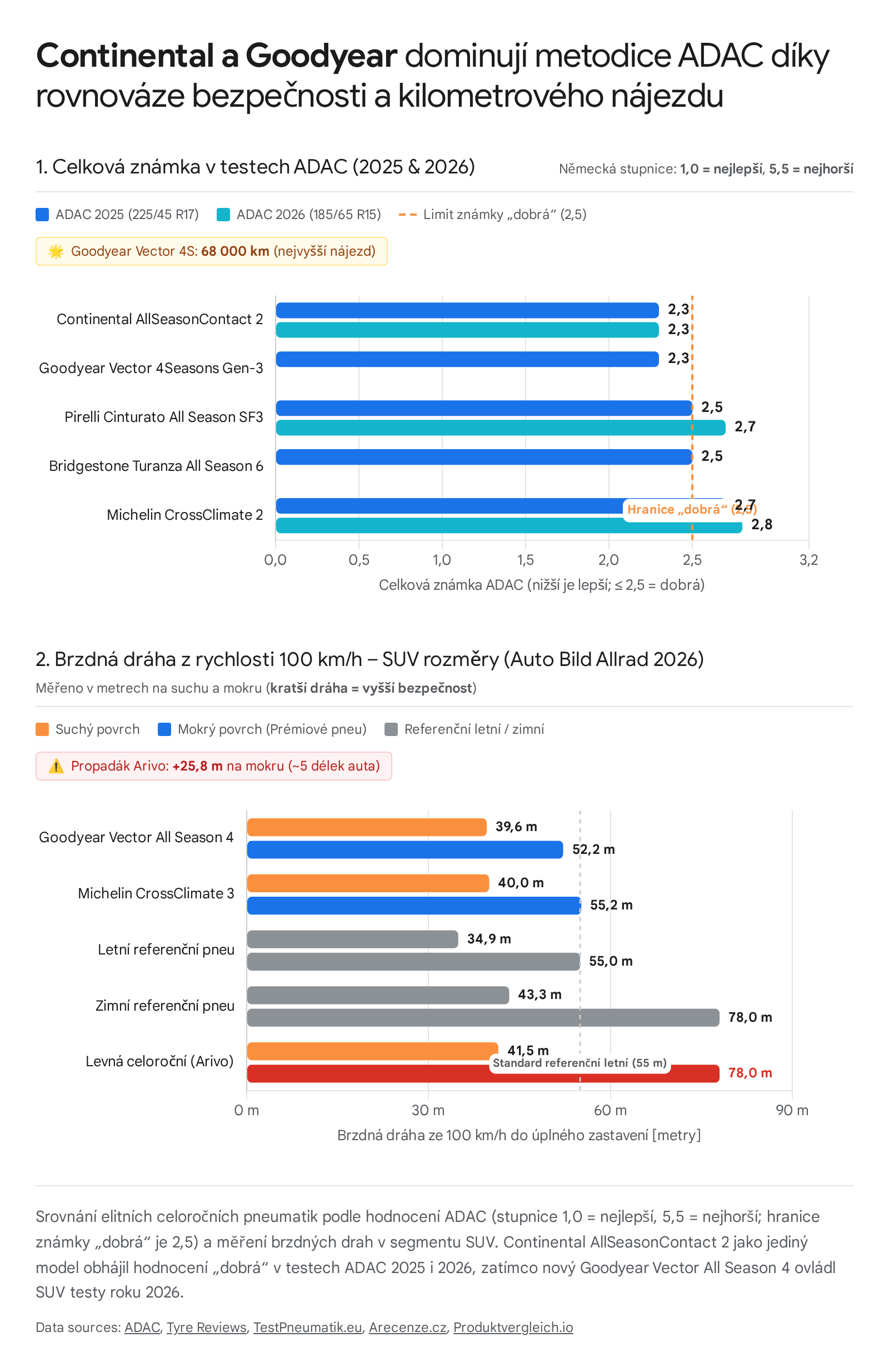
#### Evolution of ADAC Test Results (2024–2026)
Whereas back in the 2020 ADAC SUV test (size 235/55 R17), the original Continental AllSeasonContact won ahead of the Goodyear Vector 4Seasons Gen-2 and Michelin CrossClimate+ with only a "satisfactory" rating due to an extended dry braking distance (6.5 meters longer than the summer reference tire) [35, 36], a major technological breakthrough occurred between 2024 and 2026 [13, 37]. In the 2024 ADAC test (size 205/55 R16, 16 tested models), an all-season tire earned a "good" rating for the first time in history (score 2.4), a milestone achieved by the Goodyear Vector 4Seasons Gen-3 (safety 2.7; environmental balance 1.8 with a projected mileage exceeding 60,000 km) [37]. Second place went to the Pirelli Cinturato All Season SF2 (2.6 overall), which achieved the best driving safety score of all (2.3) thanks to the shortest braking distances on wet roads and ice, but fell short in tread life (environmental score 3.3) [37, 39]. Third and fourth places were shared with an identical score of 2.7 by the Hankook Kinergy 4S2 and Michelin CrossClimate 2, with Michelin dominating dry braking, snow handling, and low wear, while losing points for an earlier onset of understeer in the wet [37, 39].
Even sharper differentiation emerged in the 2025 ADAC test in size 225/45 R17 (16 tested models), whose lower aspect ratio more closely reflects the torsional stresses of 19-inch wheels [13, 40]. Only four premium models earned a "good" rating in this test, while the remaining twelve either failed or remained average [13]. First place was shared by the Goodyear Vector 4Seasons Gen-3 and the Continental AllSeasonContact 2 with an identical overall score of 2.3 [41, 42]. The Continental AllSeasonContact 2 became the only tire in the entire test to achieve a "good" rating in both main pillars—both for driving safety and environmental balance [29]. It recorded the shortest stopping distance on both wet asphalt and wet concrete, delivered precise steering on dry roads, and ranked fourth in projected mileage [29]. Co-winner Goodyear Vector 4Seasons Gen-3 dominated the tread life test with a record projected mileage of 68,000 km, the lowest rubber abrasion, and excellent braking on ice (2nd place) and snow (4th place), paying a minor penalty in steering precision on hot summer asphalt [13, 29, 42]. Tied for third and fourth place with a score of 2.5 ("good") were the Pirelli Cinturato All Season SF3 (the absolute dry-road leader with the shortest dry braking distance and highest resistance to curved aquaplaning, though weaker in snow braking) and the Bridgestone Turanza All Season 6 (best in straight-line aquaplaning and second in both dry and wet braking, yet below average in snow traction and noisier) [13, 29, 43]. The Michelin CrossClimate 2 finished fifth—once again the absolute best in winter disciplines (snow traction and braking) and third in the dry, though average wet grip pushed it behind the leading quartet [29].
In the latest 2026 ADAC edition (size 185/65 R15, 16 tested models), only a single winning model passed the automobile club's stringent criteria with a "good" rating: the Continental AllSeasonContact 2 in first place [34, 38, 44]. ADAC engineers highlighted its complete composure at the limit on dry, wet, and snow-covered surfaces combined with the lowest fuel consumption in the entire test field [38]. According to the published ADAC ranking, second place went to the Pirelli Cinturato All Season SF3 and third place to the Michelin CrossClimate 2 (both rated "satisfactory" overall), followed by the Vredestein Quatrac, Hankook Kinergy 4S2, Goodyear Vector 4Seasons Gen-3, and Nokian Seasonproof 2, which recorded the shortest braking distance on wet asphalt of all tires in this test [16, 38, 45].
#### Transferability of Results to 235/50 R19 and SUV Tests (Auto Bild Allrad, AvD, Tyre Reviews)
Because only a specialized winter SUV tire test has been conducted in the exact 235/50 R19 dimension in recent years (Auto Bild 2025) [1, 46, 47], accurately assessing the behavior of wide tires on heavy vehicles (Škoda Kodiaq, VW Tiguan, Volvo XC40) requires correlating ADAC data with German SUV all-season tire tests in closely related sizes such as 225/55 R18, 235/55 R18, 235/60 R18, and 245/45 R18/R19 [3, 43, 48]. Immediately upon its release, the new Goodyear Vector All Season 4 won both the autumn 2026 Auto Bild Allrad test (size 225/55 R18 102V on a Mini Countryman) and the 2026 Tyre Reviews test (225/40 R18 on a VW Golf GTI Clubsport) [3, 48, 49]. In this generation, Goodyear eliminated the historical weakness of the Gen-3 model (longer braking distances and softer dry response) and combined a 100% wet handling score with elite snow traction [3, 41]. The new Michelin CrossClimate 3 placed fourth in the 2026 Auto Bild Allrad test (behind the winning Goodyear and second-placed Continental AllSeasonContact 2), completely dominating snow braking and cornering while trailing Goodyear by 3.0 meters in wet braking distance (55.2 m versus 52.2 m) [3, 16].
In the segment of heavy SUVs and high-torque electric vehicles, crucial data came from the 2025 Auto Bild test in size 245/45 R19, where the Hankook iON FlexClimate won with a score of 1.4 ("very good") ahead of the Michelin CrossClimate 2 [3, 4, 43]. In the extensive 2025 SUV test by the German automobile club AvD (size 235/60 R18), the Pirelli SF3 architecture triumphed (in the SUV-specific Scorpion All Season SF3 version with 4.5 stars) narrowly ahead of the Continental AllSeasonContact 2 and Goodyear Vector 4Seasons Gen-3, with all three models receiving the top "very good" verdict [16, 50]. At the same time, these tests issue a critical warning against cheap Asian imports (such as Arivo, Transmate, Westlake/Goodride, Milever, or Tomason), where the presence of the snowflake symbol (3PMSF) provides no guarantee of wet-road safety [3, 42, 51, 52]. In Auto Bild Allrad measurements, a cheap Arivo all-season tire required 78.0 meters to stop from 100 km/h in the wet (matching the winter reference tire), whereas the best all-season tire stopped in 58.0 meters [52]. This 20-meter gap represents more than four car lengths and means in practice that at the exact point where a car on premium tires has come to a complete standstill, a vehicle on cheap tires is still traveling at a residual speed exceeding 45 km/h [38, 52].
| Tire Model | ADAC 2025 (225/45 R17) | ADAC 2026 (185/65 R15) | Auto Bild Allrad 2026 (225/55 R18 SUV) | Auto Bild 2025 (215/50 R18 SUV) | AvD 2025 (235/60 R18 SUV) |
| :--- | :--- | :--- | :--- | :--- | :--- |
| **Continental AllSeasonContact 2** | **1st place** (2.3 – good) [42] | **1st place** (good) [34, 45] | **2nd place** [3, 16] | **1st place** (1.2 – exemplary) [16, 43] | **2nd place** (very good) [43, 50] |
| **Goodyear Vector All Season 4** | *Launched in 2026* [3] | *Not tested in R15* | **1st place** (Test Winner) [3, 49] | *Launched in 2026* [3] | *Launched in 2026* [3] |
| **Goodyear Vector 4Seasons Gen-3** | **1st place** (2.3 – good) [41] | **6th place** (satisfactory) [45] | *Replaced by All Season 4* | **5th place** (in 245/45 R18: 2.1) [53] | **3rd place** (very good) [50] |
| **Pirelli Cinturato All Season SF3** | **3rd place** (2.5 – good) [13, 29] | **2nd place** (satisfactory) [3, 16] | **5th place** [3, 16] | **1st place** (1.2 – exemplary) [16, 43] | **1st place** (Scorpion SF3 version) [16, 50] |
| **Bridgestone Turanza All Season 6** | **4th place** (2.5 – good) [29, 43] | *Not tested (A005 tested)* [45] | **6th place** [16] | **1st place** (1.2 – exemplary) [16, 43] | **4th place** (good) [16, 43] |
| **Michelin CrossClimate 2** | **5th place** (satisfactory) [16, 29] | **3rd place** (satisfactory) [3, 16] | *Replaced by CC3* | **2nd place** (in 245/45 R18/R19) [3, 43] | **5th place** (CC2 SUV version) [16] |
| **Michelin CrossClimate 3** | *Launched after test* | *Not tested in R15* | **4th place** (best in snow) [3, 16] | **7th place** (in 225/40 R18 Eco-Meister) [43] | **4th place** (AvD 2026 225/50 R17) [3] |
| **Hankook Kinergy 4S2 / 4S2 X** | *Not tested in 2025* | **5th place** (satisfactory) [45] | *Not tested* | **5th place** (4S2 X version: 2.2) [16, 43] | **4th place** (Tyre Reviews 235/55 R18) [3] |
| **Nokian Tyres Seasonproof 2** | *Not tested in 2025* | **7th place** (satisfactory) [45] | *Not tested* | *Tyre Reviews 235/55 R18 Winner* [3] | **4th place** (Auto Motor Sport 2026) [45] |
### Chemical Engineering and Structural Architecture: How Manufacturers Solve the Thermal Paradox
From the perspective of polymer chemistry, developing a top-tier all-season tire in size 235/50 R19 with a V, W, or Y speed rating requires resolving a fundamental physical contradiction involving the glass transition temperature (T_g) and viscoelastic hysteresis [37, 54]. A winter compound requires a very low T_g value so that polymer chains remain mobile and flexible at temperatures well below freezing and can conform to the micro-roughness of ice and snow [54, 55]. Conversely, a summer UHP tire rated W (up to 270 km/h) or Y (up to 300 km/h) demands high structural rigidity at road surface temperatures of +30 °C to +50 °C so that sipes do not deform under the load of a heavy SUV, the compound does not overheat, and severe wear or loss of stability during an emergency evasive maneuver is prevented [7, 37, 54].
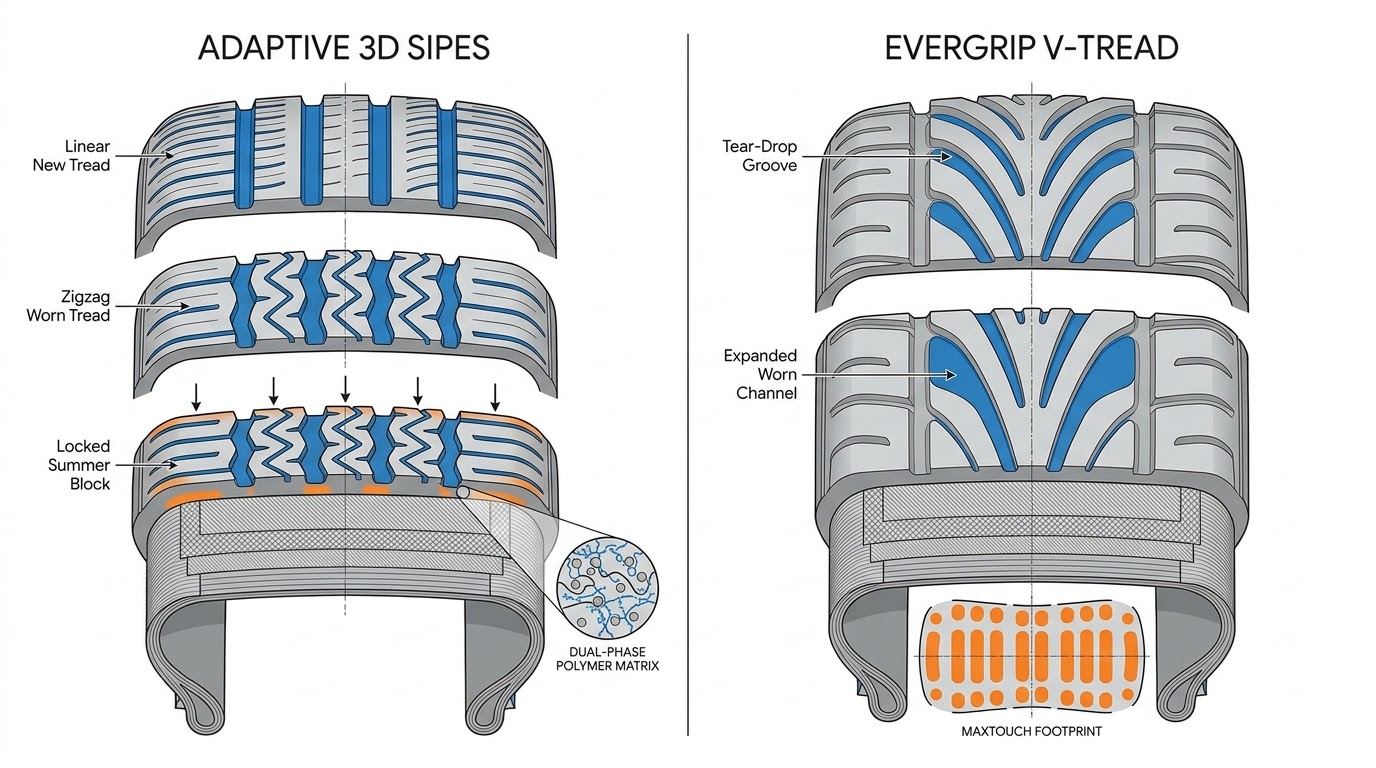
#### Detailed Analysis of Technologies and Chemistry by Manufacturer
Continental's chemical division developed an innovative compound called Chili Blend for the AllSeasonContact 2, synthesizing insights from its winter Cool Chili technology and summer UHP Black Chili technology [14, 56, 57]. This chemistry relies on a new generation of high-damping plasticizers and cross-linked elastomers that maintain the flexibility of the silica matrix in freezing temperatures while exhibiting high thermal stability in summer [57]. A crucial innovation lies in modifying the inner carcass and undertread layer, where Continental introduced a new low-hysteresis material that dramatically reduces internal friction and carcass deformation during rolling [56]. This reduced rolling resistance while simultaneously increasing mileage by 15% compared to the first generation without compromising wet grip [14, 56]. Structurally, the AllSeasonContact 2 employs a directional V-shaped tread pattern with interlocking C-shaped blocks arranged in the center [57]. These blocks support one another during braking and cornering, eliminating tread squirm and ensuring linear steering response throughout the tire's service life [56, 57].
For the Cinturato All Season SF3 (and its sibling SUV model, the Scorpion All Season SF3), Pirelli deployed exceptionally sophisticated materials engineering developed entirely through virtual modeling of physical stress distribution across the contact patch [54, 58, 59]. To utilize wider drainage grooves—which protect against aquaplaning and aid traction in deep snow, but reduce block stiffness in summer on conventional tires—Pirelli had to radically rework the tread chemistry [5, 54]. The resulting compound combines special dual-phase polymer microstructures (preserving high molecular mobility in the cold while maintaining high stiffness in the heat), new natural resins acting as low-temperature adhesion activators, and liquid polymers that maximize snow grip without penalizing wet and dry traction [54, 59]. A unique mechanical feature of Pirelli is its Adaptive Tread technology with variable-geometry 3D sipes [54, 60]. At full new tread depth, the sipes have a linear shape on the surface, transitioning toward the bottom of the groove into a three-dimensional zigzag profile [54, 61]. As the tire wears down and tread depth decreases, this zigzag geometry is exposed, extending the active length of the biting edges that trap snow [54]. Moreover, these 3D sipes are engineered to mechanically interlock under high kinetic energy (such as hard braking on a dry highway), instantly transforming the siped winter block into a compact, rigid summer block [54]. In size 235/50 R19, Pirelli includes Seal Inside (s-i) technology as standard—an internal layer of viscous sealant inside the tread that immediately seals punctures without loss of pressure [12, 62].
France's Michelin applies a fundamentally different engineering philosophy in the CrossClimate 2 and CrossClimate 3 series: whereas other manufacturers historically started from a winter tire and tried to stabilize its siping for summer use, Michelin took the architecture of a summer tire and integrated winter technologies into it [63]. This approach eliminated rapid wear and block instability in summer heat [63]. At its core is the Thermal Adaptive Tread Compound with an increased proportion of next-generation silica, which dynamically adjusts its elasticity across a temperature window from -10 °C to +30 °C and maintains microscopic surface contact on both frozen and scorching asphalt [64, 65, 66]. The second pillar is EverGrip technology, consisting of stepped V-grooves and tear-drop sipes running through the full depth of the tread [63, 66, 67]. As the tire wears, these internal channels widen, enabling a tire with 3 to 4 mm of remaining tread depth to retain snow-trapping and water-evacuation capabilities comparable to a new tire [63, 66]. In the latest CrossClimate 3 generation, Michelin further optimized this synergy, shortening wet braking distance by 4% and achieving snow performance on par with dedicated winter tires [3, 65]. The third element is MaxTouch Construction, a carcass design that evenly distributes acceleration, braking, and cornering forces across the contact patch and, by eliminating localized stress peaks, extends tread life by up to 15% (delivering an average of 5,000 km more than premium competitors) [63, 65, 66].
American manufacturer Goodyear builds the Vector 4Seasons Gen-3 and the new Vector All Season 4 (2026) around its Weather Reactive Technology suite [3, 68]. The tread employs Snow Grip technology—a high density of intersecting 3D waffle blades (3D-BIS) in the center of the tread that stimulate each other to open at their intersections upon contact with snow, acting like mechanical claws [68, 69]. Water evacuation is handled by Aqua Control Technology via deep hydrodynamic grooves that maintain drainage capacity throughout the tire's life [68, 69]. Chemically, Goodyear's compound excels in abrasion resistance, as its elastic polymer network achieves the lowest mass loss and the highest mileage of 68,000 km in ADAC testing [13, 29]. While this compound elasticity led to slightly longer dry braking distances in the Gen-3 generation, the new Vector All Season 4 (2026) introduces stiffer Dry Handling crown and shoulder blocks along with a modified silica compound that substantially improved dry braking and lowered rolling resistance into EU label class A/B [3, 7].
Specific technological approaches are also applied by Japan's Bridgestone, South Korea's Hankook, and Finland's Nokian. The Bridgestone Turanza All Season 6 uses NanoPro-Tech™ molecular mixing, which controls the distribution of silica and polymer particles at the nanometer level, preventing silica agglomeration, reducing internal tread heat buildup, and maximizing wet grip [22, 55, 70, 71]. This chemistry is paired with the lightweight ENLITEN carcass platform, reducing tire weight and sidewall deformation, which delivers excellent aquaplaning resistance and low rolling resistance [6, 22, 70]. For the iON FlexClimate (IL01A), Hankook engineered a structure specifically for the high axle loads and instant torque of electric vehicles and heavy SUVs, where a high-concentration silica compound and reinforced 3D sipes prevent edge chipping under heavy torque while maintaining acoustic optimization (70 dB) [3, 4, 18]. Meanwhile, the Nokian Tyres Seasonproof 2 combines Nordic winter chemistry for extreme wet grip (EU label class A [18, 38]) with a unique structural advantage in size 235/50 R19 in the form of Aramid Sidewalls technology [27]. The tire's sidewall incorporates synthetic aramid fibers that protect a heavy SUV tire against curb cuts and impact punctures in deep potholes [27].
#### Engineering Comparison of Manufacturers' Technological Maturity
From the standpoint of pure chemical and structural engineering, the market has no single absolute hegemon, instead dividing into three technological pinnacles depending on the driver's primary priorities. Continental represents the most balanced chemico-mechanical synthesis with its Chili Blend compound and low-hysteresis carcass with C-blocks [56, 57]. Continental is the only manufacturer to have resolved the traditional conflict between wet grip, dry handling precision, snow traction, and low rolling resistance without any measurable weakness—as demonstrated by earning "good" ratings across both safety and environmental categories in the 2025 and 2026 ADAC methodologies [29, 34, 38].
Pirelli offers the most advanced dynamic tread and compound adaptation for paved surfaces through its combination of variable-geometry 3D sipes, liquid polymers, natural resins, and Seal Inside technology [12, 54, 59]. Pirelli leads technologically in the mechanical transformation of a winter tread into a summer tread under heavy loads and offers unmatched chemistry for dry and wet braking (class A) paired with the lowest noise level of 69 dB, with the sole trade-off for this high-adhesion compound being somewhat faster wear compared to Goodyear and Michelin [3, 12]. Meanwhile, Michelin (EverGrip + MaxTouch) and Goodyear (Weather Reactive in the new Vector All Season 4 generation) hold the edge in long-term geometric stability and wear resistance [3, 65, 68]. Michelin holds the technological lead in how a tire performs on snow after 30,000 km thanks to its expanding tear-drop grooves [63, 66], while Goodyear combines the most abrasion-resistant polymer network (68,000 km) with radically improved dry and wet handling in the new Vector All Season 4 [3, 13].
### Final Evaluation and Ranking of the Best Tires in Size 235/50 R19
Based on a synthesis of independent tests (ADAC 2024–2026, Auto Bild Allrad 2025–2026, AvD, Tyre Reviews), chemical and technological sophistication, EU label parameters, and actual availability in the Czech Republic in size 235/50 R19 with a minimum speed rating of V, a definitive, evidence-based ranking can be established [2, 3, 29, 38].
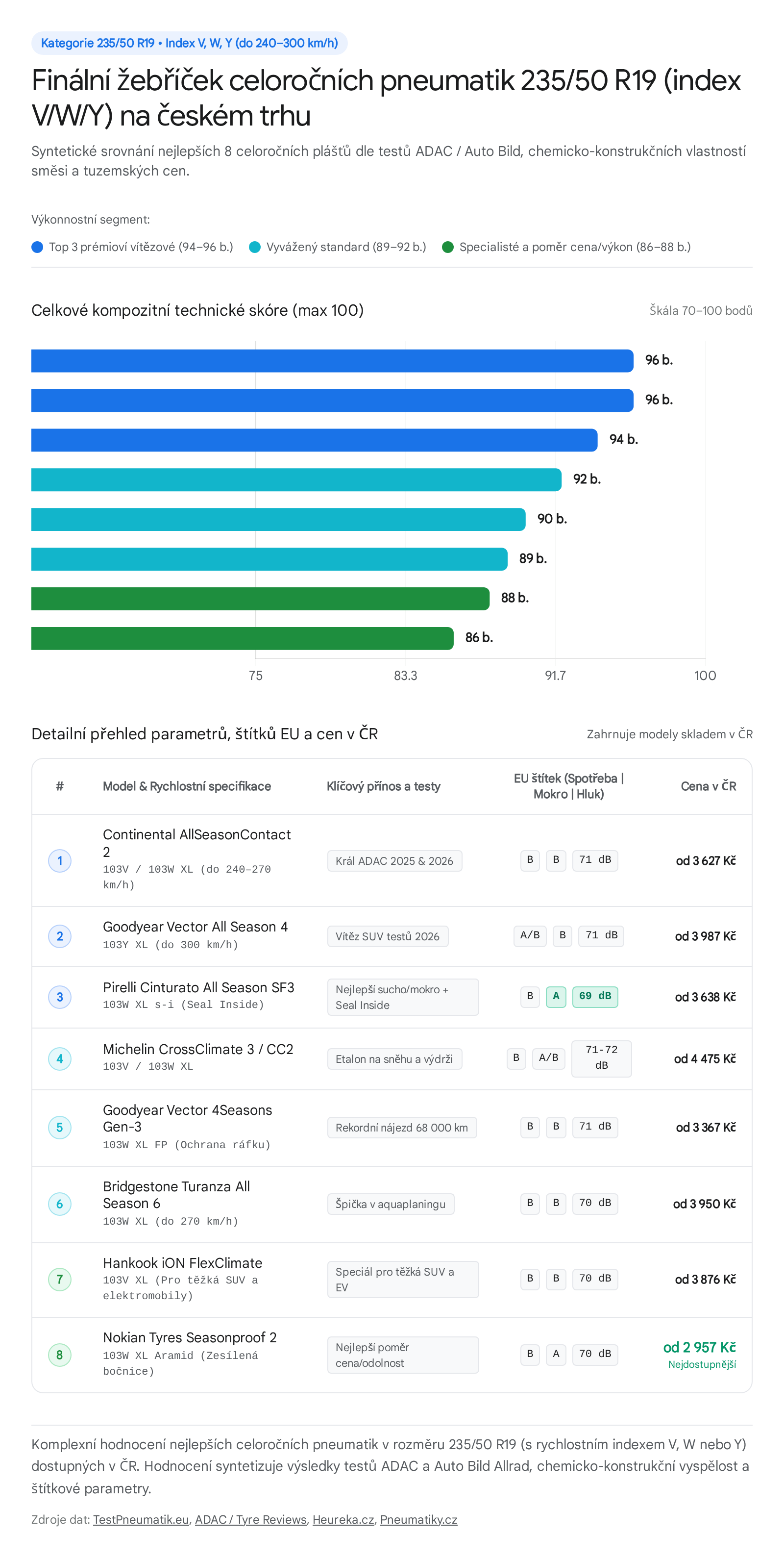
#### Detailed Evaluation of Individual Ranking Positions
First place goes to the **Continental AllSeasonContact 2 (235/50 R19 103V XL or 103W XL)**, which represents the absolute benchmark of balance and is the only tire on the market to have won both recent ADAC tests (2025 in size 225/45 R17 and 2026 in size 185/65 R15) with a "good" rating in both safety and environmental performance [29, 34, 38]. In SUV tests (Auto Bild Allrad 2026, AvD 2025, Auto Bild 2025 215/50 R18), it consistently ranks first or second [16, 43, 50]. Its Chili Blend compound and mutually supporting C-blocks give it the shortest braking distances on both wet asphalt and concrete, top-tier snow traction, low rolling resistance, and 15% higher mileage than its predecessor [29, 56, 57]. When purchasing in the Czech Republic, buyers simply need to verify the second-generation AllSeasonContact 2 designation (103V from approx. 3,627 CZK or 103W from 3,715 CZK) and avoid confusing it with the older first generation sold under the non-compliant 99T rating [8, 11].
Second place (and a shared technological pinnacle for 2026) belongs to the newcomer **Goodyear Vector All Season 4 (235/50 R19 103Y XL)** [3]. Introduced in 2026, this cutting-edge design immediately won both the 2026 Auto Bild Allrad SUV test and the 2026 Tyre Reviews test [3, 49]. With the fourth generation, Goodyear resolved the sole weakness of the older Gen-3 model—softer response and longer braking on dry summer asphalt—while preserving brilliant wet performance (a 100% wet handling score) and snow traction [3]. In size 235/50 R19, it is also produced in cheaper 99H and 103H versions (up to 210 km/h); to meet the minimum V speed rating requirement, buyers must therefore order exclusively the top-tier 103Y XL version (up to 300 km/h, priced in the Czech Republic from approx. 3,987 to 4,176 CZK) [2, 3].
Third place goes to the **Pirelli Cinturato All Season SF3 (235/50 R19 103W XL Seal Inside)** as the best all-season tire for dynamic drivers, predominantly highway driving, and dry or rainy conditions [3, 29]. In Auto Bild and ADAC tests, it repeatedly wins dry braking (12 times best in test) and aquaplaning resistance (11 times best in test) [3, 29, 72]. In size 235/50 R19 103W XL on the Czech market, it offers three standout attributes: class A wet grip, exceptionally quiet operation at 69 dB, and integrated Seal Inside (s-i) self-sealing technology in the vast majority of listings at a highly competitive price of 3,638 to 4,229 CZK [2, 12]. A minor compromise is that in deep snow braking and overall mileage, it slightly trails Continental, Goodyear, and Michelin [3, 29].
Fourth place is held by the duo **Michelin CrossClimate 3 and CrossClimate 2 (235/50 R19 103V XL / 103W XL)**, which stands as the unmatched leader in winter conditions and long-term performance retention [3, 29]. When a heavy SUV is frequently driven in mountainous areas, on packed snow, and in slush, the Thermal Adaptive compound with EverGrip tear-drop grooves is unrivaled—outperforming even some dedicated winter tires in snow traction and braking in ADAC and Auto Bild tests, while MaxTouch construction guarantees minimal wear [3, 29, 65, 66]. The reason for its fourth-place ranking is its significantly higher purchase price in the Czech Republic (4,475 to 5,037 CZK per tire—i.e., 3,000 to 4,000 CZK more per set compared to Continental or Pirelli) as well as slightly weaker lateral grip and longer braking distances on wet asphalt compared to the top three in ADAC and Auto Bild tests [2, 3, 29, 38].
Fifth place belongs to the **Goodyear Vector 4Seasons Gen-3 (235/50 R19 103W XL FP)**, which remains a widely available winner of the 2024 and 2025 ADAC tests with the highest projected mileage of 68,000 km [13, 41, 42]. For high-mileage drivers (over 25,000 km per year) seeking the lowest cost per kilometer along with strong rain and snow performance, promotional prices from 3,367 to 3,918 CZK make it an exceptionally rational choice, although compared to the newer Vector All Season 4 it exhibits less precise steering and longer dry braking distances in summer heat [3, 10, 17, 29]. Following in sixth place is the **Bridgestone Turanza All Season 6 (235/50 R19 103W XL ENLITEN)**, holder of a "good" rating (2.5) from the 2025 ADAC test and winner of the 2025 Auto Bild test (215/50 R18) [13, 29, 43]. Thanks to NanoPro-Tech nanotechnology and its lightweight ENLITEN carcass, it excels when driving through deep water (1st place in straight-line aquaplaning in ADAC 2025) and in braking on wet concrete and asphalt, though on snow and ice it delivers rather average traction better suited to lowland climates [22, 29, 38, 67].
Rounding out seventh and eighth place are the specialized and cost-effective models **Hankook iON FlexClimate (235/50 R19 103V XL)** and **Nokian Tyres Seasonproof 2 (235/50 R19 103W XL Aramid Sidewalls)** [3, 27]. The Hankook iON FlexClimate (from 3,876 CZK), winner of the 2025 Auto Bild test in size 245/45 R19, represents the optimal choice for owners of heavy plug-in hybrid SUVs and electric vehicles, standing out with extreme block stiffness, low rolling resistance, and acoustic comfort of 70 dB [3, 4, 43]. Meanwhile, the Nokian Tyres Seasonproof 2 (from 2,957 to 3,288 CZK, or the comparable SUV alternative Hankook Kinergy 4S2 X from 2,909 CZK) dominates the price-to-performance category below 3,300 CZK [2, 11, 26]. The Nokian Seasonproof 2 won the 2025 Tyre Reviews SUV test (235/55 R18), recorded the shortest stopping distance on wet asphalt in the 2026 ADAC test, carries an EU class A wet grip rating, and features aramid sidewalls in size 235/50 R19—making it the most mechanically durable tire for rough country roads and unpaved surfaces [3, 18, 27, 38].
| Rank | Model (235/50 R19) | ADAC / SUV Test Verdict | Key Technological Advantage | Ideal Use Case |
| :--- | :--- | :--- | :--- | :--- |
| **1.** | **Continental AllSeasonContact 2** (103V/W) | **1st place ADAC 2025 & 2026** (score 2.3 "good") [34, 42] | `Chili Blend` compound + low-hysteresis carcass and C-blocks [56, 57] | All-round benchmark with no weaknesses across all driving conditions [38] |
| **2.** | **Goodyear Vector All Season 4** (103Y) | **1st place Auto Bild Allrad 2026** & Tyre Reviews 2026 [3] | Enhanced `Dry Handling` + `Weather Reactive` (2026 model) [3, 68] | Drivers requiring the latest generation with a Y rating (300 km/h) [3] |
| **3.** | **Pirelli Cinturato All Season SF3** (103W) | **3rd place ADAC 2025** (2.5), **2nd place ADAC 2026** [3, 29] | `Adaptive 3D Sipes` (linear to zigzag) + **Seal Inside** [12, 54] | Spirited highway driving, priority dry/wet braking, quietness (69 dB) [3, 12] |
| **4.** | **Michelin CrossClimate 3 / CC2** (103V/W) | **3rd–5th place ADAC**, #1 in snow in Auto Bild 2026 [3, 29] | `Thermal Adaptive` + `EverGrip` tear-drop sipes + `MaxTouch` [65, 66] | Mountainous regions, frequent snow, focus on performance consistency as tread wears [3, 63] |
| **5.** | **Goodyear Vector 4Seasons Gen-3** (103W) | **1st place ADAC 2024 & 2025** (score 2.3 "good") [37, 41] | Highly durable polymer network + `Snow Grip` [7, 68] | High annual mileage (record 68,000 km in ADAC test) [13, 42] |
| **6.** | **Bridgestone Turanza All Season 6** (103W) | **4th place ADAC 2025** (score 2.5 "good") [29, 43] | `NanoPro-Tech` molecular silica dispersion + `ENLITEN` carcass [22, 70] | Rainy lowlands and highways, maximum aquaplaning protection [29] |
| **7.** | **Hankook iON FlexClimate** (103V) | **1st place Auto Bild 2025** (245/45 R19 EV/SUV) [3, 43] | EV/SUV-specific compound and reinforced block architecture [3, 4] | Heavy SUVs, plug-in hybrids (PHEVs), and electric vehicles [3, 4] |
| **8.** | **Nokian Tyres Seasonproof 2** (103W) | **1st place Tyre Reviews SUV 2025**, 7th place ADAC 2026 [3, 45] | Sidewalls reinforced with **aramid fibers** + class A wet grip [18, 27] | Best price-to-performance ratio (from ~3,000 CZK), rough roads and mountains [11, 27] |
### Sources
1. [235/50 R19 Tyres - Tests, Reviews and the Best Rated](https://www.tyrereviews.com/Tyre-Size/19-Inch-Tyres/235-50-19-Tyres.htm)
2. [Celoroční Pneumatiky Osobní, SUV a 4x4 235/50 R19](https://www.pneumatiky.cz/celorocni-pneumatiky-osobni-suv-a-4x4-235-50-r19-t5)
3. [TestPneumatik.eu - celoroční pneumatiky 235/50 R19](https://www.testpneumatik.eu/235-50-R19/celorocni/)
4. [Test celoročních pneumatik ADAC 2025: které modely obstály?](https://www.mikona.eu/novinky/celorocni-pneumatiky-test/)
5. [Cinturato All Season SF3, excellent cumulated braking - Pirelli](https://www.pirelli.com/global/en-ww/road/cars/tyres/cinturato-all-season-sf3-119843/)
6. [Bridgestone | Mojepneu.cz](https://www.mojepneu.cz/bridgestone/vyrobce/)
7. [Goodyear Vector 4Seasons Gen-2 vs Gen-3 AUTODOC BLOG](https://www.autodoc.co.uk/info/goodyear-vector-4seasons-gen-2-vs-goodyear-vector-4seasons-gen-3)
8. [Continental AllSeasonContact 235/50 R19 99T od 3 965 Kč](https://pneumatiky.heureka.cz/continental-allseasoncontact-235-50-r19-99t/)
9. [Continental AllSeasonContact 235/50 R19 99 T Celoroční](https://www.pneumatiky.cz/continental-allseasoncontact-235-50-r19-99-t-contiseal-celorocni-pneumatiky-03555760000-t1)
10. [Výsledky na dotaz: pneu 235 50 r19 - Heureka](https://www.heureka.cz/?h%5Bfraze%5D=pneu+235+50+r19)
11. [Výsledky na dotaz: 2,50 19 pneu - Heureka](https://www.heureka.cz/?h%5Bfraze%5D=2%2C50+19+pneu)
12. [Pirelli Cinturato All Season SF3 235/50 R19 103W od 3 638 Kč](https://pneumatiky.heureka.cz/pirelli-cinturato-all-season-sf3-235-50-r19-103w/)
13. [Test 16 celoročních pneumatik ADAC: Vybírat byste měli jen ze 4](https://www.arecenze.cz/clanky/test-16-celorocnich-pneumatik-adac-znamku-dobra-ziskaly-jen-4-modely-zbytek-selhal-tyhle-2-doporucujeme/)
14. [Continental AllSeasonContact 2 235/35R19 91Y XL AS](https://www.seafordtyres.co.uk/tyresearch/details/144520/continental-allseasoncontact-2)
15. [continental allseason contact 2 245/50 r19 xl fr 105 w - Heureka.cz](https://www.heureka.cz/?h%5Bfraze%5D=continental%20allseason%20contact%202%20245/50%20r19%20xl%20fr%20105%20w&haff=280666&utm_medium=affiliate)
16. [Ganzjahresreifen Test 2025: Ergebnisse im Überblick | Pneuhage](https://www.pneuhage.de/reifentest/ganzjahresreifen-test-2025)
17. [Goodyear Vector 4Seasons Gen-3 235/50 R19 103W od 3 739 Kč](https://pneumatiky.heureka.cz/goodyear-vector-4seasons-gen-3-235-50-r19-103w/)
18. [Osobní pneumatiky celoroční, 235, R19 - Heureka.cz](https://pneumatiky.heureka.cz/f:5428:100839;5434:235;5437:25316/)
19. [Pirelli Cinturato All Season SF3: 92 %, 1 recenze, od 1 969 Kč](https://www.test-pneumatik.cz/pirelli-cinturato-all-season-sf3/)
20. [michelin crossclimate 2 235 50 r19 103v fr - Heureka.cz](https://pneumatiky.heureka.cz/michelin-crossclimate-2-235-50-r19-103v-fr/)
21. [Bridgestone Turanza All Season 6: 81 %, 2 recenze, od 1 960 Kč](https://www.test-pneumatik.cz/bridgestone-turanza-all-season-6/)
22. [Bridgestone tyres: cheaper car tyres | GRIP500](https://www.grip500.co.uk/tyre/bridgestone/)
23. [Bridgestone TURANZA ALL SEASON 6 - stránka č. 7 - Pneucom.sk](https://www.pneucom.sk/pneumatiky-na-auta/bridgestone/celorocne-bridgestone/turanza-all-season-6?page=7)
24. [Celoroční pneumatiky 235/50 R19 | Pneuboss.cz](https://www.pneuboss.cz/pneumatiky/osobni-pneu/235-50-r-19/celorocni)
25. [235/50 R20 - Nejlepší celoroční pneumatiky 2026 – přehled trhu](https://www.testpneumatik.eu/235-50-R20/celorocni/)
26. [hankook kinergy 4s x h750a 235 50 zr19 103w - Heureka.cz](https://pneumatiky.heureka.cz/hankook-kinergy-4s-x-h750a-235-50-zr19-103w/)
27. [nokian seasonproof 2 ( 235/50 r19 103w xl aramid ... - Heureka](https://www.heureka.cz/?h%5Bfraze%5D=nokian+seasonproof+2+%28+235%2F50+r19+103w+xl+aramid+sidewalls+%29&haff=233366&utm_medium=affiliate)
28. [Dunlop All Season 2 235/50 R19 103W od 3 290 Kč - Heureka.cz](https://pneumatiky.heureka.cz/dunlop-all-season-2-235-50-r19-103w/)
29. [2025 ADAC All Season Tyre Test - Tyre reviews and ratings](https://www.tyrereviews.com/Tyre-Tests/2025-ADAC-All-Season-Tyre-Test.htm)
30. [Levné celoroční pneumatiky 235/50 R19 | Alza.cz](https://www.alza.cz/auto/levne-celorocni-pneu-235-50-r19/18896336.htm)
31. [Celoroční pneumatiky](https://www.pneumatiky.cz/celorocni-pneumatiky-osobni-suv-a-4x4-t8)
32. [NEXEN N'Blue 4Season 2 235/50 R19 103 W XL od 2 359 Kč - Zboží](https://www.zbozi.cz/vyrobek/nexen-n-blue-4season-2-235-50-r19-103-w-xl/)
33. [Nejlevnější celoroční pneu na auto 235/50 R19 - MegaMax24](https://www.megamax24.cz/pneu/filtr/autopneu/autopneucelorocni-235-50-19?price-order=ASC)
34. [Tyre tests - ADAC - Tyre reviews and ratings](https://www.tyrereviews.com/Tyre-Tests/publisher=ADAC/)
35. [2020 ADAC SUV All Season Tyre Test](https://www.tyrereviews.com/Tyre-Tests/2020-ADAC-SUV-All-Season-Tyre-Test.htm)
36. [ADAC Ganzjahresreifentests | Oponeo.at](https://www.oponeo.at/blog/adac-ganzjahresreifentests-c49)
37. [ADAC Test Ganzjahresreifen 205/55 R 16: Erstmalig ein guter Reifen](https://www.adac.de/rund-ums-fahrzeug/ausstattung-technik-zubehoer/reifen/reifentest/ganzjahresreifen/205-55-r16/)
38. [ADAC Ganzjahresreifen-Test 2026 - 185/65 R15 - Tyre Reviews](https://de.tyrereviews.com/Tyre-Tests/2026-adac-all-season-tyre-test-185-65-r15.htm)
39. [Personalise the results - 2024 ADAC All Season Tyre Test](https://www.tyrereviews.com/Tyre-Tests/2024-ADAC-All-Season-Tyre-Test.htm/Results-Grid/)
40. [2025 ADAC All Season Tire Test - Tyre reviews and ratings](https://www.tyrereviews.com/Tyre-Tests/2025-ADAC-All-Season-Tire-Test.htm/Results-Grid/)
41. [Testsieger Ganzjahresreifen 2026 | Quick Reifendiscount](https://www.quick.de/testsieger/ganzjahresreifen)
42. [Ganzjahresreifen 17 Zoll Test 2026: Note nur 225/45](https://www.produktvergleich.io/hub/16-18-zoll-ganzjahresreifen/ganzjahresreifen-17-zoll/sub/ganzjahresreifen-17-zoll-test-vergleich)
43. [Ganzjahresreifen Test 2025: Testsieger und Berichte - Reifen-Ehrhardt](https://www.reifen-ehrhardt.de/reifentest/ganzjahresreifen-test-2025/)
44. [Das ist laut ADAC der einzige Ganzjahresreifen, der auf allen ... - CHIP](https://www.chip.de/news/auto-fahrrad/das-ist-laut-adac-der-einzige-ganzjahresreifen-der-auf-allen-fahrbahnbelaegen-ueberzeugt_7ce398d6-fc5f-407f-8049-49059d4e726d.html)
45. [Continental AllSeasonContact 2 - test 2026 a ceny od 1 878 Kč](https://www.testpneumatik.eu/continental-allseasoncontact-2/)
46. [Test zimních pneumatik 235/50 R19 Auto Bild 2025 | Pneuboss.cz](https://www.pneuboss.cz/poradna/clanky/test-zimnich-pneumatik-235-50-r19-auto-bild-2025)
47. [2025 Autobild SUV Winter Tyre Test - Tyre reviews and ratings](https://www.tyrereviews.com/Tyre-Tests/2025-Autobild-SUV-Winter-Tyre-Test.htm)
48. [Auto Bild Allrad SUV-Ganzjahresreifentest 2026 - Tyre Reviews](https://de.tyrereviews.com/Tyre-Tests/2026-auto-bild-allrad-suv-all-season-tyre-test.htm/Results-Grid/)
49. [Continental – pneumatiky 2026 – přehled trhu, testy, hodnocení](https://www.testpneumatik.eu/continental/)
50. [Reifentest Ganzjahresreifen 2025 - AvD](https://avd.de/reifentest-ganzjahresreifen-2025)
51. [ADAC Ganzjahresreifen-Test 2026 - 185/65 R15 - Tyre Reviews](https://de.tyrereviews.com/Tyre-Tests/2026-adac-all-season-tyre-test-185-65-r15.htm/Charts/)
52. [Autobild SUV-Ganzjahresreifentest 2025 - Tyre Reviews](https://de.tyrereviews.com/Tyre-Tests/2025-Autobild-SUV-All-Season-Tyre-Test.htm)
53. [Auto Bild Allrad Ganzjahresreifentest 2024: 245/45 R18 - Vergölst](https://vergoelst.de/reifentest/auto-bild-allrad-ganzjahresreifentest-2024-245-45-r18.html)
54. [NEW PIRELLI CINTURATO ALL SEASON SF3 LAUNCHED](https://press.pirelli.com/new-pirelli-cinturato-all-season-sf3-launched-the-braking-champion-with-an-a-rating-on-the-european-tyre-label-for-wet-grip/)
55. [Bridgestone Blizzak LM 001 RFT 225/50 R17 94H *, EVc, run-flat](https://www.mytyres.co.uk/rshop/tyre/Bridgestone/Blizzak-LM-001-RFT/225-50-R17-94H----EVc--runflat/R-264550)
56. [the Continental AllSeasonContact 2](https://www.continental.com/en/press/press-releases/20230927-allseasoncontact2-technical/)
57. [The new AllSeasonContact 2 - safety and balance at the highest level](https://www.continental.com/en/press/press-releases/20230522-allseasoncontact2-technical/)
58. [Cinturato, the best all-season tyre according to Autobild - Pirelli](https://www.pirelli.com/global/en-ww/road/cars/tyres/cinturato-as-sf3-autobild-tyre-reviews-178739/)
59. [Focus on: Pirelli's Cinturato All Season SF3 tire](https://www.european-rubber-journal.com/article/2095176/focus-on-pirelli-s-cinturato-all-season-sf3-tire)
60. [Pirelli CINTURATO All Season SF3 Tyre All-Seasons Tyre, 205/55](https://www.topbanden.com/EN/Pneus/Pirelli/CINTURATO%20All%20Season%20SF3/205/55/R19/674522)
61. [Cinturato AS SF3 wins Autobild Sportscars test - Pirelli](https://www.pirelli.com/global/en-ww/road/cars/tyres/cinturato-as-sf3-autobild-sportscars-183159/)
62. [PIRELLI CINTURATO ALL SEASON SF3 SEAL INSIDE XL 235/50](https://www.expert-pneumatiky.cz/157642-pirelli-cinturato-all-season-sf3-seal-inside-xl-235-50-r19-103w-celorocni.html)
63. [What are the best all-season tyres for SUV? - Michelin Africa](https://africa.michelin.com/en/auto/advice/suv-tyres-guide/all-season-tyres-suv)
64. [Michelin CrossClimate 3 255/45 R20 105 V Celoroční | Pneumatiky.cz](https://www.pneumatiky.cz/michelin-crossclimate-3-255-45-r20-105-v-xl-celorocni-pneumatiky-0348310-t1)
65. [Michelin CrossClimate 3 205/55 R16 91W od 2 067 Kč - Heureka.cz](https://pneumatiky.heureka.cz/michelin-crossclimate-3-205-55-r16-91w/)
66. [Michelin CrossClimate 2 SUV | Обзор шины на Shina Guide](https://shina.guide/reviews/michelin-crossclimate-2-suv/)
67. [Bridgestone Turanza All Season 6 vs Michelin CrossClimate 2](https://www.autodoc.co.uk/info/bridgestone-turanza-all-season-6-vs-michelin-crossclimate-2)
68. [Vector 4seasons Gen-3 - HiQ Tyres & Autocare](https://www.hiqonline.co.uk/tyres/goodyear/vector-4seasons-gen-3)
69. [Buy Goodyear Tyres Online | Merityre Specialists](https://www.merityre.co.uk/tyres/tyre-manufacturers/goodyear-tyres)
70. [The best summer car tyres 2025 - WhatTyre Tyre of the Year Awards](https://whattyre.com/news/the-best-summer-car-tyres-2025-whattyre-tyre-of-the-year-awards/)
71. [Pneumatiky Bridgestone | Pneu-stop.cz](https://www.pneu-stop.cz/bridgestone)
72. [The Cinturato All Season SF3 continues to impress in tests - Pirelli](https://www.pirelli.com/global/en-ww/road/cars/tyres/cinturato-all-season-sf3-adac-tests-174722/)
73. [continental allseasoncontact 235/50 r19 99 t ( ) - Heureka.cz](https://www.heureka.cz/?h%5Bfraze%5D=continental%20allseasoncontact%20235%2F50%20r19%2099%20t%20%28%2B%29)
74. [Výsledky na dotaz: pneu 235 50 r19 - Heureka](https://www.heureka.cz/?f=434&h%5Bfraze%5D=pneu%20235%2050%20r19)
75. [Testy celoročních pneumatik 2026, 2025, 2024 i starší](https://www.pneumatiky.cz/testy-celorocnich-pneu?page=6)
76. [Test celoročních pneumatik 235/50 R19](https://www.test-pneumatik.cz/celorocni-235-50-19/)
77. [Auto Bild testoval celoroční pneu pro sportovní vozy. Vítězem testu](https://www.pneuboss.cz/poradna/clanky/auto-bild-testoval-celorocni-pneu-pro-sportovni-vo)
78. [TESTY PNEUMATIK - letní, zimní a celoroční pneu](https://www.adactest.cz/)
79. [Testy pneumatik Autobild – letní, zimní a celoroční - ABApneu.cz](https://www.abapneu.cz/testy-pneumatik/autobild)
80. [Několik modelů propadlo. Test ADAC odhalil katastrofální celoroční](https://www.autojournal.cz/nekolik-modelu-propadlo-test-adac-odhalil-katastrofalni-celorocni-pneumatiky/)
81. [ADAC testy celoroční | Test-Pneumatik.cz](https://www.test-pneumatik.cz/adac-testy-celorocni/)
82. [Testy pneumatik: letní, zimní i celoroční na jednom místě | Alza.cz](https://www.alza.cz/auto/testy-pneumatik)
83. [235/55 R19 Reifen - Tests, Bewertungen und die Besten](https://de.tyrereviews.com/Tyre-Size/19-Inch-Tyres/235-55-19-Tyres.htm)
84. [Tyre Test Prediction - Tyre Reviews And Ratings](https://www.tyrereviews.com/Tools/tyre-prediction)
85. [Test mondial des pneus d'été 2025 - Tyre Reviews](https://fr.tyrereviews.com/Tyre-Tests/2025-Teknikens-Varld-Summer-Tyre-Test.htm)
86. [2025 ADAC All Season Tire Test - Avis et notes sur les pneus](https://fr.tyrereviews.com/Tyre-Tests/2025-ADAC-All-Season-Tire-Test.htm)
87. [Testsieg für Hankooks SUV-Allwetterreifen Kinergy 4S 2 X bei Auto](https://www.hankooktire-mediacenter.com/de/pressemitteilung/news/testsieg-fuer-hankooks-suv-allwetterreifen-kinergy-4s-2-x-bei-auto-bild-allrad)
88. [Ganzjahresreifen Test 2025 : Top-Modelle & Sieger im Überblick](https://www.firststop.de/reifentest/ganzjahresreifen-test-2025/)
89. [Auto Bild Allrad SUV-Ganzjahresreifentest 2026 - Tyre Reviews](https://de.tyrereviews.com/Tyre-Tests/2026-auto-bild-allrad-suv-all-season-tyre-test.htm)
90. [Für Kompakt-SUVs: Ganzjahresreifen-Test 215/60 R 16 - AUTO BILD](https://www.autobild.de/produkttests/ganzjahresreifen-test-215-60-r-16-18596331.html)
91. [Ganzjahresreifen-Test für mittlere SUVs: 215/65 R17 - AUTO BILD](https://www.autobild.de/produkttests/ganzjahresreifen-test-215-65-r-17-20519765.html)
92. [Celoroční pneumatiky 235/50 R19 103W - Prezuto.cz](https://www.prezuto.cz/pneumatiky/celorocni/235-50-r19/?li=103&si=W)
93. [Celoroční Pneumatiky 235/50 R19 | Pneumatiky.cz](https://www.pneumatiky.cz/celorocni-pneumatiky-235-50-r19-t5)
94. [Celoroční pneumatiky Osobní, SUV 235/50 R19](https://www.pneumatiky-obchod.cz/pneumatiky-osobni-suv-celorocni-235-50-r19.html)
95. [Nokian Tyres Seasonproof 2 235/50 R19 103 W Celoroční](https://www.pneumatiky.cz/nokiantyres-seasonproof-2-235-50-r19-103-w-xl-celorocni-pneumatiky-t433469-t1)
96. [Continental AllSeasonContact 2 235/50 R19 103 V Celoroční](https://www.pneumatiky.cz/continental-allseasoncontact-2-235-50-r19-103-v-xl-celorocni-pneumatiky-03201100000-t1)
97. [235/45 R20 - Nejlepší celoroční pneumatiky 2026 – přehled trhu](https://www.testpneumatik.eu/235-45-R20/celorocni/)
98. [Nejlepší celoroční pneumatiky 2026: Test, recenze & Vše, co](https://www.homago.cz/i/1023/nejlepsi-celorocni-pneumatiky-2024-test-recenze-vse-co-potrebujete-vedet)
99. [Celoroční pneu — výběr podle rozměru a značky - Pneu-Kvalitně Brno](https://www.pneu-kvalitne.cz/Celorocni-pneu-c7_0_1.htm)
100. [Michelin Crossclimate 2 225/45 R 18 95Y celoroční | SROVNAME.cz](https://www.srovname.cz/michelin-crossclimate-2-225-45-r-18-95y-celorocni/srovnani-cen/k.5398454)
101. [Continental Allseasoncontact 2 255/40 R 19 100Y celoroční](https://www.srovname.cz/continental-allseasoncontact-2-255-40-r-19-100y-celorocni/srovnani-cen/k.6254135)
102. [GOODYEAR VECTOR 4SEASONS GEN-3 | 235/55/R19/105T](https://www.goodyear.eu/de_de/consumer/tires/vector_4seasons_gen-3/235-55-19-105-T-598481.html)
103. [AutoBild-Reifentest 2019 – Ganzjahresreifen der Größe 235/55 R19](https://vergoelst.de/reifentest/autobild-ganzjahresreifentest-2019-235-55-r19.html)
104. [Continental AllSeasonContact 2 225/45R18 95Y XL AS](https://www.durringtontyres.co.uk/tyresearch/details/147620/continental-allseasoncontact-2)
105. [Continental AllSeasonContact 2 - Launched - Tyre reviews and ratings](https://www.tyrereviews.com/Article/Continental-AllSeasonContact-2---Launched.htm)
106. [Pirelli Cinturato All Season SF3 - Tyrecellar](https://www.tyrecellar.co.uk/tyre/details/pirelli/cinturato-all-season-sf3)
107. [Crushing Experience With Pirelli Cinturato All Season SF3 Tyres](https://www.pellonautocentre.com/pirelli-cinturato-all-season-sf3-tyres/)
108. [Pirelli Cinturato All Season SF3 Tread and Sidewall - YouTube](https://www.youtube.com/watch?v=h_VJUYouGz8)
109. [Pirelli unveils Cinturato All Season SF3 - Tyrepress](https://www.tyrepress.com/2024/02/pirelli-unveils-cinturato-all-season-sf3/)
110. [Continental AllSeasonContact vs. Pirelli Cinturato All Season (2026)](https://www.testpneumatik.eu/vs/continental-allseasoncontact/pirelli-cinturato-all-season/)
111. [255/45 R18 - Nejlepší celoroční pneumatiky 2026 – přehled trhu](https://www.testpneumatik.eu/255-45-R18/celorocni/)
112. [Jsou celoroční pneumatiky lepší než zimní? Test Autozeitungu](https://www.testpneumatik.eu/mag/jsou-celorocni-pneumatiky-lepsi-nez-zimni-test-autozeitungu-prinesl-zajimave-vysledky/)
113. [Bridgestone Turanza All Season 6 215/40 R18 - Test pneumatik](https://www.testpneumatik.eu/bridgestone-turanza-all-season-6/215-40-R18)
114. [Continental AllSeasonContact vs. Nokian Seasonproof 2 (2026)](https://www.testpneumatik.eu/vs/continental-allseasoncontact/nokian-seasonproof-2/)
115. [Test celoročních pneumatik Auto Motor und Sport 2026 (195/55 R16)](https://www.testpneumatik.eu/mag/test-celorocnich-pneumatik-auto-motor-und-sport-2026-195-55-r16-vitezi-continental/)
116. [Continental AllSeasonContact vs. Hankook Kinergy 4S2 H750 (2026)](https://www.testpneumatik.eu/vs/continental-allseasoncontact/hankook-kinergy-4s2-h750/)
117. [Bridgestone – pneumatiky 2026 – přehled trhu, testy, hodnocení](https://www.testpneumatik.eu/Bridgestone/)
118. [Bridgestone Turanza All Season 6 - test 2026 a ceny od 1 919 Kč](https://www.testpneumatik.eu/bridgestone-turanza-all-season-6/)
119. [195/45 R16 - Nejlepší celoroční pneumatiky 2026 – přehled trhu](https://www.testpneumatik.eu/195-45-R16/celorocni/)
120. [Vector 4Seasons Gen-3 - Turanza T005 DriveGuard - Test pneumatik](https://www.testpneumatik.eu/vs/bridgestone-turanza-t005-driveguard/goodyear-vector-4seasons-gen-3/)
121. [225/55 R19 - Nejlepší celoroční pneumatiky 2026 – přehled trhu](https://www.testpneumatik.eu/225-55-R19/celorocni/)
122. [255/45 R19 - Nejlepší celoroční pneumatiky 2026 – přehled trhu](https://testpneumatik.eu/255-45-R19/allseason/)
123. [Continental AllSeasonContact 2 vs Pirelli Cinturato All Season Plus](https://www.testpneumatik.eu/vs/continental-allseasoncontact-2/pirelli-cinturato-all-season-plus/)
124. [Linglong Sport Master 4S 205/50 R17 - nejlevnější nabídky 2026](https://www.testpneumatik.eu/linglong-sport-master-4s//205-50-17)
125. [Porovnání: Pirelli Cinturato All Season SF3 vs ... - Test pneumatik](https://www.testpneumatik.eu/vs/pirelli-cinturato-all-season-sf3/pirelli-cinturato-p7-all-season/)
126. [Hankook Kinergy 4S2 X H750A vs. Kumho HA32 Solus 4S (2026)](https://www.testpneumatik.eu/vs/hankook-kinergy-4s2-x-h750a/kumho-ha32-solus-4s/)
127. [Hankook Kinergy 4S2 X H750A - test 2026 a ceny od 2 524 Kč](https://www.testpneumatik.eu/hankook-kinergy-4s2-x-h750a/)
128. [Bridgestone Turanza All Season 6 vs Hankook Kinergy 4S2 X H750A](https://www.testpneumatik.eu/vs/bridgestone-turanza-all-season-6/hankook-kinergy-4s2-x-h750a/)
129. [Hankook Kinergy 4S2 X H750A 285/40 R21 - nejlevnější nabídky](https://www.testpneumatik.eu/hankook-kinergy-4s2-x-h750a/285-40-R21/)
130. [Hankook Kinergy 4S2 X H750A 215/60 R17 - nejlevnější nabídky](https://www.testpneumatik.eu/hankook-kinergy-4s2-x-h750a/215-60-R17/)
131. [Hankook Kinergy 4S2 X H750A 235/50 R20 - nejlevnější nabídky](https://www.testpneumatik.eu/hankook-kinergy-4s2-x-h750a/235-50-R20/)
132. [Porovnání: Hankook ION FlexClimate vs. Hankook Kinergy 4S2 X](https://www.testpneumatik.eu/vs/hankook-ion-flexclimate/hankook-kinergy-4s2-x-h750a/)
133. [Hankook Kinergy 4S2 X H750A vs. Uniroyal RAINEXPERT 5 (2026)](https://www.testpneumatik.eu/vs/hankook-kinergy-4s2-x-h750a/uniroyal-rainexpert-5/)
134. [Nokian – All season pneumatiky 2026 – přehled trhu, testy, hodnocení](https://www.testpneumatik.eu/nokian/allseason/)
135. [Nokian – pneumatiky 2026 – přehled trhu, testy, hodnocení](https://www.testpneumatik.eu/nokian/)
136. [Porovnání: Nokian Seasonproof 1 vs. Nokian Seasonproof 2 (2026)](https://www.testpneumatik.eu/vs/nokian-seasonproof-1/nokian-seasonproof-2/)
137. [Porovnání: Nokian Seasonproof vs. Nokian Seasonproof 1 (2026)](https://www.testpneumatik.eu/vs/nokian-seasonproof/nokian-seasonproof-1/)
138. [Nokian Seasonproof 1 vs. Nokian Seasonproof SUV (2026)](https://www.testpneumatik.eu/vs/nokian-seasonproof-1/nokian-seasonproof-suv/)
139. [Porovnání: Nokian Seasonproof 1 vs. Michelin CrossClimate 2 (2026)](https://www.testpneumatik.eu/vs/nokian-seasonproof-1/michelin-crossclimate-2/)
140. [Porovnání: Nokian Weatherproof C vs. Nokian Seasonproof 1 (2026)](https://www.testpneumatik.eu/vs/nokian-weatherproof-c/nokian-seasonproof-1/)
141. [Porovnání: Linglong Grip Master 4S vs. Nokian Seasonproof 1 (2026)](https://www.testpneumatik.eu/vs/linglong-grip-master-4s/nokian-seasonproof-1/)
142. [Continental AllSeasonContact 2 vs Goodyear Vector 4Seasons Gen-3](https://www.autodoc.de/info/continental-allseasoncontact-2-vs-goodyear-vector-4seasons-gen-3)
143. [Ganzjahresreifen Test 2026: Vollständige Analyse der TCS & ADAC](https://www.toopneus.com/PT/Boutique/ganzjahresreifen-test-2026-tcs-adac)
144. [ADAC Ganzjahresreifentest 2026 – Autoreifen & Felgen ... - Geizhals](https://geizhals.de/?cat=aumrfgz&preset=758)
145. [Gefährlich oder praktisch? Das sagt der TÜV zu Ganzjahresreifen](https://www.chip.de/news/Gefaehrlich-oder-praktisch-Das-sagt-der-TUeV-zu-Ganzjahresreifen_184988013.html)
146. [ADAC Winterreifentest 2024: Das sind die besten Reifen](https://www.adac.de/news/winterreifen-test-2024/)
147. [Tests - ÖAMTC](https://www.oeamtc.at/thema/tests/)
148. [ADAC Ganzjahresreifen-Test 2024 in der Größe 205/55 R16](https://blog.reifen-vor-ort.de/adac-ganzjahresreifen-test-2024-205-55-r16)
149. [Winterreifen 205/55 R 16 H im ADAC Test 2024](https://www.adac.de/rund-ums-fahrzeug/ausstattung-technik-zubehoer/reifen/reifentest/winterreifen/205-55-r16/)
150. [Ganzjahresreifentest 2025: Welche Reifen sind ideal für den Skiurlaub](https://www.snowplaza.de/weblog/ganzjahresreifentest-2025-welche-reifen-sind-ideal-fur-den-skiurlaub/)
151. [Comprehensive Technical Analysis of Michelin Tire Mechanics | PDF](https://www.scribd.com/document/1065945401/Comprehensive-Technical-Analysis-of-Michelin-Tire-Mechanics)
152. [Bridgestone Turanza All Season 6 vs Continental AllSeasonContact 2](https://www.autodoc.co.uk/info/bridgestone-turanza-all-season-6-vs-continental-allseasoncontact-2)
153. [Bridgestone Turanza T005AD | Tests and Reviews | Oponeo.ie](https://www.oponeo.ie/tyre-model/bridgestone-turanza-t005ad)
154. [Bridgestone Tyres in Aldershot | GForce Tyres & Fitting](https://gforcetyres.co.uk/brands/bridgestone-tyres/)
155. [Pneumatiky 235/50 R19](https://www.pneumatiky.cz/pneumatiky-235-50-r19-t5)
156. [Pirelli Cinturato All Season SF3 - Celoroční pneu levně](https://www.pneumatiky.cz/pirelli-cinturato-all-season-sf3-t2)
157. [Pirelli Cinturato All Season SF3 235/50 R19 103 W XL FR - Zboží](https://www.zbozi.cz/vyrobek/pirelli-cinturato-all-season-sf3-235-50-r19-103-w-xl-fr/)
158. [Pirelli CINTURATO ALL SEASON SF3 235/50 R19 103 W Celoroční](https://www.mikona.eu/pirelli-cinturato-all-season-sf3-235-50-r19-103-w-celorocni/)
159. [Pirelli Cinturato All Season SF3 235/50 R19 103 W Celoroční](https://www.pneumatiky.cz/pirelli-cinturato-all-season-sf3-235-50-r19-103-w-xl-celorocni-pneumatiky-4313300-t1)
160. [Recenze Pirelli Cinturato All Season SF3 235/50 R19 103W XL](https://www.alza.cz/recenze/pirelli-cinturato-all-season-sf3-23550-r19-103w-xl-celorocni-12489154.htm)
161. [continental 235/55r17 99h allseasoncontact r tl m s 3pmsf - Heureka](https://www.heureka.cz/?h%5Bfraze%5D=Continental+235%2F55R17+99H+AllSeasonContact%E2%84%A2+R+TL+M%2BS+3PMSF&haff=259319&utm_medium=affiliate)
162. [Celoroční osobní pneumatiky Continental - 519 produktů - Heureka.cz](https://pneumatiky.heureka.cz/f:5428:100839;5440:102791/)
163. [Osobní pneumatiky Continental - 3 893 produktů - Heureka.cz](https://pneumatiky.heureka.cz/f:5440:102791/)
164. [Continental AllSeasonContact 2 235/50 R19 103V od 152,48](https://pneumatiky.heureka.sk/continental-allseasoncontact-2-235-50-r19-103v/)
165. [Osobní pneumatiky Bridgestone - 2 818 produktů - Heureka.cz](https://pneumatiky.heureka.cz/f:5440:64543/)
166. [bridgesto turanza all season 6 235/50 r19 103 w xl - Heureka.cz](https://www.heureka.cz/?h%5Bfraze%5D=bridgesto+turanza+all+season+6+235%2F50+r19+103+w+xl&haff=233366&utm_medium=affiliate)
167. [bridgestone turanza t006 235 50 r19 99v - Heureka.sk](https://pneumatiky.heureka.sk/bridgestone-turanza-t006-235-50-r19-99v/)
168. [bridgestone l235/35 r19 turanza 6 91y xl enliten rg - Heureka.cz](https://www.heureka.cz/?h%5Bfraze%5D=bridgestone+l235%2F35+r19+turanza+6+91y+xl+enliten+rg&haff=233366&utm_medium=affiliate)
169. [bridgesto turanza 6 245/50 r19 105 w xl - Heureka.cz](https://www.heureka.cz/?h%5Bfraze%5D=bridgesto+turanza+6+245%2F50+r19+105+w+xl&haff=233366&utm_medium=affiliate)
170. [235/50 R19 - Pneumatiky | RÁJ PNEU CZ](https://www.rajpneu.cz/pneumatiky/235-50-R19)
171. [pozor podezrela cena 3220 id 5872481185 bridgestone 215 65 r 17](https://pneumatiky.heureka.cz/pozor-podezrela-cena-3220-id-5872481185-bridgestone-215-65-r-17-turanza-all-season-6-dg-99v-rft-enliten/)
172. [Hankook Kinergy 4S2 X H750A 235/50 R19 103W od 2 909 Kč](https://pneumatiky.heureka.cz/hankook-kinergy-4s2-x-h750a-235-50-r19-103w/)
173. [Goodyear | Mojepneu.cz](https://www.mojepneu.cz/goodyear/vyrobce/)
174. [Goodyear | Mojepneu.eu](https://www.mojepneu.eu/goodyear/vyrobce/)
175. [Goodyear Vector 4Seasons Gen-2 vs Gen-3 AUTODOC BLOG](https://www.auto-doc.fr/info/goodyear-vector-4seasons-gen-2-vs-goodyear-vector-4seasons-gen-3)
176. [Ganzjahresreifen Goodyear Vector 4SEASONS 205 55 R16 »–›](https://www.preissuchmaschine.de/trend/GANZ/Ganzjahresreifen-Goodyear-Vector-4SEASONS-205-55-R16.html)
177. [Goodyear ganzjahresreifen | Machen Sie den Preisvergleich bei](https://www.nextag.de/shopping/products?search=goodyear-ganzjahresreifen&page=2)
178. [Pneu Goodyear 4 saisons - BestDrive](https://www.bestdrive.fr/pneu/goodyear/4-saisons.html)
179. [Pneuplus.cz - Michelin CrossClimate 3 Sport 255/45 R19 104Y XL](https://shop.pneuplus.cz/crossclimate-3-sport--255-45-r19-104y-xl--32184.html)
180. [Michelin CrossClimate 3 255/60 R18 112V od 3 351 Kč - Heureka.cz](https://pneumatiky.heureka.cz/michelin-crossclimate-3-255-60-r18-112v/)
181. [Michelin CrossClimate 3 vs 2 SUV Comparison - Blackcircles](https://www.blackcircles.com/news/michelin-crossclimate-3-vs-crossclimate-2-suv)
182. [Michelin CrossClimate 3 Sport 325/35 R22 » Automax.hu](https://automax.hu/michelin-crossclimate-3-sport/325-35-r22/209931)
183. [Michelin CrossClimate 2- Legjobb négyévszakos gumiabroncs a](https://spintero.hu/michelin-crossclimate-2-legjobb-negyevszakos-gumiabroncs-a-jelenlegi-kinalatban)
184. [Anvelopa All Season Michelin 225/55 R17 97y Crossclimate 2 Zp](https://www.compari.ro/anvelope-c3615/michelin/anvelopa-all-season-michelin-225-55-r17-97y-crossclimate-2-zp-run-flat-ms-3pmsf-e-4-6-p1296019555/)
---
## Commercial Agronomy, Nutritional Biochemistry, and Cross-Cultural Processing Dynamics of the Macadamia Nut
URL: https://omniresearchhub.com/macadamia-nut-agronomy-nutrition-processing-cultures/
Published: 2026-10-28
Updated: 2026-10-28
Tags: macadamia, nutrition, food science
> Macadamia nut from Australian rainforest to global commodity: history, taxonomy and world production, nutritional biochemistry, toxicity (including dogs), and Western kernel-out versus Russian sawn in-shell processing.
### Historical Trajectory and Domestication
The macadamia nut represents one of the few commercially significant horticultural crops domesticated from the indigenous flora of the Australian continent [1, 2]. For millennia prior to European colonization, Indigenous Australian peoples, including the Bundjalung, Gubbi Gubbi, and Jinibara nations, harvested wild macadamias from the subtropical rainforests of eastern Australia [3, 4]. Known variously in Aboriginal languages as *gyndnl*, *kendal*, *boomberra*, and *goomburra*, the nuts served as a prized seasonal staple, a durable non-perishable trading commodity, and a concentrated energy source [4]. Because of the extreme structural density of the shell, cracking the nuts required traditional stone anvils and hammerstones, a physical barrier that later presented significant obstacles to industrial exploitation [4]. During early contact with European settlers, Indigenous groups frequently traded harvested nuts for tools, clothing, and provisions [4].
European botanical documentation commenced in 1828 when the explorer and botanist Allan Cunningham first collected plant specimens in eastern Australia [3, 5]. Formal taxonomic classification was established in 1857 by the German-Australian botanist Baron Ferdinand von Mueller and Walter Hill, the founding superintendent of the Brisbane Botanic Gardens [3, 6]. Von Mueller established the genus *Macadamia* in honor of his colleague Dr. John Macadam, an influential Scottish-Australian chemist, medical lecturer, and honorary secretary of the Philosophical Institute of Victoria [3, 6, 7]. The first recorded consumption of macadamia nuts by a non-Indigenous individual occurred in 1858, when Walter Hill observed a young assistant consume a raw kernel without ill effect, dispelling earlier assumptions that the seeds of Proteaceae trees were universally toxic [3]. Walter Hill subsequently germinated seedlings and planted a specimen in the Brisbane Botanic Gardens in 1858, which survives to this day as the oldest cultivated macadamia tree in the world [3, 4].
Commercial exploitation developed slowly within Australia during the nineteenth century. The earliest commercial orchard was established around 1888 at Rous Mill, near Lismore, New South Wales, by Charles Staff [3, 5]. However, early Australian attempts to commercialize the crop were stifled for decades by a lack of specialized mechanical cracking machinery, as conventional shellers crushed the soft kernel against the resilient pericarp [5, 8].
As a result, the primary center of domestication and commercial development shifted overseas to Hawaii [1, 9]. In 1882, William H. Purvis introduced macadamia seeds to the Hawaiian Islands, planting them in the Kapulena and Kukuihaele regions of the Big Island to serve as windbreaks for sugarcane plantations [1, 3, 6]. A second introduction was conducted in 1892 by the brothers Edward and Robert Jordan in Honolulu [1]. Commercial scaling in Hawaii commenced in earnest after World War I, led by the entrepreneur Ernest Sheldon Van Tassel, who founded the Hawaiian Macadamia Nut Company in 1922 and established the first dedicated industrial shelling and processing plant in Honolulu in 1931, marketing the crop under the "Van's Macadamia Nuts" label [3, 7].
The technological turning point that facilitated modern industrial production took place in 1937, when Winston Jones and J. H. Beaumont at the University of Hawaii Agricultural Experiment Station perfected vegetative propagation techniques using clonal grafting [3]. Until this discovery, orchards planted from open-pollinated seedlings exhibited substantial heterogeneity in yield, shell thickness, and kernel recovery [1, 3]. Clonal propagation permitted the standardization of elite, high-yielding *Macadamia integrifolia* selections, providing the agronomic predictability required for commercial capital investment [1, 3]. Subsequent commercial operations by Castle & Cooke under the "Royal Hawaiian" brand from 1948 onward popularized the nut in international consumer markets, cementing Hawaii's role as the global industry benchmark through the 1980s [3, 4, 8].
Recognizing Hawaii's commercial success, Australian agricultural developers, led by Colonial Sugar Refining (CSR), reintroduced high-performing grafted Hawaiian cultivars back to the nut's native habitat in northern New South Wales and Queensland during the 1960s [4, 8]. Bolstered by state research funding, grower levies, and the establishment of the Australian Macadamia Society, Australia expanded its domestic processing infrastructure, ultimately surpassing the United States in 1997 to become the leading global producer, before South Africa and China subsequently achieved global commercial scale [3, 4, 8, 10].
### Botanical Taxonomy and Global Agronomic Distribution
The genus *Macadamia* belongs to the family Proteaceae and is indigenous to the subtropical coastal rainforests of eastern Australia, spanning a native range between latitudes 25°S and 31°S [2, 4, 6]. The genus comprises four documented species, although their commercial and dietary utility varies dramatically [2, 11]. Only *Macadamia integrifolia* (the smooth-shelled macadamia) and *Macadamia tetraphylla* (the rough-shelled macadamia) produce edible kernels [2, 4].
*Macadamia integrifolia* is native to southeastern Queensland, characterized by leaves borne in whorls of three, cream-colored flowers on pendulous racemes, and smooth-surfaced shells containing kernels with an oil content exceeding 72% [2, 4, 8]. Because of its consistent oil content and stability during roasting, *M. integrifolia* and its modern hybrids form the vast majority of commercial orchards worldwide [1, 8, 12].
*Macadamia tetraphylla*, native to northern New South Wales, features spiny leaves arranged in whorls of four, pinkish racemes, and pebbled, rough-surfaced shells [2, 4]. Its kernels possess a slightly higher natural sugar content, imparting a sweeter raw flavor, but this elevated sugar level accelerates non-enzymatic browning via the Maillard reaction during industrial roasting, making it less suitable for commercial kernel processing [4, 13].
The remaining two wild species, *Macadamia ternifolia* and *Macadamia jansenii*, are small-stature trees producing unpalatable, bitter kernels that contain high levels of cyanogenic glycosides, rendering them toxic and unsuitable for commercial cultivation [2, 4, 12].
Macadamia trees are evergreen, medium-to-large perennial trees reaching heights between 12 and 20 meters, with productive lifespans that can exceed a century [2, 3, 8]. Commercial production is constrained by specific pedoclimatic requirements: trees require deep, well-drained, acidic to neutral volcanic or alluvial soils (pH 5.0 to 6.5) with an annual rainfall of 1,200 to 2,000 millimeters and moderate temperatures [13, 14]. Macadamias form specialized proteoid or cluster roots, consisting of dense mats of rootlets that exude organic acids to scavenge bound phosphorus from deficient soils [13]. Clonal orchards typically require 7 to 10 years to achieve commercial yields, although modern high-density rootstocks such as the MCT1 cultivar can initiate commercial bearing in 3 to 4 years [3, 12].
The global production landscape has shifted from the traditional cultivation centers of Hawaii and Australia toward large-scale developments in Africa and East Asia [10, 15]. As of 2025, global production exceeded 340,000 metric tonnes of nut-in-shell, led by rapid orchard expansion in South Africa and the southern provinces of China [10].
| Global Rank | Origin / Nation | Primary Production Regions | 2025 Harvest Forecast (Tonnes, NIS @ 3.5% Moisture) | Market Positioning and Agronomic Characteristics |
| :--- | :--- | :--- | :--- | :--- |
| 1 | South Africa | Mpumalanga, Limpopo, KwaZulu-Natal | 95,500 | World's leading origin; diversified export structure serving both Western shelled markets and Asian in-shell demand [10]. |
| 2 | China | Yunnan, Guangxi, Guangdong | 74,500 | World's fastest-maturing origin; rapid domestic orchard maturation coupled with specialized domestic processing facilities [10, 16]. |
| 3 | Australia | Northern NSW, Bundaberg, Gympie | 55,960 | Global benchmark for horticultural research and premium kernel-out processing; highly mechanized [8, 10]. |
| 4 | Kenya | Central Highlands, Embu, Meru | 47,500 | Scale origin built primarily on smallholder farming cooperatives integrated into centralized export processing hubs [10]. |
| 5 | United States | Island of Hawaii (Kona, Hamakua) | 15,500 | Mature production base characterized by high operating costs; oriented heavily toward domestic tourism and premium North American kernel markets [10, 17]. |
| 6 | Guatemala | Central Highlands, Pacific Slopes | 12,000 | Rebounding export origin integrating macadamia cultivation with shade-grown coffee agroforestry [10]. |
| 7 | Malawi | Southern Region, Thyolo | 11,000 | Established plantation sector delivering export-grade kernels directly to European and African channels [10]. |
| 8 | Vietnam | Central Highlands (Dak Lak, Lam Dong) | 8,000 | Emerging Asian origin expanding processing ties across the regional Pacific Rim trade corridor [10, 18]. |
| 9 | Brazil | São Paulo, Bahia, Espírito Santo | 5,000 | Production historically susceptible to cyclical drought; primarily supplies domestic South American confectionery [10]. |
| 10 | Colombia | Eje Cafetero (Coffee Triangle) | 1,150 | Expanding agroforestry origin utilizing elevated topography for specialized small-scale production [10]. |
### Nutritional Biochemistry and Physiological Impacts
Macadamia nuts possess an exceptional energy density, driven by a lipid profile that sets them apart from all other commercially traded tree nuts [19, 20]. Lipids comprise approximately 76% of the raw kernel weight, providing nearly 89% of the total caloric content, while maintaining a negligible glycemic impact [20, 21, 22].
| Nutritional Parameter | Quantity Per 100 g (Raw Edible Kernel) | Quantity Per Standard 1 oz Serving (28.35 g) | Biochemical Function and Dietary Impact |
| :--- | :--- | :--- | :--- |
| Food Energy | 718 kcal (3,004 kJ) | 204 kcal (852 kJ) | High caloric density driven by a high overall lipid fraction [21, 23]. |
| Total Protein | 7.91 g | 2.24 g | Low overall protein fraction; rich in arginine and low in lysine [7, 23]. |
| Total Lipids | 75.77 g | 21.48 g | Primary energy reserve; accounts for 87–89% of metabolic energy [19, 20]. |
| — Monounsaturated (MUFA) | 58.88 g | 16.69 g | Comprises 78–80% of total fatty acids; dominated by oleic and palmitoleic acids [7, 23]. |
| — Saturated Fatty Acids (SFA) | 12.06 g | 3.42 g | Primarily palmitic (16:0) and stearic (18:0) fatty acids [23, 24]. |
| — Polyunsaturated (PUFA) | 1.50 g | 0.43 g | Low PUFA content enhances thermal and oxidative shelf-life stability [23, 25]. |
| Carbohydrates (by difference) | 13.82 g | 3.92 g | Low carbohydrate density resulting in negligible postprandial glucose shifts [21, 23]. |
| — Dietary Fiber | 8.60 g | 2.44 g | Insoluble and soluble fractions supporting fermentation into short-chain fatty acids [21, 23]. |
| — Total Sugars | 4.57 g | 1.30 g | Simple mono- and disaccharides (predominantly sucrose, fructose, and glucose) [21, 26]. |
| Manganese (Mn) | 4.13 mg | 1.17 mg | Over 50% Daily Value (DV) per ounce; serves as a cofactor for mitochondrial superoxide dismutase [23]. |
| Thiamine (Vitamin B₁) | 1.20 mg | 0.34 mg | Essential coenzyme for carbohydrate metabolism and neuronal ATP synthesis [23]. |
| Magnesium (Mg) | 130.0 mg | 36.9 mg | Supports endothelial tone, calcium homeostasis, and enzymatic kinase signaling [23, 26]. |
| Copper (Cu) | 0.76 mg | 0.21 mg | Critical for iron transport, collagen cross-linking, and cellular respiration [19, 23]. |
| Potassium (K) | 368.0 mg | 104.0 mg | Intracellular electrolyte facilitating sodium excretion and cardiovascular function [23, 27]. |
| Phytosterols | 116.0 mg | 32.9 mg | Non-nutritive sterols (primarily β-sitosterol) competing with luminal cholesterol absorption [23, 25]. |
The physiological effects of macadamia consumption stem largely from its unique fatty acid composition [7, 26]. The lipid fraction is dominated by monounsaturated fatty acids (MUFAs), primarily oleic acid (18:1 cis-9, ~43.8 g/100 g) [13, 23]. Unlike most other edible plant oils, macadamias also contain elevated concentrations of palmitoleic acid (16:1 cis-9), an omega-7 monounsaturated fatty acid that constitutes roughly 13% to 20% of the total lipid pool (~13.0 g/100 g) [13, 23]. Palmitoleic acid functions physiologically as a signaling lipokine, mediating cross-talk between hepatic and adipose tissues [28]. Experimental evidence suggests that palmitoleic acid enhances cellular insulin sensitivity and reduces pro-inflammatory cytokine expression via downregulation of the NRF2/TBK1 signaling axis [29].
Clinical feeding trials have established that replacing isocaloric quantities of dietary saturated fats with macadamia nuts induces significant reductions in total cholesterol and low-density lipoprotein cholesterol (LDL-C) while preserving high-density lipoprotein cholesterol (HDL-C) [23, 30, 31]. In controlled trials where macadamias provided approximately 15% of daily energy intake, researchers documented a 5.3% reduction in LDL-C and marked decreases in circulating biomarkers of oxidative stress and systemic inflammation, including a 24% decline in leukotriene B₄ and a 22% decrease in 8-isoprostane [23, 30].
Because macadamias have a verified Glycemic Index and Glycemic Load of 0, they elicit virtually no acute blood glucose or insulin spikes, making them an ideal component of low-carbohydrate nutritional protocols [21]. Furthermore, randomized clinical trials evaluating adults with abdominal obesity indicated that consuming 35 to 59 grams of macadamias daily for eight weeks did not result in increased body weight or adipose tissue deposition [23]. This energy balance maintenance is attributed to strong peptide satiety signaling and incomplete lipid bioaccessibility, as a portion of the dense lipid matrix remains encapsulated within intact plant cell walls and is excreted unabsorbed [23].
### Toxicological Factors, Allergens, and Dietary Contraindications
The nutritional benefits of macadamia nuts are accompanied by specific biochemical, immunological, and species-specific safety considerations that govern their handling and consumption [32, 33].
From a human nutritional perspective, the nut's high energy density (718 kcal/100 g) makes unmeasured, ad-libitum snacking a potential driver of unintended caloric surplus, offsetting cardiovascular benefits if the nuts are added to an existing diet without substituting for other lipid or energy sources [20, 21, 23].
Immunologically, macadamias produce genuine IgE-mediated hypersensitivity reactions in sensitized individuals [24, 32]. The allergenic seed storage proteins can trigger rapid immunological responses ranging from mild oral allergy syndrome, contact urticaria, and angioedema to life-threatening bronchospasm and systemic anaphylactic shock [32]. Due to protein conformational similarities across tree nut seed storage proteins, cross-reactivity is frequently observed in individuals diagnosed with preexisting allergies to cashews, hazelnuts, or walnuts [32].
In non-commercial macadamia species, botanical toxicity remains a major biological hazard [4, 12]. The wild species *Macadamia ternifolia* and *Macadamia jansenii* synthesize substantial quantities of cyanogenic glycosides, predominantly proteacin and dhurrin [12, 33, 34]. In *M. ternifolia*, concentrations of cyanogenic glycosides reach up to 9.6 µmol/g within the kernel, roughly sixty times higher than the trace amounts occasionally found in commercial cultivars [24, 25]. When plant cells are physically crushed, endogenous β-glucosidase and α-hydroxynitrile lyase enzymes come into contact with the glycosides, rapidly hydrolyzing them and releasing free hydrogen cyanide (HCN) [33]. Ingestion of free cyanide blocks cytochrome c oxidase in the mitochondrial electron transport chain, precipitating acute histotoxic hypoxia that leads to cellular asphyxiation, respiratory distress, and potential mortality [33]. Although extensive breeding has ensured commercial *M. integrifolia* and *M. tetraphylla* cultivars are virtually free of cyanogenic toxins, wild foraging of unidentified native nuts in Australian rainforests carries severe toxicological risks [2, 12].
A critical veterinary liability is the severe, species-specific vulnerability of domestic canines (*Canis familiaris*) to macadamia nut toxicosis [35, 36, 37]. Dogs represent the only known mammalian species susceptible to this acute syndrome; cats and other domestic animals show no clinical pathology following accidental exposure [36, 37].
| Toxicological Parameter | Clinical Specification | Pathophysiological Manifestation and Prognosis |
| :--- | :--- | :--- |
| Minimum Documented Toxic Dose | 0.7 to 2.4 g/kg body weight | Ingestion of as little as a single commercial kernel per kilogram of body mass can induce acute clinical illness [36, 37, 38]. |
| Mean Ingested Toxic Exposure | 11.7 g/kg (observed range: 2.2 to 62.4 g/kg) | Moderate to severe neuromuscular impairment frequently manifests at exposure doses exceeding 2.0 g/kg [32, 38]. |
| Latency to Symptom Onset | Typically <12 hours (clinical range: 3 to 24 hours) | Rapid digestive absorption leads to prompt neurological, systemic, and gastrointestinal signs [32, 36]. |
| Primary Clinical Signs | Bilateral hind-limb weakness, ataxia, vomiting, tremors, hyperthermia, lethargy | The characteristic diagnostic sign is acute rear-limb paresis causing an uncoordinated, drunken gait paired with fever [32, 37, 39]. |
| Etiological Agent / Mechanism | Unknown toxic principle | The exact chemical compound responsible remains unidentified; laboratory profiles show transient elevations in serum lipase [32, 37]. |
| Clinical Prognosis | Excellent; spontaneous resolution within 24–48 hours | The syndrome is typically self-limiting; severe risk emerges primarily when macadamias are co-ingested with chocolate, raisins, or xylitol [32, 36, 39]. |
### Cross-Cultural Processing Paradigms: Western Industrial vs. Russian and Eurasian Models
The macadamia's structural morphology governs the methods required to bring the kernel to market. The edible embryo is protected by an exceptionally tough, dense endocarp composed of interlocking, lignified sclerenchyma cells [13, 40]. Cracking an intact, raw macadamia shell requires compressive loads between 300 psi and 450 psi (exceeding 2,000 Newtons of mechanical force). Because this shell makes up 70% to 75% of the total harvested nut weight, shipping the nut in-shell incurs substantial transport and tariff penalties [13, 41].
These economic and mechanical realities have split the global market into two divergent processing models: the Western kernel-out supply chain and the Russian/Eurasian sawn in-shell format [10, 40, 42].
#### The Western Industrial Kernel-Out Model
The dominant processing paradigm throughout North America, Western Europe, and Australasia relies on centralized cracking and kernel recovery in the country of origin prior to international export [8, 10]. When freshly harvested, the macadamia kernel has a moisture content of 20% to 30% and completely fills the internal shell cavity, adhering tightly to the inner endocarp wall [13, 43]. Applying mechanical crushing forces to freshly harvested nuts shatters the kernel into an unusable paste.
To overcome this, processing plants subject de-husked nuts to an extended, multi-stage curing process in heated, ventilated silos over two to three weeks, gradually reducing internal kernel moisture to between 1.5% and 3.5% [43, 44]. As moisture evaporates, the kernel shrinks away from the rigid shell wall, creating an internal air gap that frees it from the endocarp [44].
Once cured, the nuts pass through mechanical crackers—such as rotary shear crackers, counter-rotating rollers, or pneumatic impact devices—calibrated precisely to fracture the brittle shell without damaging the loose kernel within [8, 45]. The cracked mixture is separated using vibrating screens, air-classification aspirators, and advanced optical sorters that isolate shell fragments from whole and split kernels [8, 46].
The resulting kernels are classified according to standardized commercial sizing styles established by the United Nations Economic Commission for Europe (UNECE) and the Australian Macadamia Society [46].
| UNECE Quality Style | Physical Kernel Classification | Typical Commercial Application |
| :--- | :--- | :--- |
| Style 0 | Minimum 95% whole kernels; caliber >16 mm | Premium retail glass jars, luxury gift assortments [46]. |
| Style 1 | Minimum 90% whole kernels; caliber 14 to 16 mm | Standard premium snack packs, high-end grocery retail [46]. |
| Style 2 | Minimum 50% whole kernels, balance uniform halves | Mixed tree-nut packages, consumer snack blends [46]. |
| Style 3 | Minimum 90% halves or larger; minimum 15% whole kernels | Commercial culinary services, cocktail nut mixes [46]. |
| Style 4 | Minimum 50% half kernels; no units larger than halves | Premium bulk confectionery, food service preparations [46]. |
| Styles 5 & 6 | Diced pieces and chips (>2.34 mm to 7.8 mm) | Bakery inclusions (cookies, pastries), ice cream crumbles [46]. |
| Styles 7 & 8 | Bits and fines (<2.34 mm to 6.25 mm) | Macadamia nut pastes, spreads, confectionery coatings [46]. |
In Western markets, macadamias are sold almost exclusively as bare kernels, either raw or dry-roasted, and packaged in nitrogen-flushed, vacuum-sealed bags to prevent lipid auto-oxidation [7, 8, 25]. Regulatory frameworks and consumer preferences enforce clean-label standards, meaning nuts are lightly salted or left entirely unseasoned [8].
#### The Russian and Eurasian Sawn In-Shell Paradigm
In contrast to the Western approach, macadamia nuts marketed across Russia, Belarus, Kazakhstan, and parts of Central Asia are sold almost universally **in-shell with a machine-sawn circumferential cut**, packaged alongside a small, stamped metal lever key [42, 47, 48]. Upon opening, these nuts release an intense, sweet aroma of vanilla, sweet cream, or caramel that is absent in natural raw macadamias [40, 48].
This distinctive format originated from the rapid industrialization of macadamia processing in China, centered in Yunnan and Guangxi provinces [10, 16]. China's processing sector handled both domestic crops and massive volumes of imported nut-in-shell from South Africa and Australia, developing a specialized method to add retail value without requiring expensive, high-loss industrial cracking lines [10, 16, 40].
Instead of removing the shell, processors run calibrated, high-grade whole nuts through automated rotary saws that cut a narrow slit (1.0 to 2.0 mm wide) around 180 to 270 degrees of the shell's equator [42, 47]. The saw blade depth is controlled mechanically to penetrate the dense sclerenchyma shell completely without piercing the kernel within [47].
This machine cut serves two distinct functions:
* **Mechanical Accessibility:** It neutralizes the shell's structural strength, eliminating the need for a 300 psi nutcracker. The consumer inserts the blade of the supplied T-shaped steel key into the slit and rotates it 90 degrees, using mechanical leverage to pop the shell into two clean halves with minimal force [47, 48].
* **Flavor Infusion Pathway:** Intact macadamia shells are dense and impermeable to marinades. The sawn slit creates a direct channel into the shell cavity, allowing processors to soak the nuts in warm, pressurized syrups containing water, salt, sucrose, and synthetic vanillin or milk aromatics [40, 42, 49]. Capillary action draws the flavoring syrup through the slit, coating the kernel surface [40].
After soaking, the nuts undergo convective roasting [40, 47]. The heat evaporates water from the brine while driving sugars and vanillin into the outer layers of the kernel and the inner lining of the shell [40]. This produces the distinct, sweet, dessert-like flavor profile that characterizes the retail macadamia market across Russia and the post-Soviet sphere [40, 48].
| Comparative Feature | Western European and American Model | Russian and Eurasian Model |
| :--- | :--- | :--- |
| Commercial Product Format | 100% shelled kernels (graded by UNECE styles) [8, 46]. | In-shell nut with machine-cut equatorial slit and metal key [42, 47]. |
| Primary Supply Chain Origin | Cracking facilities in South Africa, Australia, Kenya, Hawaii [8, 10]. | Processing factories in China (Yunnan/Guangxi) and regional re-packers [10, 16, 42]. |
| Characteristic Flavor Profile | Natural buttery macadamia flavor; raw or dry-roasted, lightly salted [7, 8]. | Strongly sweetened and aromatized (synthetic vanillin, toffee, cream) [40, 48]. |
| Shell Inclusion Strategy | Complete elimination of shell at origin to minimize freight costs [13, 41]. | Shell retained to protect kernel from damage, oxidation, and transit wear [40, 48]. |
| Primary Snacking Context | Convenient grab-and-go snack, premium cooking and baking ingredient [7, 8]. | Interactive, tactile social leisure snacking; gift and holiday novelty [42, 48]. |
| Processing Economics | High investment in optical sorters; broken pieces lose market value [8, 46]. | Lower sorting losses; shell protects lower-grade kernels and masking flavors ensure consistency [40, 46]. |
These differing commercial models are reinforced by regional snacking traditions [4]. In Russia and the broader CIS region, consumer food culture has long included interactive, hands-on snacking, exemplified by sunflower seeds (*semechki*) and Siberian pine nuts (*kedrovye orekhi*). Cracking nuts manually at the table is an established leisure ritual. The slotted macadamia fits into this tradition, turning consumption into a social activity centered around the mechanical key [42, 47, 48].
By contrast, Western consumers prioritize convenience, clean labels, and culinary versatility [7, 8]. Western shoppers view nuts primarily as natural health foods, creating strong resistance to artificial flavoring agents like synthetic vanillin [8, 21]. Furthermore, paying premium grocery prices for heavy inedible shells that must be discarded runs counter to Western consumer expectations of product value [13, 41].
### Strategic Synthesis and Future Outlook
The rise of the macadamia nut from an Australian rainforest resource to an international commodity highlights the interplay between plant genetics, industrial mechanization, and regional consumer preferences [1, 3, 4]. Agronomically, the crop's long juvenile period, exact climatic requirements, and energy-intensive shell development have constrained supply, maintaining its position as one of the most valuable tree nuts in global trade [3, 13]. As mature orchards in South Africa and China expand, global supplies will continue to climb, diversifying trade routes and shifting competitive dynamics [10].
Biochemically, the macadamia provides a rich source of healthy fats, combining high levels of oleic acid with uncommon plant-derived palmitoleic acid [13, 23]. While this profile confers proven cardiovascular and metabolic benefits by lowering LDL cholesterol and mitigating inflammatory pathways, its energy density (718 kcal/100 g) requires intentional dietary moderation [23, 30]. In addition, its unique and potent toxicity to canines underscores the need for clear product labeling and pet-owner awareness [32, 37, 39].
The market split between the Western and Russian retail formats illustrates how food engineering adapts to cultural and economic environments. The Western preference for centralized cracking yields a convenient, unadulterated ingredient aligned with clean-label health trends [7, 8]. Meanwhile, the Eurasian in-shell model bypasses industrial cracking costs by combining an engineered slit and manual key with vanilla infusion, transforming a difficult-to-open nut into an interactive, confection-style snack [40, 47, 48].
### Sources
1. [(PDF) Macadamia domestication in Hawai'i - ResearchGate](https://www.researchgate.net/publication/283943765_Macadamia_domestication_in_Hawai'i)
2. [Phenotypic Characterisation for Growth and Nut Characteristics](https://pdfs.semanticscholar.org/2b51/c4c7c6624901961abe44d0419fb427facc30.pdf)
3. [Macadamia - Wikipedia](https://en.wikipedia.org/wiki/Macadamia)
4. [The Macadamia Story – an Overview](https://wildmacadamia.org.au/wp-content/uploads/2020/01/The-Macadamia-Story.pdf)
5. [Macadamia nuts commercially grown - Australian food history timeline](https://australianfoodtimeline.com.au/macadamia-nuts/)
6. [Macadamia Nuts in Hawaii: History and Production](https://www.ctahr.hawaii.edu/oc/freepubs/pdf/res-039.pdf)
7. [The Perfect Nut | Images of Old Hawaiʻi](https://imagesofoldhawaii.com/the-perfect-nut/)
8. [Macadamia: Domestication and Commercialisation, West Australia](https://www.growables.org/information/TropicalFruit/MacadamiaWANATCA.htm)
9. [Inside Australia's macadamia nut industry | AusBiz](https://ausbizmedia.com/macadamia-industry/)
10. [Top 10 Macadamia Producing Countries in 2025](https://statranker.org/agriculture/top-10-macadamia-producing-countries-in-2025/)
11. [Genotype-Driven Proteomic Diversity in Macadamia Nuts](https://pubs.acs.org/jafcau/article/73/36/22272/3642846/Genotype-Driven-Proteomic-Diversity-in-Macadamia)
12. [Macadamia Guide - Primal Fruits](https://www.primalfruits.net.au/macadamia-guide/)
13. [Challenges to optimal macadamia (Macadamia spp.) kernel quality](https://connectsci.au/fp/article/52/4/FP24218/199738/Challenges-to-optimal-macadamia-Macadamia-spp)
14. [Assembly and comparative analysis of the complete mitochondrial](https://pmc.ncbi.nlm.nih.gov/articles/PMC9064092/)
15. [Cultivar–Environment Interactions in Macadamia - MDPI](https://www.mdpi.com/2077-0472/16/21/2348)
16. [Pacific Horticultural and Agricultural Market Access Program (PHAMA)](https://spccfpstore1.blob.core.windows.net/digitallibrary-docs/files/6c/6cbcc9d869eb788a0340576f9d39a9bc.pdf?sv=2015-12-11&sr=b&sig=43TIl%2FbOtLyNer728hL5l9i6WdpVJvdGbW3KKtKyxEk%3D&se=2027-01-04T23%3A07%3A37Z&sp=r&rscc=public%2C%20max-age%3D864000%2C%20max-stale%3D86400&rsct=application%2Fpdf&rscd=inline%3B%20filename%3D%22Technical_Report_46___Review_of_the_Potential_for_Cut_Flowers_and_Foliage_Exports_from_Vanuatu_to_Australia_and_New_Zealan.pdf%22)
17. [Big Island Macadamia Nuts | From Down Under - BigIsland.org](https://bigisland.org/the-history-of-big-island-macadamia-nuts-the-long-lived-bush-trees-from-down-under-that-revolutionized-hawaiian-agriculture/)
18. [WANATCA Yearbook 1998](https://www.wanatca.org.au/yearbooks/Y22all.pdf)
19. [Nuts, macadamia nuts, raw Nutrition Facts - Calories, Protein, Carbs](https://foodzilla.com/foods/nuts-macadamia-nuts-raw)
20. [Nuts, macadamia nuts, raw Calories and Protein - RestinCal](https://restincal.com/foods/nuts-macadamia-nuts-raw/)
21. [Macadamia Nuts Glycemic Index, Glycemic Load & Nutrition Facts](https://www.nutrioptio.com/foods/macadamia-nuts)
22. [Nuts, macadamia nuts, raw Calories & Nutrition Facts (per 100g](https://calorie.monster/en/food/nuts-macadamia-nuts-raw)
23. [Macadamia Nuts: Benefits, Nutrition, Keto & Side Effects | Dr. Axe](https://draxe.com/nutrition/macadamia-nuts/)
24. [Chemical Composition and Protein Antigenicity – Almond (Prunus](https://www.researchgate.net/publication/254672157_Chemical_Composition_and_Protein_Antigenicity_-_Almond_Prunus_Dulcis_and_Macadamia_Nut_Macadamia_Integrifolia_Seeds)
25. [Chemistry and Functionality of Cold-Pressed Macadamia Nut Oil](https://www.mdpi.com/2227-9717/10/1/56)
26. [11 Amazing Macadamia Nuts Benefits For Health - StyleCraze](https://www.stylecraze.com/articles/amazing-health-benefits-of-macadamia-nuts/)
27. [Nuts Macadamia Nuts evidence — The Food Glossary](https://thefoodglossary.com/wiki/evidence/global_nuts_macadamia_nuts)
28. [The MAC (Macadamia Nut Effects on Adiposity and Cardiovascular](https://www.facebook.com/MacadamiaSouthAfrica/posts/the-mac-macadamia-nut-effects-on-adiposity-and-cardiovascular-risk-factors-study/806908261230978/)
29. [The anti-inflammatory activity of palmitoleic acid from macadamia nuts](https://pubs.rsc.org/fo/article/17/13/6144/1263841/The-anti-inflammatory-activity-of-palmitoleic-acid)
30. [Protocol for a randomized placebo-controlled clinical trial using pure](https://www.frontiersin.org/journals/endocrinology/articles/10.3389/fendo.2023.1306528/full)
31. [Macadamia Nuts and Cardiovascular Disease Risk Factors](https://www.researchgate.net/publication/352581156_Macadamia_Nuts_and_Cardiovascular_Disease_Risk_Factors_A_Review_of_Clinical_Trials)
32. [Macadamia nut toxicosis in dogs - ASPCApro](https://www.aspcapro.org/sites/default/files/x-toxbrief_0402.pdf)
33. [Cyanogenesis in Macadamia and Direct Analysis of Hydrogen](https://www.researchgate.net/publication/339191775_Cyanogenesis_in_Macadamia_and_Direct_Analysis_of_Hydrogen_Cyanide_in_Macadamia_Flowers_Leaves_Husks_and_Nuts_Using_Selected_Ion_Flow_Tube-Mass_Spectrometry)
34. [List of poisonous plants - Wikipedia](https://en.wikipedia.org/wiki/List_of_poisonous_plants)
35. [Macadamia nut toxicosis in dogs - ResearchGate](https://www.researchgate.net/publication/238739703_Macadamia_nut_toxicosis_in_dogs)
36. [Macadamia Nut Poisoning in Dogs - Vetster](https://vetster.com/en/conditions/dog/macadamia-nut-poisoning)
37. [Macadamia Nut Toxicosis in Dogs - Toxicology](https://www.msdvetmanual.com/toxicology/food-hazards/macadamia-nut-toxicosis-in-dogs)
38. [Macadamia Nuts | American College of Veterinary Pharmacists](https://vetmeds.org/pet-poison-control-list/macadamia-nuts/)
39. [Can Dogs Eat Macadamia nuts? Toxic: do not feed - Webvet](https://www.webvet.com/nutrition/can-dogs-eat-macadamia-nuts/)
40. [Орех макадамия - технология сбора, польза, рецепты, советы по](https://www.torrefacto.ru/blog/macadamia-overview-and-recipes/)
41. [CBP and Trade Automated Interface Requirements](https://www.cbp.gov/sites/default/files/2024-06/ACE%20CATAIR%20Appendix%20PGA_20Oct2023_508c.pdf)
42. [орех Макадамия один из самых твердых и дорогих орехов в мире](https://irecommend.ru/content/orekh-makadamiya-odin-iz-samykh-tverdykh-i-dorogikh-orekhov-v-mire)
43. [Facilities | Golden Macadamias](https://goldenmacadamias.com/about/facilities)
44. [Macadamias – Harvesting for Quality - Ambercircle](https://ambercircle.co.za/macadamias-harvesting-for-quality/)
45. [Macadamia Farming Opportunities in India | PDF | Trees | Nut (Fruit)](https://www.scribd.com/document/888808506/Bahuvida-Limited-s-Macadamia-Catalogue)
46. [Macadamia - Healthy Food Limited | 港利豐食品有限公司](http://www.healthyfoodltd.com/product-macadamia.php)
47. [Макадамия в скорлупе с ключиком купить - 25–27 мм - Делюкс](https://deluxe.com.ua/catalog/orehi/makadamiya-v-skorlupe.html)
48. [Орехи Макадамия - «Царский подарок себе на 8 марта | отзывы](https://irecommend.ru/content/tsarskii-podarok-sebe-na-8-marta-portsiya-samykh-dorogikh-orekhov-v-mire-makadamiya-gde-i-ka)
49. [Code Description Origin criterion](https://wtocenter.vn/upload/files/fta/174-ftas-concluded/188-vietnam---eurasian-/241-full-text/Annex%203(b)%20-%20Product%20Specific%20Rules.pdf)
50. [Macadamia - High Valley Dawn](https://www.highvalleydawn.com.au/plant-identification-hub/bush-tucker/macadamia)
51. [Global Macadamia Market Outlook for 2024 | Produce Report](https://www.producereport.com/article/global-macadamia-market-outlook-2024)
52. [Macadamia Market - Future Market Insights](https://www.futuremarketinsights.com/reports/macadamia-market)
53. [Macadamia nuts - Agribook Digital](https://www.agribook.co.za/macadamia-nuts/)
54. [StatRanker Sitemap | Browse Rankings & Research](https://statranker.org/sitemap/)
55. [Agriculture - StatRanker](https://statranker.org/category/agriculture/)
56. [A Quick Guide to the Serving Size of Nuts - Lose It!](https://www.loseit.com/articles/a-quick-guide-to-the-serving-size-of-nuts/)
57. [Macadamia Nuts Raw: 718 Calories per 100g (Nutrition Facts](https://sculptai.io/foods/nuts-macadamia-nuts-raw)
58. [Macadamia nut effects on cardiometabolic risk factors: a randomised](https://www.cambridge.org/core/journals/journal-of-nutritional-science/article/macadamia-nut-effects-on-cardiometabolic-risk-factors-a-randomised-trial/8A8CCE0739574BE88F88C737916A8DFD)
59. [1 of 139](https://www.gub.uy/ministerio-relaciones-exteriores/sites/ministerio-relaciones-exteriores/files/inline-files/-Oferta%20bienes%20UNI%C3%93N%20EUROPEA.pdf)
60. [Annex 2B](https://treaties.un.org/doc/Treaties/2012/02/20120213%2004-05%20PM/Annexes%202-B%20(Tariff%20Schedule%20of%20Australia),%204-A%20(Textile%20or%20Apparel%20Specific%20Rules%20of%20Origin)%20and%205-A%20(Specific%20Rules%20of%20Origin).pdf)
61. [GAZETTE - East African Community](https://www.eac.int/documents?controller=download&task=download.file&file=e4164a25-729c-4642-8f22-2c6ea656f463&name=EAC%20Vol.%20AT%201%20NO.%2012%20MAY%202026.pdf.pdf&Itemid=297)
62. [ASPCA Animal Poison Control | Valor Vet Emergency](https://www.valorvetemergency.com/aspca-animal-poison-control)
63. [Animal Poison Control Alert: Macadamia Nuts are Toxic to Dogs](https://www.aspca.org/news/animal-poison-control-alert-macadamia-nuts-are-toxic-dogs)
64. [Weakness, tremors, and depression associated with macadamia](https://pubmed.ncbi.nlm.nih.gov/10670081/)
65. [AU2009243170A1 - Processing biomass - Google Patents](https://patents.google.com/patent/AU2009243170A1/en)
66. [Risk and Pathway Assessment for the Introduction of Exotic Insects](https://research.fs.usda.gov/download/treesearch/50026.pdf)
67. [Commodity risk assessment of Acer palmatum plants grafted ... - PMC](https://pmc.ncbi.nlm.nih.gov/articles/PMC9096882/)
68. [ithalatihracat.biz](https://www.ithalatihracat.biz/?Syf=39&search=%20US%20)
69. [Assembly and comparative analysis of the complete mitochondrial](https://www.biorxiv.org/content/10.1101/2022.01.24.477484.full)
70. [5 Essential Macadamia Curing Principles for Quality Preservation](https://systeco.co.za/blog/five-key-macadamia-curing-principles/)
---
## The British Healthcare Chief Executive: A Sociological, Institutional, and Behavioral Profile of Major Hospital Leadership
URL: https://omniresearchhub.com/british-nhs-hospital-chief-executive-profile/
Published: 2026-10-28
Updated: 2026-10-28
Tags: NHS, sociology, Europe
> A sociological and institutional profile of chief executives of major British NHS teaching hospitals: demographics, career routes, governance, daily rhythm, pressures and private life.
### Demographic Composition and Educational Pedigree
The Chief Executive Officer (CEO) of a major National Health Service (NHS) acute teaching hospital—particularly within the London metropolitan footprint and the academic Shelford Group—occupies one of the most operationally demanding, publicly scrutinized, and politically complex leadership roles in the British public sector [1, 2, 3]. Directing organizations with annual operational revenues ranging from £1 billion to well over £2.5 billion and workforces spanning 12,000 to 22,000 personnel, these leaders preside over tertiary clinical delivery, international research infrastructure, and localized emergency services [1, 4, 5]. The demographic profile of this executive tier reflects an intricate blend of traditional public-service tenure, meritocratic academic accreditation, and institutional path dependency [1, 6].
Across major London teaching trusts—including Guy’s and St Thomas’, University College London Hospitals (UCLH), Imperial College Healthcare, Barts Health, and King’s College Hospital—the median age of a substantive chief executive sits at 53 years, with the majority falling between 48 and 58 years of age [6, 7, 8, 9, 10]. Despite successive national initiatives targeting workforce equality, diversity, and inclusion, the demographic composition at the executive board level remains disproportionately White British and male relative to the wider urban clinical workforce [6, 7, 11]. While female representation has advanced significantly across NHS trust boards, acute and tertiary teaching hospital chief executive positions continue to tilt moderately male, in contrast to community and mental health providers where female leadership has achieved greater historical parity [6, 12].
| Demographic Dimension | Cohort Benchmark | Contextual Nuance in London Acute Providers |
| :--- | :--- | :--- |
| **Age Distribution** | 48–58 years (Median: ~53 years) | Appointments under 45 remain exceptional; boards prioritize deep crisis-tested operational tenure [1, 6]. |
| **Gender Balance** | ~55% Male / ~45% Female | Tertiary surgical and academic trusts maintain higher male prevalence than mental health or community trusts [6, 12]. |
| **Ethnic Origin** | >82% White British / European | Pronounced structural gap persists between executive boards and London's diverse clinical and support workforce [6, 7, 11]. |
| **Socioeconomic Origin** | NRS Social Grade AB | Disproportionately raised in households anchored in professional, managerial, educational, or civil service lineages [13]. |
| **Remuneration Framework** | £220,000 – £315,000 per annum | Classified under Very Senior Manager (VSM) Level 1; top-tier London acute trusts occupy the apex of public-sector earnings [1, 14, 15, 16]. |
| **Academic Attainment** | Elite Undergraduate + Master's / Doctorate | Preponderance of Russell Group and Oxbridge degrees, supplemented by MBAs, health policy MScs, or higher clinical doctorates [9, 10, 17]. |
| **Average Tenure in Post** | 3.5 to 4.2 years | Significantly compressed relative to private corporate chief executives; driven down by regulatory and political turnover [18, 19, 20]. |
The educational pedigree of these executives is distinguished by elite credentialing [9, 10, 17]. Non-clinical executives overwhelmingly hold first degrees in the humanities, law, economics, or social sciences from Russell Group institutions, commonly supplemented by a Master of Business Administration (MBA) or a specialized Master of Science in Healthcare Leadership and Management [10, 21]. Conversely, clinical chief executives almost universally hold primary medical degrees (MBBS, MB BChir) from top-tier research universities, supplemented by specialist Royal College fellowships (such as FRCP or FRCS), and frequently doctorates of medicine (MD) or philosophy (PhD) in clinical science [8, 9, 13].
Socio-spatially, London hospital chief executives reside primarily within affluent, leafy suburban transport corridors that allow rapid physical access to the hospital while offering high-amenity residential environments [22, 23]. Geographically, their residences cluster within affluent zones of South West London (such as Wimbledon, Putney, and Richmond), North London commuter enclaves (such as Highgate and Hampstead), or commuter belts across Surrey, Kent, and Hertfordshire, aligning with the domestic patterns of senior British civil servants and corporate partners [22, 23].
---
### Career Trajectories: Administrative Management Versus Clinical Ascendancy
The pathway to the chief executive role of a major British teaching hospital runs through two distinct structural conduits: the administrative-managerial ascent and the clinical-academic transition [1, 24]. Each archetype brings unique institutional legitimacy, operational competencies, and sociological challenges to executive governance [10, 24].
| Career Pathway Dimension | Administrative-Managerial Route | Clinical-Academic Route |
| :--- | :--- | :--- |
| **Foundational Entry** | NHS Graduate Management Training Scheme (GMTS) [1, 10, 17]. | House Officer / Specialty Medical Registrar [9, 17, 24]. |
| **Mid-Career Milestone** | Operational Directorate Manager / General Manager [1, 7]. | Specialty Consultant / Academic Senior Lecturer [8, 17, 24]. |
| **Immediate Precursor Post** | Chief Operating Officer (COO) / Director of Strategy [1, 7, 10]. | Chief Medical Officer (CMO) / Medical Director [8, 24, 25]. |
| **Core Epistemic Competence** | Process engineering, financial controls, system metrics [1, 10]. | Clinical credibility, patient safety governance, research strategy [9, 24]. |
| **Primary Structural Friction** | Ongoing contestation of legitimacy by senior consultants [24, 26]. | Demanding transition to corporate balance-sheet management [1, 24]. |
The administrative pipeline is grounded in early professional immersion via the NHS Graduate Management Training Scheme or equivalent competitive operational entries [1, 10, 17]. These executives build their foundational competence across twenty to twenty-five years of progressive line management, managing clinical rotas, bed allocations, surgical theaters, and department-level budgets [1, 10]. Progression follows a vertical hierarchy through Directorate Manager and Divisional General Manager to Executive Chief Operating Officer (COO) [1, 7]. The COO role acts as the primary proving ground for aspiring administrative CEOs, testing their capacity to withstand unrelenting performance pressures, winter bed crises, and emergency throughput targets [1, 7]. The administrative CEO brings fluent technical mastery over NHS financial regimes, capital business cases, procurement protocols, and integrated care system (ICS) negotiations [1, 10]. However, their primary leadership challenge remains sociological: they must secure voluntary cooperation from senior medical consultants, who may view non-clinical managers as transient technocrats focused on administrative metrics rather than patient welfare [24, 26].
The clinical ascendancy model operates through professional distinction and medical leadership [8, 9, 24]. These leaders establish their reputation as specialist physicians or surgeons, typically working as substantive consultants in academic teaching centers for over a decade while publishing peer-reviewed research [9, 17, 24]. Their managerial engagement develops incrementally from Specialty Clinical Lead to Divisional Clinical Director, eventually culminating in appointment as Trust Medical Director or Chief Medical Officer (CMO) [8, 24].
Elevated to the chief executive role, the clinician-CEO commands peer respect from the medical workforce, allowing them to bridge traditional divides, confront uncooperative consultant behavior, and redesign care pathways with authority [24, 25]. Conversely, clinician-CEOs face a steep initial learning curve regarding capital financing structures, public procurement regulations, estate management, and national system governance, requiring them to lean heavily on experienced operational and financial directors [1, 24].
---
### Executive Governance, Direct Reports, and Systemic Hierarchy
Under the UK National Health Service Act and the Health and Social Care regulatory frameworks, the Trust Chief Executive functions as the statutory Accountable Officer [1, 27]. This role carries direct, personal, and indivisible legal responsibility to Parliament, the Department of Health and Social Care, and NHS England for the propriety of public funds, the quality of care, and overall statutory performance [1, 27].
| Direct Report Title | Statutory Status | Strategic Portfolio and Functional Scope |
| :--- | :--- | :--- |
| **Chief Operating Officer (COO)** | Executive Board Member | Urgent and emergency access (4-hour A&E), 18-week referral-to-treatment elective recovery, cancer pathways, patient flow, and bed capacity [1, 7]. |
| **Chief Financial Officer (CFO)** | Statutory Executive Board Member | Management of £1B–£2.5B budget, capital accounting, Cost Improvement Plans (CIPs), procurement efficiency, and statutory financial balance [1, 14]. |
| **Chief Medical Officer (CMO)** | Statutory Executive Board Member | Clinical governance, patient safety incidents, medical revalidation, research portfolios, pharmacy, and doctor performance frameworks [1, 14, 24]. |
| **Chief Nurse / Director of Nursing** | Statutory Executive Board Member | Inpatient nurse-to-patient staffing ratios, infection prevention and control, safeguarding, patient experience metrics, and statutory duty of candour [1, 14, 22]. |
| **Director of Strategy & Transformation** | Executive Board Member | Long-term capital redevelopment, hospital rebuild schemes, service reconfigurations, and partnership alignment with the local Integrated Care Board (ICB) [1, 7, 10]. |
| **Chief People / Workforce Officer** | Executive Board Member | Clinical recruitment, retention initiatives, overseas staffing pipelines, relations with trade unions, and employee well-being [1, 28]. |
| **Chief Digital & Information Officer** | Executive Director | Implementation of Electronic Health Records (such as Epic or Cerner), clinical digital transformation, cyber resilience, and data security [13, 29]. |
| **Director of Corporate Governance** | Trust Secretary / Board Officer | Board secretariat, Council of Governors liaison, legal affairs, public inquiries, and statutory Freedom of Information compliance [1, 21]. |
The executive leadership team reporting directly to the chief executive represents a balance of clinical governance, finance, and operational control [1, 6]. Beyond internal board oversight, the contemporary London chief executive spends substantial professional time managing external relationships [1, 21]. The restructuring mandated by the Health and Care Act has tied acute trusts into regional Integrated Care Boards (ICBs) and provider collaboratives [1, 21, 30]. In London, this framework requires CEOs to balance their statutory institutional duties with shared system objectives across local boroughs, balancing organizational autonomy against integrated regional care [1, 21, 31]. Additionally, leaders of prestigious academic centers collaborate through networks such as the Shelford Group to influence national workforce planning, research investment, and public tariffs [2, 3, 25].
---
### Operational Temporality and the Daily Executive Rhythm
The working life of a major hospital chief executive falls within the sociological parameters of an extreme job: a reality marked by long work weeks, an unpredictable pace, constant interruptions, and non-stop crisis accountability [1, 32]. Although their formal contracts reflect standard working arrangements, observational studies show that major acute hospital chief executives regularly work between 60 and 70 hours per week, with continuous phone connectivity across evenings and weekends [1, 32].
The chief executive's day usually begins between 07:00 and 07:30 with an immediate review of the overnight operational sit-rep [28, 32]. This review tracks emergency department attendance, ambulance queue times, critical care bed occupancy, and unresolved clinical incidents from the night shift [28, 32]. An operational huddle with the COO and CMO follows, providing an initial assessment of site pressure and capacity issues [28, 32]. Mid-mornings are dominated by formal committee work, covering capital investments, clinical quality assurance, workforce challenges, or internal audits [1, 21]. Lunch is typically brief and taken at a desk while answering urgent emails, reading board briefings, or engaging in informal corridor meetings with clinical leaders [28, 33, 34].
Afternoons balance internal operational oversight with external system commitments [1, 28]. The CEO often joins regional NHS England operational calls, attends ICB executive boards, meets with university medical school partners, or handles external press inquiries [1, 9, 10]. Later in the afternoon, executives frequently conduct walk-rounds across acute wards, emergency assessment units, or surgical suites alongside the Chief Nurse [32, 33, 34]. These rounds serve both as informal intelligence gathering and as visible executive leadership to maintain staff morale [32, 33, 34].
The formal on-site working day concludes between 18:30 and 19:30, usually shifting into evening work at home, reviewing regulatory documents, reading board papers, and monitoring overnight operational escalations [1, 32, 35].
Academic research by Davide Nicolini, John Powell, and Maja Korica into the daily work of NHS trust chief executives reveals that managerial practice at this level relies heavily on informal, non-linear sense-making [33, 34, 36]. Rather than following structured corporate decision trees, chief executives maintain a personal knowledge infrastructure based on casual verbal check-ins, hallway conversations, and intuitive pattern recognition [33, 34]. They spend much of their day synthesizing fragmented, competing streams of information—such as a sudden change in bed occupancy, a regulatory warning, an informal staff concern, or a central policy shift—into a coherent working picture to steady the wider organization [33, 34].
In addition to weekday schedules, the chief executive takes part in the institutional Strategic Executive On-Call Rota (serving as the Gold Commander), typically on a one-in-six to one-in-eight week rotation [1, 37, 38, 39, 40]. When rostered as Gold Command, the executive holds sole statutory authority to declare major internal or external incidents [38, 39]. They lead the hospital's response through clinical surges, severe infrastructure failures, major cyberattacks, or external emergencies across London, carrying 24/7 accountability while on call [1, 37, 38, 39].
---
### Sociological Dynamics and Psychological Architecture
The chief executive functions as an institutional shock absorber, situated directly between political demands from Whitehall and the day-to-day realities of frontline patient care [6, 35]. This structural position requires tailored sociological behaviors to maintain organizational equilibrium [6, 33, 41].
Hospitals are complex institutions defined by strong professional identities, where medical consultants, registered nurses, and management structures often hold differing views on resource priorities [24, 26]. The chief executive cannot rely solely on executive orders, as senior consultants possess considerable clinical autonomy and public standing [24, 26]. Effective governance depends instead on relational persuasion, building consensus, and framing managerial initiatives around patient care and safety rather than crude cost-cutting [24, 33, 42]. At the same time, the CEO acts as a protective buffer against central health authorities [6, 35]. During winter crises or performance reviews, national bodies frequently demand rapid target compliance [1, 6, 35]. The CEO must translate these high-pressure directives into practical frontline steps without damaging staff morale or clinical focus [6, 35, 43]. In response to rising post-pandemic turnover and industrial tensions, modern hospital leaders increasingly adopt compassionate and collective leadership approaches, moving away from older, transactional styles toward collaborative cultures that support retention and workforce well-being [6, 44, 45, 46].
From a psychological perspective, leading an acute hospital trust requires clear cognitive and emotional resilience [6, 41, 47]. Chief executives rely heavily on emotional compartmentalization, frequently pivoting from serious clinical incident investigations or infant mortality reviews to multi-million-pound contract talks, followed by celebratory nursing events [4, 28, 32]. This constant role-switching requires steady emotional control and an even public temperament under operational strain [41, 47].
Furthermore, these executives must navigate significant administrative ambiguity: central policy often instructs them to eliminate operational backlogs, balance their financial bottom line, and maintain broad clinical coverage, even amid structural underfunding and capital limits [5, 6, 7, 43]. Sustaining effective leadership under these contradictory pressures requires high tolerance for ambiguity, quiet personal resolve, and strong political navigation skills across both local communities and national oversight bodies [10, 33, 48].
---
### Institutional Vulnerabilities, Systemic Stressors, and Professional Fears
The chief executive's role carries considerable career instability, with the average tenure lasting between 3.5 and 4.2 years [18, 19, 20]. A leader's tenure often ends abruptly following systemic failures, regulatory interventions, or severe performance declines [6, 24].
| Risk Category | Underlying Systemic Mechanism | Institutional and Career Consequence |
| :--- | :--- | :--- |
| **Financial Deficit Breaches** | Inflationary cost spikes, reliance on agency staffing, and unfunded pay dynamics [4, 6, 49]. | Trust placed into national recovery regimes (Segment 4); dismissal of executive leadership [6, 18, 49]. |
| **Emergency Access Failures** | Overcrowded A&E facilities, 12-hour trolley breaches, and ambulance handover delays [1, 5, 7, 50]. | Escalated intervention by NHS England regional directors; reputational damage [1, 5, 7, 50]. |
| **CQC Regulatory Downgrades** | Inspection downgrades to "Requires Improvement" or "Inadequate" [7, 51, 52]. | Public loss of foundation trust autonomy; executive replacements under regulatory pressure [6, 7, 52]. |
| **Catastrophic Patient Harm** | Systemic failures in maternity services, corporate duty of candour breaches, or cluster deaths [1, 24, 29]. | Inquiries by HSSIB, coronial scrutiny, and disqualification under Fit and Proper Person rules [1, 24, 53]. |
| **Estate & Infrastructure Failure** | Aging operational plant, capital maintenance backlogs, and critical digital outages [5, 43, 54]. | Diverted clinical care, operational shutdowns, and public criticism of management oversight [5, 43, 54]. |
The 2024 independent investigation into the NHS led by Lord Darzi noted that decades of capital starvation, institutional reorganizations, post-pandemic challenges, and a compliance-heavy regulatory environment have created severe operating strain across the provider landscape [5, 43, 52, 54]. In this environment, executive decisions are shaped by distinct institutional anxieties [6, 24]:
The most pervasive concern is the fear of an undetected, systemic safety failure [24, 26, 29]. In organizations that manage over a million patient interactions annually across dozens of departments, leaders worry that subtle patterns of poor care—such as hidden maternity problems, high surgical infection rates, or patient neglect—could go unnoticed by internal audits until exposed by an outside investigation or coroner's inquest [24, 26, 29].
This concern is amplified by personal accountability under the Care Quality Commission’s Fit and Proper Person Test (FPPT) [1, 24]. A formal finding of management failure can lead to public disqualification, permanently ending their career in public leadership [1, 24].
Finally, executives operate under the ongoing prospect of administrative sacrifice [6, 24]. When an acute hospital experiences severe operational bottlenecks or mounting balance-sheet deficits, central authorities often feel compelled to step in [6, 24]. Removing the chief executive provides a swift, public demonstration of action, making hospital leaders particularly vulnerable to shifts in political climate and system pressures [6, 24, 43].
---
### Domestic Configuration, Lifestyle, and Work-Life Equilibrium
Sustaining a demanding healthcare leadership career across several decades requires a stable domestic foundation to withstand extended hours, unpredictable schedules, and constant crisis alerts [1, 17, 23, 32].
The domestic profile of a major London hospital CEO typically features a long-term partnership or marriage established in early adulthood [17, 22, 23]. Given their educational and professional milieu, spouses are usually established professionals—such as corporate partners, senior civil servants, hospital consultants, university academics, or school heads—creating dual-career households that balance significant public and professional responsibilities [22, 23].
Their children are generally in late adolescence or early adulthood, progressing through secondary education or attending university [17, 23]. In the commuter suburbs of Greater London and the Home Counties, families frequently rely on high-performing state grammar schools or competitive independent day schools [22].
The primary domestic challenge remains the difficulty of setting firm boundaries between hospital demands and personal time [32, 35]. Because the CEO is personally accountable for round-the-clock operational crises, family commitments, evenings, and weekend plans remain vulnerable to sudden disruption from major incidents, severe winter bed pressures, or urgent requests from central health officials [1, 32, 35].
To balance this operational pressure, chief executives tend to approach their limited leisure time with deliberate focus, choosing activities that offer complete mental detachment from the hospital environment [10, 55]:
Physical health routines are common, with many executives participating in structured, solo endurance sports [55]. Disciplines such as long-distance road cycling, marathon preparation, competitive rowing, open-water swimming, and early-morning fitness training are widespread [55]. These pursuits provide an outlet with direct, predictable effort, offering a clear contrast to the ambiguities and political negotiations of hospital leadership [33, 55].
Culturally, London-based healthcare leaders participate actively in the capital's arts scene, maintaining memberships with institutions like the Royal Opera House, the National Theatre, the Tate, and the Royal Academy of Arts [4]. Attending exhibitions and performances offers intellectual engagement separate from work, providing cultural downtime without requiring professional networking [4].
Annual leave is frequently spent away from busy population centers, favoring cottage retreats in the Cotswolds or Cornwall, hillwalking in the Lake District and Scottish Highlands, or quiet cultural travel in mainland Europe. To manage mental fatigue, executives also rely on non-medical reading, turning to historical biographies, geopolitical analysis, and literary fiction to step back from technical policy documents and maintain a broader worldview [10].
---
### Strategic Synthesis of the Contemporary Chief Executive Role
The Chief Executive Officer of a major British acute hospital balances the values of universal healthcare against the realities of public finance constraints, operational limits, and political expectations [1, 6, 43, 56]. The role brings together deep public-service dedication with continuous crisis oversight, where executive decisions carry direct consequences for clinical care and institutional performance [1, 6, 43].
Whether arriving through the operational ranks of the NHS Graduate Management Training Scheme or through distinguished academic and clinical leadership, the modern London CEO manages complex organizational trade-offs [1, 10, 24]. They lead complex institutions with workforces larger than many FTSE 250 firms, navigating aging estates, evolving patient needs, and post-pandemic care backlogs, all within strict public-sector budgets [1, 5, 43].
As the NHS implements structural reforms aimed at shifting care closer to communities, integrating regional networks, and adopting modern digital platforms, hospital chief executives remain vital operational anchors [5, 29, 30, 31]. Their daily work centers on maintaining staff trust, coordinating across broader health economies, and preserving quality care under intense public scrutiny [6, 33, 43, 56]. Ultimately, they serve as the administrative keystones of the British welfare state, aligning medical practice, public policy, and institutional management to deliver care across the capital and the nation [1, 43].
### Sources
1. [NHS Trust Chief Executive: Pay, Salary, Progression & How to](https://www.nhspaycalculator.co.uk/nhs-roles/chief-executive-nhs)
2. [Shelford Sub Groups](https://shelfordgroup.org/sub-groups/)
3. [Professor Tim Orchard - Imperial College Healthcare NHS Trust](https://www.imperial.nhs.uk/leaders/professor-tim-orchard)
4. [Chief Executive's Board Report: September 2022 - BHR Hospitals](https://www.bhrhospitals.nhs.uk/chief-executive-board-report/chief-executives-board-report-september-2022-3790/)
5. [Summary of Lord Darzi's independent investigation of the NHS in](https://modgov.sefton.gov.uk/documents/s126673/Darzi%20Report%20Document.pdf)
6. [Leadership in today's NHS - The King's Fund](https://assets.kingsfund.org.uk/f/256914/x/366f8af5c5/leadership_in_todays_nhs_2018.pdf)
7. [Leadership In Today's NHS | The King's Fund](https://www.kingsfund.org.uk/insight-and-analysis/reports/leadership-todays-nhs)
8. [Ian Abbs | King's College London](https://www.kcl.ac.uk/people/ian-abbs)
9. [Professor Tim Orchard | Consultants](https://www.imperial.nhs.uk/consultants/tim-orchard)
10. [Spotlight on: UCL GBSH Honorary Professor David Probert](https://www.ucl.ac.uk/population-health-sciences/news/2021/dec/spotlight-ucl-gbsh-honorary-professor-david-probert)
11. [Ethnic health inequalities and the NHS](https://www.nhsrho.org/wp-content/uploads/2023/05/Ethnic-Health-Inequalities-Kings-Fund-Report.pdf)
12. [WEM0024 - Evidence on Women in Executive Management](https://committees.parliament.uk/writtenevidence/67516/html/)
13. [There and Back Again: Ian Abbs on the Life of an NHS Chief Executive](https://www.drdoctor.co.uk/resources/podcast/there-and-back-again-ian-abbs-on-the-life-of-an-nhs-chief-executive)
14. [NHS Executive Pay: A Director's Guide to Board-Level Compensation](https://veblendirectors.com/nhs-executive-pay/)
15. [University vice-chancellors are paid far more than public sector peers](https://www.theguardian.com/education/2018/mar/11/university-vice-chancellors-are-paid-far-more-than-public-sector-peers)
16. [United Kingdom's NHS scandal? Over 500 managers earn more](https://m.economictimes.com/news/international/uk/united-kingdoms-nhs-scandal-over-500-managers-earn-more-than-prime-minister-starmers-salary-even-as-patient-waiting-lists-grows-longer/articleshow/121418326.cms)
17. [Our Board - Executive directors](https://www.guysandstthomas.nhs.uk/about-us/our-board/executive-directors)
18. [Chairs And NHS Trust Chief Executives - The King's Fund](https://www.kingsfund.org.uk/insight-and-analysis/blogs/nhs-trust-chairs-fit-in)
19. [The Role of Top Managers in the Public Sector: Evidence from the](https://www.tse-fr.eu/sites/default/files/TSE/documents/sem2025/ecopub/propper.pdf)
20. [The Impact of CEOs in the Public Sector: Evidence from the English](https://www.nber.org/system/files/working_papers/w25853/revisions/w25853.rev0.pdf)
21. [Board in common | About us](https://www.nwl-acute-provider-group.nhs.uk/about-us/board-in-common)
22. [David Probert, chief executive : University College London Hospitals](https://www.uclh.nhs.uk/about-us/who-we-are/board-directors/meet-directors/executive-directors/david-probert-chief-executive)
23. [Miles Scott, Chief Executive | Website](https://www.mtw.nhs.uk/miles-scott/)
24. [Why doctors don't dare go into management - The BMJ](https://www.bmj.com/bmj/section-pdf/891755?path=/bmj/350/7997/Feature.full.pdf)
25. [Our Board - Chelsea and Westminster Hospital](https://www.chelwest.nhs.uk/about-us/organisation/board-of-directors)
26. [How do they manage? A qualitative study of the realities of middle](https://www.journalslibrary.nihr.ac.uk/hsdr/HSDR01040)
27. [Annual report and accounts 2019/20 - NHS Resolution](https://resolution.nhs.uk/wp-content/uploads/2020/07/NHS-Resolution-2019_20-Annual-report-and-accounts-WEB.pdf)
28. [More interviews with NHS staff - The Guardian](https://www.theguardian.com/theguardian/2006/may/11/features11.g2)
29. [Lord Darzi NHS Review 2026: Summary & Findings](https://www.theukcatpeople.co.uk/post/lord-darzi-nhs-independent-investigation-health-report-medicine)
30. [Good leadership doesn't happen by accident](https://www.miphealth.org.uk/wp-content/uploads/2024/12/HCM62-Winter-2024-25-Digital-Edition.pdf)
31. [The work of The King's Fund - HFMA](https://www.hfma.org.uk/system/files/2024-05/SW%20slides_HFMA%20session%20230524%20-%20Sarah.pdf)
32. [Are healthcare middle management jobs extreme jobs?](https://www.emerald.com/jhom/article/27/5/646/215294/Are-healthcare-middle-management-jobs-extreme-jobs)
33. [How NHS Chief Executives mobilise knowledge and information in](https://www.journalslibrary.nihr.ac.uk/hsdr/HSDR02260)
34. [how NHS chief executive officers mobilise knowledge and ... - NCBI](https://www.ncbi.nlm.nih.gov/books/NBK259958/)
35. [Whitehall meddling forced me to quit as an NHS chief executive](https://www.theguardian.com/public-leaders-network/2015/jun/23/whitehall-meddling-quit-nhs-chief-executive)
36. [Davide NICOLINI | Professor (Full) | Warwick Business School (WBS)](https://www.researchgate.net/profile/Davide-Nicolini)
37. [MKUHFT Incident Response Plan - Milton Keynes University Hospital](https://www.mkuh.nhs.uk/document/response-7456-mkuhft-incident-response-plan_v-public-facing)
38. [Lockdown Policy - Hywel Dda University Health Board](https://hduhb.nhs.wales/about-us/governance-arrangements/policies-and-written-control-documents/policies/lockdown-policy)
39. [Major incident Plan - Walsall Healthcare NHS Trust](https://www.walsallhealthcare.nhs.uk/wp-content/uploads/2019/05/Major-incident-Plan.pdf)
40. [OP02 Emergency Preparedness, Resilience and Response Policy](https://royalwolverhampton.nhs.uk/wp-content/uploads/2024/10/17537_OP_02_PUBLIC_Policy_Printable_Version.pdf)
41. [University of Southampton Research Repository - ePrints Soton](https://eprints.soton.ac.uk/id/eprint/470730/1/Thesis_for_deposit_Oct_2022.pdf)
42. [Leadership for healthcare 9781847424884 - DOKUMEN.PUB](https://dokumen.pub/leadership-for-healthcare-9781847424884.html)
43. [Summary letter from Lord Darzi to the Secretary of State for Health](https://www.gov.uk/government/publications/independent-investigation-of-the-nhs-in-england/summary-letter-from-lord-darzi-to-the-secretary-of-state-for-health-and-social-care)
44. [UHBW Annual Reports and Accounts 2023 2024](https://www.bristolft.nhs.uk/sites/default/files/2026-06/UHBW-Annual-Report-And-Accounts-2023-2024.pdf)
45. [Change In Health And Care | The King's Fund](https://www.kingsfund.org.uk/events/thinking-differently-change-health-care-sector)
46. [Developing compassionate leadership in the UK in healthcare](https://www.dovepress.com/developing-compassionate-leadership-in-the-uk-in-healthcare-contexts-a-peer-reviewed-fulltext-article-JHL)
47. [A Review of Leadership Theory and Competency Frameworks - UNL](https://docentes.fcsh.unl.pt/luisrodrigues/textos/Lideran%C3%A7a.pdf)
48. [the managerial work of CEOs in Italian public healthcare organizations](https://d-nb.info/1276228694/34)
49. [Deficits in the NHS 2016 - The King's Fund](https://assets.kingsfund.org.uk/f/256914/x/6f50119da9/deficits_in_nhs_2016.pdf)
50. [The Darzi investigation: what you need to know - NHS Confederation](https://thenhsalliance.org/resources/the-darzi-investigation-what-you-need-to-know)
51. [Greta McLachlan: How to navigate the NHS towards good leadership?](https://blogs.bmj.com/bmj/2018/12/17/greta-mclachlan-how-to-navigate-the-nhs-towards-good-leadership/)
52. [Independent Investigation of the National Health Service in England](https://www.gov.uk/government/publications/independent-investigation-of-the-nhs-in-england/independent-investigation-of-the-national-health-service-in-england-accessible-version)
53. [Our response to the Lord Darzi Review — HSSIB](https://www.hssib.org.uk/news-events-blog/our-response-to-the-lord-darzi-review/)
54. [Independent Investigation of the National Health Service in England](https://assets.publishing.service.gov.uk/media/6a05a27e97000cb6073e4dd8/lord-darzi-independent-investigation-of-the-national-health-service-in-england-updated-14-May-2026.pdf)
55. [Three minutes with Simon Shepard](https://www.csp.org.uk/frontline/article/three-minutes-simon-shepard)
56. [for the NHS leadership community - GOV.UK](https://assets.publishing.service.gov.uk/media/5a7c5e5940f0b626628ab92e/dh_122271.pdf)
57. [differential attainment in leadership roles in the uk nhs - The Physician](https://www.thephysician.uk/da-leadership-paper)
58. [Executive summary: Trends in the NHS workforce | A critical moment](https://reader.health.org.uk/a-critical-moment/executive-summary-trends-in-the-nhs-workforce)
59. [Equality Diversity and Inclusion Operational Plan 2022-2025](https://sthk.merseywestlancs.nhs.uk/media/PDFs/EDandI/2022-25%20Strategy.pdf)
60. [Access to and experiences of health care by ethnic minorities](https://www.tameside.gov.uk/documents/d/guest/healthwatch-tameside_access-to-and-experiences-of-health-care-by-ethnic-minorities-report_april-2024-pdf)
61. [Culture and Leadership Programme Phase 2 | NHS England](https://www.england.nhs.uk/wp-content/uploads/2021/08/Design-phase-guide.pdf)
62. [ASPIRING CHIEF EXECUTIVES - NHS Leadership Academy](https://www.leadershipacademy.nhs.uk/wp-content/uploads/dlm_uploads/2017/11/Aspiring-CEOs-programme-report.pdf)
63. [Chief Executive Officer yearly salaries in the United Kingdom at NHS](https://uk.indeed.com/cmp/Nhs-1/salaries/Chief-Executive-Officer)
64. [Band 9 NHS Salary 2026/27 | Chief Executive ... - NHS Pay Bands](https://www.nhspayband.uk/nhs-pay-band-9)
65. [NHS Long Term Workforce Plan](https://www.england.nhs.uk/wp-content/uploads/2023/06/nhs-long-term-workforce-plan-v1.21.pdf)
66. [Department of Health: managing NHS hospital consultants](https://publications.parliament.uk/pa/cm201314/cmselect/cmpubacc/358/358.pdf)
67. [So you want to work in the NHS? | Health - The Guardian](https://www.theguardian.com/society/2007/oct/09/health.publicsectorcareers)
68. [University of Glasgow - Senior Clinical Academic Staff Appraisal](https://www.gla.ac.uk/myglasgow/pod/medical/consultant/appraisal/)
69. [North Bristol NHS Trust Annual Report 2024/25 “Proud of our Progress](https://www.nbt.nhs.uk/sites/default/files/document/North%20Bristol%20NHS%20Trust%20Annual%20Report%202024-2025.pdf)
70. [review of health and disability in medical education and training - GMC](https://www.gmc-uk.org/-/media/documents/report---review-of-health-and-disability-in-medical-education-and-training_pdf-50697081.pdf)
71. [A strategy for a preregistration quality management training](https://pharmaceutical-journal.com/article/opinion/a-strategy-for-a-preregistration-quality-management-training-programme)
72. [Leadership - ResearchGate](https://www.researchgate.net/profile/Darren-Leech-2/publication/341345130_This_article_appeared_in_the_Kings_Fund_reading_list_Oct_2009/data/5ebbd11192851c11a86550a3/Kings-Fund-Reading-List-Oct-2009.pdf?origin=publication_list)
73. [Contents - NHS England](https://www.england.nhs.uk/wp-content/uploads/2021/08/wye-valley-nhs-trust-ara-2019-20.pdf)
74. [Health Services Management Centre - University of Birmingham](https://www.birmingham.ac.uk/documents/college-social-sciences/social-policy/hsmc/publications/policypapers/policy-paper-6.pdf)
75. [Doctors seek pension chaos redress - The BMJ](https://www.bmj.com/bmj/section-pdf/1009510?path=/bmj/365/8205/This_Week.full.pdf)
76. [The state of health care and adult social care in England 2021/22](https://www.cqc.org.uk/system/files?file=2023-06/20230629_stateofcare2122_print.pdf)
77. [When 'record' spending is nowhere near enough](https://www.healthcampaignstogether.com/pdf/Lowdown-issue-54.pdf)
78. [Annual Report - Future Health Intelligence](https://futurehealthintelligence.com/wp-content/uploads/2023/12/Nottingham-University-Annual-Report-and-Accounts-2022-23.pdf)
79. [Creative Health: The Artsfor Health and Wellbeing](https://artlift.org/wp-content/uploads/2019/03/Creative_Health_Inquiry_Report_2017.pdf)
80. [The Health of the Nation - Lord David Owen](https://www.lorddavidowen.co.uk/wp-content/uploads/2020/06/The-Health-of-the-Nation-pages.pdf)
81. [BOARD OF DIRECTORS MEETING PART 1](https://www.eput.nhs.uk/wp-content/uploads/2026/10/Board-of-Directors-Part-1-Meeting-Papers-07.10.2026.pdf)
82. [The Healthy NHS Board 2013](https://www.leadershipacademy.nhs.uk/wp-content/uploads/2013/06/NHSLeadership-HealthyNHSBoard-2013.pdf)
83. [The Healthy NHS Board 2013](https://www.leadershipacademy.nhs.uk/wp-content/uploads/2013/06/NHSLeadership-HealthyNHSBoard-Review-2013.pdf)
84. [Davide Nicolini - University of Warwick](https://warwick.ac.uk/fac/soc/wbs/research/ikon/people/davidenicolini/_cv_nicolini_2019__full_current.pdf)
85. [Improving the capabilities of NHS organisations to use evidence](https://www.journalslibrary.nihr.ac.uk/hsdr/HSDR05180)
86. [Evidence-Based Decision-Making That Works | Windear Consulting](https://windearconsulting.com/evidence-based-decision-making/)
87. [Maja Korica - Google Scholar](https://scholar.google.com/citations?user=Pc2V5GwAAAAJ&hl=en)
88. [A conceptual framework for investigating documentary practices in](https://informationr.net/ir/24-4/colis/colis1931.html)
89. [University of Southampton Research Repository - ePrints Soton](https://eprints.soton.ac.uk/id/eprint/508368/1/Thesis_-_Tara_Lamont_post_vivaDec25.pdf)
90. [12 Employee Benefits Trends: Understand the Perks of the Future](https://www.deel.com/blog/employee-benefits-trends/)
91. [Nottingham University Hospitals NHS Annual Report and Accounts](https://www.england.nhs.uk/wp-content/uploads/2021/08/nottingham-university-hospitals-nhs-trust-ara-2019-20.pdf)
92. [Resident Doctors: Rota Code of Practice Compliance Data Collection](https://digital.nhs.uk/data-and-information/data-collections-and-data-sets/data-collections/resident-doctors-rota-code-of-practice-compliance-data-collection)
93. [Implementing NICE public health guidance for the workplace - RCP](https://www.rcp.ac.uk/media/5qfmraix/shipreport.pdf)
94. [Board of Directors | Public Meeting 07.10.2026](https://www.rjah.nhs.uk/media/5cei40gs/board-of-directors-public-meeting-07102026.pdf)
95. [Evaluating the evidence on employee engagement and its potential](https://www.journalslibrary.nihr.ac.uk/hsdr/HSDR03260)
96. [UK NHS Health Care News & Industry Insights](https://www.nationalhealthexecutive.com/category/news)
97. [Mindfulness vs Resilience for Care Staff Wellbeing](https://theoutstandingsociety.co.uk/mindfulness-vs-resilience-training-what-works-better-for-care-home-staff-wellbeing/)
98. [Annual Report andAccounts 2025/26](https://www.uhd.nhs.uk/uploads/comms/Publications/uhd_annual_report_and_accounts_25-26.pdf)
99. [The emerging 'super league' of academy trust CEO pay](https://schoolsweek.co.uk/the-emerging-super-league-of-academy-trust-ceo-pay/)
100. [Meeting of the Trust Board Wednesday 18 October 2023 AGENDA](https://www.gosh.nhs.uk/documents/15376/Public_Trust_Board_agenda_and_papers_181023_wmBQa2L.pdf)
101. [South East Coast Ambulance Service NHS Foundation Trust Annual](https://www.england.nhs.uk/wp-content/uploads/2022/09/south-east-coast-ambulance-service-nhs-foundation-trust-ara-20-21.pdf)
102. [Annual Repor Annual Report and Accounts](https://www.sheffieldchildrens.nhs.uk/download/1456/annual-reports/68674/annual-report-and-accounts-2024-25.pdf)
103. [Annual Report and Accounts 2024-25](https://www.nnuh.nhs.uk/wp-content/uploads/2025/07/NORWICH-Annual-Report-and-Accounts-2024-25-Signed.pdf)
104. [Social care vacancies at decade low but recruitment growth slows](https://www.healthcare-management.uk/social-care-vacancies-decade-low-recruitment-growth-slows)
105. [Care vacancies hit record low but recruitment growth stalls](https://www.thecarehomeenvironment.com/story/52857/care-vacancies-hit-record-low-but-recruitment-growth-stalls)
106. [The NHS in a nutshell | The King's Fund](https://www.kingsfund.org.uk/insight-and-analysis/projects/nhs-in-nutshell)
107. [Adult Social Care Reform: the cost of inaction - Parliament UK](https://publications.parliament.uk/pa/cm5901/cmselect/cmhealth/368/report.html)
108. [CQC State of Care 2024/25: persistent fragility across services](https://www.promedical.co.uk/news/cqc-state-of-care-2024-25-persistent-fragility-across-services/)
109. [Developing Compassionate Leadership in the UK in Healthcare](https://pmc.ncbi.nlm.nih.gov/articles/PMC13135760/)
110. [David Probert - GOV.UK](https://www.gov.uk/government/people/david-probert)
111. [UCLH chief executive granted UCL honorary professorship](https://www.uclhprivatehealthcare.co.uk/about/news/uclh-chief-executive-granted-ucl-honorary-professorship)
112. [health trust chief executives' pay sorted by salary - The Guardian](https://www.theguardian.com/society/salarysurvey/table/0,,1044933,00.html)
113. [Annual Report and Accounts 2022/23 - King's College Hospital Charity](https://supportkings.org.uk/sites/default/files/uploads/docuemnt/KC-AR-2023_FINAL_NUMBERS_SPREADS.pdf)
114. [NHS Trust Chief Executive Salaries | PDF - Scribd](https://www.scribd.com/document/215075884/CEO-NHS-Salaries)
115. [NHS Finance Career Stories](https://financecareers.nhs.uk/wp-content/uploads/2022/03/FFF-Finance-Career-Stories-2015.pdf)
116. [NHS 70 year success down to “brilliance” of staff says Simon Stevens](https://www.england.nhs.uk/2018/07/nhs-70-year-success-down-to-brilliance-of-staff-says-simon-stevens/)
117. [health service nhs: Topics by Science.gov](https://www.science.gov/topicpages/h/health+service+nhs)
118. [A qualitative and quantitative study of medical leadership and](https://www.researchgate.net/publication/272312682_A_qualitative_and_quantitative_study_of_medical_leadership_and_management_experiences_competencies_and_development_needs_of_doctor_managers_in_the_United_Kingdom)
119. [Should nurses be role models for healthy lifestyles? Results from a](https://www.researchgate.net/publication/308758559_Should_nurses_be_role_models_for_healthy_lifestyles_Results_from_a_modified_Delphi_study)
120. [PhD Thesis Acute Hospital Bed Manager in NHS Trust June 2025.pdf](https://oro.open.ac.uk/104778/1/PhD%20Thesis%20Acute%20Hospital%20Bed%20Manager%20in%20NHS%20Trust%20June%202025.pdf)
121. [Health On The Line - Acast](http://feeds.acast.com/public/shows/61162fa9510c6700127d4527?id=15c7598c-6225-5a8e-ad66-e2a52937ef2a)
122. [Perspectives on wellbeing initiatives amongst - Enlighten Theses](https://theses.gla.ac.uk/84832/2/2024YanezOspinaPhD.pdf)
123. [Chief Executive Report](https://northeastnorthcumbria.nhs.uk/media/c44ncqz3/item-8-ceo_board_report_october_final.pdf)
124. [What do the UK public think about policies that can deliver for](https://www.imperial.ac.uk/grantham/publications/all-publications/what-do-the-uk-public-think-about-policies-that-can-deliver-for-climate-and-health.php)
125. [Lord Darzi's Independent Investigation into NHS Performance](https://commonslibrary.parliament.uk/research-briefings/cdp-2024-0121/)
126. [Ara Darzi is charged with uncovering “hard truths” of NHS performance](https://www.bmj.com/content/386/bmj.q1552)
127. [Shelford Group Team](https://shelfordgroup.org/team/)
---
## Eschatological Hermeneutics of the Seven Trumpets: Biblical Typology, Nuclear Apocalypticism and the Current Geopolitical Crisis
URL: https://omniresearchhub.com/eschatological-hermeneutics-seven-trumpets/
Published: 2026-10-20
Updated: 2026-10-20
Tags: religion, Book of Revelation, geopolitics
> A hermeneutical analysis of the seven trumpets motif in the Book of Revelation: biblical typology, readings of nuclear war in the dispensationalist tradition, and how prophetic texts are used to interpret the current geopolitical crisis.
The motifs of the seven trumpets, the last trumpet, the fall of the walls of worldly resistance to God and the subsequent Great Tribulation do not form a single isolated passage in the biblical canon. They are a connected eschatological axis running through both the Old and the New Testament [1, 2, 3]. For centuries these texts shaped the Christian understanding of history, but with the arrival of the atomic age after 1945, and in the context of today's geopolitical upheavals in Eastern Europe and the Middle East, they have acquired an entirely new security-political dimension [4, 5, 6]. Analysing these prophecies requires first anchoring them precisely in the biblical canon, then examining the functional analogy between ancient trumpets and modern early-warning systems, then dissecting the mechanism by which these images are related to thermonuclear war, and finally assessing their application to the current global security architecture [6, 7, 8].
### Identifying the Biblical Motifs and the Theological Architecture of the Text
The motifs in question draw on four interlinked biblical passages, which theological tradition combines into a single eschatological scenario for the end of the age [1, 2, 3]. The central text for the seven trumpets is the Book of Revelation (the Apocalypse), specifically chapters 8:1–9:21 and 11:15–19 [9, 10]. In this vision the Lamb opens the seven seals of the scroll of God's judgement [11, 12]. Opening the seventh seal does not bring an immediate end of the world, however, but establishes a half-hour of silence in heaven, understood theologically as a dramatic "calm before the storm", after which seven angels standing before God receive seven trumpets [10, 12, 13]. The successive sounding of the first six angels sets off a series of escalating ecological, cosmic and military catastrophes that fall on rebellious humanity in response to the prayers of the suffering saints [2, 9, 10, 11].
This apocalyptic cycle is directly continued by the New Testament concept of the "last trumpet", which comes from the Apostle Paul's first letter to the Corinthians (1 Corinthians 15:51–52). It states that not all believers will die, but all will be changed in a moment, in the twinkling of an eye, at the sound of the last trumpet, when the dead will be raised imperishable [3, 14, 15]. The parallel passages in 1 Thessalonians 4:16 and Matthew 24:31 connect this mighty sound of God's trumpet with the second coming of Christ and the gathering of the elect from the four winds [1, 2, 3]. In the Book of Revelation this culmination corresponds to the sounding of the seventh angel (Revelation 10:7 and 11:15), when the mystery of God is accomplished and the kingdom of the world definitively passes under the direct rule of the Lord and his Messiah [3, 7, 10].
The image of the collapsing "walls of this world's resistance to God" is not a literal quotation of a single sentence from the Apocalypse but a key biblical typology on which the whole of Revelation 8–11 is built [2, 12]. The Old Testament prefiguration is the conquest of the fortified city of Jericho in the Book of Joshua 6, in which seven priests carried seven trumpets of ram's horn before the ark of the covenant, circled the city in complete silence for six days, and on the seventh day, after circling it seven times and a long blast, the walls of Jericho fell [8, 12, 16]. In the theology of Revelation, Jericho is an archetype of "Babylon" and "the great city", that is, the organised worldwide system of human pride, idolatry and political resistance to God [2, 13, 16, 17]. Just as the walls of Jericho fell at the seventh blast, so at the seventh trumpet and the subsequent seventh bowl of wrath the spiritual and political "walls of resistance" of the godless world collapse, symbolised in the text by a great earthquake and the fall of the false kingdom of the beast (Revelation 11:13–19; 16:19; 18:21) [2, 8, 10, 16].
The whole process unfolds in the temporal and historical framework called the *Great Tribulation* (Greek *megalē thlipsis*), which Jesus defined in his Olivet Discourse in Matthew 24:21–22, declaring that there will then be great tribulation such as has not been from the beginning of the world until now and never will be again, and that unless those days were cut short, no one would be saved [18, 19, 20]. In eschatological models, the judgements of the seven seals, seven trumpets and seven bowls of God's wrath form the inner dramatic structure of precisely this unprecedented period of global suffering [10, 13, 21, 22].
| Biblical motif in the query | Primary biblical sources | Old Testament archetype | Eschatological meaning in the text |
| :--- | :--- | :--- | :--- |
| **Seven trumpets** | Revelation 8:2–9:21; 11:15–19 [10, 16] | The ten plagues of Egypt (Exodus 7–11) and the siege of Jericho (Joshua 6) [7, 16] | An escalating series of partial warning judgements on nature and humanity [7, 9, 11] |
| **The last trumpet** | 1 Corinthians 15:51–52; 1 Thessalonians 4:16; Revelation 10:7; 11:15 [1, 3] | The trumpet blast on Mount Sinai (Exodus 19) and the Year of Jubilee (Leviticus 25) [1, 7, 8] | Resurrection of the dead, transformation of believers and the coronation proclamation of God's kingdom [3, 7, 14] |
| **The fall of the walls of the world's resistance** | Joshua 6:2–20; Jeremiah 51:27; Revelation 11:15–19; 18:21 [8, 12, 16] | The collapse of the walls of Jericho after a seven-day march and trumpet blasts [2, 12] | The overthrow of "Babylon" (worldly empires and power structures defying God) [2, 12, 13] |
| **The Great Tribulation** | Matthew 24:21–22; Revelation 7:14 [13, 18, 20] | Judgements on Egypt and on unfaithful Israel (Deuteronomy 28:59–60) [2, 16] | An unprecedented global crisis culminating immediately before the return of the Messiah [13, 18, 22] |
### The Semantics and Function of Trumpets: From the Ancient Shofar to Modern Warning Systems
The question of whether the biblical seven trumpets might relate to war sirens or civil defence and early-warning systems precisely captures the original historical and anthropological function of this instrument [7, 8]. In biblical antiquity the trumpet played in the life of the community the same role that the air-raid siren or an emergency broadcast system plays in modern industrial society [8]. Old Testament Hebrew distinguished two main types of horn: the *shofar* (also *qeren* or *yovel*), a worked ram's horn used for signals and alarms, and the *chatzotzerah*, a long silver trumpet made and used by the Levitical priests [8, 12]. Exegetical studies on the eschatological trumpets explicitly state that the *shofar* functioned in ancient Israel in the same way as today's air-raid siren [8]. In the Book of Ezekiel (33:3–6) and in the prophet Joel (2:1), a watchman stands on the city wall whose only task is to watch the horizon. When he sees an enemy army approaching, he blows the *shofar* to warn the population of the danger of attack and enable them to save their lives [7, 8, 16]. Whoever hears the horn and ignores the warning bears responsibility for their own death, whereas a watchman who fails to sound the alarm is held accountable for the blood of those who perish [7, 8, 16].
In the Book of Revelation the trumpets take over this Old Testament semantics and develop it on three specific levels, which explain why the author chose the symbol of the trumpet. The first level is the function of an alarm siren and a call to repentance in the first to sixth trumpets [7, 11, 23]. The theological structure of the first six trumpets shows a fundamental mathematical regularity: the plagues always strike exactly one third of the given segment, a third of the earth and trees, a third of the sea, a third of the fresh waters, a third of the sunlight and, at the sixth trumpet, a third of humanity [9, 10, 16]. The fact that this is not total annihilation shows that the first six trumpets are not the final judgement but a warning alarm sent while there is still time to respond [7, 11, 16]. Just as the plagues of Egypt in Exodus were meant to break Pharaoh's pride, these partial catastrophes are intended as shocks reminding humanity of the uncertainty of its earthly sovereignty, in order to provoke repentance before the final turning point [7, 11, 16]. Revelation 9:20–21, however, adds with tragic gravity that the surviving two-thirds majority of humanity did not repent of their deeds, idolatry and violence even after these warning blows [1, 16].
The second level is the function of a military mobilisation signal for battle [1, 8, 16]. In Numbers 10:9, in Judges 7:16–22 or in the prophecy of Jeremiah 51:27, the sound of the trumpet serves as a battle command to summon armies and as a signal that God himself is entering a holy war against oppressive empires (Babylon) to break their power in response to the prayers of his persecuted people (Revelation 8:3–5) [2, 8, 11, 16]. The third level is the function of a coronation fanfare and proclamation of liberty at the seventh trumpet [1, 7]. It is extremely significant that the seventh, "last" trumpet detonates nothing and physically destroys nothing in itself [7]. In ancient Israel, the blowing of the *shofar* on the Day of Atonement every fifty years announced the so-called Year of Jubilee (Leviticus 25:8–9), and the start of the new year (Rosh Hashanah, Numbers 29:1–6), when slaves were released, debts forgiven and the land cleansed [1, 7, 8]. The seventh trumpet in Revelation 11:15 is therefore a supreme legal and royal act: it is not a weapon but a loud proclamation that the usurping rule of rebellious human systems has ended and that Christ is assuming legal sovereignty over the earth [3, 7, 24].
### The Hermeneutics of Nuclear War: How the First-Century Apocalypse Became Linked to the Thermonuclear Era
The answer to the question of how the prophecy of the seven trumpets relates to nuclear war depends on the hermeneutical method chosen, that is, on the theological key used to interpret the Apocalypse [9, 17]. In the history of Christian thought, four main approaches have emerged, differing fundamentally in how they place these visions in time [9, 17].
| Hermeneutical school | Temporal anchoring of the prophecy | Interpretation of the seven trumpets and the Great Tribulation | Relation to nuclear weapons |
| :--- | :--- | :--- | :--- |
| **Preterism** (e.g. Gary DeMar) | The past (1st century AD) [9] | A symbolic description of the Jewish War, the siege and destruction of Jerusalem by the Romans in AD 70 and the fall of the Old Testament temple order [7, 9]. | None; the prophecy was already fulfilled in antiquity [7, 9]. |
| **Historicism** (e.g. Uriah Smith, traditional Adventism) | The course of the whole of church history [12, 17] | The individual trumpets represent historical invasions (e.g. the raids of the Vandals and Huns on Rome) and spiritual decline in European history [12, 17]. | Indirect; the final phase of history may include global conflicts, but most of the trumpets lie in the past [17]. |
| **Idealism / Covenant theology** (e.g. Sam Storms, Derek Thomas) | Timeless principles in every era [16, 17] | Theological symbols of the constant clash between God's kingdom and the forces of evil; natural and wartime catastrophes as a general divine warning to humanity [1, 11, 16]. | Nuclear war is only one possible manifestation of human self-destruction (Abaddon), not the literal object of a cipher [11, 25]. |
| **Futurism / Dispensationalism** (e.g. Hal Lindsey, Tim LaHaye, J. Walvoord) | The future (a seven-year Great Tribulation at the end of the age) [9, 21, 22, 26] | Literal global catastrophes that are yet to occur just before the second coming of Christ [9, 22, 27]. | **Direct correlation:** John on Patmos saw a vision of modern thermonuclear war and described it in first-century vocabulary [21, 22, 28]. |
#### The Mechanism of Futurist and Dispensationalist Nuclear Exegesis
Linking the seven trumpets, the seven bowls of wrath and the Great Tribulation with nuclear war is a central pillar of dispensationalist futurism, a theological current formulated in the 19th century by John Nelson Darby and popularised on a mass scale in the second half of the 20th century by authors such as Hal Lindsey (author of the 1970 bestseller *The Late Great Planet Earth*), John Walvoord and Tim LaHaye in the *Left Behind* series [21, 22, 28, 29]. As the historian Paul Boyer documented in his landmark monograph *When Time Shall Be No More*, popular biblical eschatology underwent a radical transformation after the atomic bombs were dropped on Hiroshima and Nagasaki in 1945 [6, 30]. Whereas earlier interpreters had to understand the apocalyptic images of burning mountains, poisoned waters and the darkening of the sun either as purely supernatural or as allegory, the nuclear arsenal provided for the first time in history a technical means capable of producing these phenomena by physical means on a global scale [6, 28, 31].
The futurist school proceeds from the assumption that the Apostle John on the island of Patmos in the 1st century AD received an authentic visual vision of events of the 20th or 21st century, but lacked the modern technical terminology to describe nuclear explosions or modern military technology [10, 28]. He was therefore forced to describe these perceptions using the closest images and concepts he knew from his ancient world [28].
##### Analytical Matrix: Revelation 8–11 and Thermonuclear Scenarios
- **Preliminary alarm trumpets:** six partial warnings with the functional character of air-raid alarms (trumpets 1–6).
- **Quantitative destruction metric (1/3):** 33.3% destruction of the given environmental or demographic systems in trumpets 1–4 and 6 (trumpet 5 inflicts no lethal destruction during five months of torment).
- **Final coronation:** one trumpet (the seventh brings 0% direct physical bombardment and 100% transfer of sovereignty to the Kingdom of God).
| Trumpet | Physical scope | Biblical imagery (Revelation 8–11) | Old Testament precedent | Modern nuclear interpretation |
| :--- | :--- | :--- | :--- | :--- |
| **1st: Earth** | 33.3% (1/3) | Hail and fire mixed with blood; a third of the earth, a third of the trees and all green grass burned. | The 7th plague of Egypt: destructive hail and lightning (Exodus 9:22–25). | Mass ICBM salvos; thermal radiation from ground bursts igniting regional firestorms; radioactive fallout mingling with rain [9, 10, 21]. |
| **2nd: Sea** | 33.3% (1/3) | A blazing mountain cast into the sea; a third of the sea turns to blood; a third of marine life dies; a third of the ships are destroyed. | The 1st plague of Egypt: the Nile turned to blood (Exodus 7:20–21); the fall of Babylon (Jeremiah 51:25). | Submarine-launched nuclear strikes, annihilation of naval task forces, underwater bursts, or asteroid/missile ocean impacts generating tsunamis [9, 10, 16]. |
| **3rd: Waters** | 33.3% (1/3) | The burning star Wormwood (*Apsinthos*) falls on rivers and springs; the waters turn bitter; many die of poisoning. | The bitter waters of Marah (Exodus 15:23); the bitter judgement of wormwood for idolatry (Jeremiah 9:15). | The Ukrainian name for wormwood is *Chornobyl*; widespread ionising radiation and radionuclides poisoning freshwater reservoirs [9, 10, 32, 33]. |
| **4th: Cosmos** | 33.3% (1/3) | A third of the sun, moon and stars struck; a third of day and night deprived of light. | The 9th plague of Egypt: thick darkness over the land (Exodus 10:21–23). | "Nuclear winter": millions of tonnes of soot, smoke and particulates lofted into the stratosphere, attenuating sunlight [9, 10, 21]. |
| **5th: 1st woe** | 0% lethal (5 months of torment) | The bottomless pit opened; demonic locusts with iron breastplates, scorpion stings and human faces under Abaddon. | The 8th plague of Egypt: swarms of locusts (Exodus 10); the invading army in Joel 2. | Attack helicopters deploying neurotoxins, non-lethal biological incapacitating agents or chemical dispersal systems [10, 28]. |
| **6th: 2nd woe** | 33.3% of humanity (1/3) | Four angels at the Euphrates released; a cavalry of 200 million breathing fire, smoke and sulphur kills a third of mankind. | Imperial invasions from beyond the Euphrates; fire and brimstone on Sodom and Gomorrah (Genesis 19:24). | A full-scale strategic exchange and land mobilisation of eastern Eurasian powers culminating at Armageddon [9, 21]. |
| **7th: 3rd woe** | 0% (100% transfer) | Proclamation: the kingdoms of this world have become the kingdom of our Lord and of his Christ; the heavenly temple is opened. | The seventh trumpet blast at Jericho (Joshua 6); the Jubilee trumpet (Leviticus 25). | Total institutional, spiritual and military collapse of the worldly geopolitical order ("Babylon"); the triumphant return of Christ [3, 7]. |
Within this futurist interpretive framework, the individual trumpets and bowls are decoded as sequential effects of a global thermonuclear exchange [9, 21, 28]. At the sounding of the first trumpet (Revelation 8:7), hail and fire mixed with blood fall on the earth, burning up a third of the earth, a third of the trees and all green grass. Nuclear exegesis interprets this as a massive salvo of intercontinental ballistic missiles and the resulting firestorms caused by the thermal radiation of nuclear explosions [9, 10, 21]. The subsequent second trumpet (Revelation 8:8–9), in which something "like a great mountain burning with fire" is thrown into the sea, turning a third of the sea to blood, destroying a third of the ships and killing a third of the sea creatures, is interpreted as a naval thermonuclear detonation or the impact of a massive warhead or object in the world ocean [9, 10, 16].
An altogether exceptional place in nuclear apocalypticism is held by the third trumpet (Revelation 8:10–11), in which a great star burning like a torch falls from heaven on a third of the rivers and springs of water [9, 10]. The name of this star is Wormwood (Greek *Apsinthos*, botanically *Artemisia absinthium*, a plant known for its extreme bitterness and poisonous properties), and a third of the waters turn to wormwood and many people die from the poisoning by bitter water [9, 10]. This verse gained a very concrete historical resonance in April 1986 after the Chernobyl nuclear power plant disaster in Ukraine, because the Ukrainian name of the town, *Chornobyl*, is identical to the botanical name for the plant mugwort (*common wormwood*) [32, 33]. As a result of this linguistic coincidence, the third trumpet came to be widely understood in eschatological literature as a direct reference to ionising radiation, radioactive fallout and the contamination of water sources after a nuclear disaster [32, 33].
This radiation-and-fire imagery is logically followed by the fourth trumpet (Revelation 8:12), which strikes a third of the sun, moon and stars, so that a third of the day and night is without light [9, 10]. In the context of modern strategic studies, this darkening corresponds precisely to the geophysical effect of nuclear winter, in which millions of tonnes of soot and dust hurled into the stratosphere after the burning of cities and forests at the first trumpet block out the sunlight [9, 10, 21]. In strategic defence literature this scenario was modelled in the TTAPS studies of the 1980s: soot trapped in the upper atmosphere blocks solar radiation and leads to the collapse of agriculture. After the fourth trumpet comes the warning cry of an eagle flying in mid-heaven, who proclaims a threefold "woe" to the inhabitants of the earth before the remaining three trumpets (Revelation 8:13) [1, 10]. The fifth trumpet (the first woe, Revelation 9:1–12) opens the shaft of the abyss, from which smoke rises like that of a great furnace, and from the smoke emerge locusts with breastplates of iron, human faces, a thunder of wings like war chariots and tails with stings like scorpions [1, 10, 11]. Hal Lindsey and other futurists interpreted this image as John's attempt to describe modern attack helicopters dispersing nerve gases or biological agents [10, 28]. The sixth trumpet (Revelation 9:13–21), which looses an army of two hundred million spewing fire, smoke and sulphur that kills a third of humanity, and the subsequent sixth and seventh bowls of God's wrath (Revelation 16:12–21), then represent in the dispensationalist reading the very climax of thermonuclear war at Armageddon, accompanied by a giant earthquake and devastating fallout [9, 21]. Cold War interpreters regularly linked this image with the prophecy of Zechariah 14:12 about rotting flesh and the eyes of soldiers while they stand on their feet, which they read as the effects of thermal and radiation shock from a nuclear weapon explosion [34].
#### Critical Academic Reflection on the Nuclear Interpretation
From the standpoint of academic biblical scholarship and Reformed covenant theology, however, directly identifying the seven trumpets with the nuclear arsenal runs into serious exegetical and methodological objections [22, 25, 28, 35]. The biblical scholar Bart Ehrman points out that Lindsey's popular reading of the fifth trumpet as an attack by modern helicopters or nuclear weapons overlooks a key detail in the biblical text itself (Revelation 9:4–5) [28]. These creatures from the abyss are expressly commanded not to harm the grass of the earth or any tree, but only to torment, for five months, people who do not have the seal of God on their foreheads, and they were not allowed to kill them [1, 10, 28]. No thermonuclear weapon, neutron warhead, cluster munition or conventional helicopter offensive works by leaving vegetation entirely untouched and causing, for five months, exclusively non-lethal suffering without a single death [28].
Theologians such as Sam Storms, G. K. Beale and Mark Atkinson therefore stress that the key to understanding the seven trumpets is not guessing at 20th-century weapons systems but the principle that Scripture interprets Scripture through Old Testament intertextuality [11, 16, 17]. John on Patmos did not invent ciphers for modern military technology but consciously modelled the seven trumpets on the ten plagues of Egypt from the Book of Exodus [7, 10, 16]. The first trumpet (hail and fire) is a direct parallel to the seventh plague of Egypt (Exodus 9:22–25). The second and third trumpets (the sea turned to blood and the spoiled river water) reflect the first Egyptian plague (Exodus 7:20–21). The fourth trumpet (the darkening of the heavenly bodies) derives from the ninth plague of darkness in Egypt (Exodus 10:21–23), and the fifth trumpet transforms the eighth plague of locusts (Exodus 10:12–15) onto a demonic plane [7, 10, 16]. The name of the king of these locusts, Hebrew *Abaddon* and Greek *Apollyon*, meaning "Destruction" or "Destroyer" (Revelation 9:11), deeply captures the spiritual essence of the history of the 20th and 21st centuries, in which humanity itself causes most of its suffering and the threat of nuclear self-destruction through its own rebellion and idolatry of power [1, 11].
### The Current Geopolitical Crisis in the Mirror of Prophetic Texts and Scenarios for the Near Future
In the current geopolitical discourse, shaped by the Russo-Ukrainian war since 2022, the escalation of conflicts in the Middle East and the deepening strategic alliance between Moscow and Tehran, futurist eschatology is experiencing an extraordinary wave of interest [4, 36, 37]. Current global events and prospects for the near future are analysed in this prophetic literature primarily through a synthesis of two biblical blocks: the invasion by the coalition of Gog and Magog (Ezekiel 38–39) and the drying up of the river Euphrates at the sixth trumpet and sixth bowl (Revelation 9:13–21 and 16:12) [36, 38, 39, 40].
##### Strategic Topography of the Eschatological Coalition
- **Northern vector (Ezekiel 38:2–3, 6, 15):** coming from the "far north", this force is identified by futurist commentators with the Russian Federation (*Rosh* and *Magog* across the Eurasian and Pontic-Caspian steppes), allied with regional northern actors (*Gomer* and *Beth-togarmah*, historically linked with Anatolia/Turkey) [36, 38, 41].
- **Eastern vector (Ezekiel 38:5; Revelation 9:14; 16:12):** from the east comes Iran (*Persia*), matched with the apocalyptic descriptions of military hosts crossing the dried-up strategic barrier of the Euphrates [38, 39, 41].
- **Southern / North African vector (Ezekiel 38:5):** supporting forces identified as Libya (*Put*) and Sudan / the Upper Nile (*Cush*), widening bilateral military and diplomatic coordination with the northern bloc [36, 38, 41].
#### The Gog and Magog Coalition and the Formation of the Moscow–Tehran Axis
The prophecy in Ezekiel 38–39 describes how in the "latter days" a leader named Gog of the land of Magog, prince of Rosh, Meshech and Tubal, will rise up and lead from the "far north" a mighty military coalition against the restored state of Israel [38, 41, 42]. Representatives of present-day prophetic exegesis (such as David Jeremiah, Thomas Ice or Steve Miller), referring to historical geography and the linguistic work of the 19th-century Hebraist Wilhelm Gesenius, identify the ancient place names of this coalition with specific powers of contemporary international politics [36, 38, 42]. Ancient Magog designated the Scythian tribes inhabiting the vast steppes north of the Black and Caspian Seas, which stretched precisely in a belt from today's Ukraine in the west to Russia and Siberia in the east [42]. The Hebrew term *Rosh* in Ezekiel 38:2–3 and 39:1 is translated by preterist critics such as Gary DeMar as a general adjective, "chief prince", whereas Gesenius and the futurists take it as the proper name of a northern nation mentioned in Byzantine sources, an ancient ethnonym referring to the early *Rhos* people along the Dnieper and the Volga. In combination with the geographical designation "from the far north" (Ezekiel 38:6, 15), it is identified with the Russian Federation [5, 38, 41, 42]. The Russian invasion of Ukraine in 2022 is therefore seen in these analytical circles as a prelude to a broader Eurasian conflict and a catalyst for the formation of a northern confederation [4, 37, 42].
While the philological identification of the term *Rosh* is debated in academia, the identification of the key ally of this northern power, biblical Persia in Ezekiel 38:5, is geographically and historically unambiguous [38, 41, 42]. Persia adopted the official name Iran in 1935 and after 1979 was transformed into the Islamic Republic of Iran [38, 41]. The fact that today's Russia is Iran's strongest military and diplomatic ally and at the same time an adversary of the Western security architecture is, for futurist interpreters, central evidence that the geopolitical chessboard for Ezekiel's war is being assembled in real time [36, 38, 41, 42]. To this Russo-Iranian axis the text adds Gomer and Beth-togarmah from the north, often identified with modern Turkey, and the North African regions of Put (Libya) and Cush (Sudan / ancient Ethiopia south of Egypt), which are gradually deepening their diplomatic and military ties with Moscow and Tehran [36, 38, 41]. The climax of this invasion itself in Ezekiel 38:19–22 and 39:6 (and in parallel in Revelation 20:8–9), where God sends fire and sulphur on the armies of Gog, on the land of Magog itself and on those "who dwell securely in the coastlands/islands", is then interpreted by Hal Lindsey and his followers as a direct reference to the use of thermonuclear weapons against the invading forces and the aggressors' own heartland [29, 37, 41, 43].
#### The Paradox of the "Unwalled Villages" and Scenarios for the Near Future
When Ezekiel 38 is applied in detail to the current geopolitical crisis, however, a fundamental analytical paradox arises that determines what shifts would have to occur in the near future for this scenario to be fulfilled literally [38, 41, 44]. Ezekiel's text sets three cumulative conditions for the northern invasion to begin. First, Israel must be physically present in its land after centuries of dispersion (fulfilled by the founding of the state in 1948). Second, the land must be exceptionally prosperous economically (Ezekiel 36:11; 38:12–13), which corresponds to Israel's modern technological and economic standing. Third, at the moment of attack Israel must be living in complete peace and unarmed security [38, 41]. Ezekiel 38:11 expressly states that Gog will go up against "the land of unwalled villages, come upon the quiet people who dwell securely, all of them dwelling without walls, having no bars or gates" [38, 41, 44].
This third condition stands in sharp contrast to today's security reality, because present-day Israel is not a disarmed state without walls and bars but, on the contrary, a country in the highest state of continuous combat readiness, whose borders are constantly guarded by patrolling fighter aircraft and other armed machines wait on runways with engines running for immediate take-off [38, 41, 44]. From this contradiction, prophetic analyses derive two opposing outlooks for the near future. According to the first scenario, the current escalation in the Middle East will result in Israel militarily defeating Iran's proxy networks on its borders entirely [43]. This defeat of the proxies may lead either to an enforced, seemingly stable regional peace settlement that gives Israel a sense of unthreatened security, or, conversely, to panic in Tehran over the collapse of its forward defence, forcing Iran to draw Russia and Turkey directly into a massive coalition intervention [38, 41, 43]. The second analytical view, by contrast, points out that the geopolitical constellation matched Ezekiel 38 much better in the days of the Cold War and the Warsaw Pact, and that these wars may still lie in the distant future, or may represent a symbolic image of the final spiritual clash between good and evil rather than an immediate political timetable [4, 43, 44].
#### The Drying Up of the Euphrates and the Mobilisation of Eastern Powers
Another point where the prophecy of the seven trumpets intersects with the current crisis is the fate of the river Euphrates [7, 39, 40]. In biblical theology the Euphrates formed the sacred northeastern boundary of the land promised to Abraham (Genesis 15:18; Joshua 1:4) and at the same time a strategic barrier separating Israel from the Mesopotamian empires of Assyria and Babylon and from the eastern empires beyond the river [7, 11, 39]. In the Book of Revelation the Euphrates appears first at the sixth trumpet (Revelation 9:13–21), when four angels bound at this river are released to lead an army of horsemen from the east, and then at the sixth bowl of God's wrath (Revelation 16:12), when an angel pours out his bowl on the great river Euphrates and its water dries up "to prepare the way for the kings from the east" for the final clash at Armageddon [7, 9, 10, 39].
Because the Euphrates basin is currently undergoing a historic loss of water and ecological drying (drought, upstream damming and desertification of the region), the passage in Revelation 16:12 has become the subject of intense discussion about whether today's hydrological collapse in Mesopotamia is a direct preparation for the end of the age [40, 45]. Mainstream exegetes stress that Revelation 16:12 is not a meteorological or hydrological report but a theological symbol of the removal of a protective barrier set by God (picking up the Old Testament prophecies of Isaiah 11:15–16 and Jeremiah 50:38 about the judgement of Babylon). Futurist geopolitics, by contrast, sees the drying of the Euphrates and the fall of the "walls of resistance" as a symbol of the breakdown of Middle Eastern security borders, which opens a power corridor for Asian great powers (the "kings from the east") to take a direct part in the Middle East conflict [39, 40, 45, 46]. Academic exegetes add that the drying of the Euphrates in Revelation 16:12 is a symbolic allusion to the conquest of Babylon by Cyrus the Great in 539 BC, when the Persian king diverted the river and entered the city beneath its water gates, a theological metaphor for the removal of the divine barriers that hold back judgement.
| Biblical geographic or power term | Biblical reference | Traditional historical-critical meaning | Current futurist-geopolitical identification |
| :--- | :--- | :--- | :--- |
| **Gog of the land of Magog, prince of Rosh, Meshech and Tubal** | Ezekiel 38:2–3; 39:1; Revelation 20:8 [37, 38, 42] | Scythian tribes of the Black Sea steppes and tribal confederations in Asia Minor [42] | **The Russian Federation** (and the Black Sea and Eurasian steppe region including Ukraine) as leader of the northern coalition [4, 38, 42] |
| **Persia** | Ezekiel 38:5 [38, 43] | The ancient Persian Empire [38] | **The Islamic Republic of Iran** (official change of name from Persia in 1935) as a key ally of Moscow [38, 41] |
| **Gomer and Beth-togarmah** | Ezekiel 38:6 [38, 43] | The Cimmerians and Anatolian tribes in the north [38] | **Turkey** and related peoples on the northern border of the Middle East [36, 38, 41] |
| **Put and Cush** | Ezekiel 38:5 [38, 43] | Ancient Libya and the region south of Egypt [41] | **Libya and Sudan** as the North African wing of the invasion alliance [36, 38, 41] |
| **The river Euphrates and the "kings from the east"** | Revelation 9:14–16; 16:12 [7, 39] | The eastern boundary of the promised land and the threat of invasion by eastern empires (Parthians/Persians) [7, 11, 39] | Removal of a geographic and strategic barrier in Mesopotamia for the advance of eastern powers to Armageddon [39, 40] |
### Sociopolitical Consequences: Self-fulfilling Prophecy and the "Shortened Shadow of the Future"
A deeper political-science and cultural-historical analysis shows that the relationship between biblical apocalypticism and the current geopolitical crisis does not play out only at the level of passive observation. The prophecies of the seven trumpets, Armageddon and Ezekiel's war not only reflect history but actively shape it, through millions of voters and political actors in the USA, in the West and in the Muslim world [5, 31, 34, 47]. The historian Paul Boyer and the political scientists David C. Barker and David H. Bearce have shown that widespread belief in the literal fulfilment of apocalyptic prophecies generates serious systemic effects in international politics [31, 34, 47].
The first of these mechanisms is the phenomenon of the shortened "shadow of the future" and the associated nuclear and ecological fatalism [31]. Empirical political-science research confirms that belief in an imminent and literal end of the world markedly shortens the perceived time horizon of the future, leading individuals and political representatives to favour short-term gains at the expense of long-term sustainability and the survival of civilisation [31]. In dispensationalist theology, where every historical period ends in the inevitable failure of humanity and divine judgement, and where believers expect their supernatural rapture to heaven before the Great Tribulation breaks out, a pessimistic view of the world arises in which the church serves only as a "lifeboat" [22, 25, 27]. If nuclear war (identified with the trumpets and bowls of Revelation or with Zechariah 14:12) is seen as divinely predestined and unavoidable, this weakens public support for nuclear disarmament, diplomatic de-escalation and the fight against global threats, as was already evident in the shaping of American foreign and defence policy during the Cold War in the Ronald Reagan era [6, 31, 34].
The second systemic consequence is a deep distrust of multilateral peace institutions and international arms control [6, 25, 47]. In the futurist reading, any attempt to build global security governance without direct divine intervention is interpreted as building "Babylon" and preparing the institutional infrastructure for the global tyranny of the Antichrist (Revelation 13) [6, 25]. Already at the dawn of the atomic age, prophecy interpreters labelled the Acheson–Lilienthal Plan for international control of atomic energy a potential instrument for the rise of a demonic ruler of the end times, and in later decades the United Nations (UN) and the European Union were viewed through the same lens [6, 25, 47]. When, in addition, the Gog and Magog prophecy resonates with the spiritual instincts of the masses in the West and the Islamic world against the background of the Middle East and Eastern Europe, there is a risk of a self-fulfilling prophecy in which actors interpret conventional geopolitical clashes as an unavoidable cosmic battle [4, 5, 31].
### Synthesis and Final Assessment
A comprehensive analysis of the biblical texts, their historical reception and contemporary security parallels shows that the motifs of the seven trumpets (Revelation 8–11), the last trumpet (1 Corinthians 15:52) and the fall of the walls of worldly resistance (the Jericho typology from Joshua 6) were not, in the authors' original intent, a cryptographic description of modern military technology. They are a theological message about God's sovereignty over history and the certainty of the fall of every tyrannical "Babylon" [1, 11, 16, 25]. The first six trumpets, each striking exactly one third of the natural or human order, serve in the architecture of Revelation as an alarm and early-warning system: the ancient *shofar* of the watchman on the wall (Ezekiel 33), which is a direct functional equivalent of today's war siren [7, 8, 16]. Their purpose is to shake humanity's false sovereignty and provoke repentance before the seventh, final trumpet sounds, which is no longer a catastrophe or an explosion but a royal coronation fanfare announcing the end of the rebellion and the assumption of rule over the world [3, 7, 11].
The direct linking of these trumpets and bowls of wrath with thermonuclear war, heightened by the fascinating linguistic coincidence between the third trumpet (the star *Wormwood*) and the Ukrainian name *Chornobyl*, is a product of the futurist and dispensationalist hermeneutics of the 20th century [6, 21, 32, 33]. Although the literal identification of apocalyptic images with ballistic missiles and attack helicopters runs into serious exegetical limits in the biblical text itself (which draws primarily on the Old Testament plagues of Egypt) [7, 16, 28], on a symbolic and theological level it accurately reflects the fact that in the nuclear age humanity possesses, for the first time, the technological capacity to bring about destruction of apocalyptic dimensions with its own hands, which in Revelation 9:11 is personified by the name of the angel of the abyss, *Abaddon / Apollyon* ("Destruction / Destroyer") [11, 31].
In the context of the current geopolitical crisis, the formation of a military-political alliance between Russia (*Rosh/Magog*) and Iran (*Persia*), accompanied by war on the East European steppes, instability in the Middle East and the ecological drying of the river Euphrates, shows outward features that resonate strongly with the geographic framework of Ezekiel 38–39 and Revelation 9 and 16 [36, 38, 40, 41]. The greatest real danger for the near future, however, is not that the ancient text would mechanically compel a nuclear catastrophe, but the risk of apocalyptic fatalism and a shortened "shadow of the future" [31]. If political elites and the public accept the thesis that the fall of restraints and a global nuclear clash are a divinely predestined necessity, this very belief can undermine diplomatic efforts to avert war [5, 6, 31]. In the original biblical sense, the exact opposite holds: the sound of the watchman's trumpet does not sound to lead to fatalistic resignation about the fate of the world, but to awaken conscience, warn of approaching destruction and lead to the averting of catastrophe [7, 8, 11].
### Sources
1. [When the Trumpets Sound (HTML) - thirdmill.org](https://thirdmill.org/magazine/article.asp/link/der_thomas%5Eder_thomas.Rev.06.html/at/%20When%20the%20Trumpets%20Sound)
2. [Revelation 8 - New European Christadelphian Commentary](https://www.studylight.org/commentaries/eng/nec/revelation-8.html)
3. [Návrat Krále - AC, Křesťanské centrum Český Těšín](https://www.kctesin.cz/cz/clanek/navrat-krale/all)
4. [What Countries Will Beinthe Battleof Armageddon Explained - Ballarat](https://ballarat.aussiedisposals.com.au/apocalyptic-prophecies)
5. [The Prophecy That Is Shaping History: New Research on Ezekiel's](https://www.researchgate.net/publication/287815431_The_Prophecy_That_Is_Shaping_History_New_Research_on_Ezekiel's_Vision_of_the_End_The_most_thorough_investigation_into_the_ancient_and_current_identities_of_the_northern_nations_of_Ezekiel's_Gog_prophe)
6. [[PDF] When Time Shall Be No More by Paul Boyer - Perlego](https://www.perlego.com/book/1978645/when-time-shall-be-no-more-prophecy-belief-in-modern-american-culture-pdf)
7. [The 7 Trumpets Meaning In Revelation Explained](https://soh.church/blog/7-trumpets-meaning/)
8. [The Meaning and Identification of God's Eschatological Trumpets](https://digitalcommons.liberty.edu/cgi/viewcontent.cgi?article=1077&context=sor_fac_pubs)
9. [The Seven Trumpets of Judgment: Preterist vs. Futurist](https://millingtonbaptist.org/pastors-table-blog/the-seven-trumpets-of-judgment-preterist-vs-futurist-interpretations-revelation-86-1119/)
10. [What are the seven trumpets of Revelation? | GotQuestions.org](https://www.gotquestions.org/seven-trumpets-Revelation.html)
11. [Revelation Study 6: The Trumpets of God - Theology Matters](https://theologymatters.com/articles/revelation-study-6-trumpets-of-god/)
12. [Revelation 8:1-5 - Historicism](https://www.historicism.com/blog/revelation/chap-8/rev-81-5)
13. [Chapter Eight The Breaking Of The Seventh Seal](https://plymouthbrethren.org/article/5717)
14. [1 Korintským 15:52 (CSP) - naráz, v okamžiku, při zvuku posled](https://www.bible.com/cs/bible/509/1CO.15.52.CSP)
15. [Nepekelná Bible - Nový Zákon](https://nepekelnabible.cz/nz_k07_1_korintskym_015.html)
16. [The Seven Trumpets - Part I - Sam Storms](https://www.samstorms.org/all-articles/post/the-seven-trumpets---part-i)
17. [Issues in the Interpretation of the Seven Trumpets of Revelation](https://adventistbiblicalresearch.org/articles/issues-in-the-interpretation-of-the-seven-trumpets-of-revelation)
18. [Co je to sedmileté soužení? : r/Christianity - Reddit](https://www.reddit.com/r/Christianity/comments/1ck4n6c/what_is_the_7_year_tribulation/?tl=cs)
19. [Once Saved is always Saved – bez ohledu na to… je to pravda? : r](https://www.reddit.com/r/Christianity/comments/1nvzw9m/once_saved_is_always_saved_no_matter_what_is_this/?tl=cs)
20. [Je tu někdo, kdo věří v posttribulační? : r/TrueChristian - Reddit](https://www.reddit.com/r/TrueChristian/comments/1458s0z/anyone_here_a_post_tribulation_believer/?tl=cs)
21. [I told you I was not the only one who thought that the 6th and 7th](https://www.reddit.com/r/Christianity/comments/1gtc6q4/i_told_you_i_was_not_the_only_one_who_thought/)
22. [Problematic Use of Revelation in Dispensational Theologies](https://fisherpub.sjf.edu/cgi/viewcontent.cgi?article=1410&context=verbum)
23. [Revelation 8:6-11:19 | Seven Trumpets | Bible Study - YouTube](https://www.youtube.com/watch?v=PO5fBlKuBqE)
24. [The Seven Trumpets | Revelation 8:1-11:19 | The Voice 14.32](https://www.venicechurchofchrist.org/voice/seventrumpets/)
25. [REVELATION: How Do We Read & Understand this Apocalyptic](https://pcnovato.org/community-blog/revelation-how-do-we-read-understand-this-apocalyptic-stuff-anyway/)
26. [Hal Lindsey Dispensationalism Part 12 - YouTube](https://www.youtube.com/watch?v=n2v1KaEkSFs)
27. [A Critical Evaluation Of Dispensationalism: On The Fulfillment Of](https://adventistbiblicalresearch.org/articles/a-critical-evaluation-of-dispensationalism-on-the-fulfillment-of-the-signs-of-the-second-coming-of-jesus-christ)
28. [Why Most People Who Read Revelation Are Wrong About It](https://ehrmanblog.org/why-most-people-who-read-revelation-are-wrong-about-it/)
29. [Hal Lindsey | PDF | Dispensationalism | Covenant Theology - Scribd](https://www.scribd.com/document/448297341/Hal-Lindsey)
30. [When Time Shall Be No More - Harvard University Press](https://www.hup.harvard.edu/books/9780674951297)
31. [Nuclear Alarmism and Climate Change Fatalism as a Secular](https://scholarship.depauw.edu/cgi/viewcontent.cgi?article=1085&context=studentresearch)
32. [notes on 'Chernobyl': biblical prophecy | cultural disaster](https://wordhistories.net/2019/08/31/chernobyl-wormwood-disneyland/)
33. [Wormwood: A Revelation - Leaf Environmental](https://www.leaf.ie/waste-producer-compliance-news/wormwood)
34. [Manifest Destiny - Digital Commons @ Andrews University](https://digitalcommons.andrews.edu/cgi/viewcontent.cgi?article=1481&context=pd)
35. [Hal Lindsey and Biblical Prophecy - The Gospel Coalition](https://www.thegospelcoalition.org/themelios/review/hal-lindsey-and-biblical-prophecy/)
36. [How Close Are We to the Ezekiel 38–39 Invasion of Israel?](https://harvestprophecy.com/how-close-are-we-to-the-ezekiel-38-39-invasion-of-israel/)
37. [Ukraine and the 'War of Gog and Magog' - ICEJ](https://www.icej.org/blog/ukraine-and-the-war-of-gog-and-magog/)
38. [Russia's Role in End-Times Prophecy - David Jeremiah Blog](https://davidjeremiah.blog/what-does-the-bible-say-about-modern-russia/)
39. [Euphrates River Drying Up: What Revelation 16:12 Means](https://www.sermonacademy.com/articles/euphrates-river-drying-up-biblical-meaning)
40. [Euphrates River Drying Up: Revelation 16?](https://endoftimebook.com/euphrates-river-revelation-16/)
41. [Russia's Role in End-Times Prophecy - ProphecyExplained.org](https://www.prophecyexplained.org/the-church-age/russias-role-in-end-times-prophecy)
42. [Ezekiel 38 & 39 - LU Faculty SHARE](https://facultyshare.liberty.edu/files/40218751/Ezekiel%2038%20_%2039.pdf)
43. [The Battle of Gog and Magog - The Friends of Israel Gospel Ministry](https://www.foi.org/2021/12/10/the-battle-of-gog-and-magog/)
44. [Is Ukraine war the onset of Gog and Magog? Explainer](https://www.jpost.com/christianworld/article-701004)
45. [Is the Euphrates River Drying Up a Sign of the End Times? - YouTube](https://www.youtube.com/watch?v=0V-0NWObrLw)
46. [What is the significance of the Euphrates River drying up ... - Bible Hub](https://biblehub.com/q/Euphrates_drying_in_Rev_16_12_meaning_2.htm)
47. [Give Me that End-Time Religion: The Politicization of Prophetic](https://reflections.yale.edu/article/end-times-and-end-gamesis-scripture-being-left-behind/give-me-end-time-religion)
48. [Hal Lindsey (1929-2024): The end times theologian who](https://www.premierchristianity.com/obituaries/hal-lindsey-1929-2024-the-end-times-theologian-who-popularised-the-rapture/18647.article)
49. [Hal Lindsey's dispensational eschatology and its implications for an](https://escholarship.mcgill.ca/concern/theses/w3763756g)
50. [Seven trumpets - Wikipedia](https://en.wikipedia.org/wiki/Seven_trumpets)
51. [What Are the Seven Trumpets in Revelation? - Bible Study Tools](https://www.biblestudytools.com/bible-study/topical-studies/what-are-the-seven-trumpets-in-revelation.html)
52. [Revelation - The Seven Trumpets - Bible App](https://www.bible.com/events/49155768)
53. [Trumpets, tiny scroll, and two witnesses in Revelation | Join The](https://www.jointhejourney.com/7302-trumpets-tiny-scroll-and-two-witnesses-in-revelation)
54. [Seventh Seal – the Final Siege Against Babylon - The Revelation of](https://revelationjesuschrist.org/2019/05/25/seventh-seal-the-final-siege-against-babylon/)
55. [Sermon: The First Four Trumpets: Revelation 8:6–13](https://emmausrbc.org/2017/06/04/sermon-first-four-trumpets-revelation-86-13/)
56. [What is the significance of the Euphrates River in the Bible?](https://www.gotquestions.org/Euphrates-River.html)
57. [When Time Shall Be No More Prophecy Belief in Modern America](https://www.christianbook.com/shall-more-prophecy-belief-modern-america/paul-boyer/9780674951297/pd/51298)
58. [The Effect of Prophecy on American Politics… The End of Time?](https://www.libertymagazine.org/article/the-effect-of-prophecy-on-american-politics...-the-end-of-time)
59. [Planning ahead: The Enduring Appeal of Prophecy Belief](https://www.religion-online.org/article/planning-ahead-the-enduring-appeal-of-prophecy-belief/)
60. [Homeland Mythology: Biblical Narratives in American Culture By](https://www.psupress.org/books/titles/978-0-271-02993-1.html)
61. [Analyzing Apocalyptic Imagery in the Context of Modern Catastrophes](https://www.researchgate.net/publication/383367112_Revelation_and_Nuclear_War_Analyzing_Apocalyptic_Imagery_in_the_Context_of_Modern_Catastrophes)
62. [Apocalyptic Rhetoric of Dispensational Premillennialism](https://www.dbu.edu/naugle/academic-papers/_pdfs/index/apocalyptic_rhetoric.pdf)
63. [NE BEZ VAROVÁNÍ - worldchallenge.org](https://www.worldchallenge.org/cs/devotion/ne-bez-varov%C3%A1n%C3%AD)
64. [All Sermons For 1. Korintským - Křesťané Kuřim](https://krestanekurim.cz/sermons-category/m-1-korintskym/)
65. [1 Korintským 15:51-52 - Porovnání všech verzí - Aplikace Bible](https://www.bible.com/cs/bible/compare/1CO.15.51-52)
66. [1. list Korintským, kapitola 15 - Rozhovor nad Biblí](https://www.rozhovor.cz/1-korintskym/1-korint15.php)
67. [Czech Study Bible Translation (CZ) - 1 Corinthians - chapter 15](https://obohu.cz/bible/index.php?kom=MHCC&k=1K&kap=15&v=19&kv=19&styl=CSP)
68. [1 Korintským 15:52 - Porovnání všech verzí - Aplikace Bible](https://www.bible.com/cs/bible/compare/1CO.15.52)
69. [Nějaké nápady k Jeho slovům v Lukáši 21:22, která podle všeho](https://www.reddit.com/r/TrueChristian/comments/1p1qdfg/any_thoughts_on_christs_words_in_luke_2122_which/?tl=cs)
70. [BOH JE LÁSKA | Facebook](https://www.facebook.com/groups/2496550727166913/)
71. [Přijde se Bůh fakt vrátit? Jsme v posledních časech? : r/AskAChristian](https://www.reddit.com/r/AskAChristian/comments/v23ybf/is_god_really_coming_back_are_we_in_the_endtimes/?tl=cs)
72. [otázka o sedmiletém soužení : r/AskAChristian - Reddit](https://www.reddit.com/r/AskAChristian/comments/qdho93/7_year_tribulation_question/?tl=cs)
73. [Podobnosti mezi událostmi v Matt 24 a Rev 6 v chronologii před](https://www.reddit.com/r/Bible/comments/1rpbp5e/matt_24_and_rev_6_similarities_in_chronological/?tl=cs)
74. [Otázka ohledně paralel ve způsobu, jakým Ježíš mluví ve větách o](https://www.reddit.com/r/TrueChristian/comments/1proqe1/question_about_the_parallels_of_christs_phrasing/?tl=cs)
---
## Clinical and Biomechanical Analysis of Cervicobrachial Syndrome in a Geriatric Patient in the Context of Mechanical Diagnosis and Therapy (the McKenzie Method)
URL: https://omniresearchhub.com/cervicobrachial-syndrome-mckenzie-method/
Published: 2026-10-20
Updated: 2026-10-20
Tags: case studies, physiotherapy, McKenzie method, health
> Case analysis of a 77-year-old man with long-standing finger tingling and neck-originating arm pain: differential diagnosis (radiculopathy, carpal tunnel, double crush, myelopathy) and comparison with the McKenzie method (MDT).
### 1. Clinical Deconstruction of the Case and Anthropometric Profile
The case describes a 77-year-old man, 162 cm tall and weighing 83 kg, which corresponds to a body mass index of BMI = 31.63 kg/m² (class I obesity). For two years the patient has suffered from chronic intermittent paresthesia (tingling) in the hand, affecting primarily the first three fingers (thumb, index and middle finger) and clearly dependent on static postural load and on the position of the cervical and thoracic spine. Clinically, this account is an exceptionally precise description of mechanically conditioned radicular irritation, in which the patient empirically identified both the provocative biomechanical vectors and the specific relieving manoeuvres.
The age group of the seventh decade of life and male sex are major predictors of structural changes in the cervical spine, since radiologically demonstrable degenerative changes (cervical spondylosis) occur in 90% of men over 50 and 90% of women over 60, with onset earlier in men [1, 2]. Higher BMI, higher age and longer symptom duration are statistically significantly correlated in clinical studies with a higher prevalence of more severe compressive conditions of the cervical spine [3, 4]. In his history the patient himself mentions an age-related loss of body height ("we've already shrunk"). This phenomenon is a direct consequence of involutional desiccation (loss of water), collapse and fragmentation of the nucleus of the intervertebral discs (*nucleus pulposus*) and subsequent bulging of the fibrous ring (*annulus fibrosus*), accompanied by the formation of spondylotic osteophytes and hypertrophy of the *ligamentum flavum* [1].
The reduction in the vertical height of the axial skeleton triggered a secondary ergonomic cascade in this patient. A table built in the past for his original body height became relatively too high relative to his resting elbow height when seated, after the involutional shortening of the trunk. To eat at the table, the patient has to abduct and elevate his arms and keep his elbows raised for extended periods in a rigid, isometric posture. This seemingly banal exogenous change sets off a pathomechanical chain in the cervicothoracic junction and the upper limb.
| Clinical parameter / Phenomenon | Patient's subjective description | Pathophysiological and biomechanical correlate | Relevant segment / Structure |
| :--- | :--- | :--- | :--- |
| **Anthropometry and age** | Man, 77 years, 162 cm, 83 kg, involutional height loss | Senile spondylosis, disc desiccation, narrowing of the neuroforamina (70–75% of cases of CR), higher BMI as a risk factor [1, 3, 4] | Lower cervical spine (C5–C7), cervicothoracic junction |
| **Primary topography of paresthesia** | Tingling of the first three fingers (thumb, index, middle finger), subjectively from the neck across the shoulders | Dermatomal irritation of the C6 and C7 roots or distal compression of the *n. medianus* in the carpal tunnel [5, 6, 7] | Spinal roots C6, C7; peripherally the *nervus medianus* |
| **Progression without compensation** | Gradual tingling of all fingers, painful radiation into the whole arm, inability to hold objects in the hand | Spread of irritation to the C8 root (4th and 5th finger), failure of axoplasmic transport, possible dynamic spinal cord compression [1, 5, 8] | Polyradicular spread (C6–C8) or the cervical spinal cord |
| **Provocative factors (static load)** | Eating at a high table, long car rides (hands at the same angle), monotonous work, loss of head alignment during sleep | Head protraction with flexion of the lower C-spine, closure of the intervertebral foramina, venous congestion of the nerve root [9, 10, 11] | Posterior disc complex and neuroforamina C5/C6, C6/C7 |
| **Relieving factors (mechanical correction)** | Pulling the arms back and pushing the chest forward, lowering the arms, sleeping on the back with the pillow pushed forward, dynamic work | Cervical retraction with thoracic extension (opening of C6–C7), passive support of the cervical lordosis, restoration of nerve microcirculation [10, 12, 13] | Segments C5–T4, release of the *n. medianus* and brachial plexus |
| **Specific differential signs** | Raising the arms overhead without difficulty, no dependence on warmth or cold | Positive (relieving) Bakody's sign (reduced root tension in abduction), exclusion of a vascular aetiology [14, 15] | Decompression of the C5–C7 roots during shoulder abduction |
---
### 2. Pathophysiology and Differential Diagnosis
A clinical picture of tingling in the first three fingers, accompanied by pain shooting from the cervical spine across the shoulder into the entire upper limb and by impaired grip, calls for a strict differential assessment among four interrelated entities: cervical radiculopathy (CR), carpal tunnel syndrome (CTS), double crush syndrome (DCS) and degenerative cervical myelopathy (DCM / spondylotic cervical myelopathy – SCM) [5, 16, 17].
#### Cervical Radiculopathy (C6/C7 and C8)
Cervical radiculopathy is a neurological condition defined by conduction block or irritation of a spinal nerve or its root, with an annual incidence of approximately 82.3 cases per 100,000 population and a marked male predominance (107 versus 64 in women) [7]. In terms of pathoanatomy, 70–75% of all cervical radiculopathies are caused by degenerative narrowing of the intervertebral foramen (foraminal stenosis due to spondylodiscarthrosis and disc height loss), while a simple herniation of the *nucleus pulposus* (HNP) accounts for the remaining 20–25% of cases, especially in younger individuals [3, 7, 18].
The most frequently affected root in the general population is C7 (45–60% of all cases), followed by C6 (20–25%), while C5 and C8 each account for about 10% of cases [7]. Sensory innervation of the first three fingers (thumb, index, middle finger) is typically provided by the C6 and C7 roots, while the C8 root innervates the fourth and fifth fingers [5]. In the study by Martiniani et al., patients with predominantly sensory disturbances were shown to have posterior compression at the C5–C6–C7 segments and ganglionic or postganglionic irritation, whereas patients with motor deficits had anterior compression and involvement of C8–T1 [19]. In the man analysed here, the symptoms begin precisely in the C6/C7 dermatome (the first three fingers). The fact that when the problem is ignored and exercise is omitted the tingling spreads to all fingers and the entire hand starts to hurt points to a transition from monoradicular C6/C7 irritation to polyradicular decompensation that also involves the C7/T1 segment (C8 root), as a result of oedema and the spread of mechanical stress in the degenerated lower cervical spine [5, 20, 21].
#### Carpal Tunnel Syndrome (CTS) versus Double Crush Syndrome
Carpal tunnel syndrome is the most common entrapment neuropathy of all, accounting for 90% of all peripheral neuropathies with an incidence of 1–3 cases per 1,000 persons per year, and arises from compression of the *nervus medianus* beneath the *ligamentum carpi transversum* [5, 9, 22]. Because the *n. medianus* supplies sensation to precisely the first three fingers, CTS and C6/C7 radiculopathy are often confused in clinical practice [5, 6, 22].
The man under assessment shows features resembling both pathologies. In favour of pure cervical radiculopathy are the immediate provocation of symptoms by a change in head position in bed, pain propagating from the neck across the shoulder into the entire arm (since CTS typically does not involve the neck [6, 9]), the spread of tingling to the fourth and fifth fingers (where a deficit in the 4th and 5th fingers rules out pure CTS [5]) and rapid relief after thoracic extension and retraction of the shoulders and neck. On the other hand, provocation of tingling when holding the steering wheel statically ("hands always at the same angle"), night-time exacerbation and the need to "work the fingers in the morning" are classic attributes of CTS, in which fluid redistribution while lying down at night raises the pressure inside the tunnel at the wrist [9]. A comparative study by Chow et al. of patients scheduled for surgery for CTS and for cervical spondylosis showed marked differences in preoperative symptoms: night-time paresthesia was present in 84% of CTS patients versus 10% in cervical spondylosis, worsening of paresthesia with hand activity in 82% versus 7%, and hand pain in 64% versus 10% [16]. Conversely, neck pain occurred in 76% of cervical spondylosis cases but only 14% of CTS cases, and 44% of patients with cervical spondylosis had lower-limb symptoms compared with only 9% in CTS [16]. The study by Tampin et al. further showed that patients with cervical radiculopathy, compared with CTS patients, have significantly reduced vibration sense at the main site of pain (p < 0.001), lower pressure pain sensitivity in the relevant dermatome (p < 0.001), higher pain intensity (p = 0.008), more severe pain attacks (p = 0.009) and pain evoked by light touch (p = 0.002) [16].
This clinical duality is explained by the concept of double crush syndrome (DCS), first formulated by Upton and McComas in 1973 when they found that of 115 CTS patients, 81 (70%) had concurrent cervical radiculopathy [3]. The DCS hypothesis holds that proximal compression of a nerve root in the cervical spine (often at the C6, C7 or C8 level) disrupts the anterograde axoplasmic transport of trophic substances along the axon, which makes the peripheral nerve (*n. medianus*) pathologically vulnerable even to mild distal compression in the carpal tunnel, the pronator space (*m. pronator teres*) or the thoracic outlet (TOS) [5, 22, 23]. Although a direct quantitative correlation between the severity of CR and the severity of CTS at the electrophysiological level has not been demonstrated in all cross-sectional studies, clinical coexistence of the two conditions is high and correlates directly with older age [3, 5, 19]. A large retrospective study by Lo et al. of 866 patients (of whom 765 cases were analysed after excluding 101 patients with comorbidities) referred for electrodiagnostic testing for unilateral neurological symptoms of the upper limb showed that 47% (362 cases) had isolated CR, 26% (198 cases) had combined CR and CTS in the form of DCS, 20% (151 cases) had isolated CTS and 7% (54 cases) had symptoms only, without an electrodiagnostic correlate [16]. In total, 73% of patients in this cohort therefore showed involvement of the cervical roots [16].
| Clinical or epidemiological parameter | Carpal tunnel syndrome (CTS) | Cervical radiculopathy (CR) / Spondylosis (CS) | Double crush syndrome (DCS: CR + CTS combined) |
| :--- | :--- | :--- | :--- |
| **Share in the electrodiagnostic cohort (Lo et al., n=765)** | 20% (151 cases) [16] | 47% (362 cases) [16] | 26% (198 cases); the remaining 7% without findings [16] |
| **Distribution of affected roots (Van Zundert et al.)** | Peripheral compression of the *n. medianus* at the wrist [22] | C7: 45–60%, C6: 20–25%, C5: 10%, C8: 10% [7] | C6: 10.6%, C7: 17.5%, C8: 23.0% (per EDX studies) [5] |
| **Night-time paresthesia (Chow et al.)** | 84% of patients [16] | 10% of patients [16] | Common (combination of positional stenosis and fluid redistribution) [9, 23] |
| **Worsening of paresthesia with hand activity (Chow et al.)** | 82% of patients [16] | 7% of patients [16] | Worsening with static grip and with neck protraction [9, 23] |
| **Hand pain vs. neck pain (Chow et al.)** | Hand pain 64%, neck pain 14% [16] | Hand pain 10%, neck pain 76% [16] | Symptoms in two separate zones (neck/shoulder and wrist/hand) [16, 23] |
| **Lower-limb symptoms (Chow et al.)** | 9% of patients [16] | 44% of patients (in spondylotic myelopathy) [16] | Depends on the degree of central cervical stenosis [16] |
Dynamic work with the hands relieves the tingling in the patient under assessment, whereas static isometric load (holding the steering wheel, rigid grip of cutlery at a high table, monotonous work) provokes the symptoms. Pathophysiologically, static muscle contraction in the shoulder girdle and forearm raises extraneural pressure and limits intraneural microcirculation (*vasa nervorum*), whereas rhythmic dynamic work acts as a muscle pump and at the same time ensures physiological gliding of the nerve (*nerve gliding / flossing*) in its bed, thereby reducing intraneural oedema [3, 9, 23]. The man's ability to raise his arms overhead without difficulty is, moreover, the clinical equivalent of Bakody's sign (Shoulder Abduction Relief Test), in which shoulder abduction reduces the longitudinal tension on the C5–C7 roots and lowers neuroforaminal pressure, which shows moderate to high specificity for cervical radiculopathy and at the same time rules out subacromial impingement [14, 15]. The fact that neither warmth nor cold affects the complaints then clinically rules out a primary vascular aetiology (e.g. Raynaud's phenomenon) and confirms a purely mechanical compressive pathogenesis [12, 24].
#### Critical "Red Flag" Screening: Spondylotic Cervical Myelopathy (SCM / DCM)
A key warning sign in the patient's account is the statement that if he does not start exercising in time, all fingers begin to tingle and he "cannot hold anything in his hand" (dropping objects). In the differential diagnosis of a 77-year-old man it is imperative to distinguish simple radicular paresis or sensory ataxia of the hand in CR/DCS from degenerative (spondylotic) cervical myelopathy (DCM/SCM) [8, 16, 17].
DCM is the most common non-traumatic cause of spinal cord lesions in adults over 50, affecting men more often than women in a ratio of 3:2 [17, 25, 26]. It arises from a combination of static compression of the cord (osteophytes, disc protrusions, ossification of the posterior longitudinal ligament, hypertrophy of the *ligamentum flavum* in a narrowed spinal canal), dynamic mechanical stress (shear and tensile forces during movement) and spinal cord ischaemia [1, 2]. Early and key symptoms of DCM include clumsiness of the hands, impaired fine motor skills, non-specific (non-dermatomal or diffuse) tingling of the fingers and frequent dropping of objects [2, 8, 27]. Ono et al. (1987) described the so-called "myelopathy hand syndrome", characterised by weakened adduction and extension of the 3rd–5th fingers and an inability to perform rapid alternating flexion and extension of the fingers (the *grip and release test*, where fewer than 20 cycles of making and opening a fist in 10 seconds is the pathological threshold) [17, 28, 29]. Ebara et al. (1988) further distinguished the so-called amyotrophic hand type, marked by weakness and atrophy of the small hand muscles without sensory disturbance and without gait disturbance [17].
In the patient under assessment, however, the key differentiating feature is full mechanical reversibility: the loss of the ability to hold an object occurs only when the patient stays in the provocative position and does not exercise, whereas after an extension-retraction manoeuvre both the tingling and the motor weakness subside. In fixed DCM the deficit tends to be permanent and creeping or stepwise progressive, with 75% of patients experiencing episodic worsening with neurological deterioration, 20% slow steady progression and 5% rapid onset [2, 17]. Even so, a 77-year-old patient may have subclinical central cervical stenosis with dynamic spinal cord irritation, which requires objective neurological exclusion using clinical prediction rules and magnetic resonance imaging (MRI) [1, 30, 31].
---
### 3. Comparing the Clinical Picture with the Findings of the McKenzie Method (MDT)
The McKenzie method, professionally known as Mechanical Diagnosis and Therapy (MDT), is an internationally validated diagnostic and therapeutic system that classifies patients not purely by the pathoanatomical findings on imaging but by symptomatic and mechanical responses to repeated movements and sustained positions (*loading strategies*) [12, 32, 33]. MDT divides mechanical disorders into three main syndromes: Derangement syndrome (an internal joint or discogenic disorder), Dysfunction syndrome (pain from mechanical deformation of structurally shortened or scarred tissue at the end of the range of motion, lasting at least 8–12 weeks) and Postural syndrome (pain from overloading normal soft tissues under prolonged static load), supplemented by an Other category for non-mechanical or specific conditions [11, 12, 34].
#### Classifying the Patient's Condition in the MDT System
Applying the MDT diagnostic algorithm to the 77-year-old man's account, a simple Postural syndrome can be ruled out, because it never presents with radicular paresthesia, motor deficit or persistent morning stiffness and disappears immediately on leaving the static position [34, 35], as can Dysfunction syndrome, which produces only local intermittent pain at the end of a restricted movement [34]. Likewise, the category of Mechanically Unresponsive Radiculopathy (MUR), formerly called irreducible derangement, can be ruled out. In recent MDT reliability studies it accounts for about 24% of all classified patients (compared with 33% for Derangement syndrome, 22% for mechanically ambiguous conditions and 7% for spinal stenosis) and is defined by constant radicular symptoms in which no repeated movement or position leads to centralisation or lasting relief [11, 35, 36, 37].
This man's symptoms fit the criteria for Cervical Derangement syndrome precisely (specifically a posterior or posterolateral derangement of the lower cervical spine with radicular radiation into the upper limb), arising on a background of cervical lateral foraminal stenosis [11, 12, 13]. In clinical studies focused specifically on the cervical spine, Derangement is the most common classification, with a prevalence of 84–88% and high inter-rater agreement (κ = 0.63–0.84, with overall agreement for Derangement reaching up to 98% in the most recent studies) [13, 35]. A characteristic feature of Derangement syndrome is the variability and inconsistency of symptoms: they may be local, referred or radicular, change in intensity and distal extent over the course of the day, and are directly influenced by everyday activities, posture and repeated movements [12, 33, 34].
Even more remarkable is the parallel with a study examining peripheral diagnoses using MDT, which showed that almost 90% of consecutive patients with limb pain had Derangement, with 46% having a spinal (cervical) Derangement masquerading as a local peripheral disorder [12, 38]. In another study following 19 consecutive patients with wrist pain, 10% of cases were likewise classified as a pure cervical Derangement [38]. Patients with an original medical diagnosis of "carpal tunnel syndrome" or "subacromial shoulder impingement" were reclassified in these studies, after examination with repeated movements, as Cervical Derangement with a directional preference for cervical retraction and extension combined with thoracic extension [12]. The absence of loss of movement in the peripheral joint and the presence of paresthesia were statistically significantly associated precisely with a spinal origin of the complaints [12].
#### Detailed Comparison of the Patient's Findings with the Principles of Robin McKenzie
An analysis of the individual points of the patient's account reveals an exact match with the biomechanical laws that Robin McKenzie and Stephen May described in the publications *The Cervical and Thoracic Spine: Mechanical Diagnosis and Therapy* and in the patient manual *Treat Your Own Neck* [10].
##### Head Protraction at a High Table and Behind the Wheel (Directional Vulnerability)
The patient observes that the tingling begins when eating at a relatively high table, where he must hold his elbows up in a rigid position, and on long car journeys with his hands at a constant angle on the steering wheel. In MDT terminology this is called directional vulnerability (DV): a repeated movement or a sustained position that consistently reproduces or worsens the symptoms [12].
In *Treat Your Own Neck*, McKenzie explains in detail the biomechanics of the so-called protruded head posture [10]. When a person sits and concentrates on manual activity in front of them (eating, driving) or relaxes in an armchair, the postural muscles tire and the head and neck slowly slide forward [10]. In this position the cervical spine divides paradoxically: the joints of the lower cervical spine (C5–C7) are relatively bent forward (in flexion), while the joints between the upper cervical spine and the skull (C0–C2) are tilted back (in extension) so that the eyes stay in the horizontal plane [10]. If this protraction is maintained long enough, the ligamentous apparatus is first overloaded, followed by distortion and a posterior or posterolateral displacement of the intervertebral disc tissue in the lower cervical spine [10, 39].
In the patient under assessment, the high table additionally forces elevation and protraction of the shoulder girdle, which mechanically fixes the thoracic kyphosis and prevents straightening of the neck. When driving, the patient does support his lower back ("supported back"), but the static position of the arms extended forward on the steering wheel pulls the shoulder blades into protraction, which again induces flexion in the cervicothoracic junction and at the same time raises pressure in the carpal tunnel [9, 10]. As soon as the patient lowers his hands and relaxes the shoulder and neck joints, he interrupts the static compression and allows an immediate partial reduction of the derangement and restoration of blood flow in the nerve root [5, 10].
##### Empirical Discovery of Directional Preference: "Arms Back and Chest Pushed Forward"
A key point of the account is the patient's finding that the tingling mostly stops when he exercises, and that what specifically helps him is to "put the arms back and push the chest forward". In the MDT concept this is a spontaneous identification of a directional preference (DP) [12, 40]. MDT research confirms that the mechanical stress provoking the complaints is in direct opposition (inverse relationship) to the directional preference in 90% of cases (9 of 10), that directional vulnerability is inverse to directional preference in 83.3% of cases (10 of 12), and that the most restricted movement coincides with the directional preference in 53.8% of cases [12].
The clinical effectiveness of pulling the arms back while expanding the chest forward rests on three interlinked biomechanical mechanisms. The first is the direct kinematic coupling of the thoracic and cervical spine: the position of the lumbar and thoracic spine immediately dictates the position of the neck, and if the trunk is kyphotic (hunched) it is biomechanically impossible to perform proper retraction of the head and neck [10]. By pushing the chest forward and pulling the arms back (retracting the shoulder blades), the patient performs thoracic extension, which automatically places the lower cervical spine into retraction and extension. This corresponds exactly to the therapeutic protocol *Cervical Retraction/Extension with Thoracic Extension* documented for cervical derangements mimicking carpal tunnel syndrome [10, 12]. The second, absolutely key factor is the selective biomechanics of the C6–C7 segment. Kinematic studies published in the McKenzie Institute literature revealed an essential difference in how extension is distributed in the cervical spine: although the total range of backward bending may be the same, extension initiated from protraction produces movement predominantly in the upper cervical spine (C1–C2), whereas extension initiated from retraction (tucking in the head and straightening the chest) produces statistically significantly greater extension precisely in the lower C6–C7 segment [13]. The patient's manoeuvre thus deliberately generates an extension moment at the C6–T1 junction, where intradiscal material is displaced ventrally, the intervertebral space opens for the C6, C7 and C8 nerve roots, and the derangement is reduced [10, 13, 39]. The third factor is neurodynamic decompression of the thoracic outlet, where retraction of the shoulder blades and elevation of the sternum widen the costoclavicular space and release tension in the *m. pectoralis minor*, thereby removing any secondary compression of the brachial plexus along its course into the arm [23].
##### The Phenomena of Centralisation and Peripheralisation
In the McKenzie method, centralisation (the gradual retreat of pain and paresthesia from the distal part of the limb towards the spine in response to repeated movements or positioning) is the most important prognostic indicator, correlating with markedly better functional outcomes and a lower degree of disability [24, 38, 41]. Peripheralisation, by contrast, denotes the spread of symptoms from the neck further into the hand, or the widening of a neurological deficit under inappropriate load [12, 24].
In his account the patient describes both processes in real time. Peripheralisation occurs when he does not start exercising in time under static load, so that the tingling spreads gradually from the first three fingers to all fingers and the grip fails motorically, or at night when the head is moved out of alignment, when the fingers start to tingle first and then "the whole hand starts to hurt". Centralisation and the subsequent abolition of symptoms, conversely, occur as soon as the patient straightens his head on his back at night or performs an extension-retraction exercise during the day, after which the pain in the whole hand and the tingling in the fingers gradually subside until they disappear completely [10, 34]. In a randomised controlled trial of 61 patients with cervical radiculopathy, the group treated with the McKenzie method showed statistically significantly better results precisely in centralisation, reduction of upper-limb pain and number of pain-free days compared with a comprehensive rehabilitation programme [42].
##### Night-time Position and the Exact Match with the McKenzie Cervical Roll Concept
The patient reports that at night he can sleep in only one position, on his back, with his head level and the pillow pushed forward. As soon as the head is not level, the fingers start to tingle and the whole hand begins to ache, whereas lying level the pain stops. This passage is practically a verbatim transcription of the chapter *Correction of sleeping surface* from Robin McKenzie's book *Treat Your Own Neck* [10]. McKenzie explains that ordinary pillows support only the head, pushing it into forward flexion (flexion and protraction) or lateral tilt, while the neck itself is left unsupported. To prevent the positive effect of daytime exercise from being undone at night by uncontrolled sleeping positions, McKenzie developed a special cervical roll (*The Original McKenzie Cervical Roll*) [10, 43].
The main function of this support is to fill the natural hollow (the contour of the cervical lordosis) between the head and the shoulder girdle without lifting or tilting the head forward [10]. McKenzie specifically instructs patients to insert the roll into the pillowcase on the upper side of the pillow, along its lower (front) edge [10, 44]. By intuitively pushing his "pillow forward" (that is, under the cervical spine towards the shoulders) and keeping his head in the horizontal plane on his back, the man under assessment created an improvised McKenzie cervical roll, which keeps the lower cervical segments in neutral retraction and prevents collapse of the intervertebral foramina at night [10, 43].
| Aspect of clinical status | Patient's empirical practice | Theoretical and therapeutic equivalent in the McKenzie method (MDT) | Biomechanical impact on segments C5–T1 |
| :--- | :--- | :--- | :--- |
| **Classification of the disorder** | "It comes from the cervical spine across the shoulders into the first three fingers" | **Cervical Derangement syndrome** (with C6/C7 radicular radiation) on the basis of spondylosis [12, 13] | Reversible mechanical obstruction and compression of the nerve root |
| **Mechanism of provocation** | Rigid sitting at a high table and driving with the hands at a constant angle | **Directional vulnerability (DV):** prolonged static head protraction and flexion of the lower C-spine [10, 12] | Posterior displacement of disc tissue, overload of the posterior ligaments, narrowing of the C5–C7 foramina |
| **Active symptom reduction** | "It helps to put the arms back and push the chest forward" | **Directional preference (DP):** retraction and extension of the cervical spine combined with thoracic extension [12] | Maximal selective extension at the C6–C7 segment, reduction of the derangement [13] |
| **Night-time management** | Sleeping on the back, head level, "pillow pushed forward" | **Correction of the sleeping surface:** applying the *Original McKenzie Cervical Roll* to the lower edge of the pillow [10, 43] | Passive support of the physiological cervical lordosis without head flexion overnight |
| **Symptom dynamics** | Tingling spreading to all fingers and the whole hand vs. retreat after straightening and exercise | **Peripheralisation vs. centralisation:** a key diagnostic and prognostic indicator in MDT [24, 38] | Change in the size and location of the mechanical compression of the C6–C8 roots |
| **Postural education** | Need to lower the hands and relax the shoulders and neck when driving or eating | **Interrupting static load (postural correction):** the 90% retraction rule and regular breaks [10] | Restoration of intraneural microcirculation and axoplasmic flow [3, 5] |
---
### 4. Clinical Diagnostic Protocol and Objectifying the Condition
Although the patient's condition shows an unambiguous mechanical response typical of a reducible cervical derangement, his age of 77, the two-year duration of the complaints and the episodic dropping of objects from the hand require an exact clinical and instrumental work-up. Within standardised neurological and physiotherapeutic care, differential testing with validated clinical prediction rules (CPR) is essential [30, 31, 45].
#### Clinical Prediction Clusters (Wainner vs. Cook) and Instrumental Diagnostics
To confirm cervical radiculopathy, the Wainner clinical prediction cluster (2003) is used, which has high specificity and consists of four clinical tests [31, 46]. The first is Spurling's test A (extension and lateral flexion of the neck towards the affected side with axial compression closing the intervertebral foramen, which on its own has a low sensitivity of 30% but a high specificity of 93% [36, 47]); the second is the cervical distraction test (manual traction of the head upwards, opening the foramen and relieving symptoms [47]); the third is the upper limb tension test ULNT1 / ULTT A (the most useful test for ruling out radiculopathy, with high sensitivity for the *nervus medianus* [47, 48]); and the fourth is limited ipsilateral rotation of the cervical spine below 60° [31, 45, 47]. If 2 of the 4 tests in the Wainner cluster are positive in a patient, the post-test probability of cervical radiculopathy is 21%; with 3 of 4 positive it rises to 65%, and with all 4 positive it reaches 90% [47].
In parallel, the Cook clinical prediction cluster for cervical spondylotic myelopathy (2010) must be applied. It serves to screen for spinal cord compression and comprises five diagnostic signs [30, 49]. These are gait deviation (abnormally wide base, ataxic or spastic gait), a positive Hoffmann sign, the inverted supinator sign (tested by tapping the tendon of the *m. brachioradialis* at the distal radius, which has by far the highest individual positive likelihood ratio, LR+ = 29.1, with a twitch into finger flexion or slight elbow extension, followed by Achilles tendon hyperreflexia with LR+ = 7.8 and quadriceps tendon hyperreflexia with LR+ = 6.9 [4, 30, 50]), a positive Babinski sign and age over 45 years [30, 49]. Age over 45 is the only parameter with a negative likelihood ratio of LR- < 0.50 (specifically 0.26–0.48), and in the 77-year-old patient it is automatically met [4]. With only 1 of 5 signs of the Cook cluster positive, sensitivity is 94%, specificity 31%, LR+ = 1.4, LR- = 0.18 and the post-test probability of myelopathy 43% (at a pre-test probability of 35%) [4, 30]. With 2 of 5 positive signs, sensitivity is 39%, specificity 88%, LR+ = 3.3, LR- = 0.63 and the post-test probability 64% [4]. If, however, 3 of 5 signs are positive, specificity rises to 99%, LR+ reaches 30.9 and the post-test probability of cervical myelopathy rises to 94% (with 4 of 5 positive tests it exceeds 99%) [4, 30]. The clinical examination should be supplemented with the quantitative 10-second *grip and release test* (where fewer than 20 cycles indicate a myelopathic hand) and the carpal compression test (direct pressure on the carpal tunnel for 30 seconds) to assess the distal contribution of CTS [9, 29].
Among instrumental methods, the method of first choice is magnetic resonance imaging (MRI) of the cervical spine, which non-invasively depicts the spinal canal, the subarachnoid spaces, the cord compression ratio (sagittal diameter × 100 / transverse diameter) and any hyperintense signal in the cord on T2-weighted images, which together with cervical kyphosis and segmental instability is a negative prognostic factor [1, 51]. Electromyography and nerve conduction velocity testing (EMG/NCV) are indicated at the same time, optionally supplemented by high-frequency ultrasound of the peripheral nerves (assessing enlargement of the cross-sectional area of the nerve root or the *n. medianus*), which reliably distinguishes isolated C6/C7/C8 radiculopathy from carpal tunnel syndrome and confirms or excludes double crush syndrome [1, 5, 16, 23].
| Diagnostic cluster / Criterion | Clinical tests and parameters assessed | Number of positive signs | Sensitivity / Specificity | Likelihood ratio (LR+ / LR-) | Post-test probability |
| :--- | :--- | :--- | :--- | :--- | :--- |
| **Wainner cluster (cervical radiculopathy)** | 1. Spurling's test A; 2. Cervical distraction; 3. ULNT1 (ULTT A) test; 4. Ipsilateral neck rotation < 60° [31, 47] | 2 of 4 tests | High specificity of the cluster [46] | N/A | **21%** [47] |
| **Wainner cluster (cervical radiculopathy)** | The same 4 tests (ULTT A has the highest sensitivity for ruling out CR) [31, 48] | 3 of 4 tests | High specificity [46] | N/A | **65%** [47] |
| **Wainner cluster (cervical radiculopathy)** | The same 4 tests (Spurling's test alone has a sensitivity of 30% and a specificity of 93%) [31, 36] | 4 of 4 tests | Extremely high specificity [46, 47] | N/A | **90%** [47] |
| **Cook cluster (cervical myelopathy)** | 1. Gait deviation; 2. +Hoffmann test; 3. Inverted supinator sign; 4. +Babinski test; 5. Age > 45 years [4, 30] | 1 of 5 tests | Sens. 94% / Spec. 31% [4] | LR+ 1.4 / LR- 0.18 [4, 30] | **43%** [4] |
| **Cook cluster (cervical myelopathy)** | The same 5 parameters (at a pre-test probability of 35%) [4] | 2 of 5 tests | Sens. 39% / Spec. 88% [4] | LR+ 3.3 / LR- 0.63 [4] | **64%** [4] |
| **Cook cluster (cervical myelopathy)** | The same 5 parameters (the inverted supinator sign alone has LR+ 29.1) [4] | 3 of 5 tests (and 4 of 5 tests) | Sens. 19% / Spec. 99% [4] | LR+ 30.9 / LR- 0.81 [4, 30] | **94%** (at 4/5 up to **99+%**) [4, 30] |
---
### 5. Therapeutic Synthesis and Ergonomic Optimisation According to the McKenzie Method
Because the patient shows a clear directional preference and the ability to centralise his symptoms with his own movements, his condition at this stage is not an indication for urgent neurosurgery, provided that an objective neurological examination and MRI exclude progressive myelopathy [1, 2]. Long-term clinical studies (e.g. Kadaňka et al. in mild to moderate CSM, or Persson et al. and Engquist et al. in cervical radiculopathy) moreover show that over a horizon of 1 to 2 years (and in non-progressive mild CSM even after 10 years) there are no statistically significant differences in strength, sensation and pain between structured conservative physiotherapy and surgical decompression, and that structured physiotherapy should always precede surgical treatment [2, 7, 36]. Similarly, a study of 272 patients comparing a home exercise programme based on retraction and extension with chiropractic care and medication showed that manipulation was at no time point during the one-year follow-up more effective than home McKenzie exercise alone [42].
For the patient to move from a regime of reactive symptom suppression (exercising only once the fingers start to tingle) to one of lasting stabilisation and relapse prevention, his daily routine requires systematic adjustment according to the four MDT steps (assessment, classification, therapy and prevention) [10, 33, 34].
#### Systematising the Exercise Protocol and Progression of Forces
The patient's intuitive exercise (pulling the arms back with the chest pushed out) works, but under the McKenzie methodology it must be systematised into precisely dosed cervical retraction, seated or standing (McKenzie's Exercise 1), optionally followed by cervical and thoracic extension [10, 52, 53]. During cervical retraction the patient sits upright with the lumbar spine supported, gaze directed straight ahead in the horizontal plane, and the head and neck are drawn smoothly horizontally backwards (as when making a "double chin") to the maximum possible end of range (*end range*), where the patient holds for 1–2 seconds and then returns to the starting position [10, 34]. As Takasaki and Yamasaki showed in a randomised experimental study, cervical retraction produces in patients with a directional preference a marked immediate hypoalgesic effect and an increase in range of motion with a large effect size (g = 1.259), and at the same time improves the performance of the deep neck flexors [42, 54]. This head retraction is followed by the shoulder blade retraction with thoracic extension and slight neck extension that the patient discovered, which in the MDT hierarchy is a dynamic end-range movement with self-overpressure (*self-overpressure*) that ensures maximal opening of the C6–C7 segment [13, 34, 52]. If morning finger stiffness persists and a concurrent double crush syndrome is suspected, the protocol is supplemented with gentle neurodynamic mobilisations (*nerve flossing*) for the *nervus medianus*, which in combination with cervical traction and retraction demonstrably improve range of motion and deep flexor endurance and reduce radicular pain after 4 to 8 weeks of therapy [7, 9].
A fundamental mistake in the patient's current routine is waiting for the paresthesia to start. In the MDT protocol for a reducible Derangement syndrome, exercise is prescribed prophylactically in sets of 10 to 15 repetitions every 2 to 3 hours during the day (and always immediately before and after static load), to prevent the gradual posterior migration of disc tissue and venous congestion of the nerve root [10, 34, 53].
#### Correcting Postural Habits and Ergonomic Intervention
McKenzie points out that maximal head retraction is a therapeutic exercise position, not a position meant to be held motionless all day. To find the optimal resting position of the head when sitting at a desk or behind the wheel, the patient must first perform maximal head retraction and then release the last 10% of that movement [10]. This achieves a correct, centred position of the head directly above the axis of the spine (the so-called 90% retraction rule), which can be held for as long as desired without overloading the ligamentous apparatus, with full automation of this postural habit taking approximately 8 days according to McKenzie [10].
Even the best exercise will fail, however, if the patient exposes the C6–C7 segment several times a day to forced static protraction at an unsuitably high table and in the car. Since the table cannot easily be lowered and the patient has lost centimetres of body height because of spondylosis, the causal ergonomic solution is to raise the chair seat with a firm ergonomic seat cushion and, at the same time, to apply a lumbar roll (*McKenzie Lumbar Roll*) in the area of the lumbar lordosis [10]. Raising the seat brings the elbows to a physiological height relative to the table top, which removes the need for abduction and elevation of the shoulders and rigid holding of the arms while eating, while support of the lumbar lordosis prevents kyphosis of the trunk and allows the head to be held freely in 90% retraction [10]. The same principle applies to driving a car, where the seat must be moved closer to the steering wheel, the backrest straightened, the lower back supported and the wheel held in a lower position with slightly bent elbows and neutral wrist positioning, to eliminate traction on the brachial plexus as well as compression in the carpal tunnel [5, 9, 10]. On longer drives it is essential at regular intervals (at a rest stop or whenever stopped) to lower the arms and perform 5 to 6 preventive head retractions with chest extension [10]. At night it is then advisable to replace the loosely shifted small pillow with the original cylindrical McKenzie cervical roll inserted directly into the pillowcase at the lower edge of the main pillow, which provides mechanically stable support of the cervical lordosis throughout the night, both on the back and, if needed, on the side, and prevents uncontrolled night-time neck flexion that causes morning paresthesia [10, 43].
---
### 6. Final Clinical Summary
The 77-year-old man's complaints are a textbook example of a mechanically conditioned cervical Derangement syndrome in the lower cervical spine (primarily at the C5/C6 and C6/C7 segments with secondary spread to C7/T1), on the basis of age-related spondylodiscarthrosis and foraminal stenosis, with a probable contribution of double crush syndrome along the course of the *nervus medianus* [1, 5, 12]. The involutional loss of spinal height has altered the body's ergonomic relationship to the table top, which when eating and when driving forces a static elevation of the arms and protraction of the cervical spine with subsequent closure of the intervertebral foramina [10, 11].
Confronting the patient's empirical findings with the knowledge of the McKenzie method (MDT) shows an extraordinary match: the relieving manoeuvre the patient discovered (pulling the arms back and pushing the chest forward) and his specific adjustment of the bed (the pillow pushed forward under the neck and the head level) mirror precisely the therapeutic principles of directional preference for cervical retraction and extension combined with thoracic extension, and of passive night-time support of the cervical lordosis with the McKenzie cervical roll [10, 12, 13]. Given his age and the episodic dropping of objects from the hand when he does not keep to the regimen, a neurological examination is indicated (including application of the Cook and Wainner clinical clusters, MRI of the cervical spine and EMG) to definitively exclude cervical spondylotic myelopathy, followed by guidance from a certified MDT therapist to transform reactive exercise into a regular, prophylactic and ergonomically corrected regimen [1, 30, 31, 52, 55].
> *This information is for informational purposes only. For medical advice or a diagnosis, consult a professional.*
### Sources
1. [Cervikální spondylóza - WikiSkripta](https://www.wikiskripta.eu/w/Cervik%C3%A1ln%C3%AD_spondyl%C3%B3za)
2. [Cervical Myelopathy - Physiopedia](https://www.physio-pedia.com/Cervical_Myelopathy)
3. [Characteristics of carpal tunnel syndrome in patients with cervical](https://pmc.ncbi.nlm.nih.gov/articles/PMC10509651/)
4. [Clustered clinical findings for diagnosis of cervical spine myelopathy](https://pmc.ncbi.nlm.nih.gov/articles/PMC3113267/)
5. [Characteristics of carpal tunnel syndrome in patients with cervical](https://www.researchgate.net/publication/374031492_Characteristics_of_carpal_tunnel_syndrome_in_patients_with_cervical_radiculopathy_A_cross-sectional_study)
6. [Cervical Radiculopathy vs Carpal Tunnel: Key Differences](https://friscorehab.com/cervical-radiculopathy-vs-carpal-tunnel-how-to-tell-the-difference/)
7. [Krční radikulopatie | Diagnostika a léčba pro lékaře - Physiotutors](https://www.physiotutors.com/cs/conditions/cervical-radiculopathy/)
8. [The Frequency of Symptoms in Patients With a Diagnosis of ... - PMC](https://pmc.ncbi.nlm.nih.gov/articles/PMC11289544/)
9. [Double Crush Syndrome - Physiopedia](https://www.physio-pedia.com/Double_Crush_Syndrome)
10. [Treat Your Own Neck by Robin McKenzie - pdfcoffee.com](https://pdfcoffee.com/treat-your-own-neck-by-robin-mckenzie-pdf-free.html)
11. [The McKenzie Method of Mechanical Diagnosis and Therapy for the](https://musculoskeletalkey.com/the-mckenzie-method-of-mechanical-diagnosis-and-therapy-for-the-classification-and-rehabilitation-of-spinal-problems/)
12. [Directional preference of the extremity: a preliminary investigation](https://pmc.ncbi.nlm.nih.gov/articles/PMC6237151/)
13. [Cervical: Studies into assessment, diagnosis and procedures](https://www.mckenzieinstitute.org/clinicians/research-and-resources/reference-list/cervical%3A-studies-into-assessment%2C-diagnosis-and-procedures/)
14. [Shoulder Abduction Relief Test - Wikipedia](https://en.wikipedia.org/wiki/Shoulder_Abduction_Relief_Test)
15. [A Simple Test for a Pinched Nerve in the Neck - YouTube](https://www.youtube.com/watch?v=q0i_5v5b7fU)
16. [Diagnostic Dilemmas in Carpal Tunnel Syndrome and Cervical](https://www.mdpi.com/2075-4418/15/2/122)
17. [1/2023 - Neurologie pro praxi](https://www.neurologiepropraxi.cz/view/e2023/eNEU_01_23/15/index.html)
18. [Cervikální radikulopatie | Nemocnice Apollo](https://www.apollohospitals.com/cs/diseases-and-conditions/cervical-radiculopathy)
19. [When the contemporary presence of a cervical radiculopathy and a](https://www.oatext.com/when-the-contemporary-presence-of-a-cervical-radiculopathy-and-a-carpal-tunnel-syndrome-can-suggest-a-double-crush-syndrome.php)
20. [Cervikální radikulopatie: Průvodce diagnostikou a léčbou dráždění](https://www.youtube.com/watch?v=WaEtVTV7YHw)
21. [radikulární a pseudoradikulární bolesti dolních končetin – praktické](https://medicinapropraxi.cz/pdfs/med/2006/05/07.pdf)
22. [CTS Vs C6 - OrthoPaedia](https://www.orthopaedia.com/cts-vs-c6/)
23. [Double Crush Syndrome: Causes, Symptoms & Treatment](https://oakridgephysio.ca/double-crush-syndrome-everything-you-need-to-know/)
24. [Mechanical and Non-Mechanical Low Back Pain: A McKenzie](https://www.physio-pedia.com/Mechanical_and_Non-Mechanical_Low_Back_Pain:_A_McKenzie_Perspective)
25. [Krčná spondylotická myelopatia (CMS) | Diagnostika a liečba](https://www.physiotutors.com/sk/conditions/cervical-spondylotic-myelopathy/)
26. [Spondylogenní cervikální myelopatie](https://www.csnn.eu/casopisy/ceska-slovenska-neurologie/2010-3-4/spondylogenni-cervikalni-myelopatie-33772)
27. [The Frequency of Symptoms in Patients With a Diagnosis of ... - Ovid](https://www.ovid.com/journals/glspn/pdf/10.1177/21925682231210468~the-frequency-of-symptoms-in-patients-with-a-diagnosis-of)
28. [Defining Pronator Drift in Neurology | PDF | Stroke | Multiple Sclerosis](https://www.scribd.com/document/632017597/5-Nervous-system-pdf)
29. [The value of Clinical signs in the diagnosis of Degenerative Cervical](https://repositorio.udd.cl/bitstreams/3c1ff161-2e3d-4ae2-8386-d61843329176/download)
30. [Cervical Spondylotic Myelopathy Cluster | Spine Assessment](https://www.physiotutors.com/wiki/cervical-myelopathy-cluster/)
31. [Cervical Radiculopathy - John Snyder, DPT](https://johnsnyderdpt.com/for-clinicians/clinical-prediction-rules/cervical-radiculopathy/)
32. [What Is the McKenzie Method? A Movement-Based Technique](https://impactphysio.org/what-is-the-mckenzie-method/)
33. [McKenzie Method - Physiopedia](https://www.physio-pedia.com/McKenzie_Method)
34. [McKenzie Method for Back Pain Relief | PDF - Scribd](https://www.scribd.com/document/850250683/McKenzie-Method-Physiopedia)
35. [Reliability of the McKenzie Method in spinal pain - PMC - NIH](https://pmc.ncbi.nlm.nih.gov/articles/PMC11699726/)
36. [Mechanically Unresponsive Radiculopathy - Physiopedia](https://www.physio-pedia.com/Mechanically_Unresponsive_Radiculopathy)
37. [Hard Times for McKenzie Method, Low Back Pain - SpineFITyoga.com](https://www.spinefityoga.com/mckenzie-method-low-back-pain-physical-therapy/)
38. [Extremities: Observational studies - McKenzie Institute](https://mckenzieinstitute.org/clinicians/research-and-resources/reference-list/extremities%3A-observational-studies)
39. [Treat Your Own Back ( PDFDrive.com ) - pdfcoffee.com](https://pdfcoffee.com/treat-your-own-back-pdfdrivecom--pdf-free.html)
40. [An Assessor-Blinded Randomized Controlled Trial for 6 Weeks - jospt](https://www.jospt.org/doi/10.2519/josptopen.2024.0810)
41. [Meckenzie approach | PPTX - Slideshare](https://www.slideshare.net/slideshow/meckenzie-approach/230778929)
42. [Cervical: Trials | The McKenzie Institute International®](https://www.mckenzieinstitute.org/clinicians/research-and-resources/reference-list/cervical%3A-trials)
43. [Official McKenzie Treat Your Own Neck + Cervical Roll Set](https://physiostore.ca/treat-your-own-neck-and-mckenzie-cervical-roll-set/)
44. [Migraines from pillow pressure on back of head - Reddit](https://www.reddit.com/r/migraine/comments/14uc64g/migraines_from_pillow_pressure_on_back_of_head/)
45. [Diagnostika cervikální radikulopatie pomocí nové predikční metody](https://www.physiotutors.com/cs/research/diagnosis-of-cervical-radiculopathy-with-radicular-pain/)
46. [Special Tests: Cervical Radiculopathy, Cervicogenic Headache, and](https://brookbushinstitute.com/courses/special-tests-cervical-radiculopathy-cervicogenic-headache-and-canadian-c-spine-rules)
47. [Wainner Cluster for Cervical Radiculopathy - [P]rehab](https://theprehabguys.com/vimeo-video/wainner-cluster-for-cervical-radiculopathy/)
48. [Reliability and diagnostic accuracy of the clinical examination and](https://pubmed.ncbi.nlm.nih.gov/12544957/)
49. [Cervical Myelopathy - John Snyder, DPT](https://johnsnyderdpt.com/for-clinicians/clinical-prediction-rules/cervical-myelopathy/)
50. [Reliability and Diagnostic Accuracy of Clinical Special Tests ... - jospt](https://www.jospt.org/doi/pdf/10.2519/jospt.2009.2938)
51. [Outcome Measures and Variables Affecting Prognosis of Cervical](https://www.e-neurospine.org/journal/view.php?number=907)
52. [McKenzie Method: Retraction-Extension for neck problems - YouTube](https://www.youtube.com/watch?v=C3W6WiBgbpA)
53. [McKenzie Method Cervical Retraction & Extension - YouTube](https://www.youtube.com/watch?v=Yzt89cNTDmA)
54. [Cervical Retraction Exercises vs Craniocervical Flexion Exercises](https://www.physiotutors.com/research/cervical-retraction-exercises/)
55. [Jak se v metodě postupuje? | McKenzie Institute Czech Republic](https://cz.mckenzieinstitute.org/pacient/postup/)
56. [The 'double crush': When a nerve pinches in 2 places](https://mayfieldclinicblog.com/the-double-crush-when-a-nerve-pinches-in-2-places/)
57. [Carpal Tunnel Syndrome vs Cervical Radiculopathy: Differential](https://athletlance.com/blog/carpal-tunnel-syndrome-vs-cervical-radiculopathy-differential-guide)
58. [What is the McKenzie Method for Back Pain and Neck Pain?](https://mckenziemethod.com/what-is-the-mckenzie-method-for-back-pain-and-neck-pain/)
59. [McKenzie Method for Cervical Pain | PDF - Scribd](https://www.scribd.com/presentation/471743359/10773090)
60. [The Cervical & Thoracic Spine Mechanical Diagnosis ... - Scribd](https://www.scribd.com/document/59013938/The-Cervical-Amp-Thoracic-Spine-Mechanical-Diagnosis-Amp-Therapy-Vol-1)
61. [The Cervical and Thoracic Spine: Mechanical Diagnosis and](https://dokumen.pub/the-cervical-and-thoracic-spine-mechanical-diagnosis-and-therapy-2-volume-set-vol-1-2ndnbsped-095836477x-9780958364775.html)
62. [Mechanical Diagnosis & Therapy: The Cervical & Thoracic Spine](https://www.scribd.com/document/405858907/Robin-McKenzie-Stephen-May-The-Cervical-and-Thoracic-Spine-Mechanical-Diagnosis-and-Therapy-2-Volume-Set-vol-1-Orthopedic-Physical-Therapy-Produc)
63. [[Robin a. McKenzie, Stephen May] the Lumbar Spine (BookZZ.org)](https://pdfcoffee.com/robin-a-mckenzie-stephen-may-the-lumbar-spine-bookzzorg-pdf-free.html)
64. [Spinal Manipulation, Medication, or Home Exercise With Advice for](https://www.acpjournals.org/doi/10.7326/0003-4819-156-1-201201030-00002)
65. [The McKenzie Institute International](https://mckenzieinstituteusa.org/forms/Order%20&%20Registrations%20Forms_Current/2023_CredentialingExamCandidatesManual.pdf)
66. [Effects of sling exercise and McKenzie exercise program on neck](https://www.jptrs.org/journal/download_pdf.php?spage=40&volume=1&number=1)
67. [McKenzie Cervical Roll Neck Pillow 20 Inch Support for Sleep Pain](https://www.ebay.com/itm/206616029871)
68. [The Cervical & Thoracic Spine- Mechanical Diagnosis & Therapy](https://www.scribd.com/document/342289930/The-Cervical-amp-Thoracic-Spine-Mechanical-Diagnosis-amp-Therapy-Vol-2-pdf)
69. [Thoracic Spine- Mechanical Diagnosis &Amp; Therapy- Vol 2](https://pdfcoffee.com/the-cervical-ampamp-thoracic-spine-mechanical-diagnosis-ampamp-therapy-vol-2-pdf-free.html)
70. [Cairo,/ Exercises , Advices & Stretches - IPC Physical Therapy Center](https://www.ipcphysicaltherapy.com/Exercises.asp)
71. [Here's what is helping me: : r/Occipitalneuralgia - Reddit](https://www.reddit.com/r/Occipitalneuralgia/comments/1on4ovm/heres_what_is_helping_me/)
72. [elbow/arm positioning and protection](http://www.cuiro.ch/all/pdfs/RehabCatalog_No-Price_2.pdf)
73. [Biomechanics of Spine Stabilization: Self-Assessment and Review](https://dokumen.pub/biomechanics-of-spine-stabilization-self-assessment-and-review-1684205794-9781684205790.html)
74. [Neurologie pro praxi – 1/2023 - Solen.cz](https://www.solen.cz/view/e2023/eNEU_01_23/39/index.html)
75. [Fyzioterapeutické postupy využívané při léčbě cervikobrachiálního](https://dspace.cuni.cz/bitstream/handle/20.500.11956/175542/120425441.pdf?sequence=1&isAllowed=y)
76. [Cervikálna myelopatia | Nemocnice Apollo](https://www.apollohospitals.com/sk/diseases-and-conditions/cervical-myelopathy)
77. [Cervikální myelopatie | Nemocnice Apollo](https://www.apollohospitals.com/cs/diseases-and-conditions/cervical-myelopathy)
78. [Poradna pro spondylogenní cervikální myelopatii](https://www.fnbrno.cz/areal-bohunice/neurologicka-klinika/poradna-pro-spondylogenni-cervikalni-myelopatii/t6978)
79. [Cervikální spondylotická myelopatie (CMS) | Diagnostika a léčba](https://www.physiotutors.com/cs/conditions/cervical-spondylotic-myelopathy/)
80. [Degenerativní cervikální myelopatie – klinický obraz, Diagnostika a](https://neurologiepropraxi.cz/pdfs/neu/2023/01/03.pdf)
81. [Cervikální myelopatie - Solen online](https://online.solen.cz/ec/ele_009_0040_00_Cervikalni_myelopatie.php)
82. [Cervikální myelopatie](https://www.lf2.cuni.cz/files/page/files/2016/cervik.pdf)
83. [Clustered clinical findings for diagnosis of cervical spine myelopathy](https://pubmed.ncbi.nlm.nih.gov/22131790/)
84. [Clustered clinical findings for diagnosis of cervical spine myelopathy.](https://dukespace.lib.duke.edu/items/461f77c6-2448-455d-8886-dc3668a8a1a4)
85. [CLINICAL PREDICTION RULES IN PHYSIOTHERAPY CLINICAL](https://openresearch.newcastle.edu.au/ndownloader/files/54426446)
86. [Cervical Radiculopathy: Assessment & Wainner Test Cluster](https://assistencialabs.com/blog/clinical/cervical-radiculopathy-assessment-wainner-test-cluster)
87. [Wainner's Clinical Prediction Rule for Cervical Radiculopathy](https://brookbushinstitute.com/videos/wainners-clinical-prediction-rule-for-cervical-radiculopathy)
88. [Cluster of Wainner | Cervical Radiculopathy Provocation Tests](https://www.youtube.com/watch?v=QKc1BV-BErs)
89. [Development and Validation of Diagnostic Models for Cervical](https://www.jospt.org/doi/10.2519/josptopen.2024.0082)
90. [Reliability of the Mechanical Diagnosis and Therapy System in](https://www.researchgate.net/publication/325949114_Reliability_of_the_Mechanical_Diagnosis_and_Therapy_System_in_Patients_With_Spinal_Pain_A_Systematic_Review)
91. [Position Statement on Educating the Physical Therapy Assistant in](https://www.mckenzieinstituteusa.org/forms/ELIGIBILITY%20PTA%20POSITION%20STMT%20MDT%20Training_Rev%2011.2018.pdf)
92. [McKenzie Back Exercises - StatPearls - NCBI Bookshelf - NIH](https://www.ncbi.nlm.nih.gov/books/NBK539720/)
93. [Cervical radiculopathy: diagnosis and treatment - Physio Learning](https://physio-learning.com/en/ressources/la-nevralgie-cervico-brachiale-radiculopathie-cervicale/)
94. [Cervical Radiculopathy - Physiopedia](https://www.physio-pedia.com/Cervical_Radiculopathy)
95. [Evaluating the Patient Using the McKenzie Approach](https://garyjacob.com/files/mckenzieApproach.pdf)
96. [Reference List | The McKenzie Institute International®](https://mckenzieinstitute.org/clinicians/research-and-resources/reference-list/)
---
## Weight Loss and Digestion Plan: 1600 kcal, Supplement Timing and Movement During Standing Work
URL: https://omniresearchhub.com/weight-loss-and-digestion-plan-for-men-1600-kcal/
Published: 2026-10-13
Updated: 2026-10-13
Tags: weight loss, nutrition, supplements, men's health, health
> A seven-day weight loss plan for men over 40 with desk-based work: calculating energy needs, soluble fibre and supplement timing, a 1600 kcal meal plan and short movement blocks.
### Introduction to Anthropometric and Metabolic Profiling
> **Disclaimer:** This plan is general information for healthy adults, not medical advice. If you have long-term digestive problems, blood in your stool, unintentional weight loss or chronic illness, consult a doctor. The example is based on a fictional reference person.
The foundation of any successful intervention aimed at reducing body weight and rehabilitating the gastrointestinal tract is an exact understanding of the starting anthropometric parameters and the body's energy requirements. The example is a reference man over 40, 172 cm tall and weighing 75 kilograms, which is slightly above the healthy range. The goal is a controlled, sustainable loss of roughly 5 to 7 kilograms. The process is, however, significantly complicated by associated factors: chronic problems with bowel motility and evacuation, specific dietary preferences (a leaning towards meat and sweets) and a markedly hypokinetic lifestyle, caused by working from home at a computer, mostly standing in one place.
To quantify the body's energy needs precisely, it is first necessary to determine the basal metabolic rate (BMR). In clinical practice, the Mifflin-St Jeor equation, which accounts for all the key somatic variables, appears to be the most accurate tool for adult men with mild overweight. The formula for a male body is:
BMR = (10 × weight in kg) + (6.25 × height in cm) − (5 × age in years) + 5
Substituting the reference man's values (with age taken as 45):
BMR = (10 × 75) + (6.25 × 172) − (5 × 45) + 5 = 750 + 1075 − 225 + 5 ≈ 1605 kcal/day
The result of approximately 1605 kilocalories represents resting expenditure. It is the amount of energy the body uses in complete physical and mental rest in a thermoneutral environment merely to maintain basic vital functions such as breathing, heart activity, cell renewal and thermoregulation. To determine total daily energy expenditure (TDEE), this basal metabolism must be multiplied by a physical activity factor.
The reference man works from home at a computer, mostly standing, with very little additional movement. Although static standing requires isometric contraction of the postural muscles and uses marginally more energy than sitting, in terms of overall metabolic turnover this lifestyle falls into the "sedentary" or at most "very lightly active" category. Muscle work during static standing is highly inefficient for lipid oxidation and does not deliver the cardiovascular benefits that would justify a higher multiplier. Using the conservative factor of 1.2 for a sedentary lifestyle gives:
TDEE = 1605 × 1.2 ≈ 1925 kcal/day
Taking standing and occasional walking into account, a TDEE of about 1900 to 2000 kcal can be assumed. To achieve safe, lasting and physiologically undemanding weight loss that minimises the loss of active muscle mass, clinical dietetics recommends setting the calorie deficit at 15% to 20% below TDEE. In this case that means aiming for a daily intake of about 1600 kcal. The daily deficit is then roughly 300 to 400 kcal, which over a week (2100 to 2800 kcal) represents a theoretical loss of about 0.3 to 0.4 kg of fat tissue. Gradual loss is easier to sustain and spares muscle mass.
After the age of 40, testosterone levels in men decline slightly and insulin sensitivity may also decrease, which makes it easier to store visceral fat, that is, fat inside the abdominal cavity. Visceral fat is not just a cosmetic issue: it is metabolically active and is linked to mild chronic inflammation. Weight loss may help digestion in some people, but direct evidence that it improves constipation is not strong, so it is more a probable benefit than a certainty.
### Pathophysiology of the Gastrointestinal Tract and the Aetiology of Constipation
A common problem with sedentary work is difficulty with intestinal transit and evacuation. This pathological situation is multifactorial, with dietary habits, hydration level, a lack of kinetic stimuli and an unsuitable composition of the diet all intersecting. The influence of fatty meat and of different types of fibre on digestion also deserves attention.
#### The Effect of High-Fat Animal Proteins on Bowel Motility
The gastrointestinal architecture is extremely sensitive to the ratio and quality of the macronutrients consumed. Eating meat with a higher share of saturated fat in particular (typical of classic Czech cuisine, such as pork, fatty beef or smoked meats) places an enormous burden on an irritated digestive tract. In sensitive people the following mechanism may operate: as soon as lipid-rich food passes through the pylorus into the duodenum, endocrine cells of the small intestine begin to secrete large amounts of the hormone cholecystokinin (CCK). This hormone primarily stimulates gallbladder contraction and the release of pancreatic enzymes, but its systemic effect also includes strong modulation of the gastrocolic reflex.
In healthy people this reflex mildly supports colonic peristalsis. In people with irritable bowel syndrome (IBS) or chronic bowel problems, a fatty meal can trigger cramping contractions, pain and bloating. The exact mechanism has not been clearly proven for all foods, so this is more a rule of thumb: it is better to limit fatty meals.
Higher intake of red and processed meat is also associated with a less favourable composition of the gut microbiome, especially when fibre intake is low. The plan therefore shifts protein towards leaner sources without excluding meat. Poultry (turkey, chicken breast), fish and strictly lean beef (e.g. top round) provide the necessary essential amino acids, iron and vitamin B12, but without the massive lipid load that triggers the hormonal cascade described above.
#### The Dichotomy of Fibre: Soluble versus Insoluble Fraction
Psyllium (Plantago ovata) is a popular fibre supplement. Common recommendations put fibre intake at around 25 to 35 grams a day, but the type of fibre matters. Fibre divides into two basic fractions: insoluble and soluble.
Insoluble fibre (found abundantly in wheat bran, nuts, seeds and vegetable skins) does not dissolve in water. It acts as a mechanical "brush" that increases stool bulk. This is beneficial for a healthy gut, but in some people with irritable bowel syndrome insoluble fibre can worsen bloating and cramps.
Soluble fibre, whose most prominent representative is psyllium itself, or the beta-glucans from oats, works on an entirely different principle. Soluble fibre has an extreme hydrophilic capacity. After mixing with water in the stomach and intestines, it absorbs fluid and forms a highly viscous, gelatinous mucilage. This gel performs several essential functions. First, it coats the entire inner wall of the intestine, which soothes micro-inflammation and reduces the sensitivity of nerve endings to bowel distension. Second, the gel mixes with the digesta and keeps it soft and pliable. If stool stagnates in the colon, the gel prevents it from drying out completely. In practice, psyllium is therefore used both for constipation and for IBS, and it helps normalise stool consistency. It is important to drink enough fluid (here, over two litres a day); without adequate fluid, psyllium can make constipation worse.
### Chronopharmacology of the Supplement Protocol
For a combination of multivitamin, probiotics and psyllium, timing is worth watching, because psyllium can slow the absorption of other substances.
#### Kinetics of Probiotic Colonisation
Probiotics are live microbial cultures whose therapeutic aim is to reach the colon, where they can modulate the local flora and produce short-chain fatty acids. The most critical stage of their journey is passage through the stomach. The gastric mucosa secretes hydrochloric acid, which normally serves as a sterilising barrier against pathogens. Eating strongly stimulates this secretory process, and the stomach pH falls to between 1.5 and 3.0. If probiotics are taken together with food or immediately after it, most strains will not survive this acid bath.
It is often recommended to take probiotics on an empty stomach or shortly before a meal with a glass of water, when there is less acid in the stomach. However, evidence on optimal timing is limited and depends on the specific product, so follow the manufacturer's instructions. In this plan they are taken in the morning after waking up.
#### The Rheology of Psyllium and the Isolation of Active Substances
As explained above, psyllium forms a thick gel in the gastrointestinal tract. This main advantage is also its biggest drawback when combined with other substances. The gel can slow or reduce the absorption of medicines and vitamins that are in the digestive tract at the same time.
A common recommendation is to leave a gap of roughly two hours between psyllium and medicines or a multivitamin. Psyllium also helps with satiety. It slows gastric emptying and carbohydrate absorption, which may mildly dampen glycaemic swings and prolong the feeling of fullness. When losing weight, it is useful to take psyllium between meals, where it increases satiety and delays hunger during work.
#### Absorption of the Multivitamin Complex
Multivitamin products contain both water-soluble vitamins (B complex, vitamin C) and fat-soluble vitamins (A, D, E, K). To absorb fat-soluble vitamins, the digestive system needs bile, whose release is stimulated only by the presence of dietary lipids in food. If a multivitamin were taken on an empty stomach, vitamins A, D, E and K would pass through without being used at all. It is therefore best taken in the middle of, or just after, a more substantial meal that contains at least a minimal amount of healthy fats (e.g. eggs, nuts, cheese).
#### Integrated Chronopharmacological Matrix
The table shows an example of how to place supplements in the day.
| Supplement | Time allocation | Pharmacokinetic and physiological rationale |
| :- | :- | :- |
| **Probiotics** | Immediately after waking (6:15 or later) | Taken with 300 ml of water. The stomach is empty after the night and acidity is minimal. Passage into the intestines is quick, which maximises strain survival. |
| **Multivitamin** | Morning, with breakfast (approx. 6:45) | Taken with food to ensure emulsification and absorption of lipophilic vitamins via endogenous bile. |
| **Psyllium** | Between meals (10:00 or 15:30) | Strict separation of 2+ hours from the multivitamin prevents malabsorption. The gel expands in the stomach, lowers ghrelin (the hunger hormone) and stabilises afternoon blood glucose. |
### Nutritional Architecture and Transforming Culinary Preferences
A 1600 kcal meal plan should not feel like deprivation. Most diets fail when they ignore taste. The plan therefore allows for meat and sweets and adapts them into lighter versions of Czech cuisine.
#### Culinary Reconstruction of Traditional Meat Dishes
A traditional meat-heavy diet is perceived as a calorie bomb because of the high share of intramuscular and associated fat. Reaching 100 to 120 grams of protein a day (which is key for protecting muscle mass during weight loss) can be approached through specific choices that satisfy the taste buds but do not cause gastrointestinal distress.
1. **Poultry and fish vectors:** Chicken and turkey breast must form the backbone of meat intake. In terms of digestibility they have no rival, they do not burden the pancreas with an excessive need for lipases, and they leave minimal residue in the digestive tract. Fatty fish (salmon, trout) are a good source of omega-3 fatty acids (EPA and DHA), which have anti-inflammatory effects.
2. **Critical selection of beef:** The taste of red meat is irreplaceable. To avoid intestinal spasms, only lean beef is allowed, typically "top round" (hovězí zadní). This meat can also be used for a lighter version of svíčková: the cream is replaced by root vegetables blended into a smooth purée (carrot, celeriac, parsley root).
3. **Egg albumin – Šmakoun:** For a man who is losing weight and wants to keep the illusion of generous portions without the calories, heat-coagulated egg white (e.g. the Šmakoun product) is a practical addition. It has minimal fat and sugar and can be used in meatloaf, salads or for simple "nuggets". Always check the composition on the packaging.
#### Metabolic Engineering of Sweets Using Casein
Cravings for sweets are usually the main saboteur of weight loss diets. Consuming sucrose or simple syrups leads to immediate hyperglycaemia. A rapid rise in blood glucose triggers an insulin surge, and in some people an energy dip and further sweet cravings follow. Quark (tvaroh) as a protein alternative can help.
Fat-free (low-fat) quark is an exceptional food. Its protein profile consists predominantly of micellar casein. From a physicochemical standpoint, casein can coagulate in the acidic environment of the stomach into a thick, cheese-like curd. Digestive enzymes break this mass down extremely slowly. This results in a gradual and stable release of amino acids into the blood over several hours. The feeling of fullness after eating quark is large and long-lasting.
From fat-free quark combined with non-caloric sweeteners (stevia, erythritol), egg and high-fibre binders (oat flour), you can bake fitness bundt cakes, muffins and sugar-free pancakes, or make no-bake desserts and chia puddings. These sweet variants fit into the 1600 kcal plan and help you stick to the diet.
#### Hepatic-Metabolic Clearance of Ethanol (The Role of Beer)
The plan allows for one beer a week, because complete abstinence is often needlessly demotivating from a sustainability standpoint. You do, however, need to count the calories and know how the body processes alcohol.
A half-litre of Czech beer has roughly 190 kcal (a "desítka", 10°) to 230 kcal (a "dvanáctka", 12°), depending on the brand. These calories come from residual carbohydrates (maltose) and primarily from ethanol. The body does not store ethanol (1 gram = 7 kcal) and breaks it down in the liver as a priority, so fat burning is temporarily reduced while it is being metabolised.
The strategy is therefore clear: the beer must be carefully counted into that day and must not push intake past the 1600 kcal limit. The best solution is to drink it on a weekend afternoon (e.g. Saturday), well away from sleep, so that the liver has time to clear the alcohol before bed and sleep is not disrupted. On that day, simply drop one carbohydrate side from lunch (e.g. rice or potatoes), which creates the calorie room for the beer.
### Kinesiological and Biomechanical Compensation for Static Standing
The reference man works from home, mostly standing, from 9:00 to 18:00. Many people think a height-adjustable desk solves the problems of sedentary work. Alternating sitting and standing is better than long sitting, but long static standing is also a strain and does not replace movement.
#### The Muscle Pump and Visceral Stasis Syndrome
During prolonged static standing, blood accumulates in the venous system of the lower limbs. Veins have no muscular wall of their own capable of strong contraction; they rely on the so-called "muscle pump". This means that when walking, the calf muscles (gastrocnemius and soleus) rhythmically contract and relax, squeezing the deep veins and pushing deoxygenated blood back to the heart against gravity. While standing at a PC, this pump does not work. Capillary pressure rises, fluid collects in the interstitial space, and swelling and general fatigue follow.
Movement is also linked to digestion: physical activity mildly supports intestinal transit, and lack of movement is a common risk factor for constipation. The "bowel massage" mechanism is more of a hypothesis, but regular movement is one of the best-supported pieces of advice for constipation.
#### Micro-movements and Therapeutic Kinetics
If morning exercise is not realistic, the plan uses short movement breaks during the day and one 15-minute block either in the lunch break or after work (18:15).
##### 1. Office Ergonomic Reset (every 90 minutes between 9:00 and 18:00)
These exercises take no more than 2 minutes and do not require leaving the desk.
- **Standing Oblique Twists:** The reference man stands with feet shoulder-width apart. The feet and pelvis are firmly fixed and point forward. With hands on hips, he smoothly and with moderate force rotates the upper body (chest) left and right, 15 times each side.
- *Anatomical effect:* Trunk rotation mobilises the spine and abdominal muscles and may help with bloating.
- **Glute Clenches:** Repeatedly clench the buttocks hard and release them while standing.
- *Anatomical effect:* Exercises the gluteal muscles and improves conscious control of the pelvic floor.
- **Calf Raises:** 20 smooth raises onto the toes. Activates the calf muscle pump, flushes out stagnant blood and prevents ischaemia and fatigue in the limbs.
##### 2. Concentrated Visceral 15-Minute Circuit (ideally at 18:15)
This circuit is designed specifically for men who are overweight. It does not overload the joints, but intensively engages the deep stabilising system and the cardiovascular apparatus.
| Kinesiological element | Biomechanical execution and duration | Visceral and metabolic effect |
| :- | :- | :- |
| **Cat-Cow** | On all fours. On a deep inhale, the belly sags towards the floor and the back arches (Cow). On a sharp exhale, the back rounds upward and the navel is pulled forcefully towards the spine (Cat). Perform smoothly for 2 minutes. | Mobilises the spine and mildly alternates intra-abdominal pressure; suitable as a relaxation exercise. |
| **Abdominal Vacuum** | Standing, leaning on the desk with hands. Exhale all the air from the lungs. Without inhaling again, draw the abdominal wall in and up under the ribs as far as possible. Hold for 5–8 seconds, then release and inhale. 5 repetitions. | The exercise engages the deep transversus abdominis muscle. Breathing exercises are often said to support the parasympathetic system, but evidence for digestion is limited. |
| **Chair Squats** | Stand in front of a chair. Lower the pelvis backwards in a controlled way until the buttocks lightly touch the seat. Then return dynamically to standing and squeeze the glutes. 3 sets of 15 repetitions. | The exercise engages the thigh and gluteal muscles, and raises heart rate and energy expenditure. |
| **Deep-bend squat / Child's pose** | Kneel on the floor and sit back onto the heels. The torso rests over the thighs, arms extended forward on the floor. Deep belly breathing. Hold for 1 minute. | A relaxing position to finish the block, promotes calm belly breathing. |
### Seven-Day Chrononutrition and Routine Protocol (1600 kcal)
The protocol is designed for a target of ~1600 kcal with a high protein share (100–120 g), moderate intake of complex carbohydrates and a limited share of fat. The plan assumes two types of days: "morning-program days" (alarm at 6:15, morning duties until 8:20) and "easier days" (alarm at, say, 7:00). The evening is reserved for family time (20:30–22:00), so dinner should be light and eaten around 19:00. Water intake exceeds 2 litres, spread evenly through the day with an emphasis on the morning hours. A maximum of 1 coffee a day.
#### Day 1: Monday (morning-program day)
| Time | Intervention | Detailed biochemical and sensory specification |
| :- | :- | :- |
| **06:15** | Wake-up | **Hydration and microbiome:** 300 ml of water with probiotics. The culture passes through a non-acidified stomach. |
| **06:40** | Breakfast | **Oatmeal with quark and fruit:** 40 g of oat flakes cooked in water (not milk, so they leave the stomach faster), 100 g of fat-free quark stirred in for casein satiety, 50 g of blueberries. Taken with the multivitamin. Fully satisfies through the morning logistics. |
| **07:15-08:20** | Morning program | Morning duties, walking, kick-starting metabolism. |
| **09:00** | Work | Start of the work block at the PC, standing. Office ergonomic reset every 90 minutes. |
| **10:30** | Supplementation | **Psyllium and coffee:** 5 g of psyllium thoroughly stirred into 400 ml of water. 1 cup of black coffee. *Reason:* Caffeine gently stimulates morning peristalsis. The psyllium begins to form a gel in the stomach and averts any pre-lunch hunger. Coffee must not be drunk after lunch because of impaired sleep. |
| **12:15** | Lunch | **Diet turkey patties and sweet potato:** 150 g of ground turkey (breast only, skinless, bound with an egg and spices), baked in the oven without oil. 120 g of baked sweet potato. 100 g of blanched green beans. Turkey is highly hypoallergenic and prevents flatulence. |
| **16:00** | Snack | **Sweet Šmakoun dessert:** 100 g of flavoured Šmakoun (e.g. plum or apricot). Pure egg protein, zero fat, suppresses the craving for sweets during the late-afternoon slump. |
| **18:15** | Exercise | End of work. **Visceral 15-minute circuit** (see above). Speeds the passage of the turkey remnants through the intestine before the evening. |
| **19:00** | Dinner | **Tofu and vegetable salad:** 100 g of smoked tofu, 150 g of sliced cucumber and tomatoes, a teaspoon of olive oil. A light plant-based dinner eases digestion before the evening family time. |
| **20:30-22:00** | Family block | Evening family time. The body is no longer digesting a large meal. |
#### Day 2: Tuesday (easier day)
| Time | Intervention | Detailed biochemical and sensory specification |
| :- | :- | :- |
| **07:00** | Wake-up | **Hydration and microbiome:** 300 ml of water with probiotics. |
| **07:30** | Breakfast | **Savoury quark spread on rye:** 100 g of fat-free quark mixed with chives and a pinch of salt. 2 slices (approx. 80 g) of 100% rye bread. Multivitamin. Rye bread provides soluble fibre and is much gentler on digestion than wheat gluten. |
| **09:00** | Work | Start of the work block. |
| **10:30** | Supplementation | Psyllium (5 g) in 400 ml of water. 1 coffee. Keeps appetite in check until lunch. |
| **12:15** | Lunch | **Fitness top round of beef with mushrooms:** 150 g of very lean top round, braised until tender with porcini on onion. 50 g of bulgur. The beef adds iron, and the mushrooms supply specific prebiotic polysaccharides that feed beneficial bacteria in the gut. |
| **16:00** | Snack | **Chia pudding with fruit:** 15 g of chia seeds swollen in 100 ml of almond milk with a few raspberries. Chia seeds generate a massive mucinous layer that lubricates the colon. |
| **18:15** | Exercise | End of work. **Visceral 15-minute circuit.** |
| **19:00** | Dinner | **Vegetable soup (fitness borscht):** A plate of hearty beetroot and cabbage soup, not thickened with flour. A warm liquid with soft vegetables is the ultimate balm for an irritated evening stomach. Beetroot supports bile formation and better transit. |
| **20:30-22:00** | Family block | Evening family time. |
#### Day 3: Wednesday (morning-program day)
| Time | Intervention | Detailed biochemical and sensory specification |
| :- | :- | :- |
| **06:15** | Wake-up | **Hydration and microbiome:** 300 ml of water with probiotics. |
| **06:40** | Breakfast | **Banana and quark pancakes:** 1 egg, 1 small banana, 30 g of oat flour and a spoonful of quark, blended and quickly cooked in a dry pan. Multivitamin. An extremely high psychological "sweet" benefit without an insulin crash. |
| **07:15-08:20** | Morning program | Morning duties. |
| **09:00** | Work | Start of the work block. |
| **10:30** | Supplementation | Psyllium (5 g) in 400 ml of water. 1 coffee. |
| **12:15** | Lunch | **Salmon balls with dip:** 150 g of salmon baked in the form of balls, 100 g of boiled potatoes, a dip of fat-free yoghurt and dill. Boiled and slightly cooled potatoes produce resistant starch, which protects the intestinal epithelial layer and reduces its permeability (leaky gut). |
| **16:00** | Snack | **High-protein Milko yoghurt:** (0% fat). An easy intake of casein and whey in the middle of the afternoon with no preparation. |
| **18:15** | Exercise | **Visceral 15-minute circuit.** |
| **19:00** | Dinner | **Baked toasts with Šmakoun:** 2 slices of wholegrain toast bread baked with slices of unflavoured Šmakoun and tomato. A warm, crunchy yet diet-friendly dinner that gives the feeling of a "forbidden" food. |
#### Day 4: Thursday (easier day)
| Time | Intervention | Detailed biochemical and sensory specification |
| :- | :- | :- |
| **07:00** | Wake-up | **Hydration and microbiome:** 300 ml of water with probiotics. |
| **07:30** | Breakfast | **Fitness apple pie with quark (pre-baked):** A dessert baked in advance from oat flour, fat-free quark and apples, without sugar. Multivitamin. Provides the necessary dose of pectin from the apples (soluble fibre). |
| **10:30** | Supplementation | Psyllium (5 g) in 400 ml of water. 1 coffee. |
| **12:15** | Lunch | **Chicken curry with apples and rice:** 150 g of chicken breast braised with mild yellow curry and diced apple. 40 g (raw weight) of basmati rice. Curry is a mild spice that supports the production of digestive juices but does not burn, so unlike chilli it does not provoke intestinal spasms. |
| **16:00** | Snack | **A handful of nuts with an apple:** About 15 g of almonds and one medium apple. Almonds supply the fats needed for hormonal balance. |
| **18:15** | Exercise | **Visceral 15-minute circuit.** |
| **19:00** | Dinner | **Egg-white and mushroom omelette:** 3 egg whites and 1 whole egg (reduced fat, lecithin retained), sautéed with button mushrooms and leek. A voluminous dinner that does not cause an afternoon stall in digestion. |
#### Day 5: Friday (morning-program day)
| Time | Intervention | Detailed biochemical and sensory specification |
| :- | :- | :- |
| **06:15** | Wake-up | **Hydration and microbiome:** 300 ml of water with probiotics. |
| **06:40** | Breakfast | **Scrambled eggs and Šmakoun:** 1 whole egg and 50 g of grated unflavoured Šmakoun in a non-stick pan, a slice of rye bread. Multivitamin. The choline in the egg supports liver function. |
| **07:15-08:20** | Morning program | Morning duties. |
| **10:30** | Supplementation | Psyllium (5 g) in 400 ml of water. 1 coffee. |
| **12:15** | Lunch | **Peanut Butter Ramen with chicken:** An Asian broth soup with 100 g of chicken, 50 g of rice noodles and 10 g of pure peanut butter. The warm broth deeply hydrates the intestinal mucosa and softens any stagnating digesta. |
| **16:00** | Snack | **Cottage cheese with cinnamon:** 100 g of cottage cheese dusted with cinnamon (lowers blood sugar). |
| **18:15** | Exercise | **Visceral 15-minute circuit.** |
| **19:00** | Dinner | **Vegetarian couscous:** 50 g of wholegrain couscous mixed with chickpeas and roasted pepper. Chickpeas contain galactooligosaccharides, which demonstrably increase the biomass of beneficial flora in the caecum. |
#### Day 6: Saturday (Integrating the Weekend Beer and Decompression)
Saturday is the day the schedule changes. Lunch must create calorie room for the desired beer so that the overall weekly deficit is not disturbed, and at the same time the liver gets enough time to oxidise the alcohol before sleep.
| Time | Intervention | Detailed biochemical and sensory specification |
| :- | :- | :- |
| **08:00** | Wake-up | **Hydration and microbiome:** 300 ml of water with probiotics. A morning without stress. |
| **08:30** | Breakfast | **Oatmeal with quark.** Multivitamin. |
| **11:30** | Supplementation | Psyllium (5 g) in 400 ml of water. No coffee (or with coffee, if that is your habit on weekends too). |
| **13:00** | Lunch | **Fitness svíčková on chicken breast (repeat):** Without a side dish, or with only a minimum of pasta (approx. 30 g). *Key step:* Removing the classic large carbohydrate side compensates for the upcoming liquid carbohydrates and the alcohol from the beer. |
| **16:00** | Relaxation | **1x beer (light 12°, approx. 221 kcal):** Drunk in the afternoon. The liver immediately begins metabolising the ethanol. At this point the body stops burning fat, but because lunch contained no carbohydrates, there is no massive storage of new fat. |
| **18:15** | Exercise | The **visceral 15-minute circuit** can be done before dinner on the weekend too, to support peristalsis. |
| **19:00** | Dinner | **Lean pork tenderloin and a large salad:** 150 g of pork tenderloin (the leanest part of the pig) pan-seared dry, with a huge bowl of leafy salad dressed with balsamic vinegar. A return to animal protein with minimal fat as a reward for the weekend. |
#### Day 7: Sunday (Metabolic and Intestinal Restart)
Sunday is conceived as a day to soothe the mucous membranes as much as possible, suppress inflammation and prepare the digestive tract for Monday's work routine and standing at the desk.
| Time | Intervention | Detailed biochemical and sensory specification |
| :- | :- | :- |
| **08:00** | Wake-up | **Hydration and microbiome:** 300 ml of water with probiotics. |
| **08:30** | Breakfast | **Quark apple pie** (pre-baked). Multivitamin. |
| **11:30** | Supplementation | Psyllium (5 g) in 400 ml of water. |
| **13:00** | Lunch | **Baked trout and roasted vegetables:** 150 g of whole trout with herbs. Roasted carrot, parsley root and a piece of pumpkin. Fish is light and does not trigger excessive bile secretion. Pumpkin is a fantastic source of soft, gentle fibre that calms the colon. |
| **16:00** | Snack | **Muesli bar with no added sugar:** A commercially available fitness snack that provides a mild dose of energy until the end of the day. |
| **18:15** | Exercise | **Visceral 15-minute circuit.** Key for physically moving Sunday's lunch through the intestinal system before sleep. |
| **19:00** | Dinner | **Savoury quark "noky" (dumplings):** Fat-free quark worked with a little rye flour into light dumplings, topped with crushed tomatoes. An easily digestible, voluminous and calming meal to end the week. |
### Conclusion and Long-Term Prognosis
This plan combines a calorie deficit of around 1600 kcal with attention to digestion, supplement timing and movement. Its real value is that it accounts for lifestyle and tastes, which makes it sustainable.
Shifting protein from fatty meat to quark, egg white and poultry eases the load on sensitive digestion. Psyllium taken separately from the multivitamin supports satiety and regular stools. A beer that is counted in lowers the risk of giving up on the diet.
### Sources
1. [A new predictive equation for resting energy expenditure in healthy individuals (Mifflin et al., 1990) - PubMed](https://pubmed.ncbi.nlm.nih.gov/2305711/)
2. [Diet and gastrointestinal disease: 8 best foods for gut health - Nebraska Medicine](https://www.nebraskamed.com/gastrointestinal-care/diet-and-gastrointestinaldisease-8-best-foods-for-gut-health)
3. [5 Foods to Improve Your Digestion | Johns Hopkins Medicine](https://www.hopkinsmedicine.org/health/wellness-and-prevention/5-foods-to-improve-your-digestion)
4. [Diet, lifestyle and medicines for IBS (irritable bowel syndrome) - NHS](https://www.nhs.uk/conditions/irritable-bowel-syndrome-ibs/diet-lifestyle-and-medicines/)
5. [Eating, Diet, & Nutrition for Irritable Bowel Syndrome - NIDDK](https://www.niddk.nih.gov/health-information/digestive-diseases/irritable-bowel-syndrome/eating-diet-nutrition)
6. [How to Take Psyllium Husk: Simple Guide for Beginners - WebMD](https://www.webmd.com/digestive-disorders/psyllium-husk-use)
7. [When Should You Take Psyllium? - Healthgrades Health Library](https://resources.healthgrades.com/right-care/food-nutrition-and-diet/when-should-you-take-psyllium)
8. [Psyllium is a natural nonfermented gel-forming fiber that is effective for weight loss: A comprehensive review and meta-analysis - PMC](https://pmc.ncbi.nlm.nih.gov/articles/PMC10389520/)
9. [Psyllium: Uses & Side Effects - Cleveland Clinic](https://my.clevelandclinic.org/health/drugs/18922-psyllium-powder-for-solution)
10. [Zdravé obědy | Recepty na fitness obědy - Aktin](https://aktin.cz/recepty/obedy)
11. [Recepty - Šmakoun](https://www.smakoun.eu/recepty)
12. [Bez cukru: 6 najjednoduchších fit receptov z tvarohu - To je nápad! - Dobré noviny](https://tojenapad.dobrenoviny.sk/15793/bez-cukru-6-najjednoduchsich-fit-receptov-tvarohu/)
13. [Top recepty z tvarohu: 14 tipů na nejlepší tvarohové dezerty](https://www.ochutnejorech.cz/blog/top-recepty-z-tvarohu)
14. [5 fit dezertů s tvarohem, které si zamilujete - GymBeam Blog](https://gymbeam.cz/blog/5-fit-dezertu-s-tvarohem-ktere-si-zamilujete/)
15. [Tvarohový dezert - kalorie, kJ a nutriční hodnoty | KalorickéTabulky.cz](https://www.kaloricketabulky.cz/potraviny/tvarohovy-dezert)
16. [Pivo a kalorie | Alza.cz](https://www.alza.cz/pivo-a-kalorie)
17. [Pivo dělá hezká těla? Pravda o kaloriích v pivu i pivním břichu - Budějovický Budvar, n. p.](https://www.budejovickybudvar.cz/blog/pivo-dela-hezka-tela-pravda-o-kaloriich-v-pivu-i-pivnim-brichu)
18. [Petr Havlíček doporučuje zaměřit se na nutriční hodnoty a použité suroviny | Prazdroj](https://www.prazdroj.cz/1608-petr-havl-ek-doporu-uje-zam-it-se-na-nutri-n-hodnoty-a-pou-it-suroviny)
19. [Škodlivé sezení: čím nám dlouhý sed škodí? - Liftor.cz](https://www.liftor.cz/blog/skodlive-sezeni.html)
20. [Dlouhodobé sezení zabíjí, aneb stůjte za počítačem - kancelare.cz](https://www.kancelare.cz/dlouhodobe-sezeni-zabiji-aneb-stujte-za-pocitacem)
21. [10 Effective Standing Desk Exercises to Boost Your Workday Energy - Moova](https://www.getmoova.app/post/effective-standing-desk-exercises-boost-workday-energy)
22. [5 Exercises to Get Your Gut Moving | St. Vincent's Medical Center](https://stvincents.org/about-us/news-press/news-detail?articleId=63356&publicid=395)
23. [5 Exercises that Aid in Optimal Digestive Health | GHA](https://www.giwebmd.com/blog/2021/5/25/5-exercises-that-aid-in-optimal-digestive-health)
24. [10 Standing Desk Exercises to Increase Your Energy Level | Ergonomic Living - Dezctop](https://dezctop.com/blog/ergonomic-living/standing-desk-exercises)
25. [Trápí vás často zácpa? Zkuste pět výborných cviků na rozhýbání střev - MagazinPlus.cz.](https://m.magazinplus.cz/styl/1119-trapi-vas-casto-zacpa-zkuste-pet-vybornych-cviku-na-rozhybani-strev.html)
26. [Sušené ovoce a ořechy proti zácpě: Přírodní pomocníci trávení | Zdravoslav](https://www.zdravoslav.cz/blog/jake-susene-ovoce-a-orechy-pomahaji-pri-zacpe/)
---
## Perineal Fistula After Failed Anal Fistula Surgery: A Ruptured Syringocele Hypothesis and Diagnostic Workup
URL: https://omniresearchhub.com/perineal-fistula-after-anal-surgery-analysis/
Published: 2026-10-13
Updated: 2026-10-13
Tags: urology, men's health, case studies, health
> Case analysis of a man over 40 with a perineal fistula that always coincides with sexual activity and did not heal after two laser operations: anatomy, differential diagnosis, the most likely mechanism and a possible approach in reconstructive urology.
### Introduction and Definition of the Clinical Picture
> **Disclaimer:** This text is an informational analysis of an anonymized case and a literature-based hypothesis, not a diagnosis or medical advice. Diagnosis and treatment must be determined by an examining physician. The case has been deliberately generalized and contains no personal data.
This analysis evaluates a highly specific, rare and diagnostically challenging clinical picture in a man over 40 of below-average height and average weight. The patient presents with a chronic, recurrent fistula in the perineal region, with symptoms persisting for roughly a year. The condition is characterized by the formation and subsequent discharge of a transparent or white fluid from the perineal area. In the early stages of progression, the fluid collected primarily in the perineal space and then drained spontaneously toward the rectum. This particular drainage path led to an initial but entirely mistaken diagnosis of cryptoglandular anal fistula, a condition typically associated with infection of the anal glands at the dentate line.
On the basis of this incorrect initial diagnosis, the patient underwent two unsuccessful surgical procedures under local anesthesia using laser ablation, probably the FiLaC (Fistula-tract Laser Closure) technique. These procedures did not eradicate the problem, which is the logical consequence of the fact that laser destruction of the terminal segment of a fistula tract cannot resolve the pathology unless the primary internal source of the secretion is identified and treated. Extensive examinations after the second operation conclusively ruled out any connection between the fistula tract and the rectum or anal canal, which definitively refuted a proctological etiology.
The key and entirely fundamental differential-diagnostic feature of this case is the complete absence of standard symptoms such as local pain, fever, purulent exudate, erythema or edema, which would indicate an acute infectious or inflammatory process such as a perianal abscess or life-threatening Fournier's gangrene. The finding that redefines the whole diagnostic approach is, conversely, the demonstrated direct mechanical and physiological link between the secretion and sexual activity. The discharge from the fistula opening, which is now located in the anterior perineum closer to the root of the penis, can be provoked mechanically by firm manual pressure on the perineum immediately after intercourse and ejaculation.
In the patient's history, this phenomenon is inseparably linked to a long-term, regular practice of prolonged masturbation with conscious and systematic delay of orgasm, commonly referred to by the English term "edging". These sessions lasted as long as sixty minutes. This set of findings (an iatrogenically unresolved fistula in the urogenital triangle, secretion tied exclusively to sexual arousal and ejaculation, previous extreme prolongation of the ejaculatory reflex, and absence of fecal or purulent contamination) shifts the center of gravity of the pathology from colorectal surgery to the highly specialized field of reconstructive urology and andrology. The aim of this report is to provide an analysis of the anatomical, physiological, neurochemical and biomechanical factors that led to this rare condition, to define the most probable pathophysiological mechanism, and to propose a diagnostic workup and therapeutic options.
### Topographic and Structural Anatomy of the Pelvic Floor and the Male Perineum
A detailed, three-dimensional knowledge of the topographic anatomy of the male perineum and the adjacent fascial spaces is absolutely essential for a precise understanding of the pathogenesis of urogenital and perineal fistulas. The perineum is a diamond-shaped region bounded anteriorly by the pubic symphysis (symphysis pubica), posteriorly by the tip of the coccyx (os coccygis) and laterally by the ischial tuberosities (tubera ischiadica). An imaginary transverse line connecting the two ischial tuberosities divides the perineum into two fundamentally different spaces: the posterior anal triangle and the anterior urogenital triangle.
The posterior anal triangle contains the anal canal, the external anal sphincter and the paired ischioanal fossae (fossae ischioanales), which are filled with fatty tissue that allows the anal canal to expand during defecation. This is the area on which previous surgical procedures focused, on the mistaken assumption that the fluid originated from the proctodeal glands located at the level of the dentate line. The fact that the fluid originally drained into the rectum was merely a consequence of the fluid dissecting along the paths of least resistance in the soft tissues of the perineum, not the primary source of the disease.
The anterior urogenital triangle is far more complex from the standpoint of urological pathology. It is divided horizontally by the perineal membrane (fascia diaphragmatis urogenitalis inferior) into the deep perineal space (spatium perinei profundum) and the superficial perineal space (spatium perinei superficiale).
The deep perineal space is a narrow cleft bounded superiorly by the pelvic fascia and inferiorly by the perineal membrane. It contains the external urethral sphincter (musculus sphincter urethrae externus), the deep transverse perineal muscle (musculus transversus perinei profundus), the membranous part of the urethra and, most critically in the context of this case, the paired Cowper's glands (glandulae bulbourethrales).
The superficial perineal space is bounded superiorly by the perineal membrane and inferiorly by Colles' fascia (fascia perinei superficialis), which continues smoothly into the dartos fascia of the scrotum and penis and into Scarpa's fascia of the anterior abdominal wall. This space contains the roots of the erectile bodies (crura penis and bulbus penis), which are covered by the corresponding muscles, the ischiocavernosus and bulbospongiosus muscles, and the proximal part of the spongy (bulbar) urethra. It is into the bulbar urethra in this superficial space that the long ducts of Cowper's glands open, passing here from the deep space through the perineal membrane. Knowing how these fasciae are arranged is central to understanding why fluid from a ruptured gland or urethra cannot drain freely into the thigh (the attachment of Colles' fascia to the ischiopubic rami prevents this), but instead collects in the perineum or scrotum, or dissects backward toward the anal triangle if the pressure is high enough.
### Histomorphology and Secretory Physiology of the Accessory Sex Glands
To interpret the clinical symptom of a discharge of "transparent or white fluid" after ejaculation, the secretory profile of all the accessory sex glands of the male reproductive system must be analyzed in detail. These organs act synergistically in forming seminal fluid, each contributing specific components at different stages of sexual arousal and ejaculation.
#### Prostate
The prostate is the largest accessory sex gland, structurally a complex of tubuloalveolar glands surrounded by fibromuscular stroma. It produces a thin, opalescent, milky-white fluid that makes up roughly twenty-five to thirty percent of the total ejaculate volume. This secretion is mildly acidic (pH around 6.5) and contains high concentrations of citric acid, proteolytic enzymes (notably prostate-specific antigen, PSA, which serves to liquefy coagulated semen), zinc, spermine and acid phosphatase. The white color of prostatic fluid is a key factor that could explain the patient's description of the discharge. Prostatic fluid is secreted predominantly during the emission phase of ejaculation, when it is expelled under high pressure into the prostatic urethra.
#### Seminal vesicles (Vesiculae seminales)
These paired, highly coiled tubular structures lie behind the bladder. They produce a thick, viscous, yellowish and strongly alkaline fluid that makes up the majority of the ejaculate volume (sixty to seventy percent). The dominant component of this fluid is fructose, which serves as the primary energy substrate for sperm motility; it also contains prostaglandins (which increase sperm motility and modulate the immune response in the female reproductive tract) and semenogelin, the protein responsible for immediate coagulation of the ejaculate after deposition. Because of its yellowish color and gel-like consistency, this fluid is not a primary candidate for the transparent secretion the patient describes, but its share in a complex discharge cannot be excluded.
#### Cowper's glands (Glandulae bulbourethrales)
In the context of this case, Cowper's glands are by far the most critical anatomical structure. They are small paired bodies approximately one centimeter in diameter, morphologically classified as compound tubuloalveolar glands of the mucinous type. They lie in the deep perineal space, and their ducts (ductus glandulae bulbourethralis), two to three centimeters long, pierce the perineal membrane and open onto the floor of the bulbar part of the spongy urethra. Histologically they consist of acini lined with columnar epithelium with flattened, basally located nuclei, a typical picture of cells producing mucus on a massive scale. The glands are surrounded by a thin connective-tissue capsule containing some smooth muscle fibers, which contract during sexual arousal and expel the contents of the glands into the ducts.
Cowper's gland secretion begins immediately at the onset of sexual arousal and continues throughout the plateau phase, well before ejaculation itself. This fluid, colloquially called "pre-cum" (pre-ejaculate), is completely clear, transparent, highly viscous and stringy. It consists mainly of galactose, galactosamine, galacturonic acid and other glycoproteins. Its primary physiological function is to neutralize the acidic environment of the urethra left after urination and to mechanically lubricate the urethral lumen so that the viscous ejaculate can pass without difficulty. Importantly, Cowper's gland secretion physiologically contains no sperm. The characteristics of this secretion as a transparent fluid match perfectly one of the forms of exudate that the patient describes.
#### Urethral glands (Glandulae urethrales, glands of Littré)
These are small mucinous glands scattered in the submucosa along the whole length of the anterior (spongy) urethra. They produce a small amount of mucus that permanently protects the urethral epithelium from the irritating effects of urine. Because of their microscopic size and low output, they cannot be the primary source of a massive post-ejaculatory discharge, although their hypersecretion in chronic urethral inflammation may contribute to the overall volume of urethral discharge.
| Accessory gland | Secretion phase | Visual characteristics | Biochemical composition and function | Proportional volume (%) |
| :- | :- | :- | :- | :- |
| **Cowper's glands** | Arousal (plateau phase) | Transparent, viscous, stringy | Mucin, glycoproteins, alkaline pH. Urethral neutralization, lubrication. | < 1 - 2 % |
| **Prostate** | Emission | Milky white, opalescent, thin | PSA, zinc, citric acid, acid phosphatase. Semen liquefaction. | 25 - 30 % |
| **Seminal vesicles** | Emission (late) | Yellowish, gel-like, thick | Fructose, prostaglandins, semenogelin. Sperm nutrition, ejaculate coagulation. | 60 - 70 % |
| **Epididymis / Testes** | Emission | Cell suspension (sperm) | Sperm, maturation fluid. Genetic information. | 1 - 5 % |
### Neurophysiology and Hydrodynamics of the Ejaculatory Reflex
To properly understand the mechanism by which a urogenital fistula or glandular rupture arose in this particular patient, the neurophysiological and hydrodynamic processes governing ejaculation must be deconstructed in detail. Ejaculation is not a simple mechanical act but a highly sophisticated, two-phase neuromuscular reflex that requires precise synchronization of the sympathetic, parasympathetic and somatic nervous systems.
#### Alterations of the NO-cGMP and RhoA-ROCK Signaling Pathways
Erection and the initial phase of sexual arousal are controlled primarily by the parasympathetic nervous system (sacral segments S2-S4). The release of nitric oxide (NO) from endothelial cells and non-adrenergic non-cholinergic nerve endings stimulates the production of cyclic guanosine monophosphate (cGMP). This intracellular messenger induces relaxation of smooth muscle in the corpora cavernosa, leading to increased arterial inflow and veno-occlusion. The tissues of the lower urinary tract, including the prostate and urethra, also express calcium-dependent NO synthase. Stimulation of this pathway causes smooth muscle relaxation. Conversely, the RhoA-ROCK pathway (a serine-threonine kinase) regulates contraction of the smooth muscle cytoskeleton, and its hyperactivation leads to rigidity and spasm of the lower urinary tract structures. The balance of these systems is key to properly preparing the tract for ejaculation.
#### Emission Phase (Emissio seminis)
The emission phase is the process of gathering all components of the seminal fluid into the posterior urethra. It is strictly controlled by the sympathetic nervous system, whose centers lie in the thoracolumbar spinal cord (segments T10-L2). Efferent fibers travel through the hypogastric plexus to the target organs. Once a sufficient threshold of sexual stimulation is reached, a massive sympathetic discharge occurs. This discharge causes rhythmic contractions of the smooth muscle of the epididymides, vasa deferentia, seminal vesicles and prostate.
The fluids from these glands are secreted under high pressure into the prostatic and bulbar urethra. To prevent retrograde ejaculation (backflow of semen into the bladder), the sympathetic nervous system simultaneously induces a strong contraction of the internal urethral sphincter (the bladder neck), which consists of smooth muscle rich in alpha-1 adrenergic receptors. At the same time, the somatically innervated external urethral sphincter (in the deep perineal space) is also held closed. This creates a hermetically sealed, high-pressure chamber in the posterior urethra into which fluid is continuously pumped, leading to a rapid rise in intraluminal hydrostatic pressure. Expansion of the posterior urethra and the presence of seminal fluid stimulate local pressure and touch receptors in the urethral mucosa, producing the sense of ejaculatory inevitability (the point of no return).
#### Expulsion Phase (Expulsio seminis)
Afferent signals from the dilated posterior urethra are carried via the pudendal nerve to the sacral segments of the spinal cord (S2-S4), where they trigger the spinal reflex of the expulsion phase. Efferent motor fibers of the pudendal nerve immediately command relaxation of the external urethral sphincter, opening the way out. At the same time, powerful, synchronized, clonic contractions of the perineal muscles occur, above all the bulbospongiosus muscle (which compresses the bulbar urethra) and the ischiocavernosus muscle. These muscle contractions generate enormous ejaculatory pressures, which reach values from 200 up to 500 centimeters of water (cm H₂O) in pulses. This huge pressure gradient ensures antegrade, pulsatile expulsion of the ejaculate through the external urethral meatus.
### Pathophysiology of Prolonged Masturbation ("Edging") and Pelvic Congestion Syndromes
Applying the physiology of ejaculation to the patient's reported history of "edging" (holding back orgasm) lasting around sixty minutes reveals the very core of the pathophysiological mechanism of this condition. Edging is a sexual practice in which a person deliberately keeps the level of sexual arousal just below the threshold of ejaculatory inevitability, then interrupts stimulation, lets arousal subside slightly and repeats the cycle. Although harmless in a mild form, extreme prolongation of this practice, on the order of tens of minutes, produces pathological biomechanical and hemodynamic states in the small pelvis.
#### Hypersecretion and Intraluminal Barotrauma
During sixty minutes of continuous sexual stimulation, Cowper's glands and the prostate are exposed to persistent and excessive activation. These glands continuously produce large quantities of their specific fluids (mainly pre-ejaculatory mucin and prostatic secretion). Because the patient consciously and repeatedly suppresses the transition to the expulsion phase, he does so by a massive voluntary contraction of the external sphincter and pelvic floor muscles (especially the pubococcygeal muscle).
The accumulated fluid in the bulbar and prostatic urethra has nowhere to escape. This leads to an extreme rise in intraluminal hydrostatic pressure in the closed system of the posterior urethra and the adjacent gland ducts. Applying Laplace's law for cylindrical structures to the anatomy of the Cowper's gland ducts, wall tension (T) can be defined by the relationship:
**T = (P × r) / h**
where P is the intraluminal pressure inside the duct, r is the radius of the duct and h is the thickness of the duct wall. During long-term suppression of ejaculation, the pressure P rises continuously and nonlinearly as a result of fluid accumulation and muscle spasm. The ducts of Cowper's glands, which open naturally into the bulbar urethra, are exposed to this enormous pressure retrogradely, because the pressure in the urethra exceeds the pressure in the gland. The increased pressure leads to gradual dilation of the fragile duct (an increase in radius r), which, according to Laplace's law, further increases wall tension T. Over repeated long sessions, permanent plastic deformation of the duct wall occurs, together with the formation of a cystic dilation known as a syringocele. Once the tensile strength of the tissue is exceeded, micro-ruptures or massive rupture of this cyst into the surrounding fascial spaces of the perineum occur.
#### Pelvic Floor Dysfunction and Congestion
A long, sixty-minute voluntary contraction of the pelvic floor, aimed at preventing ejaculation, leads to severe pelvic floor muscle dysfunction. The muscles enter a state of chronic spasm, fatigue and hypertonia. These spasms can compress the nerve endings of the pudendal nerve and the vascular bundles in Alcock's canal. Impaired microcirculation and the inability of the venous system to drain blood effectively from the heavily perfused pelvic organs during such prolonged arousal lead to pelvic congestion syndrome. Congestion causes tissue edema, hypoxia and increased fragility of the tissues of the urogenital tract, which further facilitates rupture of ducts under pressure and impedes natural healing of defects. In current urology, extreme "edging" is increasingly recognized as a significant risk factor for chronic pelvic pain syndrome (CPPS) and structural damage to the urethra, including the development of urocutaneous fistulas.
| Phase of the sexual cycle | Normal physiological state | Pathological changes in prolonged "edging" (60 minutes) |
| :- | :- | :- |
| **Arousal** | Adequate secretion from Cowper's glands, adequate lubrication of the urethral lumen. | Massive, continuous production of glycoproteins. Retention of pre-ejaculate, dilation of ducts. Muscle spasm. |
| **Emission phase** | Physiological contraction of the prostate and vesicles. Rapid closure of the bladder neck. | Repeated, prolonged emission contractions against a spasmodically closed external sphincter. Extreme intraluminal barotrauma. |
| **Expulsion phase** | Instant relaxation of the external sphincter, smooth antegrade expulsion of semen by muscle contractions. | Conscious suppressive hypercontraction of the pelvic floor muscles preventing release. The pressure wave destroys the wall of the urethra or glands. |
| **Post-ejaculatory refractory period** | Complete emptying of the glands, return of blood flow and muscle tone to normal. | Insufficient emptying, retention of secretion in cysts, pelvic congestion, muscle ischemia due to spasm. |
### Differential Diagnosis of Perineal Secretion and Urogenital Fistulas
Diagnosing a patient with a recurrent perineal fistula that secretes fluid exclusively in connection with sexual activity and ejaculation requires an absolutely precise and systematic exclusion of a wide range of proctological and urological pathologies. Each of the following entities has a specific etiology that must be confronted with the clinical picture of our case.
#### 1. Cryptoglandular Anal Fistula (Definitively Excluded Clinically)
This diagnosis was made first in the patient and led to two unsuccessful surgical procedures. Anal fistulas classically arise from acute infection and abscess formation of the deep anal glands (glandulae anales), which open into the anal crypts at the dentate line in the anal canal. The inflammation spreads through the intersphincteric space and forms tracts through the external sphincter or the ischioanal fossa to the skin of the perineum. The fact that the fluid the patient secretes is transparent or white, has no fecal odor, contains no pus or blood, and is secreted exclusively after sexual activity without defecation problems makes a cryptoglandular etiology very unlikely. The failure of both laser operations suggests that the surgeon treated only the peripheral, blind-ending external tract of the fistula in the soft tissues of the perineum, but failed to find the primary source, which most likely lies not in the rectum but deep in the urogenital system below the urogenital diaphragm.
#### 2. Prostatorectal and Urethrorectal Fistula
These are rare abnormal communications between the prostatic urethra and the rectum. These lesions arise mainly iatrogenically as a severe complication after surgical resection of the prostate (radical prostatectomy for carcinoma), after pelvic radiotherapy, after traumatic insertion of a urethral catheter (a Foley catheter with premature inflation of the balloon in the urethra), or as a devastating consequence of advanced Crohn's disease. Patients affected by this pathology typically suffer from severe symptoms such as fecaluria (stool in the urine), pneumaturia (passage of gas from the urethra) or, conversely, rectal ejaculation (a large amount of semen in the rectum after orgasm). Although our patient originally observed discharge into the rectum, the fluid now escapes at the anterior perineum and the patient has no symptoms of cross-contamination between the intestinal and urinary tracts. A prostatorectal fistula without prior massive surgical trauma or intestinal inflammation is extremely unlikely.
#### 3. Seminal Vesicle Fistula (Fistula vesiculae seminalis)
This is an entirely rare pathology that the medical literature describes almost exclusively in connection with penetrating Crohn's disease complicated by perianal abscesses. Case reports describe patients who noticed a reduced volume of antegrade ejaculate and a viscous fluid draining from older perineal abscesses. Although our patient has a white fluid (which might remotely suggest the yellowish fluid of the seminal vesicles), he lacks the underlying inflammatory bowel disease that would induce such a deep, primary organ pathology. According to the available sources, an isolated rupture of the seminal vesicles caused purely by masturbation is not well documented.
#### 4. Traumatic Urethroperineal and Urocutaneous Fistula
A urocutaneous fistula is a direct communication between the urethra (typically its bulbar part) and the skin of the perineum. In adulthood it is most often the devastating consequence of blunt perineal trauma (a so-called straddle injury, such as a fall onto a bicycle frame or a fence), of complicated insertion of foreign bodies into the urethra during risky autoerotic practices, of ischemic necrosis, or of an untreated chronic urethral stricture upstream of which urine accumulates under pressure and seeks an alternative escape route. With a classic, wide urocutaneous fistula, the patient would inevitably have voiding problems, especially a massive leak of urine through the skin defect during urination (perineal urine dribbling). The fact that our patient reports the formation and discharge of fluid strictly and exclusively in connection with sexual activity and not during urination indicates that the connection is not permanently open to urine. It could be a valve-like mechanism, a micro-fistula that opens only at pressures of 500 cm H₂O during ejaculation, or, most probably, the communication originates from a gland opening into the urethra rather than from the urethra itself.
### Mechanism of Cowper's Gland Rupture and Formation of a False Tract
Given the precise anatomical location of the defect at the anterior perineum near the root of the penis, the character of the secreted fluid and the extreme mechanical stress during long-term "edging", the most probable explanation of the clinical picture appears to be a traumatic pathology of Cowper's gland and its duct.
A syringocele is defined as a cystic dilation of the main duct of the bulbourethral (Cowper's) gland. The urological classification recognizes four basic types of this anomaly:
1. **Simple syringocele:** A mildly dilated duct without a palpable cyst.
2. **Perforated (open) syringocele:** A markedly dilated duct that communicates widely with the urethra and appears on urethroscopy as a classic urethral diverticulum.
3. **Imperforate (closed) syringocele:** An occluded duct forming a circumscribed cystic structure deep in the tissue with no possibility of drainage.
4. **Ruptured syringocele:** An extreme stage in which the cyst wall cannot withstand the pressure and bursts into the surrounding soft tissues.
Hypothesis: The raised intraluminal pressure during sixty minutes of "edging" could have led to increased production of viscous pre-ejaculatory fluid. Continuous voluntary muscle spasm could have prevented antegrade outflow of mucus into the bulbar urethra. Retention of fluid could then have led to dilation of the long duct and the formation of an imperforate syringocele. With a further, uncontrolled rise in hydrostatic pressure (for example, during the final, delayed ejaculation or a massive spasm of the pelvic floor muscles), mechanical rupture of this thinned cystic structure could have occurred. The contents of the cyst spilled into the surrounding fascial spaces of the urogenital triangle, most probably beneath Colles' fascia.
This created a hidden, artificial cavity (pocket) in the perineum. From that moment on, with every further episode of sexual arousal, this pathological cavity fills with mucous, transparent secretion from the damaged Cowper's gland. If the defect extends as far as the urethra, white prostatic secretion and semen may also enter the pocket under pressure during the emission phase of ejaculation, which would explain the presence of the "white fluid".
The fluid accumulated in this way then seeks the path of least resistance for evacuation. In the early stages of the disease, before surgical intervention, the fluid apparently dissected through deeper layers of soft tissue posterolaterally toward the ischioanal fossa, where it eventually perforated the skin near the anus or directly into the anal canal. This may be how a false fistula tract formed that could have misled proctologists to a diagnosis of anal fistula. The laser operations may have scarred and closed this distal tract running toward the anus. The pressure from the producing Cowper's gland remained, however, so the secretion may have been redirected. The path of least resistance would then be the fascia running forward to the surface of the perineum. This hypothesis explains the current clinical picture well: immediately after sex, when the glands have emptied under pressure into this false, subcutaneous space, firm finger pressure on the anterior perineum can mechanically push the accumulated fluid out onto the skin through the newly formed external opening.
| Pathophysiological step | Mechanism and anatomical context | Consequence and clinical manifestation |
| :- | :- | :- |
| **1. Duct barotrauma** | Hypersecretion of the gland lasting 60 minutes against a closed sphincter. | Formation of a closed syringocele. Hidden dilation in the perineum. |
| **2. Syringocele rupture** | The tensile strength of the cyst wall is exceeded, most often during a final spasm. | Formation of a hidden fluid pocket beneath Colles' fascia. First pain or discomfort. |
| **3. Fluid dissection (Phase 1)** | Under pressure, the mucus seeks a way out. Fascial planes guide it toward the anus. | Formation of a tract into the rectum. Mistaken diagnosis of anal fistula and mistaken operation. |
| **4. Iatrogenic occlusion of the distal tract** | The laser closes the route to the anus. Pressure in the cyst is preserved, however. | Flow is redirected. The fluid dissects ventrally toward the root of the penis. |
| **5. Current stabilized state** | Communication between the gland and the skin of the perineum. It always fills after arousal. | The white/clear fluid can be pushed manually out of the perineum after ejaculation. |
### Comprehensive Diagnostic Algorithm in Reconstructive Urology
To definitively confirm the pathogenesis deduced above and to establish the exact topographic extent of the tissue damage, the patient must under no circumstances be referred for further blind, superficial surgical or proctological interventions. On the contrary, the situation calls for immediate use of a highly specialized urological and radiological diagnostic protocol. This protocol must map the fistula tract precisely from the skin to its primary source in the urethra or the gland ducts.
#### 1. Biochemical and Cytological Analysis of the Perineal Exudate
The first step, which is non-invasive, inexpensive and of great informative value, is a detailed laboratory analysis of the expressed fluid collected immediately after ejaculation.
- **Microscopic detection of sperm:** The presence of mature sperm in the sample would definitively and unequivocally confirm that the fistula communicates directly with the main channel of the urethral tree and thus receives the final ejaculate originating from the vasa deferentia and epididymides.
- **PSA (prostate-specific antigen) level:** An abnormally high PSA level in the fluid would confirm a significant share of prostatic secretion, pointing to a massive retrograde flow of fluid from the prostatic urethra toward the site of rupture in the bulbar part.
- **Fructose test:** Identification of fructose clearly demonstrates secretion from the seminal vesicles, showing that the complete mixture of seminal fluid is escaping into the perineum.
- **Identification of mucoproteins without sperm and PSA:** If laboratory analysis showed that the fluid has purely the physicochemical properties of mucin with alkaline pH and completely lacks markers from the prostate (PSA) or the epididymis (sperm), this would reliably support the theory of an isolated rupture of the Cowper's gland duct. In that case, clear pre-ejaculate escapes directly from Cowper's gland into the perineum without any open communication with the urethral lumen itself.
#### 2. High-Resolution Imaging (MRI)
Standard ultrasonography of the perineum very often fails to image small, collapsed fistulous communications or deep glandular structures, especially when the tissue is not acutely inflamed or abscessed.
- **Magnetic resonance imaging (MRI) of the pelvis and perineum:** This is the absolute gold standard for detailed three-dimensional mapping of perineal collections, syringoceles and deep, complex urogenital fistulas. Modern high-resolution protocols use T2-weighted sequences, on which the hyperintense signal of accumulated fluid along the bulbar urethra can be detected precisely. It can also safely reveal pathologically communicating cystic lesions precisely in the anatomical bed of Cowper's glands deep to the external sphincter.
#### 3. Contrast Urethrography and Urethrocystoscopy
Radiological and optical assessment of the urethra itself will reveal defects in its wall that are the entry point for fluid into the perineum.
- **Voiding and retrograde urethrocystography (VCUG/RUG):** During this fluoroscopic examination, iodinated contrast medium is introduced under mild pressure through the external urethral meatus. If a perforated syringocele or a urethroperineal fistula exists, contrast will clearly leak (extravasate) outside the physiological axis of the urethral lumen into the soft tissues of the perineum. This imaging method also reveals any previously undiagnosed urethral stricture (narrowing). A stricture could have preceded the entire pathological process, substantially increasing resistance to the outflow of both ejaculate and urine and thereby accelerating the rupture of prostatic or bulbourethral ducts.
- **Urethrocystoscopy:** Direct optical visualization of the entire length of the urethra using a flexible or rigid instrument. The examining urologist specifically looks for an abnormal defect in the form of a pit, diverticulum or gaping fistulous opening in the floor of the bulbar urethra. Often only an asymmetric elevation of the urethral floor is visible, caused by the pressure of a filled cystic formation of Cowper's gland lying beneath it. During this optical examination, a sterile dye (for example methylene blue solution) can be instilled through the external opening of the fistula directly on the perineal skin, with great diagnostic benefit, while the monitor shows whether and at exactly which point of the urethra the dye appears in the lumen. This provides unequivocal navigation for the subsequent surgical procedure.
### Therapeutic Strategies and Management in Reconstructive Urology Centers
The repeated failures of surgical and laser treatment in this patient are a direct and inevitable consequence of misinterpreting the primary source of the disease. Any further attempts at broad ablation of the subcutaneous tract (for example with FiLaC or cryotherapy) without adequate closure of the primary urological defect and removal of the source of hypersecretion are doomed to recur. The gland or the urethral defect remains intact, continues to produce massive volumes of secretion and is exposed to destructive pressures with every subsequent sexual activity.
Successful management of such a complex condition requires a multidisciplinary approach and must be entrusted exclusively to experts in **reconstructive urology**. This highly specialized branch of urology focuses on conservative, plastic and functional reconstruction of the whole urogenital tract damaged by trauma, iatrogenic injury, congenital defects or rare fistulas. It is advisable to seek a department focused on reconstructive urology and andrology, typically the urology clinics of large university hospitals. The specific center and its experience with this diagnosis should be verified directly with the department.
The therapeutic approach to a ruptured syringocele with a fistula must be structured from the least invasive steps to radical reconstruction, based on the precisely determined extent of damage.
#### 1. Behavioral and Conservative Measures
The absolute basis and imperative of any further course of action is that the patient must stop the practice of "edging" with immediate effect. Any sexual stimulation that lasts disproportionately long (tens of minutes) and ends with voluntary, spasmodic holding back of orgasm and contraction of the external sphincter will continue to devastate the fragile, healing structures of the perineal spaces with enormous hydrostatic pressure and render any treatment attempt ineffective. Abstaining from these extreme practices and returning to the usual physiological duration of intercourse without holding back ejaculation could, in the case of very small micro-ruptures, theoretically support spontaneous collapse of the false space and closure of the fistula. However, given the eleven-month history and the existence of a scarred, epithelialized tissue channel after repeated laser ablations, spontaneous restitution ad integrum is practically impossible without intervention.
In parallel, specialized urological pelvic floor physiotherapy is an absolutely key tool. The aim of this rehabilitation is not to strengthen the muscles (so-called Kegel exercises would only worsen the situation by increasing tension), but to release chronic muscle spasms and eliminate painful trigger points in the levator ani and bulbospongiosus muscles, which arose from long-term congestion and muscle overload during long sessions. Diaphragmatic breathing, relaxation techniques and so-called reverse Kegel exercises are used to counter pelvic congestion syndrome.
#### 2. Endoscopic and Minimally Invasive Treatment
If the diagnostic process clearly confirms the existence of a perforated syringocele of Cowper's gland that contributes to the fistula as a pressure reservoir, the first-line treatment is a minimally invasive procedure called **transurethral marsupialization (deroofing / unroofing)**.
In this elegant endoscopic procedure, the surgeon advances a urethroscope through the urethra to the level of the cystic lesion. Using a special diathermy loop, a cold knife or a holmium laser, the upper vault (roof) of the cyst separating it from the urethral lumen is then incised and widely exposed under optical control. By removing this barrier, the cyst is converted into a freely open diverticulum. This immediately and permanently decompresses the Cowper's gland system, so the mucous secretion can drain freely and without resistance directly into the urethral lumen during normal urination and ejaculation. Abolishing the pressure gradient eliminates the force that drove the fluid into the perineum, which in a high percentage of cases allows the external tract leading to the perineum to collapse spontaneously and close by fibrosis without the need for further open surgery.
#### 3. Open Surgical Excision, Fistulectomy and Urethral Reconstruction
If MRI or urethrography reveals a deep, complex urethroperineal communication with advanced fibrotic changes, a hidden urogenital abscess, a massive urethral defect, or if endoscopic unroofing fails, a radical open reconstructive approach must be indicated.
This complex procedure typically begins with a classic perineal incision (in the area of the urogenital triangle) and systematic anatomical exploration of the deep structures. The identified false tract (fistula) and the chronically altered cyst must be delicately dissected from the surrounding perfused muscles and then completely excised from their external opening on the skin to the healthy source on the urethra.
The resulting defect in the urethra (after removal of the pathological tissue) must be repaired. If the defect is small, primary watertight suturing of the urethral wall with fine absorbable suture material is performed. For larger defects, or if a urethral stricture is present, flap or graft plasty is used to cover the defect, most often buccal (oral) mucosa grafts sutured into the urethra (onlay graft).
An essential principle of reconstructive fistula surgery is to prevent recurrence by isolating the healed defect. Skin or fascia must not be laid directly on the sutured urethra. The defect must be covered and underlaid with healthy, well-vascularized (well-perfused) tissue. For this purpose, experts most often use advancement muscle and fascial flaps, for example a gracilis muscle flap (harvested from the thigh), a bulbospongiosus muscle flap or a dartos fascia flap. These healthy tissues form a physical and biological barrier that prevents fluid from the healing urethra from breaking through to the skin again, and vice versa.
After such an extensive operation, complete urinary diversion (routing urine away from the reconstructed urethra) is absolutely necessary. This is typically achieved by placing an epicystostomy (a suprapubic catheter through the abdominal wall directly into the bladder), often combined with a urethral stent or a small silicone catheter, so that the fresh connection (anastomosis or suture) can heal completely dry and free of the pressure of the urine stream, which would tear the delicate stitches.
### Final Summary and Clinical Recommendations
On the basis of a thorough, cross-referenced synthesis of the supplied history, analysis of the injury mechanism and known clinical realities in urology, it can be inferred that the condition most likely does not represent a mundane proctological disease. The long-standing, mistaken and unsuccessful direction of therapy stemmed solely from the initial, purely superficial localization of the spontaneous drainage of accumulated exudate along the fasciae toward the rectum, and from clinicians' subsequent fixation on the routine diagnosis of anal fistula.
The mechanistic analysis strongly suggests traumatic or barotraumatic damage to the system of accessory sex glands, predominantly Cowper's (bulbourethral) gland, or to the bulbar urethra itself. This damage probably arose as a result of repeated abnormal chronic rises in intraluminal hydrostatic pressure in the closed pelvic space during sixty-minute episodes of delayed ejaculation, known as "edging". The picture of intermittent secretion of transparent or white fluid, which is strictly conditioned on sexual activity and ejaculation and is easily pushed mechanically out of the perineum just behind the root of the penis, corresponds to a diagnosis of a **ruptured Cowper's gland syringocele**, or possibly a complex traumatic urethroperineal fistula.
Extreme and long-sustained tissue pressure did not allow smooth antegrade outflow of the huge volumes of mucus and prostatic secretion produced into the urethra, whose lumen was firmly blocked by the raised tone of spasmodically contracted sphincters and pelvic floor muscles. This obstruction first caused cystic dilation of the gland duct and then its inevitable perforation into the soft tissues, forming a false reservoir and a fistula tract in the perineal subcutis that refills with every episode of arousal.
Safe resolution of this frustrating health problem now requires referral to a department with top specialization in reconstructive urology (such as the reference centers at university hospitals mentioned). Before any further intervention, a biochemical analysis of the expressed fluid (to prove its origin: sperm, PSA, mucin), pelvic magnetic resonance imaging (MRI) specifically targeting the deep space of the urogenital triangle, and retrograde urethrocystography to map the defect from inside the urethra should be carried out.
The first measure is to abandon any risky sexual practices based on excessive and non-physiological holding back of orgasm. This removes the probable main triggering factor, which keeps the pathological communication patent and induces further unnecessary structural damage and pelvic congestion syndrome. Subsequent adequate therapy, whether in the form of elegant endoscopic marsupialization (deroofing) of the defective gland duct from the urethral lumen or, in more complex cases, complex perineal fistulectomy supplemented by protective advancement flap plasty from the surrounding muscles, offers a realistic hope of cure and restoration of sexual function in the hands of an experienced reconstructive urologist.
### Sources
1. [Anal fistula - NHS](https://www.nhs.uk/conditions/anal-fistula/)
2. [Perianal Disease | Symptoms, Causes, Treatment and Support - Guts UK](https://gutscharity.org.uk/advice-and-information/conditions/perianal-disease/)
3. [Fournier's Gangrene due to Masturbation in an Otherwise Healthy Male - PMC](https://pmc.ncbi.nlm.nih.gov/articles/PMC3542919/)
4. [Reconstructive Urology Program at Temple Health](https://www.templehealth.org/services/urology/patient-care/programs/reconstructive-urology)
5. [Incidental findings in and around the prostate on prostate MRI: a pictorial review - PMC](https://pmc.ncbi.nlm.nih.gov/articles/PMC7973355/)
6. [(PDF) A neglected gland: A review of Cowper's gland - ResearchGate](https://www.researchgate.net/publication/7925475_A_neglected_gland_A_review_of_Cowper's_gland)
7. [HANDBOOK OF ANDROLOGY](https://www.andrologysociety.org/wp-content/uploads/2019/08/Handbook-of-Andrology-Second-Edition-English.pdf)
8. [The Penis and Testes - SHORE Centre](https://www.shorecentre.ca/wp-content/uploads/Penis-and-Testes.compressed.pdf)
9. [Urethritis: Causes, Symptoms, Pain & Treatment - Cleveland Clinic](https://my.clevelandclinic.org/health/diseases/22858-urethritis)
10. [Ejaculations and Benign Prostatic Hyperplasia: An Impossible Compromise? A Comprehensive Review - PMC](https://pmc.ncbi.nlm.nih.gov/articles/PMC8704358/)
11. [DISORDERS OF EJACULATION - Uroweb](https://uroweb.org/guidelines/sexual-and-reproductive-health/chapter/disorders-of-ejaculation)
12. [The pathophysiology of delayed ejaculation - PMC - NIH](https://pmc.ncbi.nlm.nih.gov/articles/PMC5002008/)
13. [Large, infected Cowper's syringoceles: a rare cause of perineal ...](https://pmc.ncbi.nlm.nih.gov/articles/PMC9731618/)
14. [Pelvic Congestion Syndrome in Men: Rare but Important](https://revascular.co.nz/pelvic-congestion-syndrome-in-men-rare-but-worth-considering/)
15. [Pelvic Congestion Syndrome in Men - The Whiteley Clinic](https://thewhiteleyclinic.co.uk/news-articles/pelvic-congestion-syndrome-in-men/)
16. [Chronic Pelvic Pain and Sexual Dysfunction - UToledo Health](http://health.utoledo.edu/clinics/obstetrics_gynecology/pelvicpain.html)
17. [Painful ejaculation in a patient with pelvic venous insufficiency - PMC - NIH](https://pmc.ncbi.nlm.nih.gov/articles/PMC9556572/)
18. [Pelvic Congestion Syndrome: Causes, Symptoms & Treatment - Cleveland Clinic](https://my.clevelandclinic.org/health/diseases/24213-pelvic-congestion-syndrome)
19. [Chronická pánevní bolest - Centrum urogynekologie](https://www.urogynbrno.cz/chronicka-panevni-bolest)
20. [Zánět prostaty, syndrom chronické pánevní bolesti - UROSANTÉ klinika](https://urosante.cz/urologie/zanet-prostaty/)
21. [A Curious Case of Rectal Ejaculation - PMC](https://pmc.ncbi.nlm.nih.gov/articles/PMC8381446/)
22. [A Curious Case of Rectal Ejaculation - PubMed](https://pubmed.ncbi.nlm.nih.gov/34447650/)
23. [(PDF) A Curious Case of Rectal Ejaculation - ResearchGate](https://www.researchgate.net/publication/354038839_A_Curious_Case_of_Rectal_Ejaculation)
24. [Unusual Case of Urethrorectal Fistula in Adolescence in a Patient with a History of Congenital Anorectal Malformation - PMC](https://pmc.ncbi.nlm.nih.gov/articles/PMC4996581/)
25. [Seminal vesicle fistula: a rare pathology in complicated Crohn's disease](https://casereports.bmj.com/content/15/5/e226445)
26. [Sudden decline in semen volume due to seminal vesicle ... - SciSpace](https://scispace.com/pdf/sudden-decline-in-semen-volume-due-to-seminal-vesicle-1ruiuu7kj0.pdf)
27. [Congenital posterior urethroperineal fistula, a rare congenital anomaly presented in an adult male patient: a case report - PMC](https://pmc.ncbi.nlm.nih.gov/articles/PMC11969776/)
28. [Urethrocutaneous Fistula: Causes, Symptoms & Treatment - Cleveland Clinic](https://my.clevelandclinic.org/health/diseases/17768-urethrocutaneous-fistula)
29. [Self‐Inflicted Urethrovesical Foreign Body in a 57‐Year‐Old Male Causing a Urethrocutaneous Fistula: A Case Report - PMC](https://pmc.ncbi.nlm.nih.gov/articles/PMC12058322/)
30. [Self-Inflicted Foreign Bodies in the Lower Urinary Tract Associated with Sexual Activities—A Case Series - MDPI](https://www.mdpi.com/2411-5118/6/2/15)
31. [Traumatic urethrocutaneous fistula: Case report and literature review - ResearchGate](https://www.researchgate.net/publication/259143904_Traumatic_urethrocutaneous_fistula_Case_report_and_literature_review)
32. [Bladder Fistula: Symptoms, Diagnosis & Treatment - Urology Care Foundation](https://www.urologyhealth.org/urology-a-z/b/bladder-fistula)
33. [Urologická klinika - odborná centra](https://www.urologicka-klinika.cz/odborna-centra-kliniky/)
34. [Urologická klinika 2. LF UK a FN Motol - Fakultní nemocnice Motol a Homolka](https://www.fnmotol.cz/kliniky-a-ambulance/urologicka-klinika-2-lf-uk-a-fn-motol/)
35. [Urologická klinika 2. LF UK a FNMH | 2. lékařská fakulta Univerzity Karlovy](https://www.lf2.cuni.cz/urologicka-klinika)
36. [MUDr. Květoslav Novák, FEBU - Urologická klinika](https://www.urologicka-klinika.cz/kvetoslav-novak/)
37. [Léčba rektoanastomotických píštělí po laparoskopické radikální prostatektomii](https://www.czechurol.cz/getrevsrc.php?identification=public&mag=cur&raid=221&type=fin&ver=2)
38. [MUDr. Marcela Čechová, FEBU názory - urolog Praha - ZnamyLekar.cz](https://www.znamylekar.cz/marcela-cechova-febu/urolog/praha)
39. [MUDr. Marcela Fontana, Ph.D. - 2. lékařská fakulta Univerzity Karlovy](https://www.lf2.cuni.cz/profil/marcela-fontana)
40. [Androlog • MUDr. Libor Zámečník • MUDr. Lukáš Bittner - Andrologická klinika](https://www.andrologickaklinika.cz/kdo-jsme.html)
41. [MUDr. Lukáš Bittner názory - urolog, sexuolog Praha - ZnamyLekar.cz](https://www.znamylekar.cz/lukas-bittner/urolog-sexuolog/praha)
42. [MUDr. Lukáš Bittner • Urolog, sexuolog • Vazektomie bez skalpelu](https://www.vazektomiebezskalpelu.cz/slovo-operatera.html)
43. [Dr. Lukas Bittner - No Scalpel Vasectomy](https://www.noscalpelvasectomy.cz/word.html)
44. [Zákroky I Centrum andrologie I klinika ISCARE I Praha 9](https://www.iscare.cz/cs/specializace/andrologie/nas-tym)
45. [Léčba rektoanastomotických píštělí po laparoskopic... | proLékaře.cz](https://www.prolekare.cz/casopisy/ceska-urologie/2019-2-26/lecba-rektoanastomotickych-pisteli-po-laparoskopicke-radikalni-prostatektomii-113523)
46. [I'm Dr. Betsy Greenleaf, the first U.S. female board-certified Urogynecologist with over 20 years of experience in pelvic medicine. Ask me anything about sexual wellness! : r/IAmA - Reddit](https://www.reddit.com/r/IAmA/comments/1ff5mel/im_dr_betsy_greenleaf_the_first_us_female/)
47. [RECONSTRUCTIVE SURGERY FOR URO-RECTAL AND PERINEAL FISTULAE | Request PDF - ResearchGate](https://www.researchgate.net/publication/276481554_RECONSTRUCTIVE_SURGERY_FOR_URO-RECTAL_AND_PERINEAL_FISTULAE)
---
## Biopolymer Engineering, Physiological Dynamics, and Market Realities of Hyaluronic Acid
URL: https://omniresearchhub.com/hyaluronic-acid-biopolymer-engineering-skin-science-and-pricing/
Published: 2026-10-13
Updated: 2026-10-13
Tags: skincare, chemistry, hyaluronic acid
> How hyaluronic acid is made, how molecular weight decides what it does in skin, what the label really means, and why serums cost anywhere from $5 to $250.
### Macromolecular Architecture and Industrial Production Pathways
Hyaluronic acid, systematically designated as hyaluronan, is a non-sulfated glycosaminoglycan distributed ubiquitously throughout vertebrate extracellular matrices, connective tissues, synovial fluid, and the vitreous humor1. The biopolymer is constructed of linear, unbranched repeating disaccharide units comprising D-glucuronic acid and N-acetyl-D-glucosamine linked alternately by β-(1→4) and β-(1→3) glycosidic bonds2. This polyanionic profile permits the macromolecule to entrap vast solvent volumes—coordinating up to 1,000 times its dry weight in water—which establishes its high hydrodynamic volume, shear-thinning rheology, and viscoelastic buffering capacity2.
Historically, commercial hyaluronan was isolated via the mechanical and enzymatic extraction of gallinaceous tissue, primarily rooster combs, and to a lesser degree bovine vitreous humor4. Avian tissue processing requires tissue maceration, enzymatic proteolysis utilizing papain or pepsin, and repeated solvent-based fractional precipitations using ethanol, cetylpyridinium chloride, or quaternary ammonium salts6. Although this extraction route can yield high-molecular-weight polymers, it presents operational vulnerabilities: low mass recovery relative to raw tissue weight, broad batch polydispersity, co-purification of avian proteins, and the persistent hazard of cross-species viral or prion transmission5. Co-purified avian protein impurities and sulfated glycosaminoglycans frequently triggered hypersensitivity responses in clinical applications, which catalyzed an industry-wide transition toward modern biotechnology.
Contemporary industrial manufacturing is anchored in submerged bacterial fermentation, which provides reproducible polymer chain lengths, high yields, and an animal-free origin1. The primary industrial organism is *Streptococcus equi* subsp. *zooepidemicus*, a Lancefield group C bacterium that biosynthesizes a capsular coat of hyaluronan to evade host immune defenses1. The biopolymerization process is catalyzed by hyaluronan synthase, a membrane-bound glycosyltransferase that alternately transfers uridine diphosphate glucuronic acid (UDP-GlcUA) and uridine diphosphate N-acetylglucosamine (UDP-GlcNAc) from the cytoplasm, extruding the growing polysaccharide chain into the extracellular broth1.
Downstream processing demands the separation of this high-viscosity culture broth from bacterial cells, followed by ultrafiltration, carbon adsorption, and fractional precipitation to remove residual nucleic acids, cellular proteins, and pyrogenic lipopolysaccharides1. Global biotechnology manufacturers, exemplified by the Czech producer Contipro a.s. located in Dolní Dobrouč ([Contipro Hyaluronan Specialities](https://www.contipro.com/en/our-portfolio/raw-materials-and-active-substances/hyaluronan-specialities/)), run specialized submerged fermentations utilizing non-hemolytic, non-pathogenic, and non-GMO strains of *Streptococcus zooepidemicus*1. This controlled processing generates pharmaceutical- and cosmetic-grade hyaluronan characterized by tight polydispersity indices, meeting European Pharmacopoeia (Ph. Eur.) and United States Pharmacopeia (USP) specifications with endotoxin thresholds verified well below 0.05 EU/mg for parenteral-grade applications1. While metabolic engineering has introduced endotoxin-free Gram-positive hosts such as *Bacillus subtilis* and *Corynebacterium glutamicum*, high-density *Streptococcus* fermentation remains the benchmark for high-molecular-weight pharmaceutical hyaluronan production.
| **Production Parameter** | **Avian Tissue Extraction (Rooster Combs)** | **Microbial Fermentation (Streptococcus zooepidemicus)** | **Recombinant Biosynthesis (Bacillus subtilis)** |
| :- | :- | :- | :- |
| **Primary Raw Material** | Gallinaceous avian tissue | Glucose, peptone, and yeast extract substrates | Engineered microbial biomass / defined media |
| **Yield & Scalability** | Low (< 6–8 mg/g dry tissue); constrained by slaughterhouse supply4 | High (4–10 g/L broth); scalable via industrial bioreactors | Moderate to high (2–7 g/L); scalable |
| **Purity & Endotoxin Risk** | High risk of avian viral/protein cross-contamination and sulfated GAGs7 | Contains bacterial endotoxins; requires rigorous downstream depyrogenation1 | Endotoxin-free (Gram-positive host lacking lipopolysaccharide envelope) |
| **Molecular Weight Control** | Polydisperse; subject to endogenous hyaluronidase degradation | High reproducibility; adjustable via fermentation kinetics (0.01–3.0 MDa)1 | Controllable via enzyme expression kinetics (0.1–1.5 MDa) |
| **Regulatory & Ethical Status** | Declining market presence; potential allergenicity; non-vegan1 | Global pharmacopoeia standard (EP, USP, JP); certified vegan/halal1 | Non-pathogenic, animal-free; expanding pharmaceutical adoption |
### The Molecular Weight Hierarchy: Transdermal Kinetics vs. Immunological Signaling
The physiological, rheological, and biochemical behavior of hyaluronan is dictated by its molecular weight, spanning a spectrum from sub-kilodalton oligosaccharides to megadalton biopolymers1. Understanding this structural continuum is necessary to separate surface-level cosmetic film formation from biological receptor engagement within living tissue strata9.
Topical permeation through human skin is restricted by the structural architecture of the stratum corneum, whose lipophilic intercellular lipid matrix enforces the classical 500-Dalton rule of transdermal absorption. Native high-molecular-weight hyaluronan (HMW-HA, > 1.0 MDa) possesses an extensive hydrodynamic radius exceeding 100 nm, which rules out passive intercellular or transcellular penetration into intact tissue1. Consequently, topically applied HMW-HA remains localized on the stratum corneum surface9. There, it establishes a non-occlusive, semi-permeable viscoelastic matrix that limits transepidermal water loss (TEWL), offers barrier protection against environmental pollutants, and smooths the superficial micro-relief1.
Controlled enzymatic degradation or precise chemical cleavage yields lower-molecular-weight fractions with altered transdermal kinetics11. Medium-molecular-weight hyaluronan (MMW-HA, 150–1,000 kDa) intercalates into the upper corneocyte layers, supporting the lipid envelope and reducing desquamative roughness10. Low-molecular-weight hyaluronan (LMW-HA, 10–150 kDa) diffuses deeper into the viable epidermis via follicular conduits and intercellular pathways10. Within the stratum spinosum and basale, LMW-HA interacts with transmembrane clusters of differentiation 44 (CD44) receptors, stimulating basal keratinocyte proliferation and promoting the transcription of endogenous hyaluronan synthesis machinery10. At the extreme lower boundary, very-low-molecular-weight fractions and hyaluronan oligosaccharides (VLMW/o-HA, < 10 kDa, specifically 0.4–5 kDa) reach the dermo-epidermal junction and the superficial papillary dermis, where they stimulate microvascular perfusion and support extracellular matrix integrity9.
Molecular Weight Hierarchy and Cutaneous Localization:
- High-Molecular-Weight Hyaluronan (1.0–2.5 MDa): Stratum corneum surface; viscoelastic film formation and TEWL suppression.
- Medium-Molecular-Weight Hyaluronan (150–1,000 kDa): Superficial stratum corneum; intercellular cohesion and barrier reinforcement.
- Low-Molecular-Weight Hyaluronan (10–150 kDa): Viable epidermis (stratum spinosum/basale); CD44 binding, endogenous HA, and pro-collagen synthesis.
- Oligomeric Hyaluronan (<10 kDa / 0.4–5 kDa): Dermo-epidermal junction and upper papillary dermis; microcirculation stimulation and matrix remodeling.
The biological activity of fragmented hyaluronan has sparked scientific debate regarding its receptor signaling dynamics15. In healthy physiological states, endogenous HMW-HA binds multivalently to CD44 receptors, inducing receptor clustering that supports tissue quiescence, maintains ECM structural integrity, and downregulates matrix metalloproteinases1. Conversely, endogenous hyaluronan fragments below 20–50 kDa serve in vivo as Damage-Associated Molecular Patterns (DAMPs) that signal matrix degradation, tissue trauma, or active infection15. Because these small fragments lack the chain length to induce multivalent CD44 clustering, they instead bind as low-avidity ligands to Toll-like receptors 2 and 4 (TLR-2 and TLR-4) on resident dendritic cells, macrophages, and keratinocytes15. Engagement of the TLR-2/4 complex recruits myeloid differentiation primary response 88 (MyD88), which initiates nuclear factor kappa B (NF-κB) translocation and upregulates pro-inflammatory cytokines, including tumor necrosis factor-alpha (TNF-α), interleukin-1-beta (IL-1β), and interleukin-6 (IL-6)15.
Biological Signaling Cascade:
- Intact HMW-HA (>1.0 MDa) ──► Multivalent CD44 Clustering ──► Homeostatic Maintenance, Tissue Quiescence, Suppression of MMPs.
- Fragmented Oligosaccharides (<20–50 kDa) ──► Monovalent TLR-2/4 Ligation ──► MyD88 Activation ──► NF-κB Nuclear Translocation ──► Pro-inflammatory Cytokine Release (TNF-α, IL-1β, IL-6).
This receptor mechanism led to early concerns that topical cosmetic application of LMW-HA might induce subclinical cutaneous inflammation15. However, clinical dermatology and topical toxicological assessments consistently demonstrate that topically applied, pharmaceutical-grade LMW-HA exhibits notable anti-inflammatory and barrier-repair efficacy rather than provoking irritation10.
This distinction between in vitro inflammatory signaling and topical tolerability centers on raw material purity1. Many historical in vitro studies used hyaluronan preparations derived from crude bacterial lysates or unpurified animal tissues that contained trace endotoxins (lipopolysaccharides) and protein fragments20. These lipopolysaccharide contaminants, rather than the pure hyaluronate polyanion, were often the true drivers of the observed TLR-4 activation20. Depyrogenated, pharmaceutical-grade LMW-HA manufactured under controlled biotechnology processes does not trigger inflammatory cascades when applied topically1. Instead, it reinforces tight-junction integrity in the stratum granulosum, upregulates aquaporin-3 (AQP3) expression, and accelerates re-epithelialization10.
| **Molecular Weight Tier** | **Dalton Range (kDa / MDa)** | **Cutaneous Penetration Depth** | **Receptor Interaction & Mechanism** | **Dermatological & Clinical Efficacy** |
| :- | :- | :- | :- | :- |
| **High Molecular Weight (HMW-HA)** | 1.0–2.5 MDa (1,000–2,500 kDa)1 | Stratum corneum surface; non-penetrating9 | Multivalent CD44 clustering; downregulates MMPs; suppresses inflammation1 | Viscoelastic film formation, TEWL reduction, environmental barrier shielding1 |
| **Medium Molecular Weight (MMW-HA)** | 150–1,000 kDa (0.15–1.0 MDa)10 | Intercellular spaces of superficial stratum corneum10 | Maintains cellular cohesion; regulates desquamation; preserves ECM integrity9 | Reinforces epidermal barrier, normalizes skin micro-relief, reduces sebum output10 |
| **Low Molecular Weight (LMW-HA)** | 10–150 kDa | Viable epidermis; reaches stratum basale10 | Monovalent CD44 binding; upregulates aquaporin-3; induces pro-collagen I10 | Improves epidermal thickness, restores tissue elasticity, reduces wrinkle depth10 |
| **Very Low MW / Oligomeric (VLMW/o-HA)** | < 10 kDa (0.4–10 kDa)11 | Dermo-epidermal junction and upper papillary dermis10 | Interacts with RHAMM and CD44; modulates capillary perfusion; potential TLR-2/4 ligand if impure10 | Accelerates tissue repair, stimulates microcirculation, scavenges reactive oxygen species10 |
### Nomenclature, Chemical Modifications, and Real-World Formulation Realities
A persistent disparity exists between consumer marketing language and the chemical reality of finished formulations1. Commercial cosmetic branding frequently advertises "Pure Hyaluronic Acid," yet the formulation reality involves neutralized mineral salts or chemically modified derivatives1.
Unmodified Hyaluronic Acid (CAS 9004-61-5, INCI: Hyaluronic Acid) is a free polycarboxylic acid1. In this unneutralized state, the molecule exhibits limited water solubility, generates an acidic pH environment (pH < 3.0), and undergoes rapid autohydrolysis and oxidative depolymerization1. To ensure shelf stability, manufacturers isolate and supply the biopolymer almost exclusively as a stable mineral salt: **Sodium Hyaluronate** (CAS 9067-32-7, INCI: Sodium Hyaluronate)1. Potassium Hyaluronate is occasionally prepared, but its sodium counterpart remains the global pharmaceutical and cosmetic default due to superior crystallizability and batch stability1.
Dissociation Chemistry in Aqueous Formulation Media:
- Unneutralized Acid State: [ HA - COOH ]n (Insoluble, chemically labile, subject to rapid autohydrolysis).
- Commercial Raw Powder: [ HA - COONa ]n (Stable, crystalline sodium salt).
- Solvated Formulation Phase (pH 5.0–7.0): Dissociates fully into identical [ HA - COO⁻ ]n polyanions alongside free Na⁺ and H⁺ counterions.
Both compounds dissolve in the water phase of cosmetic emulsions (typically adjusted to pH 5.0–7.0) by dissociating into the identical solvated hyaluronate polyanion (HA–COO⁻) and respective counterions (Na⁺ or H⁺)1. At physiological and formulation pH, there is no chemical, structural, or biological difference between the polymer delivered via raw Hyaluronic Acid versus Sodium Hyaluronate1. Declaring "Hyaluronic Acid" on the primary display panel reflects common trade usage, whereas the back-of-package INCI list almost universally shows Sodium Hyaluronate1.
To address the limitations of native sodium hyaluronate—such as rapid degradation by endogenous hyaluronidases, poor solubility in oils, and an inability to penetrate hydrophobic lipid membranes—chemists chemically modify the functional groups of the disaccharide backbone10:
Functional Derivatization Sites:
- D-Glucuronic Acid (Carboxylate Group, -COO⁻): Esterification/amidation targets for lipophilic acyl modification or drug conjugation.
- N-Acetyl-D-Glucosamine (Primary Hydroxyl Groups, -OH): Etherification/esterification targets for crosslinking, acetylation, and cationic functionalization.
Sodium Acetylated Hyaluronate (INCI: Sodium Acetylated Hyaluronate), often marketed as "Super Hyaluronic Acid," is produced by partially esterifying the hydroxyl groups of the polymer with acetyl groups (–COCH₃)26. This modification creates an amphiphilic biopolymer with both hydrophilic and lipophilic affinities28. Consequently, it integrates more effectively into the lipid lamellae of the stratum corneum, resists rinsing, and reduces transepidermal water loss compared to standard sodium hyaluronate26.
Sodium Hyaluronate Crosspolymer (INCI: Sodium Hyaluronate Crosspolymer) is formed by covalently bridging individual hyaluronan chains using multifunctional crosslinking agents, most commonly 1,4-butanediol diglycidyl ether (BDDE), divinyl sulfone (DVS), or polyaldehydes10. This chemical modification generates a stable three-dimensional hydrogel mesh23. Because steric hindrance prevents endogenous hyaluronidase enzymes from accessing cleavage sites within this dense network, the crosslinked polymer exhibits prolonged residence times on the skin surface, acting as a sustained-release moisture reservoir10.
Hydroxypropyltrimonium Hyaluronate (INCI: Hydroxypropyltrimonium Hyaluronate) is a cationically functionalized derivative bearing quaternary ammonium groups27. While native hyaluronan carries a net negative charge that is repelled by the anionic surface of keratin, this cationic derivative electrostatically binds to the negative charges on hair and skin surfaces27. It maintains substantive hydration even through mechanical rinse-off products such as cleansers and shampoos26.
Hydrolyzed Hyaluronic Acid (INCI: Hydrolyzed Hyaluronic Acid) comprises low-molecular-weight fragments generated via controlled enzymatic cleavage or partial acid hydrolysis14. This form exhibits low aqueous viscosity, allowing for easy handling and diffusion into the upper follicular ducts and superficial epidermal strata14.
The Czech biopolymer manufacturer Contipro a.s. has focused on developing specialized hyaluronan raw materials and custom derivatives for pharmaceutical, cosmetic, and biomedical engineering sectors ([Contipro Portfolio](https://www.contipro.com/en/our-portfolio/raw-materials-and-active-substances/hyaluronan-specialities/))9:
- **HySilk (Sodium Hyaluronate):** A low-to-medium-MW hyaluronan (150–1,300 kDa) engineered to strengthen the stratum corneum barrier, support the cutaneous microbiome, reduce surface sebum levels, and improve skin smoothness9.
- **HyActive (Sodium Hyaluronate):** A low-MW hyaluronan (10–150 kDa) developed to penetrate viable epidermal layers, increase internal cellular hydration, stimulate endogenous hyaluronan production, and smooth deep wrinkles9.
- **OligoHyaferre (Hydrolyzed Sodium Hyaluronate):** Ultra-low-MW hyaluronan oligosaccharides (0.4–5 kDa) designed to penetrate past the dermo-epidermal junction, support extracellular matrix components, stimulate microcirculation, and defend against biological aging9.
- **HyRetin (Sodium Retinoyl Hyaluronate):** A chemically conjugated ester that attaches retinoic acid to a low-molecular-weight hyaluronan backbone9. This hybrid structure acts as an amphiphilic delivery vehicle that carries the retinoid directly into the dermis without causing the irritation, flaking, or photosensitivity typical of free retinol or tretinoin, while boosting type I collagen and fibronectin synthesis9.
- **HyWhite (Sodium Hyaluronate, modified with α-Linolenic Acid):** A low-molecular-weight hyaluronan backbone functionalized with essential omega-3 α-linolenic acid9. The carrier selectively targets melanocyte systems, promoting tyrosinase degradation to address hyperpigmentation and even out overall skin tone9.
- **HA-OIL (Sodium Hyaluronate, modified with Caproic Acid):** An amphiphilic derivative modified with medium-chain fatty acids and dispersed in *Ricinus communis* (castor) seed oil9. This structural modification enables the delivery of a historically water-soluble biopolymer directly within anhydrous color cosmetics, lip treatments, and oil-based serums9.
- **CrossLinked HA (Sodium Hyaluronate & Sodium Hyaluronate Crosspolymer):** Hydrogel microparticles engineered by crosslinking hyaluronan-aldehyde with a proprietary polymeric crosslinker, providing high resistance to hyaluronidases and steady release of active compounds9.
| **Commercial / Trade Name** | **INCI Designator** | **Chemical Modification & Derivatization** | **Key Functional Attributes** | **Typical Formulation Matrix** |
| :- | :- | :- | :- | :- |
| **Standard Hyaluronan** | Sodium Hyaluronate | Unmodified sodium salt of linear high-MW polysaccharide (1.3–2.3 MDa)9 | Viscoelastic film former, surface moisture retention, TEWL reduction1 | Aqueous serums, moisturizing creams, hydrogels (0.05–0.5%)10 |
| **HySilk (Contipro)** | Sodium Hyaluronate | Fractionated medium-MW sodium salt (150–1,300 kDa)10 | Barrier stabilization, sebum control, microbiome support9 | Emulsions, daily barrier creams, balancing toners (0.01–0.1%)10 |
| **HyActive (Contipro)** | Sodium Hyaluronate | Fractionated low-MW sodium salt (10–150 kDa)10 | Epidermal permeation, stimulates endogenous HA, reduces fine lines9 | Anti-aging serums, wrinkle treatments (0.01–0.1%)10 |
| **OligoHyaferre (Contipro)** | Hydrolyzed Sodium Hyaluronate | Acid-hydrolyzed oligosaccharide chains (0.4–5 kDa)10 | Deep follicular and dermal penetration, stimulates microcirculation10 | Deep restorative serums, eye treatments (0.01–0.05%)10 |
| **Super Hyaluronic Acid** | Sodium Acetylated Hyaluronate | Hydroxyl groups partially esterified with acetyl groups (amphiphilic)26 | Lipid affinity, high substantivity, lowered wash-off kinetics26 | Rich hydrating creams, light moisturizing fluids (0.05–0.2%)23 |
| **Hyacross / CrossLinked HA** | Sodium Hyaluronate Crosspolymer | 3D covalently crosslinked polymer gel network (BDDE/poly-aldehyde)10 | High elasticity, sustained moisture release, hyaluronidase resistance10 | Long-wear hydrators, protective daily barriers (0.1–2.0%)25 |
| **Cationic Hyaluronate** | Hydroxypropyltrimonium Hyaluronate | Quaternized cationic functionalization (positive net charge)27 | Substantive electrostatic binding to anionic skin/keratin; wash-off resistant27 | Foaming face washes, body cleansers, hair conditioners (0.02–0.1%)31 |
| **HyRetin (Contipro)** | Sodium Retinoyl Hyaluronate | Chemical conjugate of retinoic acid covalently bound to LMW-HA10 | Retinoid efficacy without irritation; boosts collagen I synthesis9 | Anti-aging serums, acne-prone skin formulations (0.01–0.1%)10 |
### Cross-Disciplinary Clinical Applications: From Tissue Engineering to Regenerative Wound Healing
Beyond topical cosmetic formulations, the unique physical and biological properties of hyaluronan support critical therapies across medicine, orthopedics, ophthalmology, and surgery1. High biocompatibility, low immunogenicity, enzymatic biodegradability, and tunable viscoelasticity make the biopolymer an adaptable scaffold across healthcare sectors1.
In orthopedic rheumatology, intra-articular injections of high-molecular-weight or crosslinked hyaluronan (2.0–6.0 MDa) are used to treat degenerative joint diseases such as osteoarthritis1. Known as viscosupplementation, this therapy restores rheological properties to degraded synovial fluid, dampens mechanical friction, cushions articular cartilage, and downregulates catabolic metalloproteinases and inflammatory cytokines through chondrocyte CD44 receptor signaling1.
In ophthalmic surgery, high-purity hyaluronan serves as an ophthalmic viscosurgical device (OVD) that prevents mechanical trauma to corneal endothelial cells during phacoemulsification and intraocular lens implantation1. In general ophthalmology, uncrosslinked hyaluronan forms the basis of biocompatible artificial tear formulations, adhering to the precorneal tear film, improving mucin layer stability, and speeding corneal epithelial re-epithelialization1.
In aesthetic medicine and reconstructive surgery, BDDE-crosslinked hyaluronan hydrogels serve as the primary clinical standard for soft tissue augmentation and dermal volumization1. These hydrogels offer high safety, minimal immunogenic reactivity, predictable isovolemic degradation into safe oligosaccharide intermediates, and the ability to be dissolved using exogenous hyaluronidase injections if vascular compromise or aesthetic complications arise1.
In veterinary medicine, specialized formulations support companion and equine health37. Contipro manufactures *Bonharen*, an intravenous and intra-articular veterinary medicinal product for acute and chronic arthropathies in horses and canines, and *Anigran*, a veterinary hydrogel designed to accelerate wound closure across difficult dermal lesions37.
The macromolecule's role in tissue repair is illustrated in cutaneous wound regeneration18. In acute and chronic wounds, hyaluronan coordinates early cell migration, stabilizes the initial fibrin architecture, moderates inflammatory signaling, and guides both capillary sprouting and collagen fiber alignment18.
A notable medical application is **Hyiodine**, an advanced wound device developed by Contipro a.s.18. Hyiodine consists of high-molecular-weight pharmaceutical-grade sodium hyaluronate (1.5%, > 1.0 MDa) complexed with molecular iodine (0.1%) and potassium iodide (0.15%, creating an active iodine–iodide equilibrium)18. This formulation integrates the structural scaffolding of hyaluronan with the broad-spectrum antimicrobial activity of an iodine complex37.
The high-molecular-weight hyaluronan matrix maintains a moist wound bed, manages heavy exudate, promotes cell mobility, and prevents tissue desiccation18. Concurrently, the iodine complex is released in low concentrations directly into the wound bed, eradicating antibiotic-resistant pathogens—including methicillin-resistant *Staphylococcus aureus* (MRSA) and *Pseudomonas aeruginosa*—and breaking down bacterial biofilms without the cytotoxicity typical of standard povidone-iodine (PVP-I) rinses42. Across multi-center human clinical trials, Hyiodine has demonstrated efficacy in managing chronic, non-healing wounds, including grade III–IV diabetic foot ulcers, venous leg ulcers, pressure sores, and dehisced surgical wounds, significantly accelerating healing and reducing amputation rates38.
The regenerative action of hyaluronan is demonstrated in a controlled experimental study by Forghani et al. in the *International Wound Journal* ([PubMed ID: 42052954](https://pubmed.ncbi.nlm.nih.gov/42052954/) / PMCID: PMC10851024)45. The investigators evaluated the therapeutic efficacy of Hyiodine gel compared to standard occlusive treatment (pure Vaseline/petrolatum) on deep second-degree burn wounds induced in adult male Sprague-Dawley rats40. Burn wounds were induced under general anesthesia, and subjects received daily non-occlusive dressing changes with either Hyiodine gel or Vaseline through day 2140. Gross healing kinetics were quantified via macro-digital surface planimetry analyzed using ImageJ software on days 1, 7, 14, and 21, while blinded histopathological evaluations via Hematoxylin and Eosin (H&E) staining tracked re-epithelialization, neovascularization, inflammatory infiltration, fibroblast migration, and collagen structural organization40.
The experimental data revealed an instructive divergence between macroscopic wound contracture and microscopic tissue remodeling40. Macroscopically, the passive occlusive control group (Vaseline) demonstrated faster initial surface area closure40. On day 14, mean wound area was significantly smaller in the Vaseline group (2.07 ± 1.31 cm²) than in the Hyiodine group (3.19 ± 1.01 cm², p = 0.02)40. By day 21, Vaseline-treated burn wounds had contracted to 0.22 ± 0.23 cm², whereas Hyiodine wounds averaged 1.57 ± 0.99 cm² (p = 0.03)40. This delayed macroscopic contracture was linked to the transient inhibitory effect that molecular iodine exerts on superficial keratinocyte and fibroblast migration during the earliest healing phases40.
However, blinded histopathological analysis demonstrated superior internal tissue organization in the Hyiodine cohort40. While both cohorts achieved similar overall pathology and general epithelialization scores by day 21, the structural quality of the repaired tissue differed markedly40. The Hyiodine-treated group exhibited statistically significant increases in neovascularization (p = 0.03) and organized collagen arrangement (p = 0.02) across days 7, 14, and 2140.
While simple petrolatum prompted rapid superficial wound contracture, it produced a disorganized, poorly vascularized, and mechanically fragile scar matrix40. In contrast, the hyaluronic acid-iodine complex coordinated organized tissue regeneration40. By providing a temporary extracellular matrix and maintaining local hydration, the high-molecular-weight hyaluronan scaffold facilitated functional angiogenesis and parallel, mature collagen bundle deposition18. This organized tissue remodeling yields stronger, more pliable repaired skin with reduced fibrotic scarring and higher tensile durability39.
| **Evaluation Parameter** | **Vaseline Occlusive Treatment (Control)** | **Hyiodine HA-Iodine Complex (Active)** | **Statistical Significance (p-value)** |
| :- | :- | :- | :- |
| **Day 14 Mean Wound Area** | 2.07 ± 1.31 cm² | 3.19 ± 1.01 cm² | p = 0.02 (Significant) |
| **Day 21 Mean Wound Area** | 0.22 ± 0.23 cm² | 1.57 ± 0.99 cm² | p = 0.03 (Significant) |
| **Neovascularization / Angiogenesis** | Slower, less organized capillary distribution40 | Statistically significant vascular bed formation across Days 7–2140 | p = 0.03 (Significant)40 |
| **Collagen Structural Arrangement** | Disorganized, random, non-physiological scar patterning40 | Organized, parallel, physiologically aligned collagen bundles40 | p = 0.02 (Significant)40 |
| **Overall Histopathological Profile** | Rapid gross wound closure; disorganized dermal matrix40 | Controlled closure; superior vascular density and tissue architecture40 | Validates active ECM remodeling over simple surface occlusion39 |
### The Economics of Hyaluronic Acid: Deconstructing the Cosmetic Pricing Paradox
Retail skincare markets exhibit an extreme price divergence: entry-level 30 mL serums containing "Hyaluronic Acid" frequently sell for $5–$15, while prestige dermatological formulations displaying the same primary INCI declaration command $80–$250+. Because the primary functional molecule is nominally the same polysaccharide, this pricing gap is often misunderstood by consumers1. Resolving this paradox requires evaluating biopolymer supply chains, physical chemistry constraints, and commercial marketing strategies1.
Much of the pricing confusion stems from the ambiguity surrounding concentration claims in consumer marketing2. When commercial products claim formulations containing "100% Pure Hyaluronic Acid" or "50% Hyaluronate Complex," these percentages do not describe the dry mass of active biopolymer in the bottle2. Pure high-molecular-weight sodium hyaluronate forms an extremely thick, viscous gel at just 1.0 wt% in water18. At 2.0 wt%, high-molecular-weight hyaluronan transitions into a cohesive, near-solid jelly that cannot be dispensed through dropper pipettes or cosmetic pump actuators25.
Consequently, commercial claims of "100% Hyaluronic Acid" almost invariably describe a 100% concentration of an aqueous stock solution that itself contains only 0.5–1.0 wt% dry active sodium hyaluronate powder dissolved in water alongside preservatives2. The true dry active mass of the polysaccharide in a finished 30 mL bottle typically ranges from 30 mg to 300 mg (0.1–1.0%). Given that bulk cosmetic-grade sodium hyaluronate powder trades at $40–$150 per kilogram, the dry active biopolymer in an entry-level serum costs the manufacturer only $0.005 to $0.05 (half a cent to five cents per unit). A $5–$15 commodity serum with basic HMW-HA is therefore profitable, while a $80–$250+ product containing the same baseline concentration relies on other factors to justify its pricing.
A major driver of product variation involves raw material grade, purity, and polydispersity1. Bulk cosmetic-grade powders purchased on commodity markets often exhibit broad molecular weight distributions (polydispersity indices Mw/Mn > 2.0), variable polysaccharide chain lengths, and higher allowable limits for bacterial endotoxins and residual heavy metals1.
Conversely, active pharmaceutical ingredients (APIs) and advanced cosmetic actives produced by specialized biotechnology manufacturers like Contipro adhere to narrow molecular weight fractions, verified batch consistency, and low residual protein, solvent, and endotoxin thresholds1. Producing biopolymers with narrow polydispersity indices requires specialized ultrafiltration, continuous cleanroom monitoring, and detailed analytical characterization via size-exclusion chromatography with multi-angle light scattering (SEC-MALS)1. These measures elevate raw material costs up to $1,000–$3,000 per kilogram1.
The formulation strategy also separates commodity and prestige products9. Low-cost serums typically rely on a single grade of off-the-shelf high-molecular-weight sodium hyaluronate9. This provides immediate slip and surface moisture, but it washes away easily and cannot penetrate the skin barrier9.
In contrast, scientifically designed formulations deploy multi-fractional cascades combining distinct molecular tiers14. This multi-tiered delivery ensures functional activity throughout the cutaneous architecture: HMW forms an external protective film, MMW supports inter-corneocyte cohesion, LMW stimulates viable epidermal keratinocytes, and oligomers diffuse into the deeper tissue matrix9.
Furthermore, including functionalized and stabilized conjugates—such as Contipro's Sodium Retinoyl Hyaluronate (HyRetin), Sodium Hyaluronate Crosspolymer, or lipid-modified amphiphiles like HA-OIL—substantially increases formula costs9. These engineered molecules require specialized organic synthesis, multi-step purification, dedicated stabilization, and custom clinical validation, elevating formula manufacturing costs far above simple water-and-salt solutions9.
The surrounding vehicle matrix into which the hyaluronan is dispersed further differentiates product tiers35. While commodity serums dissolve the polymer in water with simple humectants and basic parabens, premium cosmeceuticals incorporate delivery systems such as polymeric micelles or lamellar lipid structures to help hydrophilic biopolymers cross the stratum corneum35. These products frequently combine hyaluronan with expensive, sensitive actives, such as multi-peptide complexes, barrier-identical ceramides, ectoin, and stabilized antioxidants9. Additionally, because aqueous hyaluronan media are susceptible to bacterial growth, premium formulations utilize specialized preservative blends and airless protective packaging pumps to prevent contamination and oxidation, adding substantial manufacturing expense18.
The remaining price divergence stems from commercial overhead, clinical testing, and corporate margins9. Commodity brands focus on high volume and rapid turnaround, using standard off-the-shelf formulas and minimal clinical testing. In contrast, prestige dermatological brands often commission independent in vitro testing, ex vivo human skin explant assays, and randomized, vehicle-controlled clinical trials to measure parameters like transdermal flux, barrier repair, and collagen stimulation9. Beyond testing, retail distribution arrangements and marketing campaigns account for much of the consumer markup. Thus, while price disparities reflect genuine differences in raw material purity, molecular cascading, and delivery engineering, they are also significantly amplified by commercial brand positioning.
| **Formulation & Commercial Dimension** | **Commodity Hyaluronic Serum ($5–$15)** | **Advanced Dermatological Cosmeceutical ($80–$250+)** |
| :- | :- | :- |
| **Biopolymer Source & Raw Purity** | Generic bulk cosmetic powder; broad polydispersity (Mw/Mn > 2.0); higher endotoxin tolerances1 | Fractionated biotech grade; tightly controlled polydispersity; low endotoxin levels (< 0.05 EU/mg)1 |
| **Molecular Weight Architecture** | Single HMW fraction (1.5–2.0 MDa); surface film-forming only9 | Multi-weight cascades (HMW, MMW, LMW, o-HA) combined with functional derivatives9 |
| **Presence of Specialized Derivatives** | Absent; limited to standard unmodified Sodium Hyaluronate | Modified derivatives present: crosspolymers, acetylated HA, or retinoyl conjugates9 |
| **Vehicle Design & Delivery Systems** | Simple aqueous carrier; basic glycols; standard bulk packaging10 | Polymeric micelles or lamellar systems; synergistic ceramides; airless barrier pumps25 |
| **Clinical Efficacy Documentation** | Minimal; relies on generalized ingredient literature | Independent, randomized, double-blind, vehicle-controlled clinical trials9 |
| **Cost of Active Polymer per Unit** | ≈ $0.005–$0.05 (cents per bottle)2 | ≈ $0.50–$4+ (fractions and proprietary conjugates)9 |
### Conclusions
Hyaluronic acid represents a structurally diverse, biologically responsive family of polyanionic polysaccharides whose physiological and mechanical actions depend on molecular weight, purity, and chemical functionalization1. Modern industrial biotechnology has resolved the contamination and supply limits of legacy avian extraction by implementing high-density bacterial fermentation (*Streptococcus zooepidemicus*), enabling sustainable production of defined, pharmaceutical-grade hyaluronan1.
Topically, cosmetic terminology often masks chemical reality. Unmodified, pure "Hyaluronic Acid" is an unstable free acid; commercial formulations utilize **Sodium Hyaluronate** or modified derivatives1. At physiological pH, both dissolve into the identical solvated polyanion1.
The biological behavior of this polyanion varies systematically across the molecular weight spectrum:
- High-molecular-weight polymers (> 1.0 MDa) remain on the skin surface, forming protective, non-occlusive moisture films that lower transepidermal water loss1.
- Low-molecular-weight and oligomeric fractions (< 150 kDa and < 10 kDa) diffuse deeper into epidermal layers to interact directly with membrane receptors such as CD44, upregulating aquaporins and promoting endogenous matrix synthesis10.
- While low-molecular-weight fragments can serve as pro-inflammatory DAMPs that trigger TLR-2/4 signaling in cell assays, topically applied, depyrogenated, pharmaceutical-grade LMW-HA exhibits notable anti-inflammatory and barrier-repair efficacy on human skin, underscoring the importance of purity and structural integrity10.
In clinical medicine, the biopolymer's properties are harnessed across ophthalmology, orthopedic viscosupplementation, and advanced regenerative wound healing1. As demonstrated by clinical research and preclinical studies on the hyaluronic acid-iodine complex (Hyiodine; PMID 42052954), hyaluronan provides an active structural scaffold18. Rather than merely speeding superficial epithelial contracture, hyaluronan organizes tissue regeneration by promoting neovascularization (p = 0.03) and parallel collagen architecture (p = 0.02) during cutaneous repair18.
Finally, the pricing discrepancies observed across consumer skincare reflect a combination of biopolymer engineering and commercial marketing tactics1. The term "100% Hyaluronic Acid" typically describes a diluted 0.5–1.0% stock solution, meaning the active biopolymer in basic serums costs only pennies2.
However, meaningful formulation differences exist. Commodity options rely on single-weight, broad-polydispersity HMW bulk powders that act solely on the surface1. Advanced formulations, exemplified by the specialized portfolio of manufacturers like Contipro (e.g., HySilk, HyActive, HyRetin, CrossLinked HA), utilize multi-weight cascades, specialized synthetic conjugates, advanced delivery systems, and clinical validation9. While marketing markups account for much of the luxury price gap, formulating with defined, multi-tiered molecular weights and functionalized hyaluronan derivatives provides tangible biophysical performance that simple commodity solutions cannot match9.
### Sources
1. [Active pharmaceutical ingredients - Contipro,](https://www.contipro.com/en/our-portfolio/raw-materials-and-active-substances/active-pharmaceutical-ingredients/)
2. [Hyaluronic Acid Powder | Skin Science & Formulas | Bio Shop,](https://bioshop.pk/blogs/ingredient-glossary/hyaluronic-acid-powder)
3. [Geloren Dietary supplement - Contipro,](https://www.contipro.com/en/our-portfolio/geloren-dietary-supplement/)
4. [Hyaluronic Acid—Extraction Methods, Sources and Applications,](https://www.mdpi.com/2073-4360/15/16/3473)
5. [A Review on Current Strategies for Extraction and Purification of,](https://pmc.ncbi.nlm.nih.gov/articles/PMC9181718/)
6. [Comprehensive review on biotechnological production of hyaluronic,](https://pmc.ncbi.nlm.nih.gov/articles/PMC9161949/)
7. [CN121490102A – Immunomodulator based on exosome and,](https://eureka.patsnap.com/patent/CN121490102A)
8. [Career | Contipro,](https://www.contipro.com/en/career/)
9. [Cosmetic ingredients - Contipro,](https://www.contipro.com/en/our-portfolio/raw-materials-and-active-substances/cosmetic-ingredients/)
10. [ANTI-AGEING-BROCHURE.pdf - Contipro,](https://www.contipro.com/wp-content/uploads/2026/07/ANTI-AGEING-BROCHURE.pdf)
11. [Cosmetic Ingredients - UMC,](https://umccorp.com/products/ingredients/cosmetic-ingredients-new/)
12. [EVERY FACE TELLS A STORY - Laars Techage,](https://www.laarstechage.com/app/assets/images/pdf/09.pdf)
13. [Contipro - UMC - United Mineral & Chemical Corporation,](https://umccorp.com/products/ingredients/contipro/)
14. [Hyaluronic Acid Ingredients for Injectables - BOC Sciences,](https://www.bocsci.com/hyaluronic-acid.html)
15. [Early events in the induction of allergic contact dermatitis - PMC - NIH,](https://pmc.ncbi.nlm.nih.gov/articles/PMC3578582/)
16. [Macromolecular Fragmentation on the Skin Surface - MDPI,](https://www.mdpi.com/2079-9284/13/4/180)
17. [Update on Low-Molecular Weight Hyaluronic Acid in Dermatology,](https://www.emjreviews.com/dermatology/article/update-on-low-molecular-weight-hyaluronic-acid-in-dermatology-a-scoping-review-j030124/)
18. [Wound healing through synergy of hyaluronan and an iodine complex,](https://partnermed.no/wp-content/uploads/2024/04/Wound-healing-through-synergy_JWC.pdf)
19. [e260-Low-molecular weight hyaluronic acid for the treatment of,](https://www.ijmdat.com/wp-content/uploads/sites/3/2020/07/e260-Low-molecular-weight-hyaluronic-acid-for-the-treatment-of-vulvovaginal-atrophy-an-innovative-clinical-practice.pdf)
20. [Antimicrobial Activity Versus Virulence Potential of Hyaluronic Acid,](https://pmc.ncbi.nlm.nih.gov/articles/PMC12691920/)
21. [Rosacea - Dove Medical Press,](https://www.dovepress.com/article/download/89899)
22. [Hyaluronic Acid: Known for Almost a Century, but Still in Vogue - MDPI,](https://www.mdpi.com/1999-4923/14/4/838)
23. [Safety Assessment of Hyaluronates as Used in Cosmetics,](https://www.cir-safety.org/sites/default/files/Hyaluronates_1.pdf)
24. [product catalog - Contipro,](https://www.contipro.com/images/downloads/2018%20-%20Speciality%20Hyaluronan%20Chemicals_2018%20Catalogue.pdf)
25. [020-000-116 Hyaluronic Acid Elastomer Powder - Stanford Chemicals,](https://www.stanfordchem.com/hyacross-hyaluronic-acid-elastomer.html)
26. [Hada Labo Gokujyun Oil Cleansing Review - DermApproved,](https://dermapproved.com/products/hada-labo-gokujyun-oil-cleansing/)
27. [Hydroxypropyltrimonium Hyaluronate — Drop Skincare,](https://drop-skincare.com/c/hydroxypropyltrimonium_hyaluronate)
28. [Herbal Skin Solutions Product Knowledge,](https://herbal-skin-solutions-product-knowledge.teachery.co/lessons/squalane-pro-healing-plant-medicine-serum?source=search)
29. [Acetylated Hyaluronic Acid in Skincare | Epios Skin,](https://www.epiosskin.com/pages/ingredients/acetylated-hyaluronic-acid)
30. [Product Guides | Bian Labs | Custom Formulations,](https://bianlabs.com/category/product-guides/page/4/)
31. [Anua 8 Hyaluronic Acid Moisturizing Gentle Gel Cleanser Review,](https://dermapproved.com/products/anua-8-hyaluronic-acid-moisturizing-gentle-gel-cleanser/)
32. [Hada Labo Gokujyun Foaming Face Wash Review - DermApproved,](https://dermapproved.com/products/hada-labo-gokujyun-foaming-face-wash/)
33. [8D Hyaluronic Acid Powder - Stanford Advanced Materials,](https://www.samaterials.com/item/ha15896-8d-hyaluronic-acid-powder.html)
34. [Hyaluronan specialities - Contipro,](https://www.contipro.com/en/our-portfolio/raw-materials-and-active-substances/hyaluronan-specialities/)
35. [Hyaluronan forms - Contipro,](https://www.contipro.com/en/our-portfolio/advanced-forms-and-application-solutions/hyaluronan-forms/)
36. [Saypha Volume Lido Brochure | PDF | Safety - Scribd,](https://www.scribd.com/document/1028915289/Saypha-Volume-Lido-Brochure)
37. [Veterinary products | Contipro,](https://www.contipro.com/en/our-portfolio/advanced-forms-and-application-solutions/veterinary-products/)
38. [Hyiodine 2012 presentation for clinicians and nurses | PPT,](https://www.slideshare.net/slideshow/hyiodine-2012-presentation-for-clinicians-and-nurses/13414713)
39. [PRACTICAL TIPS - BiologiQ,](https://www.biologiq.nl/wp-content/uploads/2021/06/2019_02_Hyiodine_brochure_EN.pdf)
40. [https://pmc.ncbi.nlm.nih.gov/articles/PMC10851024/](https://pmc.ncbi.nlm.nih.gov/articles/PMC10851024/)
41. [About Contipro,](https://www.contipro.com/en/about-contipro/)
42. [(PDF) Clinical Efficacy of Hyaluronic Acid with Iodine in Hard-to,](https://www.researchgate.net/publication/373616872_Clinical_Efficacy_of_Hyaluronic_Acid_with_Iodine_in_Hard-to-Heal_Wounds)
43. [Clinical Efficacy of Hyaluronic Acid with Iodine in Hard-to-Heal,](https://pmc.ncbi.nlm.nih.gov/articles/PMC10536360/)
44. [SUMMARY OF CLINICAL EVIDENCE - BiologiQ,](https://www.biologiq.nl/wp-content/uploads/2021/07/Hyiodine-Clinical-Studies.pdf)
45. [The effect of hyaluronic acid and iodine complex gel compared to,](https://pubmed.ncbi.nlm.nih.gov/42052954/)
---
## Cultured Buttermilk: Production, Composition, Benefits and Risks for Adult Men
URL: https://omniresearchhub.com/cultured-buttermilk-production-health-portion-size/
Published: 2026-10-13
Updated: 2026-10-13
Tags: buttermilk, nutrition, food science, probiotics, men's health, health
> How cultured buttermilk is made, what it contains, and what benefits and risks it carries (lactose, sodium, added sugar, dairy products and the prostate), plus how large a portion is reasonable for an adult man.
### Introduction: Fermented Dairy Drinks and the Metabolic Challenges of Middle Age
Cultured buttermilk is, from a historical, technological and biomedical standpoint, one of the most significant and complex fermented dairy drinks in the human diet. It originally arose purely as a by-product of churning butter from naturally soured cream. With the industrial revolution, widespread electrification, modern refrigeration and advances in microbiology, however, both the nature and the definition of the drink changed dramatically. Most commercially available cultured buttermilk today is a carefully cultivated product whose chemical and microbiological composition is precisely controlled to achieve optimal sensory properties and maximise health benefits. Knowing the exact production methods and the biochemical profile, and understanding the bioactive components in detail, is key to assessing how this drink affects human physiology.
This knowledge matters in preventive medicine and clinical dietetics, especially for specific demographic groups such as adult men around the age of 40. At this stage of life, significant physiological, hormonal and metabolic changes take place. Basal metabolic rate gradually declines, the ratio of muscle to fat tissue shifts, the first marked cardiovascular risks appear, and metabolic disorders such as insulin resistance or prediabetes begin to manifest. Preventing cancer, above all prostate cancer, one of the leading causes of mortality in the male population, becomes critically important.
This article describes how cultured buttermilk is made, what it contains, and how it affects health. It covers the legal framework, production technology from historical methods to the modern industrial standard, a detailed breakdown of macronutrients and micronutrients, and an assessment of both beneficial and potentially risky components. It closes with an indicative portion recommendation for an adult man.
### Legal Framework, Definition and Quality Standards in the Czech Republic
To understand what a consumer actually drinks when buying "cultured buttermilk" (*kysané podmáslí*), it is necessary to analyse the formal legal definition of the product. In the Czech Republic, the production and naming of buttermilk is strictly regulated by national legislation, whose development reflects gradual harmonisation with European Union law.
The key regulation currently in force is Decree No. 397/2016 Coll., on requirements for milk and milk products, frozen creams, and edible fats and oils. Section 2(k) of the Decree strictly defines buttermilk as "a milk product arising as a by-product of butter making". Interestingly, from the point of view of legal history, this definition has remained virtually unchanged since Decree No. 328/1997 Coll., through Decree No. 77/2003 Coll., up to the present. Paradoxically, this rigid legal definition still refers exclusively to the traditional churned form (the by-product), even though the real consumer market is today saturated almost entirely with products deliberately cultured from skimmed milk rather than from butter leftovers.
The legislator responds to this technological dichotomy in other provisions. Buttermilk itself, or in a defined mixture with milk, cream or whey, may serve as a base raw material for other categories of products, specifically "soured or cultured milk products". A product sold in ordinary retail under the commercial name "Kysané podmáslí" therefore falls legally under a specific soured milk product whose base is original (or reconstituted) buttermilk or milk, but which is then enriched with fat or, conversely, diluted to the required fat content and deliberately inoculated with bacteria.
#### Microbiological and Physico-Chemical Criteria under the Legislation
Annex 1 of Decree No. 397/2016 Coll. sets strict microbiological criteria for fermented milk products. Soured milk products not specified elsewhere, which include cultured buttermilk, must be made using monocultures or mixed cultures of lactic acid bacteria and, at the time of sale to the final consumer, must contain at least 10^6 colony-forming units (CFU) of live lactic acid microorganisms per gram of product. This legally guarantees the functional probiotic potential of the food. If the product is a soured milk product enriched with *Bifidobacterium sp.* strains in combination with mesophilic and thermophilic bacteria, at least 10^6 bifidobacteria must be present.
As for labelling, under Annexes 4 and 5 manufacturers must declare the net quantity precisely (in units of weight or volume, with strictly regulated negative weight tolerances) and the fat content under Annex 6, which is the defining quality parameter for this category. In Czech legislation buttermilk is also used as a key ingredient in other traditional local foods, such as *pomazánkové máslo* (spreadable butter), now officially termed *tradiční pomazánkové*, which is defined as a milk product made from soured cream enriched with dried buttermilk to achieve a specific texture and flavour profile.
### Production Technology: Phase Inversion versus Controlled Fermentation
The production technology is the fundamental factor that fully determines the final biochemical composition of the drink, its viscosity, its flavour profile and, above all, the presence or absence of entirely unique structural components of milk fat. In current food-industry practice it is essential to distinguish strictly between traditional churned buttermilk and modern cultured (industrial) buttermilk, because their effects on human health are not identical.
#### The Traditional Process: Churning and Phase Inversion
The historical archetype of buttermilk (called *churn buttermilk* in English-language literature) is defined as the liquid left over after the milk fat is removed during the physical process of churning cream into butter. Before the Second World War, in an era without efficient logistics and cold chains, farmers separated milk on the farm and delivered cans of cream to centralised creameries only at intervals of several days. During this transport and storage, the cream soured and fermented spontaneously thanks to the wild microflora naturally present in the environment.
From a physico-chemical standpoint, churning is a process of complex phase inversion. The starting material, cream, is an oil-in-water (O/W) emulsion, in which fat droplets are stably dispersed in the aqueous environment of the milk serum. Intensive mechanical agitation in the churn gradually breaks the protective coatings of these fat globules. The released liquid milk fat then merges (coalesces) into butter grains, creating a new structure and a water-in-oil (W/O) emulsion. The aqueous phase, into which most of the water-soluble substances from the original cream pass, and above all the structural fragments of the broken fat globule membranes (mentioned later as MFGM), is separated and called traditional buttermilk.
If the incoming cream had become strongly soured through long storage, factories of that time had to neutralise it chemically (often with sodium hydroxide) before churning to prevent technological defects in the resulting butter. The key visual and sensory characteristics of traditional buttermilk made this way are its very thin, watery consistency and only mildly sour taste, derived from wild, uncontrolled fermentation. As modern logistics and refrigeration developed, mainly so-called sweet (unsoured) cream began to be processed, which led to the gradual disappearance of naturally sour churned buttermilk as an everyday table drink. Sweet traditional churned buttermilk is in modern industry primarily condensed or dried into powder for use in the bakery and frozen-dessert industries, because it has excellent emulsifying properties.
#### Industrial Production of Cultured (Soured) Buttermilk
Most products sold in ordinary retail today as "cultured buttermilk" are not made as a by-product of butter making. They are a sophisticated primary product based on fresh, pasteurised skimmed milk or milk with a deliberately low fat content (usually less than 1% to 2%, sometimes zero fat). This artificial approach allows absolute standardisation of sensory quality, thickening of the consistency, and elimination of the hygiene risks associated with the earlier wild fermentation of raw milk, which, in the absence of pasteurisation, could not be sold widely.
The modern industrial production of cultured buttermilk consists of several consecutive, critically monitored technological steps:
1. **Standardisation and heat treatment (pasteurisation):** The starting skimmed or low-fat milk is exposed to heat treatment far more aggressive than in the production of ordinary drinking milk. Typical temperatures are 82 °C to 88 °C for a full 30 minutes, or an accelerated process at 90 °C for 2 to 3 minutes. This drastic heating has two main technological purposes. The first is the inactivation of all naturally occurring, potentially pathogenic or spoilage-causing bacteria, and the destruction of endogenous enzymes (especially lipases, which would break down triglycerides and cause rapid rancidity and sensory defects in the form of off-flavours). The second, equally important purpose of the heat treatment is the irreversible denaturation of whey proteins. These denatured proteins form a firm physical matrix in the drink that stabilises the dispersion and minimises the risk of so-called syneresis (the release of whey, a visible separation of liquid and solid phases that consumers perceive negatively).
2. **Cooling and precise inoculation:** The treated, de facto sterile milk is then immediately cooled to the optimal culturing temperature of exactly 22 °C. At this temperature it is gently inoculated with precisely defined commercial starter cultures of selected bacteria.
3. **Fermentation and ripening:** Selected strains of lactic acid bacteria are used for the culturing itself. This is usually a deliberate mixture of homofermentative bacteria, such as *Streptococcus lactis* (more recently classified as *Lactococcus lactis subsp. lactis*) and *Streptococcus cremoris*, which are primarily responsible for the rapid and efficient breakdown of milk sugar (lactose) into lactic acid, and heterofermentative bacteria such as *Leuconostoc citrovorum* or *Leuconostoc dextranicum*. The heterofermentative strains metabolise the citric acid naturally present in milk into aroma compounds, above all diacetyl and acetoin. The diacetyl molecule is the key factor sensorially responsible for the characteristic and highly desirable rich buttery aroma and taste of the finished drink. The whole ripening and fermentation process takes place by incubation lasting usually 12 to 14 hours, most often overnight.
4. **Rheological changes and ending the process:** As the bacteria metabolise sugars and continuously produce lactic acid, the pH of the whole mixture falls from the standard value of around 6.7 towards the isoelectric point of the main milk protein, casein, which lies at a pH of approximately 4.6. At this critical point casein loses its negative charge, stops repelling electrostatically, precipitates (curdles) and forms a coagulum, which dramatically increases the viscosity of the whole drink. For exactly this physical reason cultured buttermilk is markedly thicker and creamier than traditional churned buttermilk. Once the required acidity and textural thickness are reached, the coagulum is stirred very gently and slowly to homogenise it, and the product is then rapidly cooled to 7.2 °C. This sharp cooling is meant to almost completely stop the metabolic activity of the bacteria and thus prevent unwanted excessive souring during storage, after which the product is packaged and distributed in an unbroken cold chain.
### Comprehensive Nutritional Profile and Macronutrient Analysis
Nutritionally, cultured buttermilk is a highly nutrient-dense yet relatively low-calorie liquid. Although the semantics of the word "podmáslí" (and its English equivalent *buttermilk*) wrongly imply a high fat content, the biochemical reality is quite different. Both cultured and traditional buttermilk share the vast majority of their basic nutritional parameters with ordinary skimmed milk, but with the advantage of being enriched with the products of microbial metabolism and the cell mass of live bacteria.
**Table 1: Basic comparison of macronutrients in unflavoured commercial cultured buttermilk (average values per 100 ml)**
| Nutritional component | Concentration per 100 ml | Percentage / Detailed information |
| :- | :- | :- |
| **Energy value** | 36 - 62 kcal (152 - 260 kJ) | A markedly low-calorie drink, depending on residual fat. |
| **Water** | ~ 90 g | Provides excellent hydrating properties. |
| **Protein** | 3.0 - 3.5 g | Made up primarily of high-quality casein (~ 80%) and whey. |
| **Carbohydrates (lactose)** | 4.0 - 5.0 g | Includes residual lactose after partial fermentation by lactic acid bacteria. |
| **Lipids (total fat)** | 0.3 - 1.0 g | In most ordinary commercial products fat makes up less than 1%. |
| **Saturated fatty acids** | 0.4 - 0.6 g | Make up the predominant part of the small amount of milk fat present. |
| **Fibre** | 0 g | As an animal product, it naturally contains no fibre. |
*Note on the data: The values above are based on averaged analyses of commercially available products on the Czech and foreign markets (e.g. Moravia Lacto, Madeta) and on the scientific literature.*
#### Detailed Breakdown of Macronutrients
**Water and hydrating properties:** Roughly 90% of the total volume of the drink is water. Together with the naturally present minerals (especially potassium and sodium), buttermilk acts as a mildly hypotonic to isotonic solution, which makes it an ideal fluid for regulating the internal environment, replenishing fluids during the day and easing the body's thermal stress in the summer months.
**Protein:** Buttermilk contains approximately 3.0 to 3.5 g of protein per 100 ml, which is roughly 3% of the weight of the whole drink. The quality of the milk protein is top-tier. The caseins make up the firmer fraction, while the water-soluble whey proteins are rich in branched-chain amino acids (BCAA). Buttermilk thus offers the complete spectrum of all essential amino acids with high biological value, which are indispensable for maintaining, synthesising and repairing muscle mass and for tissue renewal. This is a major factor, for example, in preventing the age-related muscle loss (sarcopenia) of the ageing male population.
**Carbohydrates:** The starting raw material (milk) contains the disaccharide lactose (milk sugar) at a concentration of around 5%. During fermentation the starter bacteria metabolise roughly one fifth to one third of this lactose into lactic acid. The residual carbohydrate content of pure, unflavoured buttermilk therefore falls to around 4.0 to 4.5 g per 100 ml. Fermentation radically changes not only the sweetness but also the glycaemic profile of the drink.
**Lipids (fats):** Despite its name, cultured buttermilk is a low-fat dietary product. The fat content of ordinary commercial buttermilk is deliberately kept at a minimum, most often between 0.3% and 1.0%, and only very rarely reaches 2.0%. Most of this trace amount of lipids consists of saturated fatty acids (around 0.4 to 0.6 g per 100 ml), while the share of unsaturated fatty acids at this volume is marginal. The resulting energy value of the drink is therefore very low.
#### Micronutrients: Vitamins and Minerals
The milk matrix of buttermilk works as an excellent and biologically readily available vehicle for delivering a range of indispensable micronutrients needed for cellular metabolism.
- **Calcium and phosphorus:** Buttermilk is an excellent source of calcium (more than 100 mg per 100 g of product) with high bioavailability. The biochemical context is significant here: the acidity of the drink (achieved by fermentation) increases the ionisation of the calcium present, which molecularly facilitates its transcellular absorption in the epithelial cells of the intestinal enterocytes. Together with phosphorus, this calcium forms the key building blocks for the synthesis of hydroxyapatite crystals, which provide the strength and density of bone tissue and tooth enamel.
- **Potassium:** The presence of this electrolyte is highly important. Potassium in buttermilk helps regulate osmotic balance in cells and acts on the relaxation of smooth muscle in the vessel walls, thereby antagonising the vasoconstrictive effects of excessive salt intake and demonstrably helping with systemic blood pressure regulation and protection of the myocardium.
- **B vitamins:** Buttermilk is a rich source of riboflavin (vitamin B2), a key coenzyme in many oxidation-reduction cellular reactions and in the energy metabolism of mitochondria, thereby contributing to the maintenance of healthy skin and vision. Equally significant is the content of cobalamin (vitamin B12), an essential element for proper blood formation, the maturation of erythrocytes and the synthesis of the myelin sheaths surrounding nerve fibres.
- **Zinc and vitamin D:** These components, present in natural or sometimes fortified form, play an irreplaceable role in men. Zinc takes part in hundreds of enzymatic reactions, plays a role in wound healing and carbohydrate metabolism, and is key to the proper synthesis of the testosterone molecule. The presence of vitamin D enhances the absorption of calcium itself from the digestive tract and has marked modulatory effects on the cells of the immune system.
### Bioactive and Health-Promoting Components (Functional Substances)
The value of consuming cultured buttermilk goes far beyond the simple numerical sum of the basic nutrients listed in calorie tables. This drink, especially original traditional churned buttermilk or modern drinks to which specific fractions have been deliberately added from powder, contains functional bioactive components with demonstrable preventive and therapeutic potential, which are intensively studied in modern biomedicine.
#### Milk Fat Globule Membranes (MFGM) and Sphingolipids
From a purely scientific and biochemical viewpoint, the most fascinating and probably therapeutically most valuable isolated component of buttermilk is the so-called MFGM (Milk Fat Globule Membrane). As explained in the technology section of this report, ordinary industrially cultured buttermilk made simply by souring skimmed milk almost completely lacks this component, whereas true churned buttermilk from a creamery, or functional cultured drinks deliberately enriched with it, are from the standpoint of these substances a remarkable nutritional phenomenon and the subject of extensive research.
The MFGM has a highly complex three-layer structure. The basic building blocks of this layer are specific polar lipids (above all phospholipids), glycolipids and complex glycoproteins. In absolute terms, the concentration of these structural phospholipids in good-quality traditional buttermilk can be up to seven times higher than in conventional whole milk and even nine times higher than in skimmed milk. Biochemically, sphingomyelin, phosphatidylcholine and phosphatidylethanolamine dominate.
Studies of isolated MFGM and churned buttermilk suggest the following possible benefits. Most of the evidence comes from small clinical studies and laboratory and animal models, so these are preliminary findings:
1. **Cardiovascular protection and lipid-lowering effect:** Concentrated polar lipids in the digestive tract actively interfere, both physically and chemically, with the micellar solubilisation of dietary cholesterol. Clinical evidence from studies in healthy and ill subjects confirms that short-term consumption of these membrane fragments shows a marked ability to lower serum cholesterol and triglyceride levels. One controlled study in people with mildly elevated cholesterol reports that supplementation with 45 grams of dried buttermilk for a specified period led to a statistically significant reduction in plasma total cholesterol of 3.1% on average and in triglycerides of 10.7% compared with the placebo group.
2. **ACE inhibition and blood pressure reduction:** Hypertension is a primary risk factor for vascular catastrophes. Consuming traditional sweet buttermilk for just four weeks was shown to significantly lower blood pressure even in subjects who were still normotensive. The researchers found that this phenomenon is biochemically linked to a 10.9% reduction in the total plasma concentration of angiotensin-converting enzyme (ACE). The systemic enzyme ACE causes vasoconstriction (narrowing of the vessel lumen). Its natural inhibition by polar lipids and by bioactive peptides formed during the digestion of MFGM components thus mediates mild relaxation of the vascular bed. The mechanism is similar to that of ACE inhibitors, but the effect of buttermilk is much weaker and does not replace treatment.
3. **Anti-infective properties and immunomodulation:** Sophisticated *in vitro* cell studies on monkey kidney cell models revealed a fascinating property of buttermilk concentrates: they proved to be highly potent inhibitors of severe viral infections of the intestinal tract, specifically of the dangerous rotaviruses. The presumed mechanism of this virostatic effect is that highly specific lipid rafts, composed of complexes of sphingomyelin and cholesterol anchored in the MFGM, act in the body as decoy receptors (structural analogues of cellular binding sites). Instead of binding to the cells of the human intestinal mucosa and infecting them, the attacking pathogenic microorganism mistakenly binds to these free-floating buttermilk membranes in the intestinal lumen and is subsequently excreted harmlessly and safely from the body with the stool.
4. **Cancer prevention in the colon:** Animal oncology models (namely those using the standardised aberrant crypt foci, ACF, model for studying intestinal tumours) provided strong evidence that MFGM extracted from buttermilk actively protects the colonic epithelium against malignant cell transformation. According to current knowledge, sphingomyelin is most likely responsible for this complex biochemical process. It strongly modulates cell-signalling pathways concerning cell growth, tissue differentiation and above all the regulation of apoptosis (genetically programmed cell death). It thereby prevents the longer survival of mutated, apoptosis-resistant premalignant cells, which are a predictive indicator of incipient colorectal carcinoma.
5. **Neurobehavioural development and nervous system nutrition:** Although the vast majority of studies addressing this aspect have so far targeted mainly the infant and child population in the enrichment of milk substitutes, the presence of these sphingolipids may be related to nervous system development in adults as well; this is so far only a hypothesis.
#### Probiotics and Complex Interaction with the Microbiome
From a microbiological perspective, cultured buttermilk is essentially a living ecosystem in liquid form. As already analysed in detail in the legislation chapter, the Czech market requires, for a product to be classified as a soured milk product, the presence of an enormous number of live cells: at least one million bacteria in every single gram. These culture microorganisms, whose spectrum consists mainly of isolated and vetted strains of the genera *Lactococcus* and *Lactobacillus*, or bifidobacteria in products with a fortified culture, represent a huge probiotic potential for the host.
Probiotic bacteria consumed from buttermilk in a therapeutic dose are able to survive transit through the inhospitable acidic environment of the human stomach and can colonise, even if often only transiently (temporarily), the mucosal surfaces of the entire gastrointestinal tract. In this environment they demonstrably produce metabolites and specific substances with a direct antibacterial effect (so-called bacteriocins), thereby actively displacing competing pathogenic strains that cause diarrhoea and inflammation. They also take part in the enzymatic deconjugation of harmful bile acids and in the microbial fermentation of undigested food residues.
Regular saturation of the digestive tract with these cultures demonstrably optimises intestinal peristalsis and secretion, which makes buttermilk an excellent tool for preventing and easing constipation, for managing recovery after diarrhoeal illness, and for suppressing unpleasant meteorism and bloating. Of exceptional importance is the interaction of probiotics with the GALT system (Gut-Associated Lymphoid Tissue). Substances released by these bacteria strongly stimulate various populations of white blood cells and make the immune cells scattered through the mucosa more effective, markedly raising the body's overall systemic defence against viral and bacterial infections from the external environment.
#### Lactic Acid, Easy Digestibility and Glycaemic Control
The conversion of lactose into strong lactic acid not only changes the sensory profile of the drink (giving it a desirable, refreshing, sparkling tartness) but fundamentally shifts the entire metabolic and digestive process. Lactic acid taken into the body exogenously helps maintain an optimally low pH in the stomach, which is biochemically necessary for the proper activation of the proteolytic enzyme pepsin, which in turn makes the breakdown of ingested dietary protein more efficient and significantly eases the digestion of the whole meal with which the buttermilk is consumed.
Unflavoured buttermilk has a low glycaemic index (reported at around 35, as a rough guide). On a scale from zero to a hundred, this means that the carbohydrates in the drink are absorbed physiologically through the gut wall into the bloodstream slowly and smoothly. They therefore do not provoke sharp and harmful swings in blood glucose (glycaemic spikes) and do not force the pancreas into the subsequent massive secretion of insulin, which leads to fat storage. The remaining milk sugar, lactose, does not by itself have such a sharply negative effect on diabetics and does not dangerously raise insulin secretion compared with products containing refined sucrose or glucose-fructose syrup. For this reason unflavoured cultured buttermilk is a suitable choice even for people with prediabetes or type 2 diabetes, provided they count carbohydrates together with their doctor.
### Potentially Risky and Unfavourable Components
Despite the undeniable range of scientifically supported benefits described above, consuming cultured buttermilk carries certain risks and unfavourable aspects, which must be individualised dietetically on the basis of the current health status and genetic predisposition of the individual consumer.
#### Residual Lactose as a Risk for Intolerance and Intestinal Discomfort Syndromes
A common myth is the assumption that soured and fermented dairy products are completely and without exception lactose-free. Although the fermentation process effectively breaks down roughly a quarter to a third of the original total lactose in milk into acid, a fairly non-negligible amount of lactose (usually 3 to 5 grams per 100 ml of the drink) chemically remains in buttermilk even at the time of consumption.
Epidemiological studies show that approximately 65% of the adult world population (with marked regional differences: higher prevalence in Asia and Africa, lower in northern Europe) suffers from some degree of lactose intolerance. This condition is caused primarily by a genetically determined decline in the transcription and production of the enzyme lactase-phlorizin hydrolase (lactase for short) in the brush border of the epithelial cells of the small intestine after weaning in childhood. For people with only a very mild form of intolerance, commercial cultured buttermilk is usually tolerated surprisingly well, even without symptoms. This is helped by the fact that the drink contains less irritating lactose than unprocessed milk, and also that the live bacterial strains it contains have their own intracellular enzymatic apparatus (specifically the enzyme β-galactosidase), which is activated in the warm and suitable lumen of the human digestive tract, actively breaks down dietary lactose exogenously, and thereby de facto substantially helps the host itself digest it.
However, the situation is completely different for individuals with clinically severe lactose intolerance. For them, the residual lactose in buttermilk is a strongly risky health factor. The undigested lactose molecule passes smoothly through the small intestine and moves in bulk into the large intestine. There it immediately has a strong hyperosmotic effect: it physically draws a huge amount of water from the surrounding tissues, causing sudden watery diarrhoea. At the same time, the intestinal microbial flora (which is adapted to it) pounces on this sugar and starts violent gas fermentation, producing large amounts of expansive gases such as hydrogen, methane and carbon dioxide. This leads to severe, painful bloating, sharp abdominal cramps and uncontrollable flatulence. Drinking buttermilk or any other milk is not suitable for people with a true food allergy to milk protein (an immune reaction mediated by IgE antibodies directed against casein or whey fractions). In such patients consumption could trigger a whole-body immune reaction ranging from urticaria (hives) and severe vomiting to life-threatening airway constriction (anaphylactic shock). Alternatives are plant-based drinks (e.g. soy or oat), which can be cultured.
#### Sodium and the Masked Hypertensive Risk
Although it was stated above that buttermilk contains beneficial potassium, which lowers blood pressure, and that buttermilk peptides block the ACE enzyme, the drink itself can paradoxically pose an unexpected and insidious dietary burden for chronic cardiac patients because of its increased salt (sodium) content.
In more traditionally made types of buttermilk, churned from butter, or in industrially fortified or salted types, the concentration of sodium ions can reach a worrying 300 to even 500 mg in a single cup of roughly 240 ml. Physiologically, chronic excessive intake of pure sodium leads to a reduced ability of the kidneys to excrete water and to massive fluid retention throughout the vascular system, which mechanically raises both systolic and diastolic pressure with enormous force, putting disproportionate strain on the heart muscle and vessel walls and damaging the filtering glomeruli of the kidneys. Patients diagnosed with severe or so-called resistant hypertension, or with renal insufficiency, should therefore analyse the labels of specific products very carefully and consistently before including buttermilk in their diet, and should choose, as a rule, variants without added sodium salts.
#### Added Sugars in Sensorially Modified (Flavoured) Variants
The greatest risk on the market is the added sugar in flavoured variants. The food industry is aware that the pure, sharply sour and naturally tart taste of natural buttermilk does not suit the average consumer accustomed to sugar. It therefore responds with mass production and marketing support of a range of flavoured fruit, vanilla or chocolate variants (on the Czech market typically very popular cup-based drink lines, for example from the large producers in Kunín or from Madeta).
Whereas the completely pure natural product (such as unflavoured Jihočeské podmáslí from Madeta) contains absolutely no added refined sugar, only naturally occurring sugars from milk (purely lactose, at around 4.0 to 4.5 g per 100 g of product), and its energy value is a great 36 kcal per 100 g, flavoured variants are a fundamentally different, much more dangerous product that dramatically increases the consumer's overall glycaemic load.
Studies and government reports on the consumption of flavoured milk drinks served, for example, in school meal programmes in the USA pointed with mild optimism to the fact that, under pressure from regulators, the industry itself has voluntarily reduced the total amount of added sugars used in these flavoured drinks by roughly 50% on average over the last two decades (without having to add artificial or non-caloric sweeteners, which carry their own health risks). Yet the absolute numbers remain alarming. Even with these improvements, one standard school cup of such a flavoured milk drink (roughly a quarter of a litre) still contains, quite unnecessarily, approximately 8.2 grams of additional pure added sucrose. This needlessly adds almost 30 "empty" calories to the drink compared with the plain white version and undermines its functional benefits. From the standpoint of preventive cardiology and endocrinology, regular and unthinking consumption of sweet buttermilk variants entirely negates its wonderful dietary advantage, that extremely low glycaemic index. A higher intake of added sugars is long-term associated with weight gain and insulin resistance. If an individual wants to benefit from the clinically supported advantages of the probiotics, calcium and sphingolipids in buttermilk, it is advisable to choose pure, unflavoured and unsweetened variants of cultured buttermilk.
#### Limited Shelf Life and High Susceptibility to Oxidative Degradation
The chemical nature of the product itself brings one more pitfall. Cultured buttermilk, especially when it has a high level of the desirable, functional MFGM phospholipids, is extremely chemically prone to degradation. These unique lipids and the valuable unsaturated bonds in the membranes are very sensitive to the destructive process of free-radical oxidation mediated by atmospheric oxygen and light. If buttermilk is distributed improperly, stored in transparent packaging under the aggressive UV light of supermarket chillers, or not sealed sufficiently airtight, these valuable components degrade radically. The result is a sharp deterioration in taste, the formation of strong oxidative off-flavours and, above all, a complete loss of the precious therapeutic potential of the membrane lipids. Another aspect is that even at a temperature below 4 °C the live bacteria it contains still metabolise and curdle casein at a slow pace, so the drink can soon become unpalatably over-soured and bitter, which implies the need to consume an opened package quickly.
### Cardiovascular Health and Body Weight
Cardiovascular disease is the leading cause of illness and death in men over forty. Prevention rests on not smoking, physical activity, a healthy body weight and a diet rich in fibre with limited saturated fat. With markedly elevated LDL cholesterol, guidelines recommend treatment (typically statins) in addition to lifestyle measures; this is decided by a doctor and buttermilk does not replace it.
In this context, unflavoured low-fat buttermilk is a reasonable part of the diet:
- **A low-energy source of protein.** Roughly 36 to 45 kcal and 3 to 3.5 g of protein per 100 ml. Protein is highly satiating, which can help maintain a calorie deficit during weight loss.
- **A possible small effect on lipids and blood pressure.** Studies with buttermilk (including dried) show small reductions in cholesterol, triglycerides and blood pressure. The effects are small and the studies short, so it is a lifestyle supplement, not a treatment.
- **Potassium** from buttermilk supports blood pressure regulation, whereas the sodium in some products, conversely, raises blood pressure (see above).
### Dairy Products and the Prostate
The relationship between dairy products and prostate cancer is among the most debated questions in nutritional epidemiology. The evidence is mostly observational, the results are inconsistent, and the associations found tend to be weak to moderate. Causality cannot be inferred from them.
- **Whole milk.** A meta-analysis of 11 cohort studies (Lu et al., 2016) reports an increased risk of death from prostate cancer for high consumption of whole milk (pooled RR 1.50; each additional daily serving RR 1.43). The authors point out, however, that this rests on only two studies and concerns mortality, not incidence.
- **Low-fat milk.** In the same meta-analysis, no association was found for skimmed and low-fat milk (RR 1.00).
- **Proposed mechanisms.** The hypotheses include high calcium intake (which may reduce the formation of the active form of vitamin D) and higher IGF-1 levels after milk proteins. Both remain unconfirmed.
- **Fermented low-fat products.** Buttermilk usually contains less than 1% fat and is fermented. No direct studies on buttermilk and prostate cancer were found in the sources used, so all that can be said is that it falls rather into the category of low-fat dairy products with no demonstrated risk.
Practical conclusion: there is no reason to exclude buttermilk because of the prostate, but also none to drink it by the litre. It is reasonable to keep total dairy intake within recommended limits, prefer low-fat and unsweetened variants, and discuss prostate screening (PSA) individually with a doctor.
### What Portion Size Is Reasonable
There is no exact "ideal" amount for everyone. An indicative line of reasoning:
1. **Hydration.** The European Food Safety Authority (EFSA) considers a total water intake of 2.5 l per day adequate for men, including water from food. Buttermilk is 90% water, but water and unsweetened drinks should remain the main source of fluids.
2. **Calcium.** According to EFSA, the reference intake for adults is roughly 950 mg per day. Buttermilk contains around 110 to 120 mg of calcium per 100 ml. A glass (250 ml) therefore supplies roughly 280 to 300 mg, about a third of the daily requirement. The rest is usually covered by the rest of the diet; an intake well above the recommendation (e.g. a combination of several dairy products and supplements) has no clear benefit.
3. **Protein and calories.** A glass contains roughly 8 g of protein and 90 to 110 kcal, which fits easily into both an ordinary and a weight-loss diet.
**Indicative recommendation:** one glass (about 250 ml) of unflavoured, low-fat buttermilk a day, or several times a week, within a total of 2 to 3 servings of dairy products a day. With lactose intolerance, start with a smaller amount; with high blood pressure or kidney disease, check the sodium content on the package; and with an allergy to milk protein, avoid buttermilk.
**Table 2: Indicative content in one serving (250 ml of unflavoured buttermilk)**
| Parameter | Recommended daily requirement of an adult man | Content in a 250 ml serving | Share of daily requirement |
| :- | :- | :- | :- |
| Energy | approx. 2,400 to 2,500 kcal | approx. 90 to 110 kcal | approx. 4% |
| Protein | approx. 60 to 80 g | approx. 8 g | approx. 10 to 13% |
| Calcium | approx. 950 mg (EFSA) | approx. 280 to 300 mg | approx. 30% |
| Total fluids | 2.5 l (EFSA, including water from food) | approx. 225 ml of water | approx. 9% |
| Lactose | individual tolerance | approx. 10 to 12 g | – |
*The values are indicative and based on the average nutritional values of ordinary commercial products; actual values differ by brand and fat content.*
### Conclusion
Unflavoured cultured buttermilk is a low-calorie, protein-rich and calcium-rich drink with live dairy cultures. It can be a useful part of an adult man's diet when aiming for weight reduction or better digestion. The evidence for its other benefits (cholesterol, blood pressure) is so far weak, and the risks (lactose, sodium, added sugar) are manageable through the choice of product and portion size. The relationship between dairy products and prostate cancer is not settled; low-fat fermented products, however, are not among those for which the risk is most often reported. As a general basis, one glass of unsweetened buttermilk a day as part of a varied diet is reasonable. This article is informational and does not replace the advice of a doctor or dietitian.
### Sources
1. [Churn buttermilk and cultured buttermilk : Butter - Webexhibits](https://www.webexhibits.org/butter/buttermilk.html)
2. [New study associates intake of dairy milk with greater risk of prostate cancer | News](https://news.llu.edu/research/new-study-associates-intake-of-dairy-milk-with-greater-risk-of-prostate-cancer)
3. [Vyhláška č. 397/2016 Sb. - FAOLEX](https://faolex.fao.org/docs/pdf/cze174739.pdf)
4. [podmáslí - e-Sbírka](https://www.e-sbirka.cz/czechvoc/POJMREJ/termin/264291)
5. [Podrobné informace o potravině Podmáslí kysané](https://www.ferpotravina.cz/kysany-napoj/podmasli-kysane-moravia-lacto-a-s)
6. [Buttermilk - Wikipedia](https://en.wikipedia.org/wiki/Buttermilk)
7. [(PDF) Fermented buttermilk-based beverage: impact on young ...](https://www.researchgate.net/publication/301770309_Fermented_buttermilk-based_beverage_impact_on_young_volunteers'_health_parameters)
8. [Podrobné informace o potravině Jihočeské Podmáslí kysané Madeta](https://www.ferpotravina.cz/kysany-napoj/podmasli-kysane-madeta-a-s)
9. [Effect of buttermilk consumption on blood pressure in moderately hypercholesterolemic men and women - ResearchGate](https://www.researchgate.net/publication/258425691_Effect_of_buttermilk_consumption_on_blood_pressure_in_moderately_hypercholesterolemic_men_and_women)
10. [podmáslí kysané Kunín - kalorie, kJ a nutriční hodnoty | KalorickéTabulky.cz](https://www.kaloricketabulky.cz/potraviny/podmasli-kysane-kunin)
11. [Perspective: The Benefits of Including Flavored Milk in Healthy Dietary Patterns - PMC](https://pmc.ncbi.nlm.nih.gov/articles/PMC10509414/)
12. [Milk Consumption and Prostate Cancer: A Systematic Review - PMC - NIH](https://pmc.ncbi.nlm.nih.gov/articles/PMC8255404/)
13. [Prospective Studies of Dairy Product and Calcium Intakes and Prostate Cancer Risk: A Meta-Analysis | JNCI - Oxford Academic](https://academic.oup.com/jnci/article/97/23/1768/2521503)
14. [The association between dairy products consumption and prostate cancer risk: a systematic review and meta-analysis | British Journal of Nutrition](https://www.cambridge.org/core/journals/british-journal-of-nutrition/article/association-between-dairy-products-consumption-and-prostate-cancer-risk-a-systematic-review-and-metaanalysis/ADBD3EA24DE6E07CE23E0F110012916C)
15. [Prostate Cancer and Eggs, Dairy, Supplements: Your Questions Answered (Part 1)](https://www.pcf.org/prostate-cancer-and-eggs-dairy-supplements-your-questions-answered-part-1/)
16. [Dairy products intake and cancer mortality risk: a meta-analysis of 11 population-based cohort studies (Lu et al., Nutrition Journal 2016)](https://pmc.ncbi.nlm.nih.gov/articles/PMC5073921/)
17. [EFSA sets European dietary reference values for nutrient intakes (water: 2.5 l/day adequate for men)](https://www.efsa.europa.eu/en/press/news/nda100326)
18. [Scientific Opinion on Dietary Reference Values for calcium - EFSA Journal 2015](https://www.efsa.europa.eu/en/efsajournal/pub/4101)
---
## Cowper's Gland Pathologies: Cowperitis, Syringoceles and the European Clinical Literature
URL: https://omniresearchhub.com/bulbourethral-gland-pathologies-european-clinical-landscape/
Published: 2026-10-13
Updated: 2026-10-13
Tags: urology, men's health, health
> Overview of bulbourethral (Cowper's) gland disease – cowperitis, syringoceles, stones and rare tumours – covering classification, imaging, treatment options and the main European clinical publications.
> **Note:** This article is a literature overview for general information, not medical advice. Diagnosis and treatment must be decided by a qualified physician.
### 1. Introduction to Bulbourethral Gland Pathologies
The bulbourethral glands, universally referred to within the medical community as Cowper's glands, represent a pair of critical exocrine structures that are deeply integrated into the male reproductive and lower urinary tract systems. Situated deep within the anatomical confines of the deep perineal pouch of the urogenital diaphragm, these specialized, pea-shaped organs lie in a posterolateral orientation relative to the membranous urethra. The embryological development of these glands is intrinsically tied to the urogenital tubercle, originating from the pericloacal mesoderm in a process that is highly dependent on androgenic stimulation during fetal gestation.
The primary physiological mandate of the bulbourethral glands involves the precise secretion of a clear, highly viscous, mucoprotein-rich alkaline fluid during periods of heightened sexual arousal. This specialized pre-ejaculatory secretion is critical for lubricating the mucosal lining of the distal urethra and proactively neutralizing any residual acidic urine, thereby optimizing the biochemical environment for the subsequent passage and viability of spermatozoa during the ejaculatory reflex. Within the broader context of seminal fluid composition, the secretions from Cowper's glands complement the fluids derived from the epididymis, the testes, the seminal vesicles, and the prostate gland, ensuring the optimal pH and viscosity required for male fertility.
Historically, the initial anatomical identification of the bulbourethral glands is attributed to the French anatomist Jean Mery in the year 1684. However, the structures ultimately received their eponymous designation following a highly detailed and comprehensive morphological description published by the renowned English surgeon William Cowper in 1699. Despite centuries of anatomical recognition, the clinical pathologies affecting these glands—primarily encompassing inflammatory processes known as cowperitis, cystic ductal dilations termed syringoceles, calculous disease, and exceedingly rare neoplastic transformations—have frequently been relegated to the periphery of mainstream urological literature, leading to historical underdiagnosis and mismanagement.
In contemporary European urological practice, the increasing utilization of high-resolution cross-sectional imaging modalities, such as multiparametric magnetic resonance imaging (mpMRI) and transperineal ultrasonography, has precipitated a marked increase in the detection and diagnosis of Cowper's gland anomalies. Conditions that were historically deemed rare or exclusively congenital, such as Cowper's syringoceles, are increasingly recognized as significant contributors to lower urinary tract symptoms (LUTS), intractable perineal pain, and severe infectious complications in both pediatric and adult populations across the continent.
This article summarizes the clinical literature on bulbourethral gland pathologies: pathophysiology, diagnostic algorithms, treatment options and the main European publications on cowperitis and syringoceles.
### 2. Pathophysiological Framework and Clinical Manifestations
The clinical spectrum of Cowper's gland pathologies encompasses a wide array of infectious, structural, and neoplastic anomalies. The manifestation of these conditions varies significantly depending on patient age, the presence of concurrent urethral stricture disease, the anatomical integrity of the ductal architecture, and the underlying microbiological environment.
#### 2.1 Cowperitis and Infectious Etiologies
Cowperitis refers to the acute or chronic inflammation of the bulbourethral gland and its associated excretory ducts. The epidemiological profile of acute cowperitis has undergone a substantial and shift over the past several decades. Historically, inflammation of Cowper's glands was recognized primarily as a direct complication of sexually transmitted infections (STIs), most notably infections caused by *Neisseria gonorrhoeae*. However, recent European clinical reports indicate that the etiology of acute cowperitis is now predominantly associated with common uropathogens responsible for bacterial urinary tract infections. Modern clinical literature routinely identifies *Escherichia coli* and *Klebsiella pneumoniae* as the primary causative agents driving acute bulbourethral infections.
The clinical presentation of acute cowperitis frequently mimics other male accessory gland infections (MAGIs), such as acute bacterial prostatitis. Patients presenting to urological emergency departments often report a constellation of symptoms including high-grade fever, low blood pressure, tachycardia, severe and unremitting perineal pain, dysuria, and storage lower urinary tract symptoms. If left undiagnosed or inadequately managed with broad-spectrum antimicrobial therapy, localized cowperitis can rapidly progress to severe suppurative complications. Abscess formation within the delicate parenchyma of the Cowper's gland can lead to rapid tissue necrosis, the development of complex fistulas, and the subsequent spread of purulent exudate into adjacent anatomical spaces. Documented cases reveal that these abscesses can breach fascial boundaries to infiltrate the paraurethral region, the corpus cavernosum, the scrotum, and the cellular tissue of the pararectal fossa.
In extreme clinical scenarios, localized bulbourethral abscesses serve as a highly vascularized nidus for systemic dissemination, resulting in life-threatening septic shock. Such critical presentations necessitate aggressive, interdisciplinary resuscitation protocols, emergency percutaneous or surgical drainage, and intensive care management. Chronic cowperitis, conversely, may present much more insidiously. It often masks itself as chronic pelvic pain syndrome or therapy-resistant chronic prostatitis. Recurrent instances of cowperitis are frequently underpinned by undetected, pre-existing structural anomalies. These structural defects, such as an underlying syringocele, a fistulous connection between the urethra and the gland, or a perianal fistula, permit the continuous and unimpeded retrograde reflux of infected urine directly into the glandular architecture, perpetuating the infectious cycle.
#### 2.2 Syringoceles: Congenital and Acquired Dilatations
A Cowper's syringocele is strictly defined as a cystic dilation of the main excretory duct of the bulbourethral gland. First described in the medical literature by the physician Fenwick, the structural classification of syringoceles was formally standardized by Maizels, Stephens, King, and Firlit in a seminal 1983 publication. This foundational classification system delineates four distinct morphological variants based on clinical, radiological, and endoscopic characteristics, which remains in wide use.
| Syringocele Type (Maizels Classification) | Morphological Description and Clinical Presentation | Structural Integrity |
| :- | :- | :- |
| **Simple Syringocele** | A minimally dilated duct without significant obstruction. Often entirely asymptomatic and discovered only incidentally during routine urethral imaging. | Intact ductal walls, minimal luminal expansion. |
| **Perforated (Open) Syringocele** | A diverticulum-like dilation that maintains a patulous, open connection with the bulbous urethra. This wide aperture allows for the continuous reflux of urine into the cystic cavity, frequently leading to post-micturition dribbling and recurrent infections. | Open communication with the urethral lumen. |
| **Imperforate (Closed) Syringocele** | A submucosal, cyst-like dilated bulbous duct that completely lacks any communication with the urethral lumen. It often appears as a radiolucent mass causing extrinsic, mechanical compression of the urethra, leading to severe obstructive voiding symptoms. | Completely sealed off from the urethral lumen. |
| **Ruptured Syringocele** | Characterized by the presence of a thin, fragile mucosal membrane remaining within the urethra following the spontaneous rupture of a severely dilated, previously imperforate duct. | Remnant tissue following loss of structural integrity. |
While historically categorized almost exclusively as a rare congenital deformity predominantly affecting the pediatric population, the identification of syringoceles in adult males is rising at a steady and statistically significant rate across Europe. Pediatric presentations are frequently associated with severe obstructive voiding symptoms, recurrent febrile urinary tract infections, and episodes of gross hematuria. In children, robust epidemiological data reveals a documented anatomical association between syringoceles and posterior urethral valves (PUV). This clinical correlation suggests that an abnormal overgrowth of urethral epithelium during fetal development may serve as a common embryological origin for both highly obstructive anomalies.
In the adult demographic, however, European reconstructive urologists increasingly theorize that the etiology of many syringoceles may be acquired rather than purely congenital. Repeated intermittent urethral obstruction, external perineal blunt force trauma, or the presence of chronic distal bulbar stricture disease can induce significantly elevated intraurethral pressure. This pressure gradient inevitably leads to the slow, asymptomatic cystic dilation of the bulbourethral ducts over years or decades. Symptomatic adult patients routinely present to urology clinics with profound lower urinary tract symptoms, progressive diminution of maximum urinary flow rates, embarrassing post-micturition dribbling, vague perineal pain, or the sudden, inexplicable onset of urethral discharge. Furthermore, complex multicystic variants involving the glandular parenchyma itself—rather than just the duct—have been identified via advanced imaging. These complex lesions are highly predisposed to secondary infections and the rapid formation of perineoscrotal abscesses.
#### 2.3 Rare Neoplastic Transformations and Calculous Disease
Though exceedingly rare in the context of global urological oncology, the bulbourethral glands are susceptible to aggressive neoplastic transformation. Primary Cowper's gland carcinomas account for a minuscule fraction of urological malignancies, with primary histological subtypes restricted primarily to adenocarcinomas and adenoid cystic carcinomas. Due to the deep anatomical position of the glands within the urogenital diaphragm, these tumors are nearly always diagnosed at an advanced, locally invasive stage, requiring highly aggressive multimodal therapy and radical surgical extirpation. Cowper gland hyperplasia, a distinctly rare benign cellular entity, may present radiologically in a manner that perfectly mimics invasive malignancy on MRI, necessitating highly careful histopathological differentiation via targeted biopsy.
Additionally, calculous disease explicitly affecting the Cowper's glands has been thoroughly documented within the European literature. Cowper stones are typically radiopaque and can form insidiously within both the excretory duct and the gland proper. These calculi are often formed secondary to chronic fluid stasis and long-term, low-grade inflammation. Urethral imaging may reveal multiple, highly mobile calculi within massively enlarged bulbourethral glands. This specific pathophysiological condition frequently necessitates open surgical excision of the glands via a complex perineal approach to permanently resolve the patient's chronic infectious cycles and localized pain.
### 3. Evolution of Diagnostic Modalities and Imaging Algorithms
The deep, heavily protected perineal location of the bulbourethral glands renders them almost entirely imperceptible to standard physical examination and routine bedside imaging. Consequently, European urologists have developed highly specialized diagnostic algorithms that combine high-resolution advanced radiology and direct, dynamic endoscopic visualization. These algorithms are strictly required to accurately map structural anomalies, differentiate between benign and malignant presentations, and meticulously guide subsequent therapeutic interventions.
#### 3.1 Radiological Assessment Protocols
Retrograde urethrography and voiding cystourethrography (VCUG) remain the traditional, foundational diagnostic tests for evaluating the bulbous urethra and its associated accessory structures. In clinical cases involving a communicating (open or perforated) syringocele, the introduction of fluoroscopic contrast media will retrogradely fill the dilated Cowper's duct, clearly and definitively delineating the diverticular structure adjacent to the urethra. In adult populations, extensive retrospective reviews indicate that up to 33% of routine urethrograms performed for the evaluation of known bulbar strictures reveal the incidental, asymptomatic filling of the Cowper's ducts or glands. This suggests that mild dilatation of the ducts is common among men with strictures, though it does not show the prevalence in the general population. However, closed or imperforate syringoceles do not permit any contrast reflux. On standard fluoroscopy, these closed lesions may only present as subtle, extrinsic filling defects or faint radiolucent masses impinging upon the urethral lumen, making them exceptionally difficult to diagnose definitively without cross-sectional imaging.
To overcome the inherent limitations of standard 2D fluoroscopy, modern European urological practice relies heavily on advanced cross-sectional imaging protocols. Transperineal ultrasonography (TRUS), utilizing high-frequency linear probes (e.g., 7.5 MHz), provides a highly effective, rapid, and non-invasive method for the initial evaluation of painful perineal masses. TRUS is considered the front-line imaging modality for the precise localization of Cowper's gland abscesses, evaluating local tissue edema, and providing real-time visual guidance for emergency percutaneous drainage procedures.
Despite the utility of ultrasound, multiparametric magnetic resonance imaging (mpMRI) has emerged as the preferred modality for comprehensive morphologic assessment of the deep perineum. MRI is well suited to distinguishing between simple fluid-filled cystic dilations, complex multicystic glandular lesions, hemorrhagic cysts, and solid malignant neoplasms. On T2-weighted MRI sequences, normal bulbourethral glands reliably exhibit intermediate signal intensity, allowing expert radiologists to execute precise anatomical differentiation from confounding pathologies such as prostatic hypertrophy, complex periurethral fistulas, or local neoplastic invasion from adjacent organs. Pelvic MRI is widely recommended to confirm the volumetric extent of large syringoceles and to delineate their precise anatomical relationships to the external urinary sphincter and corpus spongiosum prior to any planned surgical extirpation.
#### 3.2 Endoscopic Visualization and Ureteroscopy
Urethrocystoscopy is the main method for the direct visual confirmation of Cowper's gland duct anomalies. Under direct, high-definition endoscopic vision, an imperforate syringocele frequently presents as a smooth, bulging cystic mass mechanically compressing the proximal bulbar urethra near the highly sensitive external sphincter. This bulge often features a distinct anatomical punctum, or a diminutive pin-hole aperture, representing the obliterated, fibrotic, or stenotic ductal orifice.
Endoscopy is particularly critical for the managing urologist when attempting to visually distinguish an imperforate syringocele from a classic acquired urethral diverticulum or an incredibly rare collateral urethral duplication. Furthermore, modern European reports detail the innovative use of flexible ureteroscopy, which has been employed dynamically to explore internal cavity junctions and assess septal communications. This technique is particularly vital in exceptionally rare and complex presentations, such as the diagnosis and management of bilateral, double-chamber syringoceles.
### 4. European Paradigms in Therapeutic Intervention and Surgical Management
The clinical management of bulbourethral gland pathologies across Europe is highly individualized, meticulously dictated by the severity of the patient's symptoms, the precise nature of the anatomical structural deformity, and the presence of superimposed life-threatening infection or sepsis.
#### 4.1 Conservative Surveillance and Antimicrobial Stewardship
In the strict absence of severe mechanical urethral obstruction or a history of recurrent febrile urinary infections, simple, asymptomatic syringoceles identified incidentally on imaging may be safely managed with conservative, active surveillance protocols. Similarly, acute, uncomplicated cowperitis is managed highly effectively through targeted, long-term antibiotic therapy. This therapy must be rigorously based on specific urine and blood culture sensitivities to avoid the promotion of antimicrobial resistance. Case reports indicate that even cases of cowperitis complicated by mild sepsis can be resolved with conservative antimicrobial management, provided that the structural integrity of the gland is maintained and extensive, coalesced abscess formation is absent on imaging.
However, in the critical event of abscess formation rapidly progressing to severe systemic sepsis or profound septic shock, empirical intravenous antibiotics must be supplemented immediately with aggressive, physical source control. Emergency percutaneous drainage, guided meticulously by transperineal ultrasonography, is strictly required to decompress the highly pressurized purulent cavity and prevent further tissue necrosis. If the abscess has breached fascial planes to devastatingly involve the scrotum, the ischio-rectal fossa, or the cavernous bodies, extensive open surgical debridement is mandatory. In such catastrophic scenarios, the placement of temporary suprapubic cystostomies is often necessary to completely divert the urinary stream away from the perineum, allowing the complex, highly inflamed fistulous tracts adequate time to heal.
#### 4.2 Endoscopic Marsupialization and Advanced Laser Ablation
For highly symptomatic, non-infectious syringoceles causing intractable lower urinary tract symptoms, mechanical obstruction, or severe post-micturition dribbling, minimally invasive endoscopic surgery remains the highly preferred therapeutic modality across European pediatric and adult centers. Endoscopic marsupialization, colloquially known as deroofing, involves the precise transurethral incision of the cystic wall. This procedure converts the closed, obstructive cyst into a wide-open diverticulum that drains freely and continuously into the urethral lumen, instantly relieving the pressure.
Historically, this delicate procedure was accomplished using simple cold knife incisions or standard diathermy hooks (such as Bugbee electrodes). However, recent rapid advancements in endourological technology have facilitated the widespread adoption of the Holmium:Yttrium-Aluminum-Garnet (Ho:YAG) laser for syringocele unroofing. Utilizing a rigid ureteroscope, the Holmium laser allows for the exceptionally precise, highly hemostatic ablation of the cystic roof. This advanced laser technique minimizes collateral thermal energy spread, thereby strictly preserving the delicate surrounding tissues of the bulbar urethra and crucially protecting the external urinary sphincter from iatrogenic damage. Endoscopic laser management has proven highly effective and incredibly safe in resolving obstructive symptoms and permanently restoring normal uroflowmetry parameters across both pediatric and adult populations.
#### 4.3 Open Transperineal Extirpation for Complex Pathologies
While minimally invasive endoscopic interventions are entirely sufficient for the vast majority of simple ductal syringoceles, complex multicystic variants that severely and irreversibly alter the internal architecture of the Cowper's gland itself often necessitate a highly aggressive open surgical approach. In specific cases where grossly dilated glands cause severe, unrelenting urethral obstruction, or where adult patients suffer from chronic, intractable perineal pain due to recurrent, deeply embedded glandular infections or heavily calcified stones, complete transperineal surgical excision of the bulbourethral glands is strongly indicated.
The transperineal approach allows for the meticulous, wide exposure and dissection of the bulbous urethra. This enables the complete, en bloc extirpation of the syringocele proximally up to the membranous urethra, followed by the immediate primary surgical repair of the resulting urethral defect. This definitive, albeit highly complex, surgical intervention provides extremely high rates of long-term symptomatic relief without significant stricture recurrence, provided it is performed by experienced reconstructive urologists.
### 5. Key European Clinical Literature
Rather than a directory of individual physicians, this section lists the main bodies of published work, with the sources cited at the end of the article.
- **Classification (1983).** Maizels and colleagues proposed the four-type classification of Cowper's duct dilatations (simple, perforated, imperforate, ruptured) based on eight boys. It is still the reference classification.
- **Adult syringoceles (UK).** A reconstructive-urology series from London reviewed urethrograms in stricture patients and found visible Cowper's ducts in roughly a third of them, which suggests that mild dilatation is common and often asymptomatic. Complex multicystic lesions were treated with transperineal excision, often together with urethroplasty.
- **Perineal sepsis (UK).** Case reports describe large, infected syringoceles presenting as perineal sepsis in adult men, managed with image-guided drainage followed by definitive treatment.
- **Paediatric series (Netherlands, Italy, Germany/Austria).** A Dutch retrospective study of 122 children is the largest paediatric series and links syringoceles to posterior urethral valves. An Italian analysis of 15 consecutive cases and German-language reports describe presentation with obstructive voiding, urinary infections and haematuria, and recommend including syringocele in the differential diagnosis of infravesical obstruction in boys and young men.
- **Cowperitis and abscess (Italy, Russia).** An Italian case report of uropathogen-related cowperitis with sepsis describes recovery on antibiotics and ultrasound follow-up. Other reports describe abscesses that spread to adjacent tissues and cause septic shock, needing surgical drainage and staged reconstruction.
- **Endoscopic treatment (Slovenia, Russia).** Case reports describe endoscopic unroofing (marsupialization), including holmium laser and bilateral cases in adolescents.
- **Stones and anatomy (France, historical German literature).** French reviews cover the anatomy and pathology of the gland and calculous cowperitis. A 1963 German paper already called cowperitis a "rarely diagnosed frequent disease".
- **Tumours (Poland, Finland).** Registry-based work on primary urethral cancer and case reports of bulbourethral gland adenocarcinoma show how rare these tumours are.
### 6. What the Literature Suggests for Practice
Three themes recur, though most evidence comes from case reports and small series, so conclusions are tentative.
1. **Imaging has changed the picture.** With MRI and transperineal ultrasound, syringoceles are being found in adults as incidental or acquired findings, not only as paediatric congenital anomalies. Urologists should consider bulbourethral pathology in adults with lower urinary tract symptoms or perineal pain.
2. **Likely pathogens have shifted.** Recent reports tie acute cowperitis to common urinary pathogens such as *E. coli* more often than to gonorrhoea. Empirical therapy for acute perineal pain should therefore cover common urinary coliforms, with culture-guided adjustment.
3. **Treatment follows lesion type.** Simple lesions may be observed. Obstructive or symptomatic syringoceles are usually treated by endoscopic unroofing. Complex multicystic disease, stones or recurrent infection may need open transperineal excision with urethral repair in an experienced reconstructive centre.
### 7. Conclusion
Cowper's gland disease is uncommon but clinically relevant: it ranges from asymptomatic duct dilatations to abscesses with sepsis, rare stones and very rare tumours. Modern imaging and endoscopic techniques allow a staged approach, from observation to minimally invasive unroofing to open excision. The evidence base is small and mostly descriptive, so treatment decisions should be made by a urologist after imaging and endoscopic assessment.
### Sources
1. [A Case of Giant Cowper's Gland Syringocele in an Adult Male Patient - PMC](https://pmc.ncbi.nlm.nih.gov/articles/PMC4568031/)
2. [Incidental finding of Cowper's syringocele in traumatic blunt injury: a case report](https://academic.oup.com/jscr/article/2024/4/rjae250/7658738)
3. [Cowper's gland syringocele in an adult: The great imitator - PMC](https://pmc.ncbi.nlm.nih.gov/articles/PMC9852918/)
4. [Cowper's Syringocele: A Literature Review - PMC - NIH](https://pmc.ncbi.nlm.nih.gov/articles/PMC9757912/)
5. [Cowper's Syringocele (Cyst of the Bulbar Urethra): A Case Report and Literature Review](https://www.researchgate.net/publication/6809750_Cowper's_Syringocele_Cyst_of_the_Bulbar_Urethra_A_Case_Report_and_Literature_Review)
6. [Large, infected Cowper's syringoceles: a rare cause of perineal sepsis in adult men - Oxford Academic](https://academic.oup.com/jscr/article/2022/12/rjac568/6881620)
7. [Case Report: Bilateral syringocele in an adolescent—area of focus - Frontiers](https://www.frontiersin.org/journals/pediatrics/articles/10.3389/fped.2023.1239615/full)
8. [Glandes de Cowper : aspects anatomique, physiologique et pathologique - Urofrance |](https://www.urofrance.org/fileadmin/documents2/data/PU/1997/PU-1997-00070563/TEXF-PU-1997-00070563.PDF)
9. [(PDF) A neglected gland: A review of Cowper's gland - ResearchGate](https://www.researchgate.net/publication/7925475_A_neglected_gland_A_review_of_Cowper's_gland)
10. [Imaging of the Bulbourethral (Cowper) Gland: Abnormalities and Differential Diagnosis](https://pubs.rsna.org/doi/abs/10.1148/rg.220099)
11. [Syringoceles of Cowper's ducts and glands in adult men - PMC](https://pmc.ncbi.nlm.nih.gov/articles/PMC7155803/)
12. [Cowper's syringocele in the pediatric population: a retrospective study of 122 patients](https://pubmed.ncbi.nlm.nih.gov/31270025/)
13. [Acute uropathogen-related cowperitis with sepsis: case report and literature review - PMC](https://pmc.ncbi.nlm.nih.gov/articles/PMC10652140/)
14. [Cowper's Glands Abscess with Spreading to Adjacent Organs and Tissues with Development of Septic Shock: An Extremely Rare Case - PMC](https://pmc.ncbi.nlm.nih.gov/articles/PMC8289462/)
15. [Sepsis secondary to Cowper's gland abscess - PubMed](https://pubmed.ncbi.nlm.nih.gov/28983461)
16. [Cowper's Gland Syringocele - PubMed](https://pubmed.ncbi.nlm.nih.gov/29906481/)
17. [COWPER'S SYRINGOCELE: SYMPTOMS, CLASSIFICATION AND TREATMENT OF AN UNAPPRECIATED PROBLEM | Journal of Urology](https://www.auajournals.org/doi/10.1016/S0022-5347%2805%2967803-2)
18. [Cowper's syringocele: A rare differential diagnosis of infravesical obstruction in boys and young adults - PubMed](https://pubmed.ncbi.nlm.nih.gov/27746247/)
19. [Epidemiology of Primary Urethral Cancer: Insights from Four European Countries with a Focus on Poland - PMC](https://pmc.ncbi.nlm.nih.gov/articles/PMC12839302/)
20. [La cowperite calculeuse - Semantic Scholar](https://www.semanticscholar.org/paper/La-cowperite-calculeuse-Puigvert/9849dbd7ded5dc592b449f41fe1071cfada009af)
21. [View of Symptomatic imperforate Cowper?s syringocele in a 5-year-old boy](https://www.radioloncol.com/index.php/ro/article/view/1303/1062)
22. [Cowper's Syringocele in Adolescent Male: Case Report - PubMed](https://pubmed.ncbi.nlm.nih.gov/29098194/)
23. [(PDF) A new variant of urethral duplication- collateral urethral duplication with paraspadiac meatus: A case report - ResearchGate](https://www.researchgate.net/publication/322218432_A_new_variant_of_urethral_duplication-_collateral_urethral_duplication_with_paraspadiac_meatus_A_case_report)
24. [collateral urethral duplication with paraspadiac meatus - Pediatric Urology Case Reports](https://www.pediatricurologycasereports.com/articles/a-new-variant-of-urethral-duplication-collateral-urethral-duplication-with-paraspadiac-meatus-a-case-report.pdf)
25. [Full article: Cowper's Glands Abscess with Spreading to Adjacent Organs and Tissues with Development of Septic Shock: An Extremely Rare Case](https://www.tandfonline.com/doi/full/10.2147/RRU.S320336)
26. [A Case of Giant Cowper's Gland Syringocele in an Adult Male Patient - ResearchGate](https://www.researchgate.net/publication/281424046_A_Case_of_Giant_Cowper's_Gland_Syringocele_in_an_Adult_Male_Patient)
27. [Späte klinische Manifestation einer Syringozele beim Erwachsenen - Case Report: Late Clinical Manifestation of a Syringocele in an Adult - - ResearchGate](https://www.researchgate.net/publication/245698316_Spate_klinische_Manifestation_einer_Syringozele_beim_Erwachsenen_-_Case_Report_Late_Clinical_Manifestation_of_a_Syringocele_in_an_Adult_-)
28. [Cowper's syringocele: an analysis of15 consecutive cases - Archives of Disease in Childhood](https://adc.bmj.com/content/archdischild/75/1/71.full.pdf)
29. [[PDF] Cowper's syringocele: an analysis of 15 consecutive cases](https://www.semanticscholar.org/paper/Cowper%27s-syringocele%3A-an-analysis-of-15-consecutive-Campobasso-Schieven/d6e58a928c55ad3c408edee009222a1086271775)
30. [COWPER'S SYRINGOCELE CAUSING PAINFUL HAEMATURIA IN AN ADULT - Semantic Scholar](https://pdfs.semanticscholar.org/8c36/c6ddb56fb2ba3c024fba34c5bac691a21391.pdf)
31. [[Cowper's gland: anatomic, physiological and pathological aspects] - PubMed](https://pubmed.ncbi.nlm.nih.gov/9410313/)
32. [(PDF) Cowper's gland syringocele in an adult: The great imitator](https://www.researchgate.net/publication/366358694_Cowper's_gland_syringocele_in_an_adult_The_great_imitator)
33. [[Cowperitis, a rarely diagnosed frequent disease, its diagnosis and treatment].](https://www.semanticscholar.org/paper/%5BCowperitis%2C-a-rarely-diagnosed-frequent-disease%2C-Chwalla/dd49bb6381b6f44b002752c7f1865b2e329c2ade)
34. [Case Report: Bilateral syringocele in an adolescent-area of focus - PubMed](https://pubmed.ncbi.nlm.nih.gov/38078322/)
35. [Bulbourethral gland adenocarcinoma in a 25-year-old man without comorbidities: radical resection of proximal urethrae with Mitrofanoff-type appendicovesicostomy - PubMed](https://pubmed.ncbi.nlm.nih.gov/24215360/)
---
## A Comprehensive Engineering and Reliability Analysis: Volkswagen Tiguan 1.5 TSI (2017) vs. Škoda Karoq 1.5 TSI (2019)
URL: https://omniresearchhub.com/vw-tiguan-vs-skoda-karoq-1-5-tsi-dsg-reliability/
Published: 2026-10-12
Updated: 2026-10-12
Tags: cars, used cars, VW Tiguan, Škoda Karoq, DSG, TSI engines
> An engineering comparison of a used VW Tiguan 1.5 TSI (2017) and Škoda Karoq 1.5 TSI (2019): DADA and DPCA engines, DQ200 and DQ381 gearboxes, timing belts and what to check before you buy.
### Introduction: the MQB modular platforms
Choosing between a 2017 second-generation Volkswagen Tiguan (platform AD1) and a 2019 Škoda Karoq (NU7), both with the 1.5 TSI petrol engine, calls for an in-depth engineering analysis that goes beyond comparing spec sheets. Both cars belong to the Volkswagen Group's global modular transverse-engine architecture (Modularer Querbaukasten, MQB) and use an engine from the EA211 Evo family, but their technical implementation, software calibration, emissions homologation and, above all, choice of transmission hardware differ fundamentally.
The basic structural difference starts with the size of the platforms themselves. The Volkswagen Tiguan is built on the more robust MQB A2 platform, designed primarily for the more premium mid-size SUV segment. It has a longer wheelbase (2,680 mm), wider tracks and a much higher overall weight; the 1.5 TSI actually weighs 1,599 to 1,663 kg depending on equipment. The extra weight and mass required heavier components able to withstand higher long-term loads, which shows, among other things, in better sound insulation and different axle kinematics.
The Škoda Karoq, by contrast, uses a derivative of the MQB A1 platform. It is a more compact, lighter architecture optimised for production cost, with a shorter wheelbase. The average kerb weight of cars in this segment is around 1,533 kg, which gives the Karoq a significant weight advantage. This reduction in size and weight, however, has a direct and absolutely critical effect on the choice of drivetrain. For lighter front-wheel-drive cars with up to 250 Nm of torque, the Volkswagen Group traditionally chooses different types of automatic gearbox than for heavier SUVs.
Although the comparison specifies 2017 and 2019, these years have to be put in the context of the turbulent development of combustion engines in response to emissions standards. 2017 was a period when VW was gradually switching from the older but exceptionally reliable 1.4 TSI to the brand-new 1.5 TSI of the EA211 Evo generation. Early 1.5 TSI engines (including the 2017 Tiguan assessed here) carry the engine code DADA in 110 kW form. The 2019 Škoda Karoq, on the other hand, represents a later, more mature stage of emissions development, when the Evo 1.5 moved to homologation code DPCA to meet the stricter Euro 6d-TEMP standard, which required a gasoline particulate filter (OPF/GPF) and a complete rework of thermal and injection management.
### The 1.5 TSI EA211 Evo engine: DADA (2017) vs. DPCA (2019)
The 1.5 TSI is a highly sophisticated turbocharged four-cylinder petrol engine with direct fuel injection that fully replaced the previous 1.4 TSI. The engineers kept the 82 mm cylinder spacing and 74.5 mm bore of the previous generation. The increase in displacement to 1,498 cc came from lengthening the stroke from 80.0 mm to 85.9 mm, which boosted low-rev torque. In the versions assessed, the engine produces a maximum of 110 kW (150 hp) at 5,000–6,000 rpm and 250 Nm across a broad band from 1,500 to 3,500 rpm.
#### Design fundamentals, metallurgy and thermal management
The engine block (crankcase) is cast from light aluminium alloy and has a newly designed water jacket that allows separate temperature control of the block and the cylinder head (cross-flow cooling). The key innovation lies in the surface treatment of the cylinder bores. The weaker 96 kW version (rarely fitted to heavy SUVs) uses conventional cast-iron liners, while the 110 kW version has bores coated by atmospheric plasma spraying, known as APS (Atmospheric Plasma Spray).
APS applies a thin steel layer directly to the walls of the aluminium cylinder. This layer is extremely hard and contains microscopic pores that retain engine oil. The result is a dramatic reduction in internal friction from the piston rings and much better heat transfer from the combustion chamber to the block's water jacket. Hand in hand with this come exhaust valves with hollow sodium-filled stems. The sodium melts at operating temperature and, as the valve moves, efficiently carries heat from the valve head to the guides, preventing overheating and knocking under sustained load.
Another specific feature is the exhaust manifold integrated into the cylinder head (iEGM). This lets coolant flow directly around the exhaust ports, which on the one hand speeds up engine warm-up in winter and on the other lowers the temperature of the exhaust gas reaching the turbocharger at full load. As a result the engine does not need to enrich the mixture to cool the catalyst and turbo, which on older engines caused a sharp rise in consumption on the motorway.
Table 1: Basic technical specifications of the 1.5 TSI 110 kW (EA211 Evo)
| Parameter | Specification |
| :- | :- |
| **Engine family** | EA211 Evo |
| **Engine code (2017 / 2019)** | DADA (no OPF on early versions) / DPCA (with OPF) |
| **Displacement** | 1,498 cc |
| **Bore × stroke** | 74.5 mm × 85.9 mm |
| **Compression ratio** | 10.5:1 |
| **Max. power** | 110 kW (150 hp) at 5,000 - 6,000 rpm |
| **Max. torque** | 250 Nm at 1,500 - 3,500 rpm |
| **Injection pressure** | 350 bar (Bosch MG1) |
| **Turbocharging** | Turbocharger with a conventional wastegate |
#### Software evolution: the "kangaroo effect"
The critical difference between the DADA in the 2017 VW Tiguan and the DPCA in the 2019 Škoda Karoq lies in software calibration and emissions control during a cold start. Early DADA engines drew heavy criticism from owners for a phenomenon known as the "kangaroo effect" (kangarooing). It involved marked jerking, fluctuating power and an unsure-feeling throttle response during the first minutes of driving, until the engine reached operating temperature.
The engineering root of this problem is not a mechanical fault in the engine but the need to meet strict emissions homologation. To heat the catalyst to its light-off temperature quickly on an engine without a particulate filter, the manufacturer programmed the control unit to create an extremely lean mixture straight after starting, combined with heavily retarded ignition (moving the spark point after top dead centre). This strategy sends a lot of heat straight into the exhaust but drastically reduces crankshaft torque and destabilises combustion. With manual gearboxes, and to a lesser extent with DSG automatics, this led to jerky starts. Volkswagen responded with a series of software updates that smoothed the behaviour somewhat, but the phenomenon is still reported on 2017 and 2018 cars. Forum sources suggest owners often still feel unpleasant jerking and shuddering even after a garage visit.
The 2019 Škoda Karoq with the DPCA engine is a step forward. This engine had to add a particulate filter (GPF/OPF) to meet Euro 6d-TEMP. The filter and reworked software (including a different fuel map calibration) largely suppressed the kangaroo effect. Forum analysis confirms that owners of cars built in late 2019 no longer struggle as much with jerky cold starts. The price of the OPF is a slightly worse throttle response at the very lowest revs. The added back-pressure in the exhaust dampens the turbo's dynamic response, so the DPCA can feel slightly more sluggish than the filterless DADA, even though the power curve is unchanged.
### Component analysis: injection, timing drive and ACT
To assess reliability fully when buying a used car with a given mileage, three critical engine systems need to be analysed: the fuel system, the timing drive and the cylinder deactivation system.
#### High-pressure injection and the risk of carbon build-up
The 1.5 TSI uses only direct injection into the combustion chamber. The Bosch system (HDEV6) works at an extremely high pressure of up to 350 bar, a significant increase from around 200 bar on the older 1.4 TSI. The high-pressure fuel pump is driven from the camshaft and supplies injectors that each have a nozzle with five tiny holes. The system allows up to five separate injections in a single compression stroke, achieving excellent mixture homogenisation, reducing soot formation and limiting the risk of knock.
Despite this advanced technology, direct injection has an inherent maintenance drawback: carbon build-up in the intake. Engines without a secondary (port) injector in front of the intake valves (unlike, for example, the larger third-generation 2.0 TSI) lack the effect of clean petrol washing the backs of the intake valves. Because of crankcase ventilation (PCV) and exhaust gas recirculation, hard carbon deposits gradually build up on the intake valve stems and seats beyond around 100,000 km. These deposits restrict airflow, cause local turbulence and, in extreme cases, stop the valves sealing properly, leading to lower compression, higher consumption and a rough idle.
The critical factor in preventing this on both cars is shortening the engine oil change interval. Relying on the manufacturer's variable "LongLife" interval (up to 30,000 km or 2 years) makes the oil's additives degrade faster. For both cars, which use oil to the VW 504 00 / 507 00 specification (usually SAE 0W-20 or 5W-30), a fixed change at most every 15,000 km or one year is strongly recommended.
#### The timing drive: chain myths and noises
The 1.5 TSI's timing drive is, paradoxically, one of the biggest sources of misinformation online, even in some parts sellers' catalogues. Various sources wrongly warn owners about a "snapping timing chain on 2017–2019 models" (fault codes P0008/P0016), shortened life and metallic rattling, but this information relates to the completely different and long-discontinued EA111 engine generation.
In fact, on EA211 Evo engines (both DADA and DPCA) the two camshafts are driven not by a chain but by a **wide toothed belt** (Teflon-coated) running dry, outside the oil bath. The manufacturer declares the belt "maintenance-free", requiring only an inspection after 240,000 km. Sound engineering and service practice, however, strongly advises preventive replacement of the whole timing kit (including tensioner pulleys and the water pump) after around 120,000 to 150,000 km or 5 to 10 years. Mechanical belt damage is not common on these engines, but ignoring prevention can lead to loss of tooth integrity and then a catastrophic collision between pistons and valves.
So if these cars do not use a chain, what causes the "rattling" and "clicking" that owners often mention immediately after a cold start, lasting about 30 seconds? The key lies in the camshaft phasers (VVT, variable valve timing) and in the turbocharger mechanism. The intake camshaft has a high-speed hydraulic actuator, the exhaust camshaft a conventional hydraulic element. When the engine has been standing for a long time, oil pressure in these elements drops. On start-up, before the oil pump fully pressurises the system, the phaser piston can audibly knock. The second common and fully confirmed source of noise is the turbocharger's wastegate linkage. Because of thermal expansion and mechanical play, the unloaded steel rod starts to buzz loudly at certain idle frequencies. The VW Group issued a fix for these engines: a repair kit with a pre-tensioned spring washer (part number 05E 198 701 A) that takes up the axial play and permanently eliminates the noise. It is therefore neither a defect in the timing drive itself nor a threat of engine destruction.
#### Active Cylinder Technology (ACT) and its effect on NVH
Another layer of technological complexity in both cars is the ACT system (called COD at some Group brands). To achieve higher thermodynamic efficiency and lower CO2 emissions at part load, the engine can physically shut down cylinders two and three.
The control unit activates electromagnetic pins on the camshafts that slide profiled cam pieces axially. This keeps the intake and exhaust valves of the two middle cylinders closed and cuts their injection and ignition. It happens only between 1,250 and 4,000 rpm and when the torque demand is below about 85 Nm (typically steady cruising or a gentle descent). The closed cylinders, with no combustion, do no pumping work; they become gas springs in which the air is compressed and then expands again, returning most of the kinetic energy to the crankshaft, minimising internal losses and reducing consumption.
From an engineering point of view, the mechanical reliability of the ACT actuators is very high, with practically no significant failures. The problem lies in NVH (noise, vibration, harshness). Switching to two-cylinder mode radically changes the crankshaft's torsional vibrations and the exhaust's acoustic frequencies. Despite the engineers' efforts to compensate with a specially tuned dual-mass flywheel, a significant percentage of drivers notice an unpleasant low-frequency drone in the cabin and fine vibrations through the floor when driving "on two cylinders", similar to lugging the engine at too low revs. Both Karoq and Tiguan owners feel these vibrations, and the different engine versions (DADA vs DPCA) behave similarly acoustically. It is an inherent characteristic of the system, not a fault, but comfort can suffer.
### Comparing the dual-clutch gearboxes (DSG): DQ200 vs DQ381
This brings us to the single most important technological difference between the two cars. If the buyer chooses the six-speed manual (MQ250), both cars have an identical solution with precise shifting and a long life (the only potential service risk after 150,000 km being replacement of a worn dual-mass flywheel). Choosing the automatic dual-clutch gearbox, however, reveals a yawning gap in how the Group approaches different weight classes and platforms (MQB A1 vs. MQB A2).
#### The DQ200 in the Škoda Karoq: dry clutches at the limit
The Škoda Karoq with the 110 kW 1.5 TSI (front-wheel drive only) is paired exclusively with the seven-speed DSG designated DQ200 (internally 0CW). This unit was developed primarily for small, light cars, and its maximum design torque capacity is exactly 250 Nm. Since the 1.5 TSI also produces 250 Nm, the gearbox works at the absolute edge of its design limits with no safety margin.
The key engineering feature of the DQ200 is its **dry multi-plate clutches**. The two clutches (K1 and K2) do not run in oil; the heat generated by friction is carried away only through the metal housings into the surrounding air. In normal smooth driving this brings almost zero parasitic hydraulic losses (slightly reducing fuel consumption) and very quick shift responses. Reliability, however, drops sharply in dense city traffic, when creeping in queues, driving slowly uphill or towing a trailer. In these situations the control unit lets the clutches slip for long periods to ensure smooth movement, which generates enormous thermal load. Thermal exhaustion of the plates leads, at around 100,000–120,000 km, to severe vibration, judder when pulling away and the need to replace the complete clutch pack.
An even bigger risk with the DQ200, however, is the mechatronics unit. This hydraulic brain of the gearbox has its own separate oil circuit (containing about 1 litre of hydraulic fluid). To generate the pressure needed to move the shift forks, the mechatronics contains an electric pump and a small pressure accumulator. Constant cycling of high pressure and temperature causes micro-cracks and then a fatal rupture of the aluminium shell of the accumulator inside the mechatronics. The car then loses pressure, cannot engage a gear, and diagnostics show typical faults such as P17BF (internal control unit fault, pressure loss) or P189C (insufficient oil pressure / invalid signal). Repairing a DQ200 damaged this way on a used Karoq is a high and hard-to-predict cost. For this reason, a used Karoq 1.5 TSI with DSG is mainly recommended for drivers who do not drive much in cities.
#### The DQ381 in the VW Tiguan: wet clutches and heavy over-engineering
For the heavier and more premium Tiguan 1.5 TSI (also in FWD versions), Volkswagen took a strategically much safer route. It fitted the seven-speed gearbox designated DQ381 (internally 0GC). This gearbox belongs to the family of heavy-duty units (derived from the earlier six-speed DQ250) and its maximum design capacity is 420 Nm. Pairing a gearbox rated for 420 Nm with an engine producing 250 Nm means the Tiguan's drivetrain has a huge reserve of 68% of its capacity. The gearbox is therefore subject to minimal material wear.
The key benefit of the DQ381 is its **wet multi-plate clutches**. The plates rotate fully immersed in an oil bath, with flowing synthetic oil providing excellent thermal management. Heat generated by slip when creeping in town is immediately carried to an integrated heat exchanger, where it is cooled. As a result, DQ381 clutches do not burn out or degrade quickly and routinely survive well beyond 250,000 km.
This bulletproof mechanism, however, comes with one non-negotiable service condition. Because the clutches release microscopic wear material (the friction layer of the plates) into the oil, and the same oil also hydraulically operates the delicate solenoid valves in the mechatronics, the Tiguan requires a fixed **gearbox oil and filter change strictly every 60,000 km**. Ideally use original Febi 49700 oil or an equivalent (e.g. Vaico V10-4991), making sure it meets the DQ381 standard. If a Tiguan owner neglects this interval and the oil degrades, the wear debris blocks the screens in the mechatronics. That then leads to harsh shift shocks (the gearbox "kicking", especially from 60,000 km if the service is postponed) and, in extreme cases, to destroyed mechatronics valves. Early DQ381s in the Tiguan could also suffer from minor software shortcomings causing hesitation when pulling away, but this is reliably fixed by flashing a new control unit map (TSB 34-19).
Table 2: Comparative analysis of the DSG automatic gearboxes in the two cars
| Design feature | DQ200 (Škoda Karoq 1.5 TSI FWD) | DQ381 (VW Tiguan 1.5 TSI FWD) |
| :- | :- | :- |
| **Dual-clutch type** | Dry multi-plate clutches with no oil circulation | Oil-cooled wet multi-plate clutches |
| **Design torque limit** | 250 Nm | 420 Nm |
| **Load vs. the 1.5 TSI (250 Nm)** | At the limit of capacity (0% reserve) | Heavily over-engineered (68% reserve) |
| **Oil fill and cooling** | Separate fills for the gears (1.7 l) and mechatronics (1.1 l) | Shared high-capacity oil circuit and heat exchanger |
| **DSG oil service interval** | Officially lifetime (very risky in practice) | Fixed interval: 60,000 km (neglect is fatal) |
| **Expected weaknesses and faults** | Plate wear, cracked mechatronics accumulator (codes P17BF, P189C) | Harsh shifts from valves clogged by old oil, early software |
| **Suitability for slow city driving** | Unsuitable (accelerated thermal clutch degradation from slip) | Very suitable (heat constantly removed by the oil) |
### The engine in the whole car: body, chassis and figures
An analysis of the drivetrain alone would not be complete without looking at how each platform integrates the engine into the car's overall dynamics.
The 2017 Volkswagen Tiguan, 4,486 mm long with a 2,681 mm wheelbase, offers a considerably larger interior with a very versatile boot of 652 litres (with the rear seats slid forward). Thanks to MQB A2 the chassis is stiffer and the body benefits from more sophisticated insulation on the engine bulkhead, which masks the ACT drone better than in the cheaper class. The downside of the bigger body with its larger frontal area is, logically, slightly worse aerodynamics and higher weight, which means the 110 kW engine works close to its maximum on motorway climbs. On average, a Tiguan 1.5 TSI automatic uses around 6.5–7.5 l/100 km.
The 2019 Škoda Karoq represents the more compact MQB A1 platform. At around 4,390 mm long with a 521-litre boot, it is easier to manoeuvre in town and takes up less space when parking. Thanks to its lower kerb weight (more than 100 kg less than the Tiguan), the 110 kW engine feels more agile and more willing to accelerate, despite a slightly muted response from the newer emissions standard and the OPF filter. It accelerates from 0 to 100 km/h faster, and average consumption in normal use stays between 5.5 and 6.5 l/100 km, making the Karoq the more economical choice on fuel. You do, however, have to accept thinner sound insulation, a simpler rear axle (a twist beam on FWD versions) and more road noise from the wheels in the cabin.
Both models have identical braking technology and very safe electronic stability control overall. The Karoq is generally cheaper to buy on the used market, but with the automatic this initial saving can quickly turn into a huge loss if the DQ200 fails.
### Recommendations for inspecting a used car and conclusions
When choosing a used example from these years, the technical specifications and empirical analysis from specialist and community platforms suggest paying attention to the following:
1. **Cold start test:** This applies particularly to the 2017 VW Tiguan (code DADA). The car must be completely cold for the test. Try pulling away over the first 50 metres on light throttle. If the car starts jerking uncontrollably (the kangaroo effect) and refuses to accelerate smoothly, this behaviour is very hard to eliminate permanently even with the manufacturer's updates, although tuning companies (e.g. Cimbu) are working on software modifications. On the 2019 Karoq (code DPCA) this risk is dramatically lower.
2. **Listening checks (ACT and rattles):** Check the noise level at idle with the windows and bonnet open. A metallic buzz or rattle behind the turbocharger most likely means a loose wastegate linkage, which can be fixed with washer 05E 198 701 A. Then, coasting gently downhill, trigger the "two-cylinder" (ACT) mode. Judge for yourself whether the drone coming through the body is subjectively unbearable.
3. **Check the oil change intervals (injection and intake):** Ask about shortened intervals. If VW 504 00 oil really was only changed every 30,000 km under the LongLife regime, a car with 100,000 km can be expected to have advanced carbon build-up on the intake valves due to direct injection.
4. **Thorough DSG gearbox check:**
- **Škoda Karoq (DQ200):** Use diagnostics to check the clutch adaptations and the mechatronics fault memory (codes P17BF, P189C, P1895 etc.). The test drive must include repeated slow starts and shifts between 1st, 2nd and 3rd gear. Any hesitation, jerk or strong vibration is a clear sign of dying plates or a loss of accumulator pressure. A car with around 120,000 km and this gearbox, without a documented previous repair, is very risky.
- **VW Tiguan (DQ381):** Cross-check the service book. The gearbox oil change at 60,000 km is an absolute must. If it is missing from the records (and the car has, say, 90,000 km), walk away. Clogged mechatronics can cause harsh jolts and the repair is very expensive. If it is documented, however, the DQ381 is highly durable and reliable for hundreds of thousands of kilometres more.
5. **Timing belt:** Budget for preventive timing belt replacement on both cars at 120,000 to 150,000 km, even though the factory claims a lifetime or 240,000 km.
### Final verdict
For long-term mechanical reliability and engineering robustness, the choice should be narrowed down in a way that reflects the biggest weaknesses of each model.
If the buyer wants a car only with an **automatic gearbox**, the clear and indisputable winner is the **Volkswagen Tiguan (2017)**. The huge thermal and mechanical capacity and technological maturity of the wet-clutch DQ381 give this car an exceptionally long drivetrain life, even in tough conditions. The weakness of the older DADA engine, more prone to retarded ignition and cold-start jerking, needs to be checked individually on the specific car, but the superior reliability of the automatic gearbox outweighs this risk.
If the buyer accepts the **six-speed manual** (MQ250), the comparison flips completely. This configuration removes the nightmare of the dry-clutch DQ200, and the **Škoda Karoq (2019)** takes the technological lead. It has the newer DPCA engine with an integrated OPF filter, whose software is much better calibrated, eliminating the "kangaroo" jerky starts and ensuring smooth, if noisier, ACT operation. The Karoq's lighter construction combined with a precise manual promises lively performance, excellent fuel economy and negligible drivetrain reliability risks.
### Sources
1. [VW/Audi 1.5 TSI EA211 Engine Specs, Problems, Reliability, Oil, Info - MotorReviewer](https://www.motorreviewer.com/engine.php?engine_id=117)
2. [Volkswagen 1.5L TSI eTSI Engine Guide 2025 | Specs, Issues, Models](https://www.enginecode.uk/volkswagen/1-5l-tsi-etsi-specs)
3. [List of Volkswagen Group petrol engines - Wikipedia](https://en.wikipedia.org/wiki/List_of_Volkswagen_Group_petrol_engines)
4. [Škoda Karoq 1.5 TSI: je tříletá ojetina s DSG a nájezdem 120 tisíc kilometrů dobrá volba?](https://magazin.tipcars.com/poradna/skoda-karoq-1-5-tsi-je-trileta-ojetina-s-dsg-dobra-volba.html)
5. [Tiguan 2017 - English | PDF | Internal Combustion Engine - Scribd](https://www.scribd.com/document/611988799/tiguan-2017-english)
6. [Tiguan People – technická data - Volkswagen.cz](https://www.volkswagen.cz/tiguan/tiguan/technicka-data/people)
7. [Volkswagen Tiguan - přehled motorů a motorizací - Autohled.cz](https://www.autohled.cz/a/volkswagen/tiguan/motory)
8. [Srovnání: Volkswagen Tiguan vs Škoda Karoq - Autohled.cz](https://www.autohled.cz/porovnavac/volkswagen-tiguan-vs-skoda-karoq)
9. [Oblíbený Volkswagen v novém. Tiguan stojí pod 700 tisíc, konkurují mu tři česká SUV](https://zpravy.aktualne.cz/ekonomika/auto/tiguan-srovnani/r~ebdbd8f6e79411ea9d470cc47ab5f122/v~sl:d53e89aa26b1d3fdc1eac2b587cfcc72/)
10. [VW Passat B8 - DSG 7 DQ 381 - Stránky 2 - Volkswagen club Česká republika](https://www.vw-club.cz/passat-b8-motory-diesel/dsg-7-dq-381-t359413-15.html)
11. [VW nahrazuje čtrnáctistovku: 1.5 TSI se už dočkal Tiguan, Touran i Passat | Auto.cz](https://www.auto.cz/vw-nahrazuje-ctrnactistovku-1-5-tsi-se-uz-dockal-tiguan-touran-i-passat-123566)
12. [nabídka priprava smesi LEON 1999/11 - - REALAUTO s.r.o.](https://realauto.cz/nabidky/seat-leon_m-1-104-217708-2017-5/priprava-smesi/3)
13. [TEST Škoda Superb Combi 1.5 TSI (110 kW) – Tiše a průměrně - Auto.cz](https://www.auto.cz/diskuse/73154/1)
14. [Used Volkswagen Tiguan 2016-2024 review - What Car?](https://www.whatcar.com/volkswagen/tiguan/estate/used-review/n938)
15. [TEST Testovali jsme všechny nové motory pro Škodu Octavia. Jsou lepší než ty končící?](https://www.auto.cz/test-testovali-jsme-vsechny-nove-motory-pro-skodu-octavia-jsou-lepsi-nez-ty-koncici-129408)
16. [Tvrdá pravda o motoru 1.5 TSI. Populární pohon Čechů skrývá past, o které se mlčí](https://www.autojournal.cz/tvrda-pravda-o-motoru-1-5-tsi-popularni-pohon-cechu-skryva-past-o-ktere-se-mlci/)
17. [1.5 TSI motor DADA vs. DPCA, zkušenosti s ACT - Stránka 2 - ŠKODA Forum](https://forum.skodahome.cz/topic/152071-15-tsi-motor-dada-vs-dpca-zku%C5%A1enosti-s-act/page/2/)
18. [Obsah uživatele sheep-master - ŠKODA Forum - SKODAHOME.cz](https://forum.skodahome.cz/profile/49203-sheep-master/content/)
19. [1.5 TSI motor DADA vs. DPCA, zkušenosti s ACT - ŠKODA Forum - SKODAHOME.cz](https://forum.skodahome.cz/topic/152071-15-tsi-motor-dada-vs-dpca-zku%C5%A1enosti-s-act/)
20. [VW Golf 7 - 1.5 TSi EVO 96 kW - zkušenosti - Volkswagen club Česká republika](https://www.vw-club.cz/golf7-motory-benzin/1-5-tsi-evo-96-kw-zkusenosti-t351256.html)
21. [Přehled novinářských testů Škody Roomster](https://skodaroomster.eu/roomster-testy.html)
22. [VW Tiguan: koupit druhou generaci s motorem 1,5 TSI? - TipCars Magazín](https://magazin.tipcars.com/poradna/vw-tiguan-koupit-druhou-generaci-s-motorem-1-5-tsi.html)
23. [Problémy s VW Tiguan - Autodoc.cz](https://www.autodoc.cz/info/problemy-s-vw-tiguan)
24. [Ojetý Volkswagen Golf VII (2013 až 2020): Poslední golf pro masy - Auto.cz](https://www.auto.cz/ojety-volkswagen-golf-vii-2013-az-2020-posledni-golf-pro-masy-135541)
25. [Doporučení na ojeté auto, 200-400k : r/czech - Reddit](https://www.reddit.com/r/czech/comments/1kq7x07/doporu%C4%8Den%C3%AD_na_ojet%C3%A9_auto_200400k/)
26. [Hlučnost motoru 1.5 TSI, studený start - ŠKODA Forum - SKODAHOME.cz](https://forum.skodahome.cz/topic/173643-hlu%C4%8Dnost-motoru-15-tsi-studen%C3%BD-start/)
27. [1.5 TSI DSG DADA ACT 2018 HRKOTANIE pri státí - ŠKODA Forum - SKODAHOME.cz](https://forum.skodahome.cz/topic/175102-15-tsi-dsg-dada-act-2018-hrkotanie-pri-st%C3%A1t%C3%AD/)
28. [Obsah uživatele Pavel_RB - Stránka 2 - ŠKODA Forum - SKODAHOME.cz](https://forum.skodahome.cz/profile/119611-pavel_rb/content/page/2/?type=forums_topic_post)
29. [Škoda Karoq - 1.5TSi DSG Style Virtual RZV - MPcars Plzeň](https://mpcars.cz/auto/skoda-karoq-1-5tsi-dsg-style-virtual-rzv)
30. [DSG 7 DQ381 - Octavia/Karoq - Auto-moto fórum - Autobazar.EU](https://forum.autobazar.eu/dsg-7-dq381-octavia-karoq-t80583.html)
31. [Převodovka DQ200 je problematická. Novější jsou lepší, starší se více kazí - Portál řidiče](https://www.portalridice.cz/clanek/prevodovka-dq200-je-problematicka-novejsi-jsou-lepsi-starsi-se-vice-kazi)
32. [Volkswagen Tiguan Allspace 1.5, 110 kW, Benzinový - Driveto.cz](https://www.driveto.cz/pages/auto-motorizace/volkswagen-tiguan-allspace-2017-1-5-110-kw-benzinovy)
33. [Volkswagen Tiguan 1.5, 96 kW, Benzinový - Driveto.cz](https://www.driveto.cz/pages/auto-motorizace/volkswagen-tiguan-ii-2016-1-5-96-kw-benzinovy)
34. [Nejčastější poruchy převodovka DSG7 DQ200 | Autoservis GARANT Praha](https://www.autoservis-garant.cz/nejcastejsi-poruchy-prevodovka-dsg7-dq200/)
35. [Láká mě nabídka na Atecu, ale děsí mě pověst DQ200 : r/Volkswagen - Reddit](https://www.reddit.com/r/Volkswagen/comments/1mqo8jm/tempted_by_ateca_deal_scared_by_dq200_reputation/?tl=cs)
36. [DQ200 Stále problematický v roce 2025? Mám se tomu vyhnout? : r/skoda - Reddit](https://www.reddit.com/r/skoda/comments/1jxeiwt/dq200_still_problematic_in_2025_should_i_avoid_it/?tl=cs)
37. [diskuze k tématu: S jakým dieselem koupit ojetou Škodu Karoq?](https://www.tipcars.eu/forum/skoda-karoq/s-jakym-dieselem-koupit-ojetou-skodu-karoq-150881.html)
38. [Převodovka dq381 bazar - Auto | Bazoš.cz](https://auto.bazos.cz/inzeraty/p%C5%99evodovka-dq381/)
39. [VW (Volkswagen), ŘJ převodovky / volicí páka, DSG 7-st. DQ381 / DQ500 (0GC / 0DL) Bosch - ecude.cz](https://ecude.cz/t/vw-volkswagen/%C5%99j-p%C5%99evodovky-volic%C3%AD-p%C3%A1ka/dsg-7-st.-dq381-dq500-%280gc-0dl%29-bosch-6426)
40. [Automatická převodovka pro VW TIGUAN (AD1, AX1) • 1.5 TSI • 110](https://tambov.shop/autodily/vw/tiguan-2016/1.5-tsi-110kw/prevodovka/automaticka-prevodovka)
41. [Převodovka pro VW TIGUAN (CT1) • 1.5 TSI eHybrid • 150 kW](https://autodilyremi.cz/autodily/vw/tiguan-2023/1.5-tsi-ehybrid-150kw/prevodovka)
42. [Technical data - Volkswagen UK](https://www.volkswagen.co.uk/en/new/tiguan.html/__ui/technical-data.app)
43. [Převodovka pro SKODA KAROQ (NU7, ND7) • 1.5 TSI 4x4 • 110 kW — Autodilyjihlava.cz - Autodíly Jihlava](https://autodilyjihlava.cz/autodily/skoda/karoq/1.5-tsi-4x4-110kw/prevodovka)
---
## Technical Analysis of Bluetooth Audio Protocols and Acoustic Discrepancies in Automotive Infotainment: A Comparative Study of Volvo Sensus IHU, iOS, and Android Platforms
URL: https://omniresearchhub.com/volvo-xc90-bluetooth-audio-quality-ios-vs-android/
Published: 2026-10-12
Updated: 2026-10-12
Tags: cars, Volvo XC90, Bluetooth
> Why a 2017 Volvo XC90 with Bowers & Wilkins sounds better with iPhone than Android over Bluetooth, and the settings that close the gap.
### The Intersection of Wireless Data and Automotive Acoustics
The integration of high-fidelity mobile audio within automotive environments represents a highly complex intersection of digital signal processing (DSP), wireless communication protocols, and psychoacoustic engineering. In premium automotive applications, such as the second-generation Volvo XC90 (manufactured since 2016, specifically focusing on the 2017 model year) equipped with the exclusive Bowers & Wilkins (B&W) audio system, the infotainment head unit (IHU) serves as the critical nexus for audio decoding and spatial rendering. Despite the presence of identical amplification and loudspeaker hardware, significant acoustic discrepancies frequently arise when alternating between different mobile operating systems, notably Apple’s iOS and Google’s Android.
A well-documented phenomenon exists wherein an Apple iPhone 13 delivers an expansive, concert-quality audio experience in the Volvo XC90, allowing the B&W system to properly execute its "Gothenburg Concert Hall" spatial profile. Conversely, connecting an advanced Android device—such as the Motorola Razr 60 Ultra—often yields a flat, compressed, or dynamically restricted acoustic profile. This stark contrast highlights a systemic vulnerability in wireless audio negotiation and software-level digital signal processing.
This comprehensive report investigates the underlying hardware specifications, software stacks, and Bluetooth protocol implementations of the Volvo Sensus IHU. By comparing these specifications against the Bluetooth architectures of modern iOS and Android smartphones, this analysis identifies the root causes of acoustic degradation. Furthermore, it outlines precise configuration strategies and settings required to achieve parity in audio fidelity across platforms, providing an exhaustive remediation guide based on hardware specifications, software capabilities, and field data from automotive and telecommunications forums.
### Hardware and Protocol Architecture of Volvo Sensus IHU (2016–2017)
To accurately diagnose the acoustic limitations experienced in the 2017 Volvo XC90, it is first necessary to dissect the hardware and network capabilities of its central computer, the Sensus Connect Infotainment Head Unit (IHU). The 2017 model year operates on either IHU version 3.0 or 3.1, which were standardized prior to the mid-2018 transition to the updated IHU 3.2 architecture.
#### Bluetooth Core Specification and Bandwidth Constraints
The Sensus Connect IHU natively relies on Bluetooth Core version 2.1+EDR (Enhanced Data Rate). Released in 2007, Bluetooth 2.1+EDR utilizes Phase Shift Keying (PSK) modulation schemes—specifically π/4-DQPSK and 8DPSK—to achieve a theoretical maximum transmission rate of 2.1 Megabits per second (Mbps). However, in practical automotive applications, protocol overhead, error correction, and environmental radio frequency interference reduce the reliable application-level throughput to approximately 721 to 1,000 Kilobits per second (kbps).
This fundamental hardware constraint immediately precludes the support of LE Audio (Low Energy Audio). The LE Audio standard, which is heavily marketed in modern smartphones for its efficiency and high-fidelity capabilities, strictly requires Bluetooth 5.2 hardware or newer. It relies on Isochronous Channels and the LC3 (Low Complexity Communications Codec) to operate, none of which exist in the 2017 Sensus IHU architecture. Consequently, all wireless audio streaming into the Volvo XC90 must traverse the classic Bluetooth Basic Rate/Enhanced Data Rate (BR/EDR) transport layer.
#### Supported Bluetooth Profiles
The Volvo Sensus system interacts with mobile devices through a specific matrix of Bluetooth profiles designed to partition varying data streams. The official specification for the Sensus Connect IHU designates support for the following profiles:
| Bluetooth Profile | Version | Primary Protocol Function |
| :- | :- | :- |
| Advanced Audio Distribution Profile (A2DP) | 1.2 | Unidirectional streaming of high-quality stereo audio (Sink). |
| Audio/Video Remote Control Profile (AVRCP) | 1.4 | Transmission of playback metadata and transport control. |
| Hands-Free Profile (HFP) | 1.6 | Bidirectional transmission of wideband speech for voice calls. |
| Phone Book Access Profile (PBAP) | 1.0 | Synchronization of contacts and call history metadata. |
| Message Access Profile (MAP) | N/A | Synchronization of SMS/text messages for infotainment display. |
| Object Push Profile (OPP) | Server | Legacy transfer of singular data objects (e.g., vCards). |
The Message Access Profile (MAP) is frequently discussed in automotive integration, and while the Volvo Sensus supports message reading and text-to-speech functionality, MAP is strictly partitioned for textual data and has zero influence on Bluetooth audio rendering.
The reliance on AVRCP version 1.4 is a critical factor in cross-platform acoustic performance. Modern smartphones natively operate on AVRCP 1.5 or 1.6, which introduced absolute volume control (synchronizing the phone's digital volume with the car's amplifier) and advanced album art rendering. Because the 2017 Sensus IHU is restricted to AVRCP 1.4, Android devices frequently encounter metadata synchronization lag and absolute volume mapping errors, which can inadvertently result in digital signal attenuation before the audio even reaches the Bluetooth encoder.
#### Supported Audio Codecs: The SBC and AAC Paradigms
The A2DP 1.2 profile mandates the inclusion of the Subband Codec (SBC) to ensure universal baseline interoperability across all Bluetooth devices. SBC is a computationally efficient, royalty-free codec that divides the audio spectrum into multiple frequency bands and dynamically allocates data bits based on psychoacoustic masking principles. However, the qualitative output of SBC is highly dependent on the "bitpool" parameter negotiated during the initial Bluetooth handshake. When the bitpool is restricted by the sink (the Sensus unit prioritizing connection stability), SBC aggressively truncates high frequencies (typically rolling off sharply above 15 kHz) and introduces audible quantization noise. This mechanism fundamentally results in a "flat," "muddy," or dynamically restricted acoustic profile.
Fortunately, the Volvo Sensus system also includes hardware decoders for the Advanced Audio Coding (AAC) codec. AAC is a highly sophisticated perceptual codec that delivers nearly transparent audio quality at bitrates between 256 kbps and 320 kbps. AAC requires significantly more computational power to encode than SBC, but it offers a vastly superior frequency response and maintains precise stereo phase separation within the 2.1 Mbps bandwidth limit of Bluetooth 2.1+EDR.
The Sensus hardware strictly does not support modern high-resolution proprietary codecs such as Qualcomm’s aptX (including aptX HD, Adaptive, or Lossless), Sony’s LDAC, or the Low Latency High-Definition Audio Codec (LHDC). If a smartphone attempts to negotiate these codecs, the Sensus IHU will automatically reject the handshake request, forcing a fallback to either AAC or SBC.
### The Bowers & Wilkins Acoustic Environment and Dirac Unison
To understand why the flat audio from the Motorola Razr 60 Ultra is so glaringly obvious, it is essential to analyze the endpoint of the audio signal: the Volvo Bowers & Wilkins premium sound system. Engineered specifically for Volvo's Scalable Product Architecture (SPA) platform, the B&W system in the XC90 is an acoustic marvel, featuring up to 19 discrete loudspeakers (including the signature "tweeter-on-top" dashboard design) driven by a 12-channel, 1,410-watt Class D amplifier.
The defining characteristic of this system is its integration of Dirac Research’s Unison spatial tuning technology. Volvo provides primary spatial rendering modes, including "Studio," "Individual Stage," and the heavily marketed "Gothenburg Concert Hall".
The "Gothenburg Concert Hall" mode relies on highly complex Room Impulse Response (RIR) algorithms. During development, acoustic engineers physically mapped the exact reverberation times, echo density, and phase delays of the actual Neeme Järvi Concert Hall in Gothenburg, Sweden. The Sensus DSP applies these impulse responses to the incoming stereo audio signal in real-time. It meticulously extracts spatial cues from the subtle phase and timing differences between the left and right channels to calculate ambient reflections, which are then routed dynamically to the headliner, surround, and chassis-integrated fresh-air subwoofer channels.
However, this sophisticated DSP is hyper-sensitive to the mathematical integrity of the incoming signal. The algorithm operates on the strict assumption that the incoming audio is a raw, unadulterated stereo mix with its original phase relationships, frequency extension, and dynamic range fully intact. If the incoming signal has already been spatially altered, dynamically compressed, or heavily quantized by a low-bitpool Bluetooth codec, the Dirac Unison DSP will inadvertently amplify these artifacts, leading to severe destructive interference. This principle—commonly referred to as "Garbage In, Garbage Out" (GIGO) in acoustic engineering—is the primary mechanism responsible for the poor sound quality observed with specific mobile operating systems.
### Smartphone Bluetooth Architecture and Codec Capabilities
The acoustic quality realized in the vehicle is ultimately determined by the software stack and hardware capabilities of the mobile device acting as the audio source. A comparative analysis of the Apple iPhone 13 and the Motorola Razr 60 Ultra reveals fundamental differences in how these platforms handle wireless audio processing and negotiation.
#### iOS Audio Architecture (Apple iPhone 13)
Apple’s approach to Bluetooth audio is highly standardized, vertically integrated, and notoriously rigid. The iPhone 13 operates on Bluetooth 5.0 hardware but fundamentally utilizes a bespoke implementation of the CoreAudio software stack. Apple deliberately eschews a broad library of codecs (refusing to support aptX, LDAC, or LHDC) in favor of absolute optimization for the AAC codec.
Apple Music and the broader iOS ecosystem natively encode, store, and stream audio in the AAC format (typically at 256 kbps). When the iPhone 13 connects to the Volvo Sensus IHU, the devices execute a handshake confirming mutual AAC A2DP support. Because the source files are already in AAC, the iPhone executes a direct bitstream transfer. The audio is not decompressed to PCM and recompressed; it is transmitted exactly as it was mastered. Consequently, the signal arriving at the Volvo’s B&W amplifier retains its full dynamic range, perfect phase coherence, and zero generational loss. The Gothenburg Concert Hall DSP receives a pristine stereo signal, allowing it to accurately extract subtle spatial cues and generate the expansive, immersive soundstage routinely praised by iPhone users in the Volvo ecosystem.
#### Android Audio Architecture (Motorola Razr 60 Ultra)
The Motorola Razr 60 Ultra represents the cutting edge of Android mobile hardware, equipped with the Qualcomm Snapdragon 8 Elite chipset and Bluetooth 5.4. The device is engineered to support a vast array of high-resolution codecs via the Snapdragon Sound platform, including SBC, AAC, aptX, aptX HD, aptX Adaptive, aptX Lossless, LDAC, and LHDC.
Despite this immense hardware capability, the Android audio pipeline is significantly more complex and prone to fragmentation than iOS. Modern Android versions utilize the Gabeldorsche Bluetooth stack and a hardware abstraction layer (HAL) that dynamically negotiates the audio connection based on the highest maximum common capabilities.
When the Motorola Razr 60 Ultra attempts to connect to the 2017 Volvo XC90, it quickly discovers that its preferred high-resolution codecs (LDAC, LHDC, aptX) are unsupported by the legacy Sensus IHU. The connection must negotiate down to either AAC or SBC. While the Motorola supports AAC, Android’s historical implementation of the AAC encoder—relying on the Fraunhofer FDK AAC software library—requires significant CPU scheduling and power tuning. Many Android OEM firmwares deprioritize AAC when connected to legacy automotive head units (due to historical issues with AVRCP timing and buffer underruns), choosing instead to default to the mandatory SBC codec to guarantee a stable connection.
When forced to utilize SBC, the Android audio flinger must decode the source audio (e.g., a FLAC file or high-bitrate Spotify stream) into uncompressed Pulse Code Modulation (PCM) audio, and then aggressively re-encode it on the fly using SBC. Because the Volvo limits the SBC bitpool to maintain stability over the older BT 2.1 protocol, the resulting audio suffers from extreme high-frequency roll-off and a collapsed stereo image, effectively starving the Dirac Unison DSP of the acoustic data it requires.
### Diagnostics of the Acoustic Discrepancy
Extensive analysis of internet forums, technical teardowns, and user reports identifies four distinct mechanisms that generate the flat, tinny, and lifeless acoustic profile when utilizing the Motorola Razr 60 Ultra in the Volvo XC90.
#### 1. The Dolby Atmos and Snapdragon Sound Conflict
The most severe contributor to the degraded sound on the Motorola Razr 60 Ultra is the interference of onboard software DSPs. Motorola heavily integrates Dolby Atmos and Snapdragon Sound tuning directly into the Razr's firmware to enhance playback on its internal speakers and standard wireless earbuds. By default, Dolby Atmos applies a "Volume Leveler" (dynamic range compression) and spatial virtualization to all media output.
Dynamic range is the acoustic variance between the quietest and loudest parts of an audio signal. The Volvo B&W DSP strictly requires an uncompressed dynamic range to accurately apply the Concert Hall reverberation. When the Motorola device passes the audio through its internal Dolby Atmos processor, it dynamically squashes the waveform—making the quiet sounds artificially loud and the loud sounds heavily restricted. Furthermore, the phone's spatial virtualization introduces artificial phase shifts.
When this pre-processed, compressed, and phase-shifted signal is transmitted to the car, the Volvo DSP attempts to apply the Gothenburg Concert Hall algorithm over an already-virtualized signal. This double-processing cascades into massive destructive interference. User reports specifically cite the Motorola Razr producing "tinny," "scratchy," and "muddy" audio over Bluetooth, explicitly pointing to the Dolby Atmos volume leveler as the culprit for stripping the audio of its depth.
#### 2. Codec Negotiation Fallback and Sample Rate Resampling
As established, the Motorola device frequently fails to negotiate an AAC connection with the legacy Bluetooth 2.1 head unit, defaulting to SBC. The SBC codec, when operating at standard automotive bitpools, lacks the resolution required for premium acoustic reproduction.
Compounding the codec issue is Android's native audio flinger, which historically resamples all audio to 48 kHz for hardware mixing. Most commercial music is mastered at a sample rate of 44.1 kHz. The continuous mathematical conversion from 44.1 kHz to 48 kHz on the smartphone, followed by SBC compression, and a subsequent decoding back to the native rate of the Volvo's amplifier, introduces significant jitter and quantization noise, flattening the mid-bass and entirely eliminating high-end clarity.
#### 3. HFP Audio Routing Anomaly
A highly documented phenomenon within Android's Bluetooth stack—particularly on Motorola devices utilizing varied modem firmware—involves the critical misrouting of A2DP media through the Hands-Free Profile (HFP).
The HFP 1.6 profile utilizes the mSBC (Modified Subband Codec) designed exclusively for wideband speech. While an improvement over older voice codecs, mSBC operates at a strict 16 kHz sample rate in monaural (mono) format, expressly optimized for human vocal frequencies. During the complex initialization handshakes between the Motorola Razr and the Volvo Sensus IHU, the Android device may erroneously classify the Volvo as a communications headset rather than a high-fidelity A2DP media sink. Consequently, media playback from Spotify or local storage is forced through the HFP channel.
The acoustic degradation in this scenario is catastrophic. The 16 kHz sample rate utterly decimates the frequency response (limiting audio output to approximately 8 kHz, akin to an AM radio broadcast), and the stereo field is collapsed to mono. Under these conditions, the B&W spatial processing cannot function, rendering the premium sound system functionally obsolete.
#### 4. Absolute Volume and Bit-Depth Truncation
Modern Android devices employ an "Absolute Volume" feature that synchronizes the Bluetooth volume of the handset with the master volume of the connected sink device. However, legacy systems like the 2017 Volvo Sensus often struggle to interpret these newer AVRCP commands smoothly. If the Absolute Volume mapping is misaligned, the Android device will digitally attenuate the audio signal before transmission. Digital attenuation works by stripping bits from the audio word length; reducing a 16-bit signal digitally on the phone lowers the bit-depth to 12 or 10 bits before encoding. This truncation introduces a remarkably high noise floor and strips the audio of its dynamic punch.
### Exhaustive Remediation and Configuration Strategy
To align the acoustic performance of the Motorola Razr 60 Ultra with that of the iPhone 13 within the Volvo Sensus environment, a series of precise, technical reconfigurations must be applied across both the mobile device and the automotive infotainment system. These steps are designed to bypass destructive DSP cascading, force higher-bandwidth codec negotiation, and optimize the final acoustic rendering.
#### Phase 1: Smartphone Signal Purification (Motorola Razr 60 Ultra)
The primary objective on the Android device is to ensure the audio signal is transmitted as a "bit-perfect," unadulterated stereo stream, entirely circumventing the mobile OS's artificial equalization and compression suites.
| Remediation Step | Target System | Action Required | Acoustic Implication |
| :- | :- | :- | :- |
| **Disable Dolby Atmos** | Motorola Audio Settings | Completely disable Dolby Atmos. If firmware restricts global disablement, create a "Custom Profile," set the equalizer flat, and disable "Volume Leveler" and "Spatial Audio/Surround Virtualizer". | Prevents dynamic range compression and artificial phase shifting. Delivers a clean stereo signal necessary for Volvo's Dirac Unison DSP to function. |
| **Mitigate HFP Routing** | Motorola Bluetooth Settings | Select the "My Volvo Car" paired connection properties. Uncheck the "Calls" profile, leaving exclusively "Media Audio" enabled. | Prevents the Android stack from erroneously routing music through the 16 kHz mono mSBC voice codec. Guarantees A2DP utilization. |
| **Force AAC Codec** | Motorola Developer Options | Set "Bluetooth Audio Codec" to "AAC". If the Volvo rejects the connection, fallback to "SBC" but maximize subsequent parameters. | Bypasses standard SBC fallback, utilizing the vastly superior psychoacoustic modeling of AAC. |
| **Align Sample Rate** | Motorola Developer Options | Set "Bluetooth Audio Sample Rate" to "44.1 kHz". | Prevents the Android audio flinger from unnecessarily resampling standard CD-quality audio to 48 kHz, reducing jitter and mathematical artifacts. |
| **Align Bit Depth** | Motorola Developer Options | Set "Bluetooth Audio Bits per Sample" to "16 bits/sample". | Matches the standard bit-depth of mainstream streaming services, preventing digital padding or truncation. |
| **Disable Absolute Volume** | Motorola Developer Options | Toggle "Disable Absolute Volume" to the "On" position. Maximize media volume on the handset, and control final volume strictly via the Volvo dial. | Prevents digital bit-depth truncation prior to Bluetooth encoding, ensuring a full-scale analog-equivalent signal is transmitted. |
| **Match AVRCP Version** | Motorola Developer Options | Downgrade "Bluetooth AVRCP Version" from the default 1.5/1.6 to AVRCP 1.4. | Perfectly matches the supported specification of the Volvo Sensus IHU, preventing metadata communication errors and packet drops. |
#### Phase 2: Automotive Acoustic Optimization (Volvo Sensus)
Once a pristine, uncompressed stereo signal is successfully delivered from the Motorola device, the Volvo's digital signal processor must be calibrated to gracefully handle the specific characteristics of Android-based Bluetooth streaming.
| Remediation Step | Target System | Action Required | Acoustic Implication |
| :- | :- | :- | :- |
| **Bypass Concert Hall** | Volvo Sound Experience | Switch the acoustic mode from "Gothenburg Concert Hall" to "Studio". | Concert Hall relies on flawless high-frequency extension to calculate reverberation delays. Because Android Bluetooth transmission often involves heavy lossy compression, Studio mode bypasses the complex room impulse response algorithms and delivers a direct, high-fidelity signal to the amplifier. |
| **Calibrate Individual Stage** | Volvo Sound Experience | If a wider soundstage is preferred, select "Individual Stage". Set "Envelopment" to no more than 180 degrees. | Pushing envelopment further demands extreme high-frequency spatial cues that SBC/AAC cannot adequately provide over a BT 2.1 connection, resulting in a hollow midrange and loss of low-end impact. |
| **Subwoofer Compensation** | Volvo Sound Settings | Maintain a flat multi-band equalizer (to prevent artificial coloring) but manually increase the Subwoofer level (+2 or +3). | The B&W system utilizes a chassis-integrated air-ventilated subwoofer. Amplifying this specific channel compensates for the loss of dynamic punch introduced by wireless SBC compression without muddying vocal frequencies. |
#### Phase 3: Hardware Transport Alternatives
Should wireless Bluetooth transmission continually fail to yield the required fidelity despite exhaustive software optimizations, hardware transport alternatives must be utilized to bypass the A2DP bandwidth bottleneck entirely.
The Volvo Sensus system natively supports direct USB audio playback. When the Motorola device is connected via a high-quality USB data cable, the Sensus IHU can read the device utilizing the Media Transfer Protocol (MTP) or as a USB Mass Storage device. This bypasses the Bluetooth stack entirely, allowing the vehicle's superior internal Digital-to-Analog Converter (DAC) to process lossless FLAC or WAV files directly, providing the ultimate fidelity.
Furthermore, because the 2017 Sensus architecture restricts Android Auto to a specialized sub-tile interface and often limits capabilities entirely on older firmware, third-party AI interface modules (e.g., ISUDAR or GROM Audio systems) can be integrated via the vehicle's LVDS (Low-Voltage Differential Signaling) connection. These aftermarket boxes utilize dual-band 5.8 GHz Wi-Fi to create a lossless, high-bandwidth wireless Android Auto connection. Audio is transmitted over Wi-Fi, completely circumventing the 2.1 Mbps limitation of the factory Bluetooth module, allowing for the delivery of uncompressed high-resolution audio directly to the B&W amplifier.
### Conclusion
The profound disparity in audio quality experienced when utilizing an iPhone 13 versus a Motorola Razr 60 Ultra within a 2017 Volvo XC90 equipped with Bowers & Wilkins audio is an intricate issue rooted in protocol negotiation, codec limitations, and cascading digital signal processing. The Volvo Sensus IHU, constrained by its legacy Bluetooth 2.1+EDR hardware architecture, strictly limits audio transport to the AAC and SBC codecs, operating within a highly constrained bandwidth environment that is physically incapable of supporting modern codecs like LDAC, LHDC, or aptX.
The iPhone excels within this specific ecosystem due to Apple’s rigid, vertical integration of the AAC codec. By matching the vehicle's capabilities perfectly, iOS delivers a pure, unadulterated stereo bitstream that provides the sophisticated Dirac Unison "Gothenburg Concert Hall" DSP with the precise phase coherence and frequency extension it requires to calculate spatial reverberation.
Conversely, the advanced Android architecture of the Motorola Razr 60 Ultra frequently succumbs to a cascade of negotiation errors. The failure to secure an AAC handshake leads to a low-fidelity SBC fallback, while Android's audio flinger introduces resampling noise. More catastrophically, Motorola’s mandatory Dolby Atmos dynamic range compression and spatial virtualizers interact disastrously with the vehicle's own spatial rendering algorithms, stripping the audio of its dynamic depth. When compounded by occasional bugs that route high-fidelity media through the narrowband Hands-Free Profile (HFP), the resulting acoustic output is universally described as flat and lifeless.
To achieve acoustic parity, intervention is required at the protocol level. By systematically disabling all artificial spatial and volume-leveling DSPs on the Motorola handset, forcing the negotiation of the AAC codec at a 44.1 kHz sample rate via Android Developer Options, and configuring the Volvo’s Bowers & Wilkins system to the precise, uncolored "Studio" mode, the destructive acoustic interference can be successfully mitigated. For uncompromising audiophile reproduction within the legacy Sensus architecture, abandoning Bluetooth transmission entirely in favor of direct USB data transport or aftermarket Wi-Fi-based Android Auto integration remains the sole definitive solution.
### Sources
1. [XC90 Twin Engine Bluetooth profiles for Sensus Connect | Volvo Support UK](https://www.volvocars.com/uk/support/car/xc90-twin-engine/article/fd8110cde8418d5bc0a8015117d81be7/)
2. [XC90 Bluetooth profiles for Sensus Connect | Volvo Support IE](https://www.volvocars.com/ie/support/car/xc90/19w17/article/e31dfd53c7f6879bc0a81f6f4c0e7fd1_289bd43cc7f7f415c0a81f6f4f8e11f0_b3ceb93c8c293732c0a8cc720426c2ad_fd8110cde8418d5bc0a8015117d81be7/)
3. [XC60 Bluetooth profiles for Sensus Connect | Volvo Support CY](https://www.volvocars.com/cy/support/car/xc60/19w46/article/fd8110cde8418d5bc0a8015117d81be7)
4. [XC90 Profily Bluetooth pro Sensus Connect | Volvo Support CZ](https://www.volvocars.com/cz/support/car/xc90/20w46/article/fd8110cde8418d5bc0a8015117d81be7/)
5. [XC40 Bluetooth-profiles for Sensus Connect | Volvo Support LB](https://www.volvocars.com/lb/support/car/xc40/article/fd8110cde8418d5bc0a8015117d81be7/)
6. [XC60 Bluetoothprofiles for Sensus Connect | Volvo Support MT](https://www.volvocars.com/mt/support/car/xc60/2021/article/e31dfd53c7f6879bc0a81f6f4c0e7fd1/289bd43cc7f7f415c0a81f6f4f8e11f0/b3ceb93c8c293732c0a8cc720426c2ad/fd8110cde8418d5bc0a8015117d81be7/)
7. [Sensus connected touch - Volvo Cars Accessories](https://accessories.volvocars.com/Guide/PdfDownload/31399182.pdf)
8. [Step-By-Step Volvo Cars Bluetooth Setup Guide | How to Connect Your Device](https://www.autonationvolvocarssanjose.com/ownership/volvo-bluetooth-setup.htm)
9. [XC40 Bluetooth-profiles for Sensus Connect | Volvo Support UK](https://www.volvocars.com/uk/support/car/xc40/article/fd8110cde8418d5bc0a8015117d81be7/)
10. [Bluetooth audio streaming - Volvo Owners Club Forum](https://www.volvoforums.org.uk/forum/technical-topics/s60-v60-18-xc60-17-s90-v90-16-xc90-15-general/261271-bluetooth-audio-streaming)
11. [WOW!!! Android Bluetooth developer options tweaks that make the TicPods sound SO MUCH BETTER!!! - Reddit](https://www.reddit.com/r/TicPods/comments/9ss0hx/wow_android_bluetooth_developer_options_tweaks/)
12. [What is LDAC, AAC, aptx, LHDC, SBC, DSEE Extreme?And what's their differences?](https://www.qcy.com/blogs/tech/what-is-ldac-aac-aptx-lhdc-sbc-dsee-extreme-and-whats-their-differences)
13. [Volvo Sensus Infotainment Guide | PDF | Menu (Computing) | Bluetooth - Scribd](https://www.scribd.com/document/906457751/2016-Sensus-Infotainment-Manual-v1)
14. [The all-new Volvo V40 – Volvo Sensus: New, personalised instrument cluster](https://www.volvoclub.org.uk/press/releases/2012/v40_volvo_sensus.shtml)
15. [Volvo Cars ready for quick expansion of digital radio in Europe and Sweden - World DAB](https://www.worlddab.org/system/news/documents/000/001/397/original/Digital_release__eng__0506_Final.pdf?1586190706)
16. [XC60 Twin Engine Compatible media formats | Volvo Support UK](https://www.volvocars.com/uk/support/car/xc60-twin-engine/article/969d8b0d9db8e34dc0a801511c11ac1a/)
17. [OK. Now an owner, now I can complain about iPhone integration. : r/teslamotors - Reddit](https://www.reddit.com/r/teslamotors/comments/9d79qu/ok_now_an_owner_now_i_can_complain_about_iphone/)
18. [The all-new Volvo V40 - Volvo Sensus: New, personalised interactive dashboard | Volvo Cars Media Intl](https://www.volvocars.com/intl/media/press-releases/9A15E168B68C5EA5/)
19. [Volvo's $3,200 Sound System Has Settings I've Never Seen, and They Make a Big Difference - The Drive](https://www.thedrive.com/news/volvos-3200-sound-system-has-settings-ive-never-seen-and-they-make-a-big-difference)
20. [How do you Bowers? Does anyone use Concert Hall? : r/Volvo - Reddit](https://www.reddit.com/r/Volvo/comments/1jg0o0a/how_do_you_bowers_does_anyone_use_concert_hall/)
21. [Sound Experience - Polestar](https://www.polestar.com/us/manual/polestar-1/2020/article/66eff7908a0e2f41c0a801513fbf29f0/?hl=ko-KR)
22. [Apple Music coming to more than two million Volvo cars, with up to three months free subscriptions - Reddit](https://www.reddit.com/r/Volvo/comments/1upru2p/apple_music_coming_to_more_than_two_million_volvo/)
23. [Motorola Razr 60 Ultra - Full phone specifications - GSMArena.com](https://www.gsmarena.com/motorola_razr_60_ultra-13805.php)
24. [Best Flip Phones | motorola razr+](https://www.motorola.com/us/en/p/phones/razr/razr-plus/pmipmfu34mm)
25. [Why is Bluetooth music so much better using and iPhone over my S23 Ultra? - Reddit](https://www.reddit.com/r/GalaxyS23Ultra/comments/12b9abu/why_is_bluetooth_music_so_much_better_using_and/)
26. [Tinny-Sounding Audio : r/razr - Reddit](https://www.reddit.com/r/razr/comments/15fofcl/tinnysounding_audio/)
27. [Tinny sound after update? : r/razr - Reddit](https://www.reddit.com/r/razr/comments/16v9g5b/tinny_sound_after_update/)
28. [If I have the option to only use either AAC or SBC Bluetooth codec for Tidal Hifi.Which one would be better? : r/audiophile - Reddit](https://www.reddit.com/r/audiophile/comments/ud2adv/if_i_have_the_option_to_only_use_either_aac_or/)
29. [Suddenly poor Bluetooth audio quality... sounds like a ripped/compressed YouTube video : r/galaxys10 - Reddit](https://www.reddit.com/r/galaxys10/comments/bl6p7i/suddenly_poor_bluetooth_audio_quality_sounds_like/)
30. [Do Not Buy a RAZR 2024-Stay Wat from Mediatek processors - Reddit](https://www.reddit.com/r/razr/comments/1fvdu99/do_not_buy_a_razr_2024stay_wat_from_mediatek/)
31. [Recommended settings for Bowers & Wilkins stereo on 2023 V60? : r/Volvo - Reddit](https://www.reddit.com/r/Volvo/comments/12r4ax5/recommended_settings_for_bowers_wilkins_stereo_on/)
32. [Sensus Spotify vs CarPlay Spotify: The hell? : r/Volvo - Reddit](https://www.reddit.com/r/Volvo/comments/o9q0ay/sensus_spotify_vs_carplay_spotify_the_hell/)
33. [Android Auto + CarPlay + Android pro Volvo XC90, S90, V90, S60, XC40, XC60 - nejlevnejsiautoradia.cz](https://www.nejlevnejsiautoradia.cz/android-auto-apple-carplay-box-pro-volvo-xc90--s90--v90--s60--xc40--xc60/)
34. [Harman Kardon Sound System : r/Volvo - Reddit](https://www.reddit.com/r/Volvo/comments/1og0m0y/harman_kardon_sound_system/)
35. [Wireless CarPlay Android Auto Decoder Box For Volvo XC60 2018-2022 With Sensus](https://www.ebay.com/itm/127916635882)
36. [Volvo GROM Audio VOLS6O4 Android Bluetooth Streaming Kit iPhone Integration | NV](https://www.ebay.com/itm/365489780803)
37. [Android Auto vs Regular bluetooth : r/AndroidAuto - Reddit](https://www.reddit.com/r/AndroidAuto/comments/154f3qv/android_auto_vs_regular_bluetooth/)
---
## Expert Assessment and Buying Advice: Volkswagen Tiguan 2.0 TSI 132 kW 4Motion Highline
URL: https://omniresearchhub.com/used-vw-tiguan-2-0-tsi-4motion-highline-inspection/
Published: 2026-10-12
Updated: 2026-10-12
Tags: cars, used cars, VW Tiguan, DSG, TSI engines
> Expert assessment of a used VW Tiguan 2.0 TSI 132 kW 4Motion Highline (84,500 km, CZK 449,900): service matrix, risks of the EA888 engine, DQ381 DSG and Haldex 5, and a pre-purchase inspection protocol.
This expert report provides an in-depth technical and economic assessment of a used second-generation Volkswagen Tiguan offered by the Direct Auto dealer network. It covers the car's market position, an audit of the manufacturer's prescribed service plan against the documented mileage, a detailed look at the design of the powertrain and drivetrain components, and a diagnostic protocol for the physical inspection before signing the purchase contract.
### 1. The car on offer and its market position
The car assessed is a second-generation Volkswagen Tiguan compact SUV (type AD1) in the top standard Highline trim. It has a 132 kW turbocharged 2.0 TSI petrol engine, a seven-speed DSG dual-clutch automatic and 4Motion all-wheel drive. It was first registered in December 2016. At the time of the offer the odometer reads 84,500 km and the asking price is CZK 449,900.
| Parameter / component | Specification of the car on offer |
| :- | :- |
| **Model and generation** | Volkswagen Tiguan II (AD1) Highline |
| **Engine identification** | 2.0 TSI (EA888 Gen 3 B-Cycle, code CZPA) |
| **Displacement and output** | 1,984 cc, 132 kW (180 hp) at 3,940–6,000 rpm, 320 Nm |
| **Gearbox** | 7-speed wet-clutch DSG automatic (DQ381 / 0GC) |
| **4x4 system** | 4Motion all-wheel drive (fifth-generation Haldex electro-hydraulic centre coupling) |
| **First registration** | 12/2016 |
| **Odometer** | 84,500 km |
| **Asking price** | CZK 449,900 |
| **Key equipment** | Digital Cockpit (digital instrument cluster), adaptive LED headlights with automatic high beam, ACC adaptive cruise control up to 210 km/h, Lane Assist, three-zone Climatronic automatic climate control, heated front and rear seats, parking camera and sensors, Kessy keyless entry, SunSet tinted glass |
An analysis of prices on the Czech used-car market shows that a second-generation Volkswagen Tiguan 2.0 TSI (132 kW to 140 kW) from 2016 to 2018 with typical mileage of 120,000 to 170,000 km sells for CZK 400,000 to 510,000. 2018 cars with around 115,000 km are listed at around CZK 485,000, while examples with more than 160,000 km drop towards CZK 400,000.
An asking price of CZK 449,900 for a late-2016 car with a documented below-average 84,500 km puts this particular car in a very competitive position. The average annual mileage is just under 10,600 km, which suggests private or urban/suburban use rather than demanding fleet motorway use. Low mileage represents significant mechanical potential, because key drivetrain components such as the turbocharger, injection system, gearbox clutches and 4x4 transfer units are in the first half of their expected life.
### 2. Service history audit and verification
The attached service document could not be read, so the service audit is based on Volkswagen Group's exact standard maintenance plan (ELSA, the electronic service plan) applied to 84,500 km and an age of 8 years. When taking delivery of the car at Direct Auto, compare the service book or electronic record presented with the following matrix of required work.
| Service item / fluid | Manufacturer's interval | Required status at 84,500 km / 8 years | Technical risk if neglected |
| :- | :- | :- | :- |
| **Engine oil and filter** | Max. 30,000 km / 2 years (LongLife), 15,000 km / 1 year recommended | Done at least 3–5 times (depending on regime). | Carbon build-up, piston ring clogging, timing chain wear. |
| **DSG gearbox oil (DQ381)** | Strictly every 60,000 km | **DONE once (at the latest at 60,000 km)**. | Oil contaminated with wear debris, mechatronics sticking, clutch wear. |
| **Haldex coupling oil** | Every 3 years / 60,000 km | **DONE at least twice (2019, 2022/2023)**. | Clogged pump intake strainer, 4x4 failure, burnt-out pump. |
| **Spark plugs** | Every 4 years / 60,000 km | **DONE at least 1–2 times (e.g. at 60,000 km)**. | Misfires, damaged coils, risk of catalyst damage. |
| **Engine air filter** | Every 6 years / 90,000 km (30,000 km recommended) | Done at least once (at 60,000 km). | Higher intake resistance, loss of power, contaminated mass airflow sensor. |
| **Cabin (pollen) filter** | Every 2 years / 30,000–60,000 km | Done at least 4 times (2018, 2020, 2022, 2024). | Misting windows, smell from the air conditioning, load on the blower. |
| **Brake fluid** | First after 3 years, then every 2 years | Done at least 3 times (2019, 2021, 2023). | Moisture absorption, lower boiling point, internal corrosion of the brake system. |
The LongLife extended service concept (changing the engine oil only after 30,000 km or 2 years) is a considerable design risk for a turbocharged petrol engine with direct and port injection. A turbocharged four-cylinder subjects its oil to high thermal stress, leading to gradual oxidation of the lubricant, loss of viscosity stability and carbon deposits.
The most important service milestone in the car's history was the 60,000 km inspection. At that point the oil in the seven-speed DSG (where it both cools and lubricates the gears and the dual-clutch friction plates) had to be changed, together with the oil in the Haldex electro-hydraulic coupling. If the service records do not show these two items, add them to your immediate post-purchase costs at roughly CZK 12,000 to 15,000.
### 3. Drivetrain design and technical risks
Properly assessing the reliability of this Volkswagen Tiguan requires detailed knowledge of the mechanical characteristics of the third-generation EA888 engine family and the related all-wheel-drive components.
#### The 132 kW 2.0 TSI (EA888 Gen 3 B-Cycle, code CZPA)
The CZPA is a technologically advanced version of the EA888 Gen 3 two-litre four-cylinder, using a modified Miller combustion cycle that VW calls the B-Cycle. It works with shortened intake valve opening during the compression stroke and an increased geometric compression ratio of 11.6:1. The result is high thermodynamic efficiency at part load and a very flat torque curve, with the 320 Nm peak available from low revs. Real-world combined fuel consumption is between 8.0 and 10.5 l/100 km.
Earlier EA888 generations (Gen 1 and Gen 2, built up to 2012) had serious design faults in their oil control rings, which led to massive oil consumption of more than 1 litre per 1,000 km. The third-generation CZPA has a completely redesigned piston assembly with wider oil control rings and optimised drainage. The CZPA also has dual fuel injection, combining FSI direct injection into the combustion chamber with MPI port injection into the intake manifold. At low and medium load, port injection effectively washes the intake valve stems with petrol, completely eliminating the carbon build-up in the intake ports that plagued pure direct-injection engines.
Increased oil consumption on the CZPA appears as a secondary effect of running the car on the 30,000 km LongLife regime. Long change intervals lead to carbon clogging of the fine piston ring grooves and failure of the crankcase ventilation (PCV) valve diaphragm. If oil gets into the combustion chamber, the burnt residue clogs the catalyst and fouls the spark plugs.
Another known weak point of the EA888 Gen 3 is the plastic water pump module with an integrated thermostat controlled by a rotary valve. The plastic housing becomes brittle and deforms from high operating temperatures, causing coolant leaks at around 60,000 to 100,000 km. The leak is usually gradual, shows as a falling level in the expansion tank and requires replacing the whole module.
The timing is driven by a chain. Although chain life on the Gen 3 is much longer than on older versions, degraded oil clogs the fine channels of the hydraulic tensioner, which can let the chain go slack and shift the camshaft timing.
#### The DSG dual-clutch gearbox (DQ381 / 0GC)
The car has the seven-speed DQ381 dual-clutch gearbox, which replaced the older six-speed DQ250. The DQ381 is designed for up to 420 Nm and uses clutches running in an oil bath ("wet clutches"). It has a secondary electric oil pump that maintains hydraulic pressure when the Start-Stop system is active and reduces mechanical losses.
The DQ381 is mechanically very durable, but its reliability depends entirely on the cleanliness of its oil. Wear debris from the dual-clutch friction plates gradually contaminates the oil. If the oil is not changed at 60,000 km, microscopic metal and organic particles clog the solenoid valves in the mechatronics control unit, causing jerky starts, imprecise shifts and, in extreme cases, mechatronics failure.
#### 4Motion all-wheel drive (fifth-generation Haldex)
Torque is sent to the rear axle by a fifth-generation Haldex electro-hydraulic centre coupling. The key design change from the fourth generation was the removal of the separate pressure oil filter and pressure accumulator. The fifth generation regulates pressure solely through the speed of the pump's electric motor and relies only on a small intake strainer mounted directly on the pump housing.
Wear debris from the Haldex friction clutches collects at the bottom of the housing and gradually clogs the pump's intake strainer. A normal oil change by simply draining and refilling leaves the dirt on the strainer. A blocked strainer causes cavitation wear and burns out the pump's electric motor. A failed 4x4 system often shows no warning on the dashboard, and the driver only discovers it when the front wheels spin on a slippery surface.
### 4. Pre-purchase inspection method and diagnostic protocol
During the physical inspection at the dealer and the test drive, a structured check aimed at uncovering hidden mechanical and electronic faults is recommended.
| Area checked | Diagnostic step / inspection method | Nominal state / correct behaviour | Sign of a fault or wear |
| :- | :- | :- | :- |
| **Engine diagnostics (ODIS / VCDS)** | Read the engine control unit fault memory and check the camshaft measured value block. | No fault codes (P0008, P0016), cam phase deviation within -3.5°. | Misfire records, cam phase deviation beyond -4° (stretched chain). |
| **Water pump module** | With the undertray removed, visually inspect the lower part of the engine block with a strong light. | Dry thermostat housing with no traces of coolant. | Pink crystalline antifreeze deposits at the joint between module and block. |
| **DSG preload and adaptation** | Test drive with the engine both cold and warm. Read the clutch pressure adaptation values in diagnostics. | Smooth starts without jerking, instant response to R/D selection, smooth shifts. | Jolt when stopping (2→1 downshift), jerky start, slip at full throttle in 3rd gear. |
| **4Motion (Haldex) function** | Acceleration test on a low-grip surface (gravel/wet) or a diagnostic actuator test of the pump. | Rear axle engages instantly without front-wheel spin, pump current within spec. | Marked front-wheel spin with no drive at the rear, pump fault code in the AWD unit. |
| **Panoramic roof sealing** | Check for damp under the carpets in the front and rear footwells, visually inspect the drain tubes. | Dry headliner and floor, clear drain channels. | Damp footwells, water running into the A-pillars, musty smell. |
| **Chassis and brakes** | On a lift, check the brake discs, play in the front arm bushes and the condition of the shock absorbers. | Even pad wear, no play in the ball joints. | Corrosion grooves on the rear discs, dull knocking over speed bumps. |
| **Electronics and Digital Cockpit** | Test all display modes of the digital cluster, touchscreen response, ACC and Lane Assist. | System boots quickly, navigation displays stably on the Digital Cockpit. | Infotainment freezing, ACC radar sensor dropouts, assistance system error messages. |
The test drive must include a motorway stretch to check wind noise and reveal any vibration from unbalanced wheels or damaged propshaft bearings. When slowing down from higher speeds, check that braking is stable. When manoeuvring on full lock, the 4Motion system must not produce any jolts or noticeable mechanical binding.
### 5. Conclusion, financial overview and final recommendation
Bringing all the technical and market findings together leads to a clear conclusion about whether this car is worth buying.
#### Verdict: A VERY GOOD BUY (provided the service records are verified)
The Volkswagen Tiguan 2.0 TSI 132 kW 4Motion Highline offered by Direct Auto for CZK 449,900 with 84,500 km is a **highly attractive offer** among quality family SUVs. The combination of low mileage, the strong and technologically mature CZPA engine, the durable DQ381 gearbox and rich Highline equipment creates an excellent basis for long-term ownership with a low risk of a steep loss in value.
#### Estimated initial spending after purchase (preventive service package)
To ensure reliability, it is recommended to carry out an initial service package after taking delivery; the costs are summarised below:
1. **Engine service**: engine oil change (switching to a fixed 15,000 km / 1 year interval) including the oil, air and cabin filters.
2. **Haldex 5 service**: oil change in the centre coupling, including physically removing the pump and cleaning its intake strainer.
3. **DSG service (if not documented at 60,000 km)**: gearbox oil and filter change on the DQ381.
4. **Spark plugs (if not changed after 4 years / 60,000 km)**: replacing the set of 4 platinum plugs.
The total preventive service budget will be between CZK 12,000 (if the DSG and spark plugs were demonstrably done) and CZK 28,000 (if all of the fluids and parts above are needed).
As Direct Auto guarantees a check of the car's origin and its history can be traced through the Cebia system, ask for these documents before signing and check them physically against the matrix in this report. If the physical inspection and diagnostics find no unrecorded accident damage or coolant leaks from the engine, buying this car can be fully recommended.
### Sources
1. [Servisní plán podle Audi / VW / Seat / Škoda MQB - Auto-prestavby.cz](https://auto-prestavby.cz/2023/11/19/servisni-plan-podle-audi-vw-seat-skoda-mqb/)
2. [Výměna oleje v DSG převodovce: Proč je důležitá a jak probíhá](https://www.oleje.cz/poradna/vymena-oleje-v-dsg-prevodovce-proc-je-dulezita-a-jak-probiha)
3. [Motory 1.8 TSI a 2.0 TSI: Je už obrovský motorový průšvih vyléčený? - Auto.cz](https://www.auto.cz/motory-1-8-tsi-a-2-0-tsi-je-uz-obrovsky-motorovy-prusvih-vyleceny-103972)
4. [Volkswagen Tiguan 2.0 TSi 4x4, Highline, DSG | Největší inzerce autobazarů - TipCars](https://www.tipcars.com/volkswagen-tiguan/suv/benzin/volkswagen-tiguan-2-0-tsi-4x4-highline-dsg-6614043.html)
5. [Volkswagen Tiguan 2.0 TSI DSG Highline 4Motion 1 | Největší inzerce autobazarů - TipCars](https://www.tipcars.com/volkswagen-tiguan/suv/benzin/volkswagen-tiguan-2-0-tsi-dsg-highline-4motion-1-9413049.html)
6. [Volkswagen Tiguan | Největší inzerce autobazarů - TipCars](https://www.tipcars.com/volkswagen-tiguan?str=4-20&ceska-republika=)
7. [SERVISNÍ PROHLÍDKY ONLINE - Volkswagen.cz](https://www.volkswagen.cz/dam/files/download/541b5a95647ebd6cf87b646c850807092cdefaee/f5bd0abb2cae8e3e7b89a64b0982c0ae/2aa2db26-af1d-41b0-b568-7aacd50c00ca/servisn-prohlidky-detail-produktu)
8. [Volkswagen Servisní balíčky](https://www.volkswagen.cz/dam/files/download/e5daa728976900c06d71700b91265f2a6b421138/bb166f4fa78486f506251627a1be4d96/947f8080-7300-4c7c-a46a-524bb12b865c/VW-servisni-balicky-produktove-podminky)
9. [Servisní intervaly, obsah servisní prohlídky | Autoservis GARANT Praha](https://www.autoservis-garant.cz/servisni-intervaly-obsah-servisni-prohlidky/)
10. [Proč motory TSI a TFSI spotřebovávají olej?](https://tfsi.cz/nadmerna-spotreba-oleje)
11. [Servisní interval pro DQ381 DSG? : r/Volkswagen - Reddit](https://www.reddit.com/r/Volkswagen/comments/1oiywu5/dq381_dsg_service_interval/?tl=cs)
12. [Dojezdové kolo pro VOLKSWAGEN VW TIGUAN II (2016-2025) 145](https://allegro.cz/produkt/dojezdove-kolo-pro-volkswagen-vw-tiguan-ii-2016-2025-145-85r18-nove-sada-b9e81d5c-4b03-4e96-b068-596966ec4ebf)
13. [TEST VW Tiguan: První jízdní dojmy - Auto.cz](https://www.auto.cz/test-vw-tiguan-prvni-jizdni-dojmy-59122)
14. [TEST VW Tiguan 2,0 TSI - Recept na úspěch - Auto.cz](https://www.auto.cz/test-vw-tiguan-2-0-tsi-recept-na-uspech-1901)
15. [Spotřeba oleje motorů TSI a TFSI: jak to řeší čeští zákazníci? A jak jiní? | Autoforum.cz](https://www.autoforum.cz/zivot-ridice/spotreba-oleje-motoru-tsi-a-tfsi-jak-to-resi-cesti-zakaznici-a-jak-jini/)
16. [Spotřeba oleje šíleně vysoká na Tiguanu 2020. Je to normální? : r/Volkswagen - Reddit](https://www.reddit.com/r/Volkswagen/comments/zwmqsb/oil_consumption_crazy_high_on_2020_tiguan_is_this/?tl=cs)
17. [Problém se spotřebou oleje u mého Tiguanu z roku 2023 : r/Volkswagen - Reddit](https://www.reddit.com/r/Volkswagen/comments/1brljr7/issue_with_my_2023_tiguan_oil_consumption/?tl=cs)
18. [Motory TSI od VW trápí spotřeba oleje - Motor 2.0 TSI - ŠKODA Forum](https://forum.skodahome.cz/topic/132248-motory-tsi-od-vw-tr%C3%A1p%C3%AD-spot%C5%99eba-oleje/)
19. [Problémy s VW Tiguan - Autodoc.cz](https://www.autodoc.cz/info/problemy-s-vw-tiguan)
20. [Výměny oleje v DSG převodovkách koncernu VW - APP servis](https://www.automatickeprevodovkypraha.cz/vymeny-oleje-v-dsg-prevodovkach-koncernu-vw.html)
---
## A Comprehensive Forensic and Technical Analysis of the Volvo XC90 II (MY2017) D5 AWD with Air Suspension
URL: https://omniresearchhub.com/used-volvo-xc90-ii-d5-awd-air-suspension-reliability/
Published: 2026-10-12
Updated: 2026-10-12
Tags: cars, used cars, Volvo XC90
> Technical analysis of a used Volvo XC90 II (MY2017) D5 AWD with air suspension: reliability of the engine, gearbox, chassis and electronics before you buy.
This detailed research report presents an in-depth technical, diagnostic and operational analysis of the second-generation Volvo XC90, built on the modular SPA (Scalable Product Architecture) platform. The car examined, a 2017 model year D5 AWD (engine type D4204T23) with active air suspension, the premium Bowers & Wilkins audio system and seven seats, is at a critical point in its life with 202,000 km on the clock. At this stage, reliability and maintenance costs no longer depend on the original factory quality but mainly on its past care, on whether the prescribed service intervals were followed (or shortened), and on a proactive approach to chronic design defects. Combining data from official recalls, service bulletins (Technical Journals), VIDA diagnostic procedures and extensive owner and expert databases gives a complete picture of the investments and technical challenges awaiting the owner of this particular car.
### Vehicle identification, history and Cebia data
The car examined was built and first registered in the Czech Republic in early 2017. The original factory paint is Bright Silver Metallic (code 71100), recorded in the Czech register simply as grey. It has a 173 kW two-litre diesel engine with two different-sized turbochargers, paired with an eight-speed automatic gearbox and all-wheel drive via a Haldex coupling.
The mileage history from the Cebia vehicle history service shows an entirely logical, linear and consistent curve with no anomalies, which reliably rules out odometer tampering. In its early years the car covered high annual mileages, which usually indicates motorway use. Paradoxically, this motorway profile is much kinder to complex emissions systems (such as the diesel particulate filter, DPF, and exhaust gas recirculation, EGR) than city driving with frequent cold starts. In terms of value, the current market price of a car with this mileage and specification is estimated at CZK 627,000 to 666,000, a huge drop from the original list price of more than two million crowns.
A critical aspect of the car's history is three recorded insurance claims. In September 2018, at 44,500 km, the car suffered damage to the front end and the left front side, with damage assessed at CZK 134,623. Given the price of original Volvo parts for the SPA platform, where a single adaptive LED headlight (fitted to this car) with its control units and labour costs tens of thousands of crowns, this amount points to a moderate accident. The bumper, headlight, wing and crumple zones were probably damaged, but most likely without serious damage to the main load-bearing body structure. The second claim, in March 2019 (at 52,000 km), was for a damaged windscreen costing CZK 32,930, which matches an authorised replacement of the heated acoustic glass along with the precise calibration of the IntelliSafe safety system's cameras and radars. The third, in January 2022 at 135,000 km, was damage to the right rear with costs of CZK 35,247, suggesting a cosmetic repair to the rear bumper or a replacement tail light.
### Timeline and prediction of failures by mileage
Combining global databases and the experience of independent specialists and authorised garages, it is possible to build a precise matrix of expected component failures by mileage. This model lets the owner anticipate upcoming service work.
| Interval (km) | System / component | Nature of the fault and symptoms | Required service work and fix |
| :- | :- | :- | :- |
| **60,000 - 80,000** | Automatic gearbox and Haldex | The "lifetime" oil fill loses its lubricating properties, abrasive material builds up, shifting starts to deteriorate. | First dynamic gearbox flush, Haldex oil change with pump strainer cleaning. |
| **100,000 - 130,000** | Front axle and bushes | Hydraulic fluid leaks from the fluid-filled bushes of the lower arms, vibration through the steering, instability under braking, dull knocks. | Replace both lower control arms and ball joints (aftermarket e.g. Meyle HD, or OEM). |
| **120,000 - 150,000** | Timing system and water pump | Critical ageing of the timing belt rubber, worn tensioner pulleys, risk of the water pump or alternator pulley bearing seizing. | Full replacement of the main timing kit, water pump and auxiliary serpentine belt kit with tensioner. |
| **140,000 - 180,000** | Air suspension (Four-C) | Micro-cracks in the rubber air springs, air leaks. Compressor runs constantly, blows its fuse, the dryer degrades. | Replace the air springs/struts, fit a new compressor and relay, software calibration of the SUM module. |
| **150,000 - 200,000+** | Engine (PowerPulse, EGR, pistons) | PowerPulse pressure hose bursts. Heavy deposits in the EGR module, plastic intake melting. Risk of piston rings sticking on some batches. | Replace the PowerPulse hose. Remove and chemically clean or replace the EGR cooler, check oil consumption and boost pressure. |
| **180,000 - 200,000+** | Emissions system (AdBlue, SCR) | AdBlue tank heater fails, urea crystallises and destroys the injector and pump. Warning counting down the kilometres until the engine is blocked from starting. | Diagnose the AdBlue injectors, replace the pump module if needed, or the faulty NOx sensors; in UK communities sometimes handled in software. |
### The VEA engine (D4204T23) and its critical weak points
When designing the Volvo Engine Architecture (VEA) family, Volvo made the radical decision to abandon its legendary five-cylinder engines in favour of a single two-litre four-cylinder block for both diesel and petrol applications. In D5 form, producing a hefty 173 kW and 480 Nm from a relatively small displacement, the engine is under extreme thermodynamic and mechanical stress. Beyond 200,000 km the limits of some innovative but not fully developed design features become fully apparent.
#### Piston ring wear and excessive oil consumption
One of the most discussed and financially devastating problems of VEA engines built between 2014 and 2016 is pathological oil consumption, which led to class action lawsuits in the United States. To maximise efficiency, reduce internal friction and meet strict emissions limits, the engineers used piston rings with extremely low radial tension. These oil control rings, which scrape the oil film off the cylinder walls as the piston moves down, had microscopic drain holes. Running on the specified low-viscosity oil with change intervals of up to 30,000 km, the oil gradually lost its thermal stability and its ability to hold contaminants in suspension. As a result the micro-holes in the rings became permanently clogged with carbon.
Once the oil control ring stopped working, oil started getting directly into the combustion chamber. This set off a cascade: burning oil produced blue smoke from the exhaust, quickly fouled spark plugs (on petrol versions) and injectors, lowered the effective octane or cetane rating of the mixture, and clogged the expensive diesel particulate filter (DPF) and oxidation catalyst with incombustible ash. Drivers started seeing warnings to top up a litre of oil at intervals often as short as 4,000 km. In its extreme stage the defect could cause fatigue fractures of the pistons themselves, destroy the cylinder head and scatter metal fragments through the lubrication system, which meant the end of the engine.
Volvo responded to this widespread problem in the course of 2016 (specifically from engine serial number 1501327) by changing the process and fitting revised pistons and oil control rings with larger drain channels. The XC90 examined, built in January 2017, should in theory already have this modified assembly. However, practical experience and reports from independent diagnosticians show that even the newer rings are not completely immune to carbon build-up if previous owners dogmatically followed fleet-style 30,000 km oil change intervals. To keep the engine healthy at 202,000 km, it is essential to shorten the change interval for high-quality synthetic oil to the Volvo VCC RBS0-2AE 0W-20 specification to a strict maximum of 15,000 km or one calendar year. Even minor oil leaks from the valve cover, which authorised garages fix for around CZK 20,000, should be taken as a warning of crankcase over-pressure.
#### The PowerPulse system and recurring pressure system defects
A notable technical feature of the D5 is the PowerPulse system. Because of its two-stage turbocharging, the large diesel four-cylinder suffered from slow boost build-up at low revs. Volvo fitted a small electric compressor in the engine bay that fills a two-litre pressure bottle with compressed air while driving. If the driver presses the accelerator hard at low revs (below effective boost pressure), the control unit opens a solenoid valve and releases a high-pressure pulse of compressed air directly into the exhaust manifold. This controlled blast instantly spins up the turbine of the large turbocharger, practically eliminating turbo lag.
Although the concept is sophisticated, its physical implementation has crude engineering shortcomings. The air's kinetic energy travels through a sturdy rubber hose that, in the engine bay, is exposed to a crushing combination of high internal pressure and radiant heat from the engine block and exhaust. As a result the rubber regularly perishes and bursts. Symptoms include a sudden loss of boost, a distinct hissing sound like escaping compressed gas on every acceleration, and the diagnostic fault ECM-P029900 (Turbocharger Underboost) stored in the engine control module.
Some authorised Volvo dealers have in the past misdiagnosed this fault as requiring a complete turbocharger rebuild, with quotes above CZK 12,000. In reality, the original PowerPulse hose costs around CZK 3,361 and its replacement is rated at just 9 time units in VIDA (just under an hour's work). After the hose is replaced, the PowerPulse system must be calibrated in software, which takes another two time units. Given the car's mileage, it is almost certain that this hose has already been replaced at some point, or is currently close to failing.
#### EGR circuit degradation and a serious fire risk
The exhaust gas recirculation (EGR) system, which returns some of the exhaust gas to the intake to lower combustion temperature and reduce nitrogen oxide emissions, is another critical weak point of the D5. On the VEA platform, the EGR module's cooling circuit proved not robust enough under certain driving conditions (especially high load followed by rapid cooling).
As the miles add up, soot-laden recirculated exhaust gas starts to mix with oil vapour from the positive crankcase ventilation (PCV) system. The result is an extremely sticky, thick carbon sludge. This sludge heavily restricts the flow through the EGR valve and clogs the fine fins of the EGR cooler. Once the cooler is blocked, exhaust gas enters the intake without adequate cooling. Carbon residue in the plastic intake manifold, combined with the hot gases, can exceed its ignition point. The result is a melted intake manifold and, in rare cases, a full engine bay fire.
This catastrophic failure forced Volvo Cars into a worldwide recall registered in the EU rapid alert system RAPEX (report number 29/2019, Volvo code 29939), affecting hundreds of thousands of vehicles built between 2014 and 2019, including the XC90. A typical symptom of a clogging system is jerky acceleration around 2,000 rpm and various fault codes linked to boost pressure discrepancies (e.g. ECM-1517 or ECM-1540). Replacing the complete EGR module is astronomically expensive. Owner communities report that even replacing just the electronically controlled EGR valve outside the authorised network costs more than GBP 900 in the UK, around CZK 26,000, assuming Volvo refuses a goodwill contribution. Some desperate owners resort to modifying the engine software and physically blanking the valve (EGR delete), which then requires switching to A3/B4 engine oils instead of low-viscosity A5/B5. Such a modification, however, is illegal, voids the car's emissions type approval and inevitably leads to problems at emissions testing during the periodic roadworthiness inspection (STK).
#### The timing system and the fatal serpentine belt defect
One of the most important service tasks determining whether a VEA engine survives beyond 200,000 km is preventing timing system failure. The manufacturer specifies replacing the main timing belt at 150,000 km or ten years. If this has not been done on the car examined, the engine is at constant risk of instant and total destruction.
The engineering trap of the D4/D5 four-cylinders, however, lies less in the main timing belt snapping than in a design flaw in how the auxiliary drive is separated. The alternator and air-conditioning compressor are driven by an auxiliary serpentine belt. This drive is subjected to extreme vibration from the diesel engine's pulses and from the air-conditioning clutch engaging. If the serpentine belt's automatic tensioner wears out, or the alternator's one-way clutch pulley seizes, the serpentine belt comes off its track and frays lengthwise. Long composite fibres from the broken belt are literally sucked in by the rotating crankshaft pulley and wound under the protective cover into the main timing belt area.
A foreign object between the teeth of the timing belt makes it jump immediately. The pistons hit the open valves with crushing force. Valve stems break, hydraulic lifters and rocker arms are crushed, and the lifter bores are often torn right out of the aluminium cylinder head casting. The repair involves a full cylinder head rebuild; independent Swedish-car specialists (such as Svedskedily.cz) charge CZK 7,865 to 32,670 just for salvaging and machining the head, not counting new lifters and assembly.
That is why it is absolutely essential that a timing service includes not only the toothed belt and the water pump but strictly also the complete serpentine belt kit with its automatic tensioner arm. Using top-quality parts is essential. Original water pumps for VEA engines are made by the renowned Japanese company Aisin (specifically model WV-012). Many specialist sellers (e.g. Swedshop) sell kits that combine an original Volvo belt with an Aisin pump in OEM packaging. Good-quality parts alone (an INA, Gates or Continental CT1010WP1 timing belt kit with water pump) cost CZK 2,200 to 6,600 from online parts shops. The labour for this extremely complex job, which requires sophisticated steel locking tools on the camshafts and crankshaft to set the timing to a hundredth of a millimetre, brings the total cost to CZK 14,500 to 32,000 depending on the garage.
### Exhaust aftertreatment (AdBlue and SCR)
To meet the strict Euro 6B emissions standard, the engine has a selective catalytic reduction (SCR) system that injects an aqueous solution of synthetic urea, sold as AdBlue, into the exhaust ahead of the catalyst. The heat hydrolyses the liquid into ammonia, which then chemically reduces toxic nitrogen oxides (NOx) in the SCR catalyst to harmless nitrogen gas and water vapour. Over the car's life, the SCR system becomes one of the most expensive and troublesome electronic subsystems.
AdBlue crystallises and freezes below -11 °C. Manufacturers fit heaters in the tanks to keep it liquid even in hard frosts. The design weakness of these tanks, which are sealed as complete units, is the failure of exactly this heating element or the high-pressure delivery pump, which are often integrated into a single module. If the heating fails and the owner tries to run a frozen system, the expanding ice can permanently rupture the pump or the fine filter. Another common fault is the urea dosing injector in the exhaust, which suffers from the solution's corrosive effects and clogs with crystalline crust.
The XC90's diagnostics immediately detect deviations in pressure values or heating anomalies. The engine control unit (ECU) generates fault codes (such as P204F93, indicating a dosing fault, or P20EE00, indicating low NOx conversion efficiency) and lights the engine warning lamp. Most dramatically from the driver's point of view, the system, as required by law, starts a countdown of kilometres (usually 1,000 km), after which the electronics will refuse to start the engine, to force the owner to visit a garage.
AdBlue repair costs vary widely by garage. In recent UK cases, authorised dealers charged more than GBP 1,150 to 1,800, or over CZK 33,000 to 50,000, for diagnosis and replacement of the complete integrated tank, heater and pump module. Independent garages often do partial repairs, such as replacing a clogged injector (GBP 300 to 800, or CZK 9,000 to 24,000) or just the NOx sensors, which are available from Bosch, Continental or Magneti Marelli for EUR 130 to 240 (about CZK 3,300 to 6,000). Because of the enormous cost, more and more companies offer to disable the system entirely in the ECU maps (AdBlue delete), combined with emulating the signals from the DPF and sensors. Independent tuners usually charge a fraction of the cost of a new pump for this, but it is a gross violation of the car's type approval and risks serious problems both at police roadside checks with mobile emissions equipment and at periodic STK inspections.
Regarding nitrogen oxide emissions, the XC90 is also affected by a worldwide recall in the Safety Gate database (code A12/02342/24), announced by the Dutch authorities in August 2024. It was found that cars built between November 2017 and May 2019 may actually produce NOx emissions well above regulatory limits, which the authorities classified as a serious environmental risk, ordering the product to be recalled from end users for correction. Although the car examined was built in early 2017, it is essential to check with an authorised Volvo dealer whether this specific VIN is subject to a modification of the fuel or emissions maps through a mandatory software update.
### The drivetrain: Aisin gearbox and Haldex AWD
The key to smoothly distributing the XC90 D5's large torque is the eight-speed Aisin TG-81SC automatic (a derivative of the widely used TF-80/TF-81SC family with a hydrodynamic torque converter). Japanese Aisin planetary gearboxes are generally considered among the most reliable on the market, but their life depends critically on the cleanliness and lubricating properties of the automatic transmission fluid (ATF).
A traditional misconception, often encouraged by the manufacturer's own older marketing manuals, is that the gearbox oil is a "lifetime fill". From an engineering and physical point of view that is nonsense. Inside the torque converter, the lock-up clutch is constantly slipping, as are the clutch packs of the planetary gearsets. Fine carbon and friction material are released into the oil. Under high operating temperatures and pressures the oil gradually loses its specified kinematic viscosity. This degraded oil, full of micro-abrasive particles, then circulates through the valve body. There it starts irreversibly wearing the fine aluminium valve spools, clogging the linear control solenoids and blocking the hydraulic channels.
If the valve body cannot regulate hydraulic pressures smoothly, the gearbox starts slipping between gears, kicks or thumps uncomfortably on downshifts, hesitates when shifting from Drive to Reverse, and the revs fluctuate at constant speed because the lock-up clutch is unstable. A clogged filter also restricts oil supply to the main pump, producing a whining noise that changes with revs.
To avoid these catastrophic scenarios, the oil must be changed at the latest every 60,000 km. On the SPA platform with the eight-speed Aisin, only a low-viscosity synthetic gearbox oil meeting the specific Volvo AW-1 standard (or the equivalent Japanese industrial standard JWS 3324, also known as Toyota Type WS) may be used. Older, thicker fluids (such as JWS 3309) would cause immediate slipping. The ideal is a full dynamic flush, which dealer garages offer for around CZK 14,500, or the cheaper method of repeated drain-and-fills, where each drain removes only about 3 to 4 litres of the total. The level must be carefully calibrated at an oil temperature of 50 to 60 °C, and afterwards the adaptive values in the TCM gearbox control unit must be reset using VIDA software.
The all-wheel-drive (AWD) system, provided by BorgWarner's fifth-generation electronically controlled electro-hydraulic Haldex multi-plate centre coupling, is not maintenance-free either. In the fifth generation, to save weight and cost, the system was designed without an external oil filter. The pump is protected only by a fine strainer on its intake. Friction material from the plates gradually contaminates the viscous oil, which turns into a thick paste. This clogs the pump strainer, and the pump then draws a huge current to do its job until it eventually overloads and burns out its windings. At that point the rear axle is completely disconnected. Regular servicing, consisting of draining the Haldex oil, removing the pump, cleaning the strainer and refilling with new oil, should also be done every 60,000 km. If the differential mechanics are already damaged, specialist firms (such as Swedish-parts specialists in the Czech Republic) offer professional exchange rebuilds for CZK 8,000 to 12,000.
### The end of luxury: problems with the active air suspension
The Volvo XC90 examined was factory-fitted with the optional Four-C active electronic air suspension. In good condition this system guarantees excellent isolation from bumps and lets you adjust ride height when the boot is loaded or off-road, but as the car approaches 200,000 km it becomes the most feared and financially crushing service trap of the SPA platform.
#### How air suspension fails
An air suspension failure never comes suddenly out of nowhere; it develops as a domino effect of failing components. It typically starts with wear of the air springs themselves, into which the electronically adjustable damper (strut) is integrated. The springs are made of fabric-reinforced technical rubber. Constant compression and extension, exposure to aggressive road salt, road dirt and extreme temperature swings gradually harden and perish the rubber surface. Micro-cracks form that are almost invisible to the eye. Air starts slowly leaking into the atmosphere. At first the owner only notices that after standing for a few days the car has noticeably dropped, or "kneels" on one corner.
The suspension control module (SUM, Suspension Module) responds to the leak by constantly telling the compressor to top up the lost pressure and level the ride height. The compressor is designed only for occasional short runs to adjust height. Because of the constant leak in the springs, it starts to overheat critically. Along with outside air it also draws in moisture. All the air passes through a cylinder filled with silica beads, the desiccant dryer. The granules can only absorb a certain amount of water; once saturated by constant running, they start letting water vapour straight into the heart of the system.
The moisture condenses into water, which gets into the fine valve blocks and into the compressor's piston housing. There it causes immediate and irreversible corrosion, rust deposits and seizing of the fine mechanism. The corroded, stiff electric motor of the compressor puts up huge mechanical resistance. Overcoming it takes an extreme amount of current, which eventually blows the main 40-amp fuse. At that point the display shows a red or yellow "Suspension Service Required" message and the car drops onto its bump stops. VIDA diagnostics then read the fatal codes SUM-B104177 and SUM-C103B4B / SUM-C103B98.
#### Costs and repair strategies
If an authorised garage follows the official procedures, it replaces the burnt-out compressor with a new, improved part with better anti-corrosion treatment of the internal valve (part number 31360720). This part was subject to an unpublicised warranty campaign, extended to 7 years regardless of mileage, because Volvo had also recorded a manufacturing fault involving residual anti-corrosion chemicals inside the valves. This warranty, however, only applied to cars with the fault codes and specific symptoms above, and for a car built in early 2017 the 7-year limit may have expired in early 2024. A new compressor from brands such as Aerosus can cost around CZK 13,794 even from the aftermarket. Replacing only the compressor without finding and fixing the leak in the air springs is completely ill-advised, because the new compressor would soon burn out again.
Original air springs/struts for the Volvo SPA system cost astronomical sums at an authorised dealer (CZK 20,000 to 30,000 for a single unit, and since they must be replaced in pairs on an axle, rebuilding both axles costs more than CZK 100,000). Brands such as Arnott or Aerosus, however, offer remanufactured or completely new OEM-quality parts for considerably less. Also note Volvo service bulletin VCC-495571-1, which responded to numerous owner complaints about unacceptable dull banging noises from the front suspension; the fix was often reflashing the SUM software followed by a demanding computer calibration of the whole air suspension, and only after making sure the tyres were not over-inflated relative to the factory placard.
#### Undersized front lower control arms
The SPA platform's double-wishbone front suspension uses hydraulic (fluid-filled) bushes instead of conventional solid rubber ones to minimise noise, vibration and harshness (NVH). The fluid sealed inside the rubber housing damps specific vibration frequencies much more effectively. Their drawback, unfortunately, is a very short life under the XC90's great weight. The rubber fatigues and the fluid starts to leak. The driver notices play in the steering, the car loses precision in fast motorway curves, the response to the steering wheel becomes vague and delayed, and the front tyres develop asymmetric saw-tooth wear.
Given the complexity of the knuckle, pressing in just a new bush is completely uneconomical and almost impossible at home. The standard approach is to replace the complete aluminium lower arms and the ball joints. Good-quality aftermarket parts are available, for example from Meyle's HD range, with stiffer polyurethane in place of the fluid. Owner communities estimate these parts last 130,000 to 160,000 km (80–100,000 miles), which for the car examined means a probable second round of this repair in the near future, unless it was done recently.
### Moisture, electronics and the premium interior
For connectivity the car has the Sensus system, dominated by a nine-inch vertical touchscreen. The control units of the early production years (2015–2017) suffered from a notorious software screen freeze right after start-up. On the software side, it is important to connect the car to diagnostics and install the Total Upgrade 2.0 package (as authorised garages do during servicing).
The top-of-the-range Bowers & Wilkins audio system, which according to the specification the car has (often a 19-speaker configuration with a powerful amplifier hidden under the seats or in the boot), delivers an excellent listening experience. Its hidden enemy, paradoxically, is water. XC90s are prone to water leaks through the door seals or blocked sunroof drain channels (if a sunroof is fitted). Moisture running down to the floor can short unprotected connections and permanently damage the audio amplifier, which explains the many requests for replacement parts on second-hand marketplaces such as Allegro.
On a car approaching ten years old, the cabin blower motor is also an expected failure. After thousands of hours the motor's bearings and brushes wear and burn out. The part itself is relatively cheap from the aftermarket, but replacing it is one of the most demanding jobs, because it involves a complicated removal of large parts of the dashboard and the onboard module. Labour estimates put it at 6 to 7 standard hours, which costs from GBP 450 (about CZK 13,000) at independent garages in the UK to almost GBP 1,000 (nearly CZK 30,000) at an authorised dealer.
### Catalogue of risks: official recalls for the 2017 model year
The manufacturer's corrective actions for dangerous engineering errors are collected in the European Union's RAPEX (Safety Gate) system, by the US NHTSA and by the German KBA. The 2017 Volvo XC90 has been recalled for reasons that in many cases posed a direct risk of injury or a fatal crash. When visiting an authorised garage, it is imperative to give the VIN and insist on a check of all open campaigns. The dealer carries out all of them free of charge.
| Type of fault / area | Reference | Code / period | Detailed description of the risk and the manufacturer's required fix |
| :- | :- | :- | :- |
| **Airbags (curtain)** | NHTSA / RAPEX | R89714 (03/2017) | Because of an incorrectly specified torque in production, the bolts anchoring the inflatable curtain airbags could crack, meaning the airbags might not deploy fully in a crash or could become loose projectiles in the cabin. The manufacturer must inspect the mountings and replace the bolts. |
| **Seat belts** | NHTSA / RAPEX | R89716 (08/2017) | A faulty crimping process for the gas micro-generator in the third-row seat belt pretensioners on some 2016–2017 cars. When activated in a crash, the gas could rupture the housing and fire deadly metal fragments at the occupants. The belts had to be replaced. In 2023 a further campaign, 23V827000, addressed loosening anchor bolts on the second-row belt buckles, which had to be retightened. |
| **Engine intake and EGR** | RAPEX EU | 29939 (07/2019) | As analysed above, melting and a risk of fire in the plastic intake manifold and engine cover due to excessive soot passing through the EGR cooler. The campaign covered all SPA platforms from 2014 to 2019, including the car examined. Volvo updated the temperature-monitoring software and fitted more durable modified parts. |
| **Telematics and SOS** | NHTSA / RAPEX | R39917 (2018-2019) | A critical software bug in the Vehicle Connectivity Module (VCM) caused a complete telematics outage. If there was a crash and the eCall system tried to contact the emergency services, it could not send them the exact GPS location, significantly reducing the chance of a timely response. Garages fixed it with a corrective update. |
| **Seat movement** | NHTSA | 21V273000 (04/2021) | An oddity that could nevertheless end in broken limbs. Coffee or condensation getting into the rear-seat touch panel could short a circuit that randomly sent the front passenger seat sliding smoothly and unstoppably all the way back, risking crushing the legs of the passenger behind. Seat control unit update. |
| **NOx emissions (environment)** | RAPEX EU | A12/02342/24 (08/2024) | Excessive NOx exhaust emissions were found. Cars built after 13 November 2017 are being recalled (the car examined is from 01/2017, but caution is still advised regarding the wider scope). The fix probably reduces engine output or increases AdBlue consumption to make up for inadequate NOx reduction. |
| **Steering rack** | RAPEX EU | (01/2023) | Risk of a fatal manufacturing defect inside the steering rack on 2018–2022 cars. A loose component inside the worm gear could completely lock the steering and cause loss of control. Check whether the parts overlap. |
### Service economics, garage network and warranty implications
Keeping a 2017 Swedish luxury car with a technically saturated equipment list (4x4, full air suspension) and more than 200,000 km running requires strategic financial thinking and the right choice of garage. The standard solution for younger cars is insurance such as DEFEND Car Protect, which fully covers sudden failures of expensive mechanical and electronic units. The key problem for this car, however, is that used-car programmes usually strictly limit the maximum mileage at which a policy can be taken out, and that limit is exactly 200,000 km. At 202,000 km the car is certainly outside any extended cover, and the owner alone will bear every catastrophic expense.
Servicing a Volvo in the Czech Republic splits into two main routes:
1. **The authorised network (Cardion Cars, AutoPalace, Srba Servis, etc.):** Staying with an authorised dealer with a ten-year-old car may at first seem a financial gamble because of the premium hourly labour rate. Volvo Cars, however, is aware of ageing cars drifting away to independent garages and runs a retention programme known as "Servis 4+" and its variants. The programme cuts the price of selected original parts across the board. The principle is simple: cars older than eight years (the 8+ programme, which the MY2017 now falls into) are entitled to a flat 25% discount on list prices for parts, service fluids and timing kits. The biggest and most underrated benefit is the "Lifetime parts warranty": if the owner pays for any mechanical or electronic part at an authorised workshop (not via insurers, and not accessories), that specific part gets a full parts-and-labour warranty valid until the car is deregistered. A smaller routine service with an oil change, cabin filters and a software update on an XC90 this old costs a reasonable CZK 10,500 to 16,000, while a major service including the fuel filter, brake fluid change, brake check and inspections costs around CZK 22,000. Highly specialised and demanding jobs such as rebuilding the air suspension or replacing the timing belt still cost many tens of thousands of crowns at a dealer.
2. **Specialist independent garages (Marra Servis, T6R, PrahaAutoservis, Volvo díly Čížek):** A deeply rooted community of independent engineers and mechanics has grown up around the Volvo brand. In and around Prague and the area east of it there are several highly regarded garages. Their advantage is a pragmatic approach to diagnosis (they have VIDA software but also rely on their ears, measurement logs and community knowledge from around the world). Instead of immediately replacing parts with new originals costing tens of thousands of crowns, they very often offer exchange repairs and rebuilds at a fraction of the price, use OEM parts from brands such as INA, Aisin, Arnott or Aerosus, and can sometimes even modify software to suppress certain shortcomings. Their hourly rates are very reasonable (e.g. a reference price of CZK 955 excluding VAT). For an extremely risky job such as replacing the timing belt on a VEA engine, these specialists are much safer than generic multi-brand garages that have no idea about the problem of the auxiliary serpentine belt being drawn in.
### Conclusion and recommended safety strategy
The outlook for a 2017 Volvo XC90 with the D5 engine, 4x4 and Four-C active air suspension and more than 200,000 km is unforgiving, though not apocalyptic, provided the owner takes a suitably informed, proactive approach. The car itself was built from excellent materials, and the robustness of its corrosion protection and its level of passive safety outclass most Asian and American competitors. Its technological weaknesses lie in the experimental four-cylinder heart, the complex suspension and the complicated chemical cascade for minimising diesel emissions.
For this complex family transporter to run safely over the next tens of thousands of kilometres, the following strict mechanical interventions are required:
1. **Immediate timing belt replacement:** Unless the history provides clear proof (an entry in the electronic service book or a physical invoice from a workshop) that the complete primary timing belt (with an Aisin water pump) was properly replaced around 150,000 km, together with the secondary serpentine belt and its automatic tensioner arm, the owner should not drive the car out of the garage at all. Neglecting this means a very real and highly probable risk of the auxiliary belt shredding, the timing jumping and the cylinder head being destroyed, after which only the body would remain, waiting for an engine salvaged from a scrapped car.
2. **Abandon the "lifetime" fluid myth:** The eight-speed Aisin planetary automatic and the BorgWarner (Haldex) hydraulic AWD coupling must be serviced without delay. Lifetime fills only last until the unit dies. A dynamic flush with original or licensed oil (AW-1 / JWS 3324) in the gearbox roughly every 60,000 km ensures smooth shifts without jerks. The Haldex pump strainer must be cleaned of the metallic sludge that burns out its electric motors.
3. **Proactive PowerPulse and EGR maintenance:** The cheap rubber PowerPulse hose will not survive the extreme heat of the diesel's turbo system forever. It usually bursts fairly quietly, so the owner only notices that the car has lost its initial pull up to around 2,000 rpm and has started hissing. The worse enemy is a carbon-clogged EGR cooler, which creates a real chance that hot gases damage the plastic intake and destroy the engine by fire, so the system must be kept clean.
4. **Discipline against carbon:** From now on, any service interval set at 30,000 km is absolutely off limits. Strictly changing the thin long-life oil at least every 15,000 km or once a year ensures that the vulnerable low-tension piston rings of early VEA engines are not ground down by abrasive carbon, keep their scraping action and do not let oil into the combustion chamber. Otherwise the owner will have to set aside CZK 20,000 a year just for valve cover leaks.
5. **Suspension:** The air springs will not last a lifetime. They start leaking through micro-pores and force the compressor to run dry with a wet dryer. If "Suspension Service Required" flashes on the display, the car must be parked before the moisture reacts with the electrics, seizes the piston, blows the fuses and burns out windings worth thirty thousand crowns.
Having this work done by a competent specialist (whether from the network of independent Prague Volvo experts or at a dealer with the 8+ discount for older cars) gives the owner real economic peace of mind. Once these pathological limits have been dealt with, the 2017 Volvo XC90 will reward its owner with premium refinement, the intact protection of IntelliSafe and a truly impressive, luxurious seven-seat cabin, set off by the superb sound of its Bowers & Wilkins system. Giving up on these cars at this mileage simply means accepting their decline; with strict care for their lubrication, they are still far from the end of their life.
### Sources
1. [svedskedily.cz – Servis pro Volvo, prodej použitých náhradních dílů](https://svedskedily.cz/)
2. [Class Action Alleges Volvo Engine Piston Defect Increases Oil Consumption, Poses Fire Risk [DISMISSED]](https://www.classaction.org/news/class-action-alleges-volvo-engine-piston-defect-increases-oil-consumption-poses-fire-risk)
3. [Volvo Burning Oil? The $9,000 Drive-E Piston Ring Issue - YouTube](https://www.youtube.com/watch?v=fa5G0llZtes)
4. [Engine oil consumption issues - Volvo Owners Club Forum](https://www.volvoforums.org.uk/forum/technical-topics/s60-v60-18-xc60-17-s90-v90-16-xc90-15-general/305948-engine-oil-consumption-issues)
5. [The Ultimate Guide to Diagnosing Volvo Piston Failures](https://www.gengrasvolvohartford.com/blog/2024/october/8/the-ultimate-guide-to-diagnosing-volvo-piston-failures.htm)
6. [2017 XC90 T6 - Needs new Piston Rings after 95,000km : r/Volvo - Reddit](https://www.reddit.com/r/Volvo/comments/15no68b/2017_xc90_t6_needs_new_piston_rings_after_95000km/)
7. [Were V60 piston ring issues fixed by the 2017 model year? : r/Volvo - Reddit](https://www.reddit.com/r/Volvo/comments/1c50krl/were_v60_piston_ring_issues_fixed_by_the_2017/)
8. [Technical Journal - nhtsa](https://static.nhtsa.gov/odi/tsbs/2018/MC-10159060-9999.pdf)
9. [XC90 D5 173Kw MY17 bez adBlue zkušenosti/spolehlivost - Volvoklub České republiky, z.s.](https://forum.volvoklub.cz/viewtopic.php?t=78441)
10. [D5 173KW D4204T23 PowerPulse porucha/oprava hadice - Volvoklub České republiky, z.s.](https://forum.volvoklub.cz/viewtopic.php?t=78456)
11. [Volvo P0299 Code: Turbocharger Underboost Issue Explained - JustAnswer](https://www.justanswer.com/volvo/topics/volvo-p0299-code-turbocharger-underboost-issue-explained)
12. [Help!! EGR Valve Replacement Shock. - Volvo Owners Club Forum](https://www.volvoforums.org.uk/forum/technical-topics/s60-v60-18-xc60-17-s90-v90-16-xc90-15-general/317113-help-egr-valve-replacement-shock)
13. [How to replace Volvo XC90 egr pipe OEM parts used. - YouTube](https://www.youtube.com/watch?v=vZoO91z05qw)
14. [2008 v70, D5 185hp, ECM-P029900 underboost, limp mode - Volvo Owners Club Forum](https://www.volvoforums.org.uk/forum/technical-topics/s80-06-16-v70-xc70-07-16-general/311942-2008-v70-d5-185hp-ecm-p029900-underboost-limp-mode)
15. [Bought a used car and P0299 code in history - 2013 Volvo S60 - how bad is this? - Reddit](https://www.reddit.com/r/Volvo/comments/1c2r0ww/bought_a_used_car_and_p0299_code_in_history_2013/)
16. [Svolávací akce Volvo XC90 (2015 - 2017) motor, požár - Svolávačky](https://svolavacky.cz/svolavaci-akce/volvo-xc90-2015-2017/)
17. [Alert number - Safety Gate: the EU rapid alert system for dangerous non-food products](https://ec.europa.eu/safety-gate-alerts/screen/webReport/alertDetail/376121)
18. [X70III, D5 nafta v oleji a EGR ventil - zkušenost - Volvoklub České republiky, z.s.](https://forum.volvoklub.cz/viewtopic.php?t=65844)
19. [XC90 - D5 Problémy s turbem ? - Volvoklub České republiky, z.s.](https://forum.volvoklub.cz/viewtopic.php?t=72958)
20. [Výmena drážkového rozvodu Volvo – prečo na ňu nezabudnúť - VolvoDiely.sk](https://volvodiely.sk/vymena-drazkoveho-rozvodu-volvo-preco-na-nu-nezabudnut/)
21. [Rozvodový řemen pro Volvo XC90 II D5 AWD 235 HP Nafta D 4204 T23 - AUTODOC.cz](https://www.autodoc.cz/autodily/rozvodovy-remen-10504/volvo/xc-90/xc90-ii/119842-d5-awd)
22. [Výměna rozvodů - cena, interval, postup - Autoservis GARANT](https://www.autoservis-garant.cz/services/vymena-rozvodu/)
23. [Sada rozvodov a remeňov Volvo 2.0D Drive-E (OE Volvo + AISIN) - Swed Shop](https://www.swedshop.sk/kompletne-servisne-sady/kompletny-servisny-balik--rozvody-klinovy-remen-vodna-pumpa-aisin/)
24. [Rozvodový řemen, sada - Originální a náhradní díly Vzone.cz](https://vzone.cz/kategoria/rozvodovy-remen-sada)
25. [Sada rozvodového řemene VOLVO XC 90 | cena online - automobilovedily24.cz](https://www.automobilovedily24.cz/sada-rozvodoveho-remene/volvo-xc-90)
26. [How much does it cost to repair an AdBlue system? - Bumper](https://www.bumper.co/blog/adblue-system-repair)
27. [Ventil egr Volvo XC90 1 D5 AWD 163 HP Nafta D 5244 T - AUTODOC.cz](https://www.autodoc.cz/autodily/ventil_egr-10651/volvo/xc-90/xc90-i/16572-d5-awd)
28. [AdBlue Pump Fault vs Heater Fault | Symptoms + Fix](https://adbluespecialist.co.uk/adblue-pump-fault-vs-heater-fault/)
29. [AdBlue Pump Failure in Commercial Vehicles – Symptoms, Causes, and Practical Solutions](https://ecusale.com/en/blog/adblue-pump-failure-symptoms-causes-solutions)
30. [AdBlue Solutions: Faults, Costs & When You Need One | Star Garage](https://stargaragemansfield.co.uk/what-are-adblue-solutions-and-why-might-you-need-them/)
31. [Volvo XC60 / XC90 Adblue and DPF Problem? How to Removal Adblue and DPF System](https://www.canbusemulator.com/en/blog/369-volvo-xc60-xc90-adblue-and-dpf-problem-how-to-removal-adblue-and-dpf-system)
32. [XC90 needs new AdBlue heater & Injector pipes...3 years old! : r/Volvo - Reddit](https://www.reddit.com/r/Volvo/comments/1fcld1h/xc90_needs_new_adblue_heater_injector_pipes3/)
33. [VOLVO XC90 - Adblue sensors - Trodo.com](https://www.trodo.com/sensor/volvo-xc90-mid-1479)
34. [Safety Gate: the EU rapid alert system for dangerous non-food products - European Union](https://ec.europa.eu/safety-gate-alerts/screen/webReport/alertDetail/10013849)
35. [Svolávací akce Volvo XC90 (2016 - 2018) elektronika, výbava - Svolávačky](https://svolavacky.cz/svolavaci-akce/volvo-xc90-2016-2018/)
36. [2017 Volvo XC90 Recalls - Cars.com](https://www.cars.com/research/volvo-xc90-2017/recalls/)
37. [2017 Volvo XC90 Recalls - Asbury Automotive Group](https://www.asburyauto.com/2017-volvo-xc90-recalls)
38. [TF80/81SC Valve Body Repair Guide | PDF | Automatic Transmission | Clutch - Scribd](https://www.scribd.com/document/895464285/Valve-Body-Repair-AW-TF-80SC-TF-81SC-Mazda-CX-7-CX-9-Hyundai-Veracruz-Volvo-XC60-XC90-S70-S60-S80-Opel-Insignia-Peugeot-308-3008-407)
39. [Volvo Automatic Transmission Fluid Change Kit - Aisin ATFWSKT - FCP Euro](https://www.fcpeuro.com/products/volvo-automatic-transmission-fluid-change-kit-aisin-atfwskt)
40. [Servis Volvo | Akční nabídka - AutoPalace](https://www.autopalace.cz/akcni-nabidky/servis-volvo-165.html)
41. [AW-1 ATF Fully Synthetic Transmission Fluid Volvo GM Saab JWS 3324 6-Speed - 4Boats](https://4boats.co.uk/products/aw-1-atf-synthetic-transmission-fluid)
42. [How To Fix Volvo XC90 Suspension Problems - Strutmasters](https://www.strutmasters.com/a/blog/fix-volvo-xc90-suspension-problems)
43. [Volvo XC90 Air Suspension Problems and How to Fix Them](https://vigorairride.com/blogs/news/volvo-xc90-air-suspension-problems-and-how-to-fix-them)
44. [Volvo XC90 Air Suspension Problem Don't Ignore This Warning! - video Dailymotion](https://www.dailymotion.com/video/xa432na)
45. [Volvo V70 S60 S80 XC70 XC90 Hidden DTCS Menu (Diagnostic Trouble codes stored in Vehicle) - YouTube](https://www.youtube.com/watch?v=fcIX5T4FvOE)
46. [So done with my 2018 XC90 - any idea what this is? : r/Volvo - Reddit](https://www.reddit.com/r/Volvo/comments/1d180cs/so_done_with_my_2018_xc90_any_idea_what_this_is/)
47. [Air suspension compressor for Volvo S90, V90, XC60, XC90 - vparts](https://vparts.se/eu/kompressor-for-luftfjadring-till-volvo-s90-v90-xc60-xc90-23031010.html)
48. [Pneumatické podvozky VOLVO](https://www.pneumaticke-podvozky.cz/volvo)
49. [Volvo XC90 II - Vzduchový měch * Tlumič * Kompresor podvozku | Stránka 2 - Aerosus](https://aerosus.cz/other/volvo/xc90-ii.html?p=2)
50. [Hydraulic suspension bushing replacement tips - YouTube](https://www.youtube.com/watch?v=RQJzcyG4PhE)
51. [How to Replace Front Lower Control Arms on a P1 Volvo | FCP Euro](https://www.fcpeuro.com/blog/how-to-replace-front-lower-control-arms-on-a-p1-volvo)
52. [Leaky Bushings? - YouTube](https://www.youtube.com/shorts/4KKhVNjh6vY?vl=en)
53. [XC90 control arm bushings are shot. Is it easier to replace the bushings or the whole arm? : r/Volvo - Reddit](https://www.reddit.com/r/Volvo/comments/70xqgk/xc90_control_arm_bushings_are_shot_is_it_easier/)
54. [2004 V70 suspension bushing question | Turbobricks - The Volvo Performance Community](https://turbobricks.com/index.php?threads/2004-v70-suspension-bushing-question.288141/)
55. [XC90 control arm bushing (front, lower, upper. Both sides) repair : r/VolvoXC90 - Reddit](https://www.reddit.com/r/VolvoXC90/comments/1jbajm0/xc90_control_arm_bushing_front_lower_upper_both/)
56. [Front lower control arms - Volvo Owners Club Forum](https://www.volvoforums.org.uk/forum/technical-topics/xc90-02-15-general/5023384-front-lower-control-arms)
57. [Volvo XC90 Front Control Arm Replacement DIY (2016-Present Volvo SPA XC90, XC60, P5) - YouTube](https://www.youtube.com/watch?v=65BrNiK3F6k)
58. [Volvo XC90 Front Control Arm & Ball Joint Replacement DIY (2003-2014 P2 XC90 3.2, 4.4 V8, T6) - YouTube](https://www.youtube.com/watch?v=VWa_l5ci3HE)
59. [Volvo Infotainment Display GLITCH Fix | Full Explanation! - YouTube](https://www.youtube.com/watch?v=1Yi4tKoEw2k)
60. [XC90 B5 173kw 2021 autorizovany servis - Volvoklub České republiky, z.s.](https://forum.volvoklub.cz/viewtopic.php?t=82682)
61. [Informační sdělení – Zpracování osobních údajů v souvislosti se svolávacími akcemi](https://www.volvocars.com/cz/l/informacni-sdeleni/svolavaci-akce/)
62. [Volvo Xc90 Zesilovač - Auto-moto - Allegro](https://allegro.cz/kategorie/auto-moto?string=volvo%20xc90%20zesilova%C4%8D)
63. [Volvo XC90 Heater Blower Motor Replacement cost - ClickMechanic](https://www.clickmechanic.com/price-estimates/volvo/xc90/heater-blower-motor-replacement)
64. [Recall Information | Volvo Cars](https://www.volvocars.com/en-ca/l/recall-information/)
65. [Volvo Recall Information | Volvo Car USA](https://www.volvocars.com/us/l/recall/)
66. [Volvo XC90 svolávací akce - Svolávačky](https://svolavacky.cz/model/xc90/)
67. [Recalls - Kraftfahrt-Bundesamt](https://www.kba.de/EN/Themen_en/Marktueberwachung_en/Rueckrufe_en/rueckrufe_node_en.html)
68. [Prodloužená záruka na nové vozy - Volvo Cars](https://www.volvocars.com/cz/l/zaruka/prodlouzena-nove-vozy/)
69. [Prodloužené záruky pro osobní vozidla - DEFEND INSURANCE](https://www.defendinsurance.eu/cs/prodlouzene-zaruky-pro-osobni-vozidla)
70. [Volvo servisní nabídka 4+ - Cardion Cars Průhonice](https://www.cardioncars-pruhonice.cz/servis-prislusenstvi/servis/servis-4-plus)
71. [Autorizovaný servis Volvo Praha-východ - Firmy.cz](https://www.firmy.cz/stitek/autorizovany-servis-volvo/kraj-stredocesky/praha-vychod)
72. [Servisy Volvo Praha-východ - Firmy.cz](https://www.firmy.cz/Auto-moto/Auto-moto-sluzby/Autoservisy/Servisy-Volvo/kraj-stredocesky/praha-vychod)
73. [Marra servis](http://marra.cz/)
74. [Servis Volvo (nezávislý) | prahaautoservis.cz](https://prahaautoservis.cz/oprava-vozu-volvo/)
75. [T6R servis vozů Volvo (Autoservis) - Mapy.com](https://mapy.com/cs/?source=firm&id=12894629)
---
## Used SUVs Under CZK 450,000: Reliability of Engines, Automatic Transmissions and Owner Experience
URL: https://omniresearchhub.com/used-suv-under-450000-czk-engine-gearbox-reliability/
Published: 2026-10-12
Updated: 2026-10-12
Tags: cars, used cars, DSG
> A technical comparison of used SUVs under CZK 450,000 (Grandland X, Outlander, ASX, RAV4, Ateca, Qashqai, Kona, Duster): which engine and automatic combinations are reliable and which to avoid.
The market for used compact SUVs and crossovers under CZK 450,000 from 2016 onwards is highly saturated, and it is where the different engineering philosophies of European and Asian car makers collide. Requiring an automatic gearbox together with a petrol, hybrid or electric powertrain narrows the list of recommendable cars considerably. There is a fundamental difference between naturally aspirated engines paired with CVTs or hybrid systems on one side, and small turbocharged engines paired with dual-clutch or torque-converter gearboxes on the other.
### Technical and operating profiles of the models assessed
#### Opel Grandland and Grandland X
The Opel Grandland X, developed as the brand moved under the PSA group (today Stellantis), is technically related to the Peugeot 3008 and sits on the modular EMP2 platform. Cars built up to spring 2019 came from Sochaux in France; later ones come from Eisenach in Germany.
The most common engine in this budget is the 96 kW three-cylinder 1.2 PureTech petrol (badged 1.2 Turbo by Opel). This engine calls for exceptional caution because of its so-called wet timing belt, which runs directly in engine oil. On short trips unburned fuel gets into the oil and chemically degrades the rubber belt. Microparticles of rubber then clog the oil pump strainer and the brake servo vacuum pump. The result is a drop in oil pressure with a risk of engine seizure, and at the same time a hard brake pedal, which significantly lengthens the stopping distance. The more powerful 1.6 PureTech four-cylinder (133 kW) is mechanically more robust, but it too builds carbon deposits in the intake because of direct injection and carries a risk of low-speed pre-ignition (LSPI).
Automatics are conventional Aisin torque-converter units. The older six-speed is considered reliable, but the eight-speed EAT8 in 2018 and 2019 cars paired with the 1.6 Turbo shows shifting anomalies in the form of jerks or delayed responses. Online discussions and recalls also point to faulty Start-Stop systems, failures of the electric fuel-filler flap, uneven seat heating and occasional faults in the infotainment system, which inherits slower software of French origin.
#### Mitsubishi Outlander and Mitsubishi ASX
The third-generation Mitsubishi Outlander and the smaller ASX represent the conservative Japanese school of engineering, which puts durability ahead of a polished interior.
In petrol form, the Outlander offers a naturally aspirated 2.0 MIVEC four-cylinder (110 kW) with a CVT, or the advanced Plug-in Hybrid (PHEV) using 2.0 or 2.4 MIVEC engines running on the Atkinson cycle. The petrol 2.0 uses port injection, so it does not suffer from carbon build-up and copes without problems with short city trips. The CVT needs its oil changed without fail every 60,000 km, or the steel belt will wear. The PHEV uses two electric motors and has no conventional gearbox. The combustion engine drives a generator or the front axle directly through a fixed ratio. On used PHEVs, the traction battery capacity must be checked with diagnostics; it degrades naturally by roughly 1 Ah for every 60,000 km. Failures of high-voltage contactors and leaks from the multiple radiators at the front of the car have also been recorded.
For the more compact ASX, the best choice after the 2019 update is the naturally aspirated 2.0 MIVEC with a CVT. The car's only weaknesses are below-average sound insulation and weaker underbody corrosion protection; the mechanical reliability of the engine and drivetrain is above average.
#### Toyota RAV4
Within the CZK 450,000 limit, the fourth-generation Toyota RAV4 (XA40 after the 2016 facelift) and early fifth-generation cars (XA50) tend to have higher mileage, which is offset by the exceptional durability of their powertrains. The gold standard is the 2.5 Hybrid with the planetary e-CVT.
The hybrid system uses a combustion engine with D-4S port and direct injection, and an electric side that has none of the conventional wear parts such as a clutch, alternator, starter or timing belts. The e-CVT is based on a planetary gearset and is extremely durable mechanically. On the fourth generation, owner complaints are limited to creaking interior plastics, poorer wheel-arch sound insulation and more engine noise under hard acceleration. On the fifth generation with AWD-i, check the high-voltage cable to the rear electric motor, whose connector suffered from electrochemical corrosion on early cars.
#### Seat Ateca
Built on the VW Group's MQB platform, the Seat Ateca combines excellent driving dynamics with a roomy cabin, but you need to distinguish precisely between engine and gearbox configurations.
The 1.4 TSI (110 kW) and newer 1.5 TSI Evo (110 kW) petrol engines are refined and economical. The older 1.5 TSI (engine code DADA, 2018–2019), however, judders unpleasantly when pulling away cold. The key risk is the DSG automatic. Front-wheel-drive versions use the seven-speed dry-clutch DQ200. In city driving its friction plates wear quickly and the mechatronics overheats. Versions with 4Drive all-wheel drive or the 2.0 TSI, on the other hand, have the seven-speed DQ381 with wet clutches in an oil bath, which is incomparably more durable and reliable as long as the oil is changed every 60,000 km.
#### Nissan Qashqai
The second-generation Nissan Qashqai (J11 after the facelift) and the third generation (J12) replaced the troublesome 1.2 DIG-T with a modern 1.3 DIG-T four-cylinder developed with Daimler.
The 1.3 DIG-T (in 103 kW and 116 kW versions) has durable plasma-sprayed cylinder walls and is both mechanically very reliable and refined. In the J11 generation it is paired with a seven-speed wet-clutch 7DCT that shifts smoothly and without delays. With the J12, Nissan switched to the X-Tronic CVT and added a 12 V mild-hybrid system. Owners on forums most often complain about noticeable turbo lag below 2,000 rpm, random assistance-system error messages when the front radar gets dirty, and the questionable benefit of the mild-hybrid system, which adds only 6 Nm of torque.
#### Hyundai Kona
The compact Hyundai Kona crossover offers a wide range of powertrains including conventional combustion engines, a hybrid and a fully electric version.
The turbocharged 1.6 T-GDI petrol (130 kW) delivers excellent performance, but the seven-speed dry-clutch 7DCT it is paired with bothers owners with jerky behaviour when creeping and higher clutch wear in city driving. A better choice is the 1.6 GDI Hybrid (104 kW), which uses a six-speed wet-clutch dual-clutch gearbox and achieves low fuel consumption. The fully electric Kona EV (especially with the 64 kWh battery) offers excellent range, but on 2018–2020 cars it is essential to confirm that the recall to replace the LG Chem traction battery, due to the risk of an internal short circuit, has been carried out. Owners of electric versions also point to a noisy reduction gear and a limited boot of just 361 litres.
#### Dacia Duster
The second-generation Dacia Duster offers relatively young cars within the CZK 450,000 limit. An automatic gearbox, however, is only available with selected engines.
The best choice is the modern 1.3 TCe petrol four-cylinder (110 kW) with the six-speed EDC dual-clutch (Getrag), available from 2021 with front-wheel drive only. This combination offers good performance and reasonable consumption. Older diesel EDC versions are best avoided because of their higher mileage and wear. Forums point to cheaper interior finish, poor sound insulation at motorway speeds and occasional software faults in the onboard electronics.
### Comparison of the models assessed
The table below sets out the key data for comparing reliability, suitable configurations and risk factors for each car under CZK 450,000.
| Model | Recommended engine and gearbox | Configuration to avoid | Key mechanical faults | Used-car risk |
| --- | --- | --- | --- | --- |
| **Opel Grandland X** | 1.6 PureTech + EAT8 (torque converter) | 1.2 PureTech with any automatic | Crumbling timing belt, blocked lubrication and brake servo. | **High** (1.2) / **Medium** (1.6) |
| **Mitsubishi Outlander** | 2.0 MIVEC + CVT or 2.4 PHEV | Imported PHEVs without electric heating | PHEV battery degradation, contactor failures, radiator corrosion. | **Low** (2.0i) / **Medium** (PHEV) |
| **Mitsubishi ASX** | 2.0 MIVEC + CVT (from 2019) | Older diesel automatics | Neglected CVT fluid maintenance. | **Low** |
| **Toyota RAV4** | 2.5 Hybrid + e-CVT | Poorly maintained cars with unclear history | Corrosion of the AWD-i HV cable connector (XA50). | **Low to medium** |
| **Seat Ateca** | 2.0 TSI / 1.4 TSI + DSG 4Drive (DQ381) | 1.5 TSI (DADA) + FWD DSG (DQ200) | Rapid wear of the DQ200 dry clutches, cold judder on the 1.5 TSI. | **Medium** |
| **Nissan Qashqai** | 1.3 DIG-T (116 kW) + 7DCT (J11) | Older 1.2 DIG-T with CVT | Turbo lag below 2,000 rpm, OPF sensor and radar faults. | – |
| **Hyundai Kona** | 1.6 GDI Hybrid + 6DCT / Kona EV 64 kWh | 1.6 T-GDI + 7DCT (dry) | Dry DCT wear, LG battery fire risk (EVs without the recall). | **Medium** |
| **Dacia Duster** | 1.3 TCe (110 kW) + 6EDC (from 2021) | Older high-mileage diesels | EDC clutch wear off-road, electronic error codes. | **Medium** |
### Engineering background and mechanical causes of failure
When assessing the reliability of used cars, individual faults should be seen not as random component failures but as the natural consequence of design choices and operating conditions.
The oil-bath timing belt on the 1.2 PureTech was chosen to reduce internal friction and lower carbon dioxide emissions. In real-world use, however, petrol is not fully burned during cold starts and short city trips. Fuel runs down the cylinder walls into the sump, where it reacts chemically with the belt's elastomers. The degraded rubber gradually flakes off in fine scales. These particles are drawn into the lubrication circuit, where they clog the fine strainer of the oil pump pick-up. The resulting drop in oil pressure damages the crankshaft and camshaft bearings. At the same time the particles reach the vacuum pump that supplies the brake servo. When the vacuum fails, the force needed to press the brake pedal rises dramatically.
The situation is different with dual-clutch automatics, where the dividing line is whether the friction clutches run in an oil bath. Dry-clutch gearboxes, such as the VW Group DQ200 or Hyundai's 7DCT, have a limited ability to shed heat. In stop-start traffic the plates are constantly rubbing and slipping, which makes them overheat, distort and then judder on engagement. The heat also harms the electronic mechatronics unit inside the gearbox housing. Wet-clutch gearboxes, such as the DQ381 or Nissan's 7DCT, use constant oil circulation that carries heat efficiently into the cooling circuit. Friction components and mechatronics last much longer in these gearboxes, provided the fluid is changed regularly.
With plug-in hybrid systems (Mitsubishi Outlander PHEV) the key problem is the electrochemical ageing of the battery. Because the battery is small, it goes through a large number of full charge cycles relative to the distance driven. If the car was often charged at DC rapid chargers without slow AC charging afterwards, the individual cell voltages were never balanced. The result is that the weakest cell limits the usable capacity of the whole battery, significantly reducing pure-electric range.
### Final recommendations for choosing a used car
When choosing a used automatic SUV under CZK 450,000, Japanese and Korean designs using naturally aspirated engines or proven hybrid systems come out as the most reliable and the cheapest to run in the long term.
The very best for mechanical durability are the Toyota RAV4 2.5 Hybrid and the Mitsubishi ASX 2.0 MIVEC with CVT. These cars have a minimal rate of serious mechanical failures and low service demands.
A very balanced alternative with an excellent ratio of price, age and technology is the second-generation Nissan Qashqai (J11) with the 1.3 DIG-T petrol four-cylinder and the 7DCT dual-clutch gearbox. This powertrain avoided the design missteps of older versions and offers excellent driving qualities.
If the choice falls on a European car, the Seat Ateca should strictly be bought with the wet-clutch DQ381 (typically 4Drive or 2.0 TSI versions), avoiding the riskier dry-clutch DQ200 in base front-wheel-drive cars. For the Opel Grandland X, the three-cylinder 1.2 PureTech must be ruled out entirely because of the high risk of destructive timing belt wear; focus only on the proven four-cylinder 1.6 PureTech with the eight-speed EAT8 automatic. Always prefer cars with a clearly documented service history and verifiable oil change intervals for both the engine and the automatic gearbox.
### Sources
1. [TEST Opel Grandland X 1,2 Turbo- Dobře je za tři! - YouTube](https://www.youtube.com/watch?v=dYrwwtxBHNw)
2. [Ojetý Opel Grandland X (i bez X): Kapka jedu na citlivém místě - Auto.cz](https://www.auto.cz/ojety-opel-grandland-x-i-bez-x-kapka-jedu-na-citlivem-miste-147796)
3. [1.2 PureTech problémy: co očekávat a čeho se obávat? | Megadetail.cz](https://www.megadetail.cz/a/1-2-puretech-problemy)
4. [Motor 1.2 VTi od PSA – info co jste určitě nevěděli (generace 2) - astra-rasag.cz](https://astra-rasag.cz/?page_id=5718)
5. [Bazarové strašáky: Tyto moderní přeplňované motory jsou sice v ojetinách hodně rozšířené, hrozí však fatálními závadami - Garáž.cz](https://www.garaz.cz/clanek/testy-ojeta-auta-bazarove-strasaky-tyto-moderni-preplnovane-motory-jsou-sice-v-ojetinach-hodne-rozsirene-hrozi-vsak-fatalnimi-zavadami-21012156)
6. [Problémy s vozem Opel Grandland X - Autodoc.cz](https://www.autodoc.cz/info/problemy-s-vozem-opel-grandland-x)
7. [Test ojetiny Mitsubishi Outlander PHEV: Domácí elektrárna - Autobible.cz](https://autobible.euro.cz/clanky/test-ojetiny-mitsubishi-outlander-phev-domaci-elektrarna/)
8. [Ojeté Mitsubishi Outlander III: Kouzlo nenápadných věcí - Auto.cz](https://www.auto.cz/ojete-mitsubishi-outlander-iii-kouzlo-nenapadnych-veci-152132)
9. [Mitsubihi Outlander PHEV | Fórum MyPower.CZ](https://forum.mypower.cz/viewtopic.php?t=4844)
10. [TEST Mitsubishi ASX 2.0 Mivec AWD CVT – Když jeden dělá totéž - Auto.cz](https://www.auto.cz/diskuse/73306/1)
11. [Mitsubishi ASX - spolehlivost a poruchovost - Autohled.cz](https://www.autohled.cz/a/mitsubishi/asx/spolehlivost)
12. [Diskuze - SUV kolem 400 000,- Kč pro delší vzdálenosti a občasnou jízdu v terénu - TipCars](https://www.tipcars.com/forum/mitsubishi-outlander/suv-kolem-400-000-kc-pro-delsi-vzdalenosti-a-obcasnou-jizdu-v-terenu-153516.html)
13. [Oprava DQ381 pro Audi, Seat, Škoda & VW - ecude.cz](https://ecude.cz/dq381---technick-dlensk-informace-303.htm)
14. [Převodovka DQ200 je problematická. Novější jsou lepší, starší se více kazí - Portál řidiče](https://www.portalridice.cz/clanek/prevodovka-dq200-je-problematicka-novejsi-jsou-lepsi-starsi-se-vice-kazi)
15. [1.4 TSI / 1.5 TSI s DSG (starostlivost o "suche" DSGcko) - Motor - ŠKODA Forum](https://forum.skodahome.cz/topic/158355-14-tsi-15-tsi-s-dsg-starostlivost-o-suche-dsgcko/)
16. [Nissan Qashqai 1.3 DIG-T 158 4WD X-Tronic – Se vší parádou - Automobil Revue](https://www.automobilrevue.cz/rubriky/testy/nas-test/nissan-qashqai-1-3-dig-t-158-4wd-x-tronic-se-vsi-paradou_49146.html)
17. [Má páru, ale musíte přečkat turbolag. Test nového motoru Nissanu Qashqai - Novinky.cz](https://www.novinky.cz/clanek/auto-ma-paru-ale-musite-preckat-turbolag-test-noveho-motoru-nissanu-qashqai-40244952)
18. [Nissan Qashqai recenze: historie, generace a zhodnocení - Runder](https://runder.cz/blog/nissan-qashqai-recenze-historie-generace-a-zhodnoceni/)
19. [Nissan Qashqai III - doporučíme motor 1,3 DIG-T? - TipCars](https://www.tipcars.sk/magazin/poradna/nissan-qashqai-iii-doporucime-motor-1-3-dig-t.html)
20. [Když u Nissanu Qashqai vyberete správný motor a převodovku, bude to spolehlivá ojetina. A jezdí velmi dobře! - Garáž.cz](https://www.garaz.cz/clanek/testy-ojeta-auta-kdyz-u-nissanu-qashqai-vyberete-spravny-motor-a-prevodovku-bude-to-spolehliva-ojetina-a-jezdi-velmi-dobre-21016714)
21. [Test Nissan Qashqai 1.3 DIG-T: klid, rozvaha a normálnost místo zbytečných efektů. Překvapí ale i cena - MOTORVIZE.cz](https://www.motorvize.cz/test-nissan-qashqai-1-3-dig-t-klid-rozvaha-a-normalnost-misto-zbytecnych-efektu-prekvapi-ale-i-cena/)
22. [Nissan Qashqai 1.3T 158 koní 2020 Automatická převodovka DCT Spolehlivost - Reddit](https://www.reddit.com/r/Nissan/comments/1ks7qxm/nissan_qashqai_13t_158ks_2020_automatic/?tl=cs)
23. [Nissan Qashqai 1.3 DIG-T – zvláštní mild-hybrid v parádním autě. - Autohled.cz](https://www.autohled.cz/magazin/nissan-qashqai-1-3-dig-t-ndash-zvlastni-mild-hybrid-v-paradnim-aute/6902)
24. [Nejčastější závady vozu Dacia Duster II - co zkontrolovat před koupí, co vyměnit po koupi?](https://motofocus.cz/jine-info-zajimavosti/81179,nejcastejsi-zavady-vozu-dacia-duster-ii-co-zkontrolovat-pred-koupi-co-vymenit-po-koupi)
---
## The Used SsangYong Korando C300: Condition, Engine Reliability, Running Risks and Owner Experience
URL: https://omniresearchhub.com/used-ssangyong-korando-c300-buyers-analysis/
Published: 2026-10-12
Updated: 2026-10-12
Tags: cars, used cars, SsangYong Korando
> Analysis of a used SsangYong Korando C300 under CZK 450,000: the 1.5 T-GDI petrol with the Aisin automatic, typical faults, owner experience and a pre-purchase checklist.
The fourth-generation SsangYong Korando compact crossover (code C300, now sold under the KGM brand) is a notable phenomenon on the Czech used-car market. The brand's entry into Europe came with aggressive pricing that lets the model compete with established C-SUVs such as the Škoda Karoq, Hyundai Tucson and Kia Sportage, but with used prices often CZK 100,000 to 150,000 lower for a comparable age and specification. For buyers with up to CZK 450,000, the Korando C300 offers a chance to get a fairly young family SUV built between 2019 and 2022, typically with under 80,000 km. This report provides a detailed technical and economic analysis of the petrol, electric and hybrid powertrains, the automatic gearbox, common faults and real-world owner experience.
### What CZK 450,000 actually buys
On both the Czech and the wider Central European used markets, the fourth-generation Korando is clearly dominated by the 1.5 T-GDI petrol engine with front-wheel drive (FWD) or all-wheel drive (AWD). With a ceiling of CZK 450,000, the market picture is very clear. Between CZK 400,000 and 450,000 the core of the offer is 2020–2022 petrol cars with front-wheel drive, the six-speed Aisin automatic, and mid to upper trims such as Style, Clever or Quartz. All-wheel-drive (4×4) automatics usually sell above CZK 480,000, and only the occasional car with higher mileage or minor past damage falls within the budget.
The electric Korando E-Motion, with a 140 kW motor and a 61.5 kWh battery, starts on the used market in the Czech Republic and on Germany's mobile.de at around EUR 21,500 (roughly CZK 520,000 to 690,000) for nearly new or ex-demo cars. Within a CZK 450,000 limit, the electric version is therefore currently out of reach.
As for hybrids, the C300 Korando has neither a full hybrid (HEV) nor a plug-in hybrid (PHEV) powertrain. KGM introduced hybrid technology only in the newer and larger Torres. Any listing offering a "hybrid Korando C300" is a seller's miscategorisation. Given the criteria (a budget of up to CZK 450,000, an automatic gearbox and no diesel), the only realistically available and technically relevant choice is the 1.5 T-GDI petrol with the six-speed Aisin automatic.
### Engines and gearbox
The 1,497 cc turbocharged petrol four-cylinder (code e-XGi 150 / G15DT) was developed in-house by SsangYong in cooperation with the Austrian engineering firm AVL. This all-aluminium engine has direct fuel injection, a turbocharger, a 16-valve DOHC valvetrain driven by a timing chain, and continuously variable valve timing. It produces a maximum of 120 kW (163 hp) at 5,000 to 5,500 rpm and 260 Nm of torque across a broad band from 1,500 to 4,000 rpm.
Mechanically, the engine is proving very robust. So far it shows no signs of excessive oil consumption, crankshaft bearing failure or premature timing chain stretch, problems known from the brand's older naturally aspirated 2.0-litre engines. It runs smoothly and refinedly, and the cabin is exceptionally well insulated for the class.
The main running risk and the weakest point of the 1.5 T-GDI, however, is its fuel efficiency. Because of a body with higher aerodynamic drag and a kerb weight above 1,500 kg, it uses considerably more fuel than rival direct-injection engines. City driving typically takes 9.0 to 10.5 l/100 km, motorway driving at around 130 km/h 8.5 to 9.5 l/100 km, and the long-term combined average is between 7.8 and 8.8 l/100 km. Only gentle driving on country roads gets consumption down to around 6.8 l/100 km.
Because of the higher fuel consumption, some buyers ask about an aftermarket conversion to liquefied petroleum gas (LPG). The 1.5 T-GDI's direct-injection system, however, makes conversions technically very complicated. For a long time LPG equipment makers did not offer a properly calibrated control unit and emulation software for this specific engine code. Some individual installations that work with supplementary petrol injection have appeared, but if poorly calibrated they risk carbon build-up on both the gas and petrol injectors, or cylinder head damage from high combustion temperatures. The manufacturer itself did not officially support LPG conversion of this engine.
The fully electric Korando E-Motion uses a permanent-magnet synchronous motor on the front axle producing 140 kW (190 hp) and 360 Nm. The battery has a total capacity of 61.5 kWh (about 55.3 kWh usable). The car is quiet and responds instantly to the accelerator, but on the used market it loses value faster because of its conservative charging architecture, with a maximum DC charging rate of around 80 kW, and a limited real-world winter range that drops below 250 km. With prices starting above CZK 520,000, it is in any case outside the budget.
Automatic shifting in the Korando C300 is handled by a six-speed torque-converter automatic from the renowned Japanese company Aisin. The gearbox excels with silky-smooth starts and no jerking at all, which drivers appreciate especially when manoeuvring in town, parking on a hill or creeping in traffic jams. Unlike dual-clutch gearboxes (DSG), a torque-converter gearbox has no friction clutches to wear out. The control software, however, is calibrated for relaxed driving. When you ask for hard acceleration (kickdown), the gearbox hesitates slightly or dithers between dropping one or two gears. To ensure a long life for the torque converter and valve body, it is essential to change the ATF SP-IV gearbox oil every 40,000 to 60,000 km, as the factory claim of a lifetime fill does not reflect real-world fluid wear.
| Parameter / version | 1.5 T-GDI (petrol) | 1.6 e-XDi (diesel) | Korando E-Motion (electric) |
| --- | --- | --- | --- |
| **Engine type** | R4 turbo, direct injection | R4 turbodiesel, common rail | Synchronous electric motor |
| **Power / torque** | 120 kW / 260 Nm | 100 kW / 324 Nm | 140 kW / 360 Nm |
| **Gearbox** | 6-speed Aisin automatic / 6-speed manual | 6-speed Aisin automatic / 6-speed manual | Single-speed reduction gear |
| **Real-world consumption** | 8.0 – 9.5 l/100 km | 6.5 – 7.5 l/100 km | 18 – 23 kWh/100 km |
| **Used price range** | **CZK 400,000 – 480,000** | CZK 430,000 – 520,000 | from CZK 520,000 |
| **Availability under CZK 450k** | **High (dominant)** | Very low (rare) | None |
| **Main technical risk** | Carbon build-up, higher consumption | DPF, EGR, belt-driven timing | Battery degradation, parts availability |
### Common faults and shortcomings
A detailed review of service records, diagnostic data and owner experience shows that the SsangYong Korando C300 is mechanically a very tough car. It does, however, suffer from several specific faults and shortcomings in its electronics, sensors and chassis components.
In the drivetrain, one specific and tricky fault is moisture getting into the connector of the automatic gearbox selector position sensor or the speed sensor. Moisture and road salt corrode the connector pins, which triggers a control unit fault message and puts the gearbox into limp mode, temporarily immobilising the car. Authorised garages fixed this by replacing the wiring harness or filling the connector with protective grease.
On the 1.5 T-GDI, the fine wiring of the humidity and pressure sensor in the intake tract can also chafe through from mechanical stress. The fault shows as the Check Engine light and a switch to a reduced-power limp map. A revised harness repair kit is available for this problem. Occasionally individual cylinders misfire because of premature ignition coil failure or overdue spark plug changes. The manufacturer specifies precious-metal (iridium/platinum) plugs, and changing them on time protects the coils from damage.
On electronics and onboard systems, owners most often criticise how slowly the Smart Audio infotainment system boots after starting. It can take several tens of seconds before it shows the parking camera image or the Apple CarPlay and Android Auto interface. The driver assistance systems (ADAS), especially lane keeping and traffic sign recognition, are oversensitive and give false alarms in rain or poor visibility. On newer model years the mandatory speeding warning chime (ISA) is very annoying. There are also faults with door micro-switches, where the control unit detects an open door even while driving, or the car cannot be locked with the remote.
The chassis has to cope with the car's higher kerb weight, which shows in the brakes. The original discs and pads wear faster and often need replacing after just 30,000 to 50,000 km. In winter, on salted roads, the guide pins of the rear brake calipers tend to seize. That causes the brakes to drag constantly, the wheels to squeal while driving and the rims to overheat.
Although the body shell's corrosion protection is good, some cars develop surface corrosion blisters on the tailgate, specifically around the number plate light and the lower edge of the glass. On 4×4 versions, check the underside for scraped anti-corrosion coating on the arms and subframes after off-road use.
When buying, also check that the recalls announced in the EU Safety Gate (Rapex) system have been carried out. The most important was a 2021 recall for cars built in 2019 and 2020, where vibration could cause micro-cracks in the fuel line in the engine bay, with a risk of fuel leaks and fire. A second campaign dealt with the steering column mounting bracket.
| Area | Identified fault | Real-world symptoms | Fix / prevention |
| --- | --- | --- | --- |
| **Gearbox** | Corroded position sensor connector | Automatic gearbox limp mode, fault message | Clean the connector, apply contact grease, replace the wiring |
| **Engine intake** | Damaged humidity sensor wiring | Check Engine light, reduced engine power | Fit the intake wiring harness repair kit |
| **Brakes** | Seizing rear brake calipers | Squealing from the wheels while driving, overheating discs | Clean and grease the guide pins at every service |
| **Body** | Surface corrosion on the tailgate | Blisters under the paint by the number plate trim and lower glass edge | Repaint under warranty, apply wax protection |
| **Comfort** | Aggressive climate control calibration | Icy air even when set to 22 °C | Manually adjust airflow direction and raise the set temperature |
| **Fuel** | Micro-cracks in the fuel line (recall) | Smell of fuel in the cabin or engine bay | Have the line inspected/replaced at an authorised garage |
### Owner complaints from forums and discussions
Owners on discussion forums (e.g. *cs.ssang-yong-club.com*) praise the high ride comfort, rich equipment and rear-seat space, but also point to several operating flaws and ergonomic quirks.
A major topic is the mismatch between the real fuel tank capacity and the range indicator. The manufacturer states a 50-litre tank (47 l on some versions). In practice, when the trip computer shows just 30 km of range (or the range goes blank and shows 0 km), you can only put in 38 to 40 litres. Combined with real-world motorway consumption of around 8.5 to 9.0 l/100 km, that means a real range of just 400 to 450 km per tank, which requires frequent fuel stops.
Another target of criticism is the automatic climate control. Owners agree that it works very aggressively and over-cools the cabin in summer. To get a comfortable temperature (around 21 °C), you have to set 23.5 °C to 24.5 °C on the climate panel; otherwise the system blasts the occupants with unpleasantly icy air.
The cabin also has a lot of chimes and warning tones. The car plays loud melodic chimes when a door opens, on start-up or when seat belts are not fastened. The options for adjusting or fully disabling these sounds in the menus are very limited, which some drivers find irritating.
On visibility, owners criticise the base trims fitted with halogen projector headlights (H7 bulbs), which give below-average light output at night. Forums clearly recommend looking for cars with the optional full-LED headlights.
Finally, owners discuss the service network and parts availability. Although the network of authorised KGM/SsangYong dealers in the Czech Republic is growing, non-original aftermarket parts are extremely rare. Common consumables such as filters, brake pads and spark plugs are readily available. But if chassis parts, body panels or electronic modules are damaged, the buyer has to rely exclusively on original KGM parts, and delivery times for less common components can be several weeks.
### Buyer recommendations and pre-purchase checklist
When checking a specific used SsangYong Korando 1.5 T-GDI 6AT under CZK 450,000, follow a structured protocol. First, run a full electronic diagnosis via OBD-II and read the fault memory of all control units. Pay particular attention to fault codes related to the automatic gearbox sensors and the intake humidity sensor. At an authorised garage, check whether the Aisin gearbox has the latest available software, which smooths the response to the accelerator.
On a lift, inspect the arms, subframes, exhaust and the paint on the lower edge of the tailgate for early corrosion. When checking the brakes, measure the disc thickness and make sure the wheels spin freely once the brake pedal is released and the rear calipers are not sticking. Also check the automatic gearbox sump for leaks and the area around the turbocharger.
On the test drive, focus on how the gearbox behaves pulling away without throttle (it must be completely smooth with no jerk), under hard acceleration on the motorway and with manual sequential shifting. Test the automatic climate control, how quickly the parking camera comes on and how stable the phone connection is via Apple CarPlay or Android Auto.
On paperwork, check the service book and use the VIN to confirm that the fuel line recall has been carried out. For the direct-injection 1.5 T-GDI, it is critical that the previous owner changed the engine oil ideally every 10,000 to 12,000 km (at most every 15,000 km or one year), which is the key protection against carbon deposits and low-speed pre-ignition (LSPI).
### Final verdict
The SsangYong Korando C300 with the 1.5 T-GDI petrol engine and the Aisin automatic is a very rational and attractive choice under CZK 450,000. Compared with European and South Korean rivals, the same budget buys a considerably younger car with lower mileage and above-average space and equipment. The mechanical durability of the core drivetrain components is high. Buyers do, however, have to accept higher real-world fuel consumption (around 8.5 l/100 km), a shorter range per tank and the car's particular software and ergonomic quirks. Buy a checked example with a clear service history and completed warranty work, and you get a reliable family SUV with excellent value for money.
### Sources
1. [SsangYong Korando je v Česku mimořádně úspěšné auto, jak si ale vede jako ojetina? Není nižší cenovka vykoupena horší kvalitou? - Garáž.cz](https://www.garaz.cz/clanek/testy-ojeta-auta-ssangyong-korando-je-v-cesku-mimoradne-uspesne-auto-jak-si-ale-vede-jako-ojetina-neni-nizsi-cenovka-vykoupena-horsi-kvalitou-21013225)
2. [Test KGM / SsangYong Korando | 2025 | Facelift korejského hitu | CZ/SK | Recenze](https://www.youtube.com/watch?v=dI79K_QXjWQ)
3. [Test SsangYong Korando 1.5 T-GDI AWD (2021) - auto-mania.cz](https://auto-mania.cz/test-ssangyong-korando-1-5-t-gdi-awd-2021/)
4. [SsangYong Korando: koupit benzín nebo diesel? - TipCars](https://www.tipcars.sk/magazin/poradna/ssangyong-korando-koupit-benzin-nebo-diesel.html)
5. [Ojetý SsangYong Korando: prozkoumali jsme nabídku v našich bazarech | TipCars Magazín](https://magazin.tipcars.com/nase-tema/ojety-ssangyong-korando-kgm-cena-vybava-recenze-322025.html)
6. [Ojetý SSANGYONG KORANDO v Německu - Mobile.de](https://www.mobile.de/cz/car/ssangyong/korando)
7. [Ojetý SSANGYONG KORANDO EL v Německu - Mobile.de](https://www.mobile.de/cz/car/ssangyong/korando/el)
8. [Ojetý SSANGYONG KORANDO E-MOTION-TITANIUM v Německu - Mobile.de](https://www.mobile.de/cz/car/ssangyong/korando/e-motion-titanium)
9. [SsangYong KGM klub](https://cs.ssang-yong-club.com/)
10. [Ssangyong Korando 1.5 GDI-T Premium – má pod čepicí - Autohled.cz](https://www.autohled.cz/recenze/ssangyong/korando)
11. [Ssangyong Korando 2021 - Stránky 4 - Hyundai club - forum](https://www.hyundaiclub.net/viewtopic.php?t=40489&start=45)
12. [Recenze, test SsangYong Korando: Král disciplíny cena / výkon - Flotila](https://www.e-flotila.cz/2022/12/04/test-ssangyong-korando-1-5-t-gdi-kral-discipliny-cena-vykon/)
13. [Test SsangYong Korando pohledem ženy: Tak trochu jiné déjà vu - Autoweb.cz](https://autoweb.cz/test-ssangyong-korando-pohledem-zeny-trochu-jine-deja-vu)
14. [Diskuzní fórum LPG/CNG | AUTOGAS-CENTRUM Strakonice](https://www.lpg-autogascentrum.cz/forum/15-630/)
15. [SsangYong Korando: Problémy a poruchy AUTODOC BLOG](https://www.autodoc.cz/info/problemy-s-vozem-ssangyong-korando)
16. [Vysoká spotřeba - Stránky 2 - Hyundai club - forum](https://www.hyundaiclub.net/viewtopic.php?t=40114&start=15)
17. [SsangYong Korando nabízí i po faceliftu za málo peněz tolik muziky, až vás to bude někdy štvát - Autosalon TV](https://autosalon.tv/novinky/testy/ssangyong-korando-nabizi-i-po-faceliftu-za-malo-penez-tolik-muziky-az-vas-to-bude-nekdy-stvat)
18. [Ssangyong Korando - Auto-moto fórum](https://forum.autobazar.eu/ssangyong-korando-t19335.html)
19. [Ssangyong Korando - časté závady - Svolávačky](https://svolavacky.cz/nejcastejsi-zavady/ssangyong/korando/)
20. [Ssangyong – časté závady - Svolávačky](https://svolavacky.cz/nejcastejsi-zavady/ssangyong/)
21. [SsangYong Korando 1.5 T-GDI AT6: hodně nabitý konkurent zaběhlých C-SUV Evropanů](https://www.motorvize.cz/ssangyong-korando-1-5-t-gdi-at6-hodne-nabity-konkurent-zabehlych-c-suv-evropanu/)
22. [Used Ssangyong Korando cars for sale in Germany - Mobile.de](https://www.mobile.de/en/car/ssangyong/korando)
23. [KGM (SsangYong) - MACH Motors (Praha, Motol) - Firmy.cz](https://www.firmy.cz/detail/13650005-kgm-ssangyong-mach-motors-praha-motol.html)
24. [KGM SUV specialista z Koreje | SFR Motor s.r.o. - Praha 8](https://sfrmotor.kgmcars.cz/)
25. [SsangYong Korando 1.5 Turbo GDI 6AT ve videotestu: Prostor a výbava za skvělou cenu](https://www.youtube.com/watch?v=IoxO7ZKcoAU)
---
## A Complete Technical and Market Analysis of the Used Škoda Karoq 1.5 TSI DSG
URL: https://omniresearchhub.com/used-skoda-karoq-1-5-tsi-dsg-buyers-analysis/
Published: 2026-10-12
Updated: 2026-10-12
Tags: cars, used cars, Škoda Karoq, DSG, TSI engines
> Technical and market analysis of a used Škoda Karoq 1.5 TSI with DSG: pricing, typical faults, repair costs and a pre-purchase inspection checklist.
This report provides a detailed forensic, technical and market analysis of the Škoda Karoq with the turbocharged 1.5 TSI petrol engine and the seven-speed DSG automatic gearbox. It draws on available technical specifications, Czech used-car market data, the manufacturer's service bulletins, and findings from owner forums and independent garages.
### Pricing and market position
An analysis of used Škoda Karoq listings with a petrol engine, automatic gearbox, under 100,000 km and an advertised price below CZK 475,000 shows that such a car sits at the very bottom of the current price range. The standard market value of comparable 2018–2019 cars with under 100,000 km in the Czech Republic is usually CZK 480,000 to 580,000, depending on trim, history and origin.
A closer look at the pricing of large used-car dealers points to several key factors behind the seemingly low price. A sticker price below CZK 475,000 at big dealers such as AAA Auto is primarily a promotional price tied to taking out a consumer loan from their partner lenders. If the buyer pays cash, the price usually rises by CZK 20,000 to 50,000. The discount for financing is recouped by the dealer through commissions on financial products, where interest rates, APR, mandatory payment protection insurance, GAP insurance and administration fees push up the total cost of the car.
Mileage approaching 100,000 km is also an important technical milestone. The used market values cars at this mileage lower because of upcoming service work, such as replacing the worn dry clutches of the dual-clutch gearbox, new spark plugs, a chassis check and possibly engine decarbonisation. Cars at the bottom of the price range also often come from ended company-fleet operating leases, which are dominated by the base Ambition trim, standard seats and no 4x4.
| Assessment parameter | Standard market average | Price level analysed (< CZK 475k) | Impact on the buyer |
| --- | --- | --- | --- |
| **Price range** | CZK 480,000 – 580,000 | below CZK 475,000 (promotional loan price) | Check the surcharge for paying cash. |
| **Expected DSG wear** | Low to medium (< 60k km) | Clutches near the end of their life (80–100k km) | Expect to pay for a clutch-pack replacement. |
| **Origin and service history** | Private owners / guarantee | Often an ended operating lease | Check oil change and service intervals. |
### Powertrain: the 1.5 TSI EA211 EVO petrol engine
The 110 kW (150 hp) 1.5 TSI, engine code DADA or DPCA, belongs to the EA211 EVO family. It is a modern all-aluminium four-cylinder running on a modified Miller cycle, with a variable-geometry turbocharger (VTG), high-pressure direct injection, a gasoline particulate filter (GPF) and Active Cylinder Technology (ACT), which automatically shuts down two cylinders.
The combination of direct injection and emissions-reduction requirements, however, causes specific drivability issues that owners discuss at length on specialist forums. One of the best-known problems of early 1.5 TSI engines (especially code DADA from 2017 to 2019) is the so-called kangaroo effect: marked roughness and jerking when pulling away with a cold engine. It stems from the engine control unit's calibration, which, to meet strict emissions limits, tries to heat the particulate filter and three-way catalyst as fast as possible by running a lean mixture with retarded ignition timing and raised idle speed.
The symptom typically appears straight after a cold start: when pulling away gently in first and second gear, the car jerks unpleasantly, loses drive and suffers sudden drops in power. The manufacturer responded with a service campaign under internal bulletin OE: 2050744/3, which updates the engine control unit software. The update significantly improves fuel metering and smooths transitions, but on some cars it did not eliminate the problem entirely. In practice, the most effective owner workaround has been to let the engine idle for about 30 to 45 seconds after starting, until the control unit lowers the raised idle used to warm the catalyst.
Another feature of the powertrain is the ACT cylinder deactivation system, which, at low to medium load between 1,400 and 3,200 rpm, closes the intake and exhaust valves of cylinders two and three and cuts their injection. On a new car the switch between two- and four-cylinder operation is almost imperceptible, but as the miles build up owners notice more vibration through the pedals, resonance in the cabin and a characteristic uneven combustion note. Long-term running in two-cylinder mode also causes uneven thermal loading of the cylinder block and increased stress on the springs of the dual-mass flywheel.
Because the engine uses direct injection only, by around 100,000 km there is a risk of carbon deposits on the intake valves and in the intake tract. Since the fuel does not pass through the intake manifold and wash the valves as it does with port injection, exhaust gas recirculation and crankcase ventilation bake oily deposits onto the valve stems. Carbon build-up shows as surging under light throttle, rough idle and a gradual loss of power. The fix is mechanical or chemical decarbonisation of the intake. A frequently discussed minor fault on forums is a metallic tinkling or rattling on cold start, caused by play in the turbocharger wastegate linkage. It does not affect the turbo's mechanical life and can be fixed cheaply by fitting a retaining clip.
### Automatic gearbox: the seven-speed DSG DQ200
The front-wheel-drive Škoda Karoq 1.5 TSI uses the seven-speed DQ200 dual-clutch DSG, code 0AM or 0CW. Unlike the more robust DQ250 and DQ381 used with the 2.0-litre engines, the DQ200 has two dry friction clutches and is designed for a maximum of 250 Nm of torque.
The dry-clutch design is the riskiest part of the entire drivetrain for long-term reliability. Without an oil bath to cool the clutch plates and carry away heat, it is very sensitive to stop-start traffic, frequent parking manoeuvres and repeated starts on steep hills. City use causes intense thermal stress, which accelerates wear of the friction material. Clutch wear shows as judder when pulling away, jerky shifts between first and second gear, or clutch slip under hard acceleration. In practice dry clutches last on average between 100,000 and 150,000 km, which makes a clutch-pack replacement an expected cost on a used car with around 100,000 km.
A serious design problem of the DQ200 is its mechatronic electro-hydraulic control unit, which generates hydraulic pressure above 50 bar to operate the shift forks and clutches. The aluminium mechatronics housing suffers fatigue where it is bolted to the steel pressure accumulator, leading to microscopic cracks. The crack causes a gradual or sudden leak of hydraulic oil and loss of pressure in the circuit. The gearbox can then no longer engage a gear and goes into limp mode.
In the VAG diagnostic system this fault comes with specific fault codes. P17BF indicates a functional limitation of the hydraulic accumulator, while P1895 and P189C signal limited function due to a drop in pressure or insufficient pressure build-up. A failed pressure sensor is usually logged as P0841, and slip or incorrect adaptation of worn clutches triggers P173A or P1740. The repair used to involve replacing the complete mechatronics unit, but independent garages now use repair kits with a steel insert and an external pressure accumulator.
The manufacturer's widely publicised claim of "lifetime" oil in the DQ200 is, technically, a myth. The gearbox has two separate fills: hydraulic oil in the mechatronics and gear oil in the mechanical section with the gears. Wear debris from the gears and synchroniser rings gradually contaminates the oil and damages the mechatronics' solenoid valves. Automatic gearbox specialists therefore strongly recommend changing both the gear oil and the mechatronics hydraulic fluid at a fixed interval of every 60,000 km.
### Chassis, body and onboard electronics
The Škoda Karoq is built on the VW Group's modular MQB platform. Front-wheel-drive versions have MacPherson struts at the front and a rear twist-beam axle with trailing arms joined by a torsionally flexible cross member.
The rear twist beam is light and needs little maintenance, but on used cars it falls short on acoustic comfort. In online discussions owners very often report dull knocking, banging or creaking from the rear axle over small bumps or sunken drain covers. In most cases these noises come from prematurely worn trailing-arm bushes, worn rear shock absorber top mounts or the anti-roll bar link. At the front, around 100,000 km, the rear bushes of the front control arms start to creak over speed bumps, which calls for lubricating them with special grease or replacing them with a more durable revised part.
The onboard electronics and comfort features have several recurring faults. The electric tailgate has reliability issues, mainly in winter at temperatures below 5 °C. Faulty motors in the struts or faulty soft-close sensors mean the boot does not close, does not open or stops halfway. The KESSY keyless entry system is a source of false "key not recognised" warnings, caused both by a weak battery in the key fob and by failing capacitive sensors in the door handles.
The Start-Stop system combined with so-called intelligent charging leads to rapid degradation of the EFB or AGM battery. The drop in system voltage then triggers random assistance-system warnings and disables comfort functions. Occasional blackouts of the infotainment touchscreen and failed blend-flap motors in the dual-zone automatic climate control are also not unusual.
### Diagnostic codes, service costs and inspection protocol
For a clear overview of potential service costs and fault codes on the Škoda Karoq 1.5 TSI DSG, the tables below set out the diagnostic specifications, typical symptoms and estimated repair costs for each component.
| Component | Diagnostic code / campaign | Symptom in use | Estimated repair cost |
| --- | --- | --- | --- |
| **DSG mechatronics** | P17BF, P1895, P189C | Crack in the accumulator housing, pressure loss, limp mode. | CZK 15,000 – 30,000 (repair kit / rebuild) |
| **DSG dry clutches** | P173A, P1740 | Judder when pulling away, plate slip in 1st and 2nd gear. | CZK 18,000 – 28,000 (clutch pack replacement + adaptation) |
| **1.5 TSI engine** | OE: 2050744/3 (campaign) | Jerking and hopping after a cold start ("kangaroo"). | CZK 0 – 3,000 (ECU software update) |
| **Intake and valves** | No DTC / misfire P0300 | Surging, rough idle due to carbon. | CZK 6,000 – 12,000 (mechanical decarbonisation) |
| **Turbo wastegate** | Audible (tinkling) | Metallic rattle of the wastegate linkage at idle. | CZK 500 – 1,500 (fitting a retaining clip) |
| **Rear axle** | No diagnostic coding | Knocking and thumps from the rear wheels over bumps. | CZK 3,000 – 7,000 (bush / mount replacement) |
| **Tailgate** | Fault in the comfort module | Electric struts not working, not closing in frost. | CZK 8,000 – 14,000 (replacing the electric struts) |
| **AGM battery** | P160A / assistance warnings | Start-Stop not working, system warnings. | CZK 4,500 – 7,000 (battery replacement and coding) |
The physical inspection and test drive should follow a systematic protocol that can reveal hidden mechanical and electronic faults before you sign the contract.
| Inspection stage | Focus | Method and expected result |
| --- | --- | --- |
| **1. Cold start** | Behaviour of the 1.5 TSI | The engine must be completely cold before the test. After starting, watch the idle speed drop. Pull away immediately and check that the engine does not hop or jerk. Listen for a rattle from the turbo linkage. |
| **2. DSG shifts at standstill** | Mechatronics hydraulics | With the brake pressed, move the selector P -> R -> N -> D. Transitions must be smooth, with no metallic knocks, clicks or delay. |
| **3. Test drive (load)** | Condition of the DSG clutches | In manual mode, select 4th gear at 1,800 rpm and floor the accelerator. A sudden rise in revs without matching acceleration indicates slipping, worn plates. |
| **4. Manoeuvring** | Smoothness when creeping | Try creeping slowly without the accelerator, just by releasing the brake. The car must move off smoothly with no jerking or vibration. |
| **5. VAG diagnostics** | Control unit fault memory | Connect ODIS/VCDS diagnostics and check the mechatronics fault code history (P17BF, P1895, P189C) and the clutch adaptation values. |
| **6. Driving over bumps** | Condition of the chassis and arms | Drive over transverse bumps and listen for metallic or dull knocks from the rear axle caused by bushes or shock absorbers. |
### Final assessment and recommendations
The analysis shows that an advertised price below CZK 475,000 is no accident. It is a direct result of the dealer's marketing price tied to loan financing, and it also reflects the technical condition of a car approaching 100,000 km. At this stage of its life the car needs closer attention to the condition of the DQ200 dual-clutch gearbox, the injection system and the chassis.
The Škoda Karoq 1.5 TSI DSG is a very practical, roomy and economical car to own. Buying one on the used market is recommendable, provided the buyer checks the real price for a cash purchase, has the gearbox mechatronics professionally diagnosed, and keeps a reserve of CZK 40,000 to 50,000 for preventive maintenance and replacing wear parts.
### Sources
1. [Škoda Karoq, suv, benzin | Největší inzerce autobazarů - TipCars](https://www.tipcars.com/skoda-karoq/suv/benzin)
2. [Škoda Karoq | Největší inzerce autobazarů - TipCars](https://www.tipcars.com/skoda-karoq?str=3-20&2019-2019=)
3. [Škoda Karoq, suv | Největší inzerce autobazarů - TipCars](https://www.tipcars.com/skoda-karoq/suv)
4. [Škoda Karoq, benzin | Největší inzerce autobazarů - TipCars](https://www.tipcars.com/skoda-karoq/benzin?str=8-20&ceska-republika=)
5. [Ojazdené vozidlá Škoda Karoq na predaj | Autobazar AAA AUTO](https://www.aaaauto.sk/ojazdene-vozidla/skoda/karoq)
6. [Ojeté vozy Škoda Karoq na prodej | Autobazar AAA AUTO](https://www.aaaauto.cz/ojete-vozy/skoda/karoq)
7. [Ojeté vozy Škoda Karoq SUV na prodej - AAA Auto](https://www.aaaauto.cz/ojete-vozy/skoda/karoq/suv)
8. [Nejčastější poruchy převodovka DSG7 DQ200 | Autoservis GARANT Praha](https://www.autoservis-garant.cz/nejcastejsi-poruchy-prevodovka-dsg7-dq200/)
9. [DSG není automat. Rozdíl, který je důvodem k reklamacím - MotoFocus.cz](https://motofocus.cz/technika/97072,dsg-neni-automat-rozdil-ktery-je-duvodem-k-reklamacim)
10. [1.5 TSI 110 kW cukání - Motor - ŠKODA Forum - SKODAHOME.cz](https://forum.skodahome.cz/topic/185543-15-tsi-110-kw-cuk%C3%A1n%C3%AD/)
11. [Starší Škoda Karoq - je lepší 1.0 TSI nebo 1.5 TSI? - Used cars in czech republic - TipCars](https://www.tipcars.eu/forum/skoda-karoq/starsi-skoda-karoq-je-lepsi-1-0-tsi-nebo-1-5-tsi-151565.html)
12. [Máte motor 1.5 TSI a škube vám? Zajeďte si na aktualizaci softwaru řídící jednotky](https://svolavacky.cz/motor-1-5-tsi-skubani-cukani/)
13. [Škodovka uznala potíže benzinového turbomotoru 1.5 TSI. Chystá svolávací akci](https://autosalon.tv/novinky/bonusy-k-tv-poradu/skodovka-uznala-potize-benzinoveho-turbomotoru-1-5-tsi-chysta-svolavaci-akci)
14. [Motory škodovek a VW mají “utajený” problém. Přitom ho lze snadno řešit! | TN.cz](https://tn.nova.cz/auto/clanek/397111-motory-skodovek-a-vw-maji-utajeny-problem-pritom-ho-lze-snadno-resit)
15. [Cukání po studeném startu - Motor 1.5 TSI - ŠKODA Forum - SKODAHOME.cz](https://forum.skodahome.cz/topic/158212-cuk%C3%A1n%C3%AD-po-studen%C3%A9m-startu/)
16. [1.5 TSI - škubání při rozjezdu - Stránka 42 - ŠKODA Forum](https://forum.skodahome.cz/topic/145119-15-tsi-%C5%A1kub%C3%A1n%C3%AD-p%C5%99i-rozjezdu/page/42/)
17. [1.5 TSI cinká při studeném startu? Opravil jsem to doma! / 1.5 TSI cold start noice / Škoda KaroQ - YouTube](https://www.youtube.com/watch?v=1s6N3H2wYHQ)
18. [Nejčastější poruchy převodovky DSG 7 DQ200](https://www.expert-autodily.cz/nase-novinky/nejcastejsi-poruchy-prevodovky-dsg-7-dq200/)
19. [Převodovka DQ200 je problematická. Novější jsou lepší, starší se více kazí - Portál řidiče](https://www.portalridice.cz/clanek/prevodovka-dq200-je-problematicka-novejsi-jsou-lepsi-starsi-se-vice-kazi)
20. [DSG – Nejčastější problémy a údržba převodovek u vozů Audi a Škoda (2025) - MROAUTOservis.cz Autoservis Bohumín](https://mroautoservis.cz/dsg-nejcastejsi-problemy-a-udrzba-prevodovek-u-vozu-audi-a-skoda-2025/)
21. [Klepání zadní nápravy - Podvozek - Škoda Octavia Fórum • OctaviaClub.cz](https://forum.octaviaclub.cz/topic/36101-klep%C3%A1n%C3%AD-zadn%C3%AD-n%C3%A1pravy/)
22. [Klepání od zadní nápravy - Podvozek - ŠKODA Forum - SKODAHOME.cz](https://forum.skodahome.cz/topic/31011-klep%C3%A1n%C3%AD-od-zadn%C3%AD-n%C3%A1pravy/)
23. [Škoda Karoq: Problémy a poruchy AUTODOC BLOG](https://www.autodoc.cz/info/problemy-se-skodou-karoq)
---
## Used Crossovers and SUVs Under CZK 450,000: Technical Reliability of Petrol and Hybrid Powertrains with Automatic Transmission
URL: https://omniresearchhub.com/used-petrol-hybrid-automatic-suvs-under-450000-czk-compared/
Published: 2026-10-12
Updated: 2026-10-12
Tags: cars, used cars, hybrids, DSG
> A comparison of used petrol and hybrid automatic SUVs under CZK 450,000 and 120,000 km (Vitara, Korando, RAV4, Qashqai, VW Group, CX-5, Sportage, Grandland X), including risky designs and an inspection protocol.
### Introduction and scope of the market analysis
Buying a used compact or mid-size SUV for up to CZK 450,000, built in 2016 or later, with under 120,000 km, an automatic gearbox and a petrol or hybrid powertrain, calls for a thorough technical evaluation. All the models assessed fall between the B-SUV and C/D-SUV segments, which makes them considerably more compact and manoeuvrable than full-size seven-seat SUVs such as the Volvo XC90, which is over 4.9 metres long.
Around 100,000 to 120,000 km these cars enter a critical phase of their life. This is exactly the mileage at which the design differences between types of automatic transmission and fuel-injection systems show most clearly. Two engineering schools clash here: on one side the Japanese-Korean approach with hydraulic torque converters or planetary e-CVT transmissions, on the other the European-Asian approach of dual-clutch automatics combined with small turbocharged direct-injection engines. Choosing the wrong powertrain can lead to unplanned spending of 10 to 20% of the car's purchase price after you buy it.
### Types of automatic transmission and powertrain design
Four basic automatic transmission concepts meet in the market for modern used SUVs under CZK 450,000, each with a different operating profile and service needs.
Hydraulic automatics with a torque converter (the six-speed Aisin units in the SsangYong Korando and Suzuki Vitara, Stellantis's eight-speed EAT8 and Mazda's Skyactiv-Drive) transmit power hydrodynamically through fluid. This principle eliminates mechanical friction when pulling away and manoeuvring. The design copes very well with stop-start city traffic and towing. With the gearbox oil changed regularly every 50,000 to 60,000 km, these units routinely last beyond 250,000 km without expensive repairs.
The second category is continuously variable transmissions and hybrid planetary systems. The Toyota RAV4 hybrid's e-CVT is mechanically extremely simple and reliable, using a planetary gearset with no conventional clutches, belts or hydraulic valve bodies. By contrast, conventional CVTs with a steel push belt, as used in the Mitsubishi ASX and Outlander, need a strict oil change at 60,000 km to prevent destructive pulley wear.
The third group is dual-clutch automatics with wet clutches running in an oil bath, such as the VW Group's six- and seven-speed DSG units (DQ250, DQ381, DQ500) or the seven-speed automatic in the Nissan Qashqai 1.3 DIG-T. Constant oil circulation through the clutch housing effectively removes the heat generated by the friction plates, giving long life even in demanding conditions. With the fluid changed regularly every 60,000 km, these gearboxes last more than 200,000 km.
The fourth and riskiest group is dual-clutch gearboxes with dry clutches, including VW's seven-speed DSG DQ200 and the Hyundai/Kia 7DCT. Without cooling oil, the plates are subjected to massive thermal stress in stop-start city driving. The software also keeps the clutches slipping continuously to smooth out shifts, which cuts clutch-pack life in city use to just 60,000 to 100,000 km. Replacing the complete clutch module and mechatronics costs CZK 35,000 to 85,000 at an out-of-warranty garage.
Petrol engines need a careful look at how the mixture is formed and how the timing drive is built. Turbocharged direct-injection engines (e.g. 1.6 T-GDI, 1.5 TSI, 1.2 PureTech) used mostly on short trips suffer from carbon build-up on the intake valves, because the intake ports are never washed by petrol. Fuel also condenses on the cold cylinder walls and gets scraped down into the sump, critically diluting the engine oil with petrol. The most durable designs use dual injection, combining direct and port injection (e.g. 2.0 TSI EA888 Gen 3/3B or Toyota's 2.5 D-4S), or naturally aspirated engines with port injection (Mitsubishi 2.0 MIVEC). A particular warning applies to the 1.2 PureTech, whose timing belt runs in oil: the rubber crumbles, blocks the lubrication circuit and disables the brake servo's vacuum supply.
### Key models
#### Suzuki Vitara IV (1.4 BoosterJet 6AT / AllGrip)
The fourth-generation Suzuki Vitara has established itself as one of the most reliable compact SUVs on the used market. For CZK 380,000 to 450,000 you can buy 2017–2020 cars with well under 100,000 km. The turbocharged 1.4 BoosterJet four-cylinder (K14C with 103 kW, or the newer mild-hybrid K14D with 95 kW) gives the car excellent performance while keeping weight low. Its trump card is the pairing of this engine with a six-speed Aisin torque-converter automatic. The combination has a minimal failure rate, shifts smoothly and does not overheat. The AllGrip all-wheel-drive system relies on an electro-hydraulic centre coupling that needs only a regular oil change every 60,000 km. The only weaker points are cheaper interior plastics and more noise at motorway speeds.
#### SsangYong Korando IV (C300 1.5 T-GDI 6AT)
The fourth-generation SsangYong Korando is an exceptionally attractive offer under CZK 450,000 in terms of price, age and equipment. The budget buys a 2019–2022 car with 40,000 to 80,000 km. The all-aluminium turbocharged 1.5 T-GDI four-cylinder (120 kW / 163 hp) was developed with the Austrian engineering firm AVL and is mechanically very robust. It is paired with a six-speed Aisin automatic with a hydrodynamic torque converter, so it pulls away smoothly without wearing friction clutches. On the running side, expect higher fuel consumption of 8.0 to 9.5 l/100 km combined. Recorded faults include corrosion of the gear selector sensor connector due to moisture (which puts the car into limp mode) and wear of the intake pressure sensor wiring. On 2019–2020 cars, also check that the fuel line recall has been carried out.
#### VW Group MQB SUVs: VW Tiguan II, Škoda Karoq, Seat Ateca
This family of compact SUVs built on the modular MQB platform offers excellent sound insulation, a great chassis and strong resale value. The deciding factor for reliability is the specific combination of engine and DSG automatic.
The best possible choice is the 2.0 TSI (132 kW or 140 kW) with 4x4 and the seven-speed wet-clutch DQ381. The engine uses dual fuel injection, which eliminates carbon build-up on the intake valves. The DQ381 handles high loads and, with oil changes every 60,000 km, lasts beyond 200,000 km. For the 2016–2017 VW Tiguan II, a very good choice is the older 1.4 TSI EA211 (110 kW) with the six-speed wet-clutch DQ250.
Front-wheel-drive versions with the 1.5 TSI Evo or 1.0 TSI, on the other hand, get the seven-speed dry-clutch DQ200. In a heavier SUV the dry clutches wear quickly in city driving. The 2018–2019 1.5 TSI (engine code DADA) also has an unpleasant judder when pulling away with a cold engine. When buying any VW Group car from 2016–2019, check the cooling circuit. The expansion tank contains a silicate pouch that can burst and clog the heater matrix. On cars with a panoramic roof, check for damp under the carpets, as the drain channels tend to block. The fifth-generation Haldex 4x4 system needs its pump intake strainer cleaned by hand at every 60,000 km oil change.
#### Toyota RAV4 (XA40/XA50) and Mazda CX-5 (KF)
The Japanese contenders under CZK 450,000 tend to have higher mileage, close to the 120,000 km limit, but make up for it with outstanding mechanical durability. The Toyota RAV4 2.5 Hybrid uses a planetary e-CVT and a full hybrid system with no conventional wear parts. On the newer XA50 generation with AWD-i, an inspection should check the high-voltage cable to the rear electric motor for electrochemical corrosion of the connector. The Mazda CX-5 relies on naturally aspirated 2.0 and 2.5 Skyactiv-G petrol engines with Mazda's own six-speed Skyactiv-Drive torque-converter automatic. This drivetrain is very reliable and copes with city driving, but the engine oil change interval should be shortened to 10,000–12,000 km to prevent lubricant degradation.
#### Nissan Qashqai II (J11, post-2018 facelift)
With the 2018 update, Nissan replaced the troublesome 1.2 with a new turbocharged 1.3 DIG-T four-cylinder (103 kW or 116 kW), developed with Daimler. The engine has durable plasma-sprayed cylinder walls. In the J11 generation it is paired with a seven-speed wet-clutch 7DCT that shifts smoothly and does not overheat. The car offers excellent driving qualities and reasonable service costs. Minor weaknesses include noticeable turbo lag below 2,000 rpm and occasional software faults in the front radar of the assistance systems.
#### Kia Sportage IV (QL, 2016–2019)
This South Korean SUV, built in Žilina, Slovakia, is in high demand on the used market, but the petrol automatic needs extra caution. The only petrol automatic for 2016–2019 is the turbocharged 1.6 T-GDI (130 kW / 177 hp) with a seven-speed dry-clutch 7DCT.
In city driving the dual clutch's friction plates wear quickly, with a lifespan of 60,000 to 90,000 km. Around 100,000 km a clutch-pack replacement is very likely, costing CZK 35,000 to 85,000 depending on the garage. The turbocharged 1.6 T-GDI warms up slowly, dilutes its oil with petrol and builds carbon deposits on the intake valves. It therefore needs the oil change interval shortened to 7,500–10,000 km. The Dynamax AWD system needs the oil in the centre coupling changed every 60,000 km; otherwise the splined shaft connecting the transfer case to the gearbox can wear away. Common electronic faults include the reversing camera failing from moisture and the TPMS sensor batteries going flat after five years.
### Comparison matrix and technical parameters
| Model and generation | Recommended engine | Automatic transmission type | Real-world consumption (l/100 km) | Service risk | Key service requirement at 100,000 km |
| --- | --- | --- | --- | --- | --- |
| **Suzuki Vitara IV** | 1.4 BoosterJet (103 kW) | Torque converter (Aisin 6AT) | 6.5 – 7.5 | Low | Oil change in the 6AT and AllGrip transfer case (at 60k km) |
| **SsangYong Korando IV** | 1.5 T-GDI (120 kW) | Torque converter (Aisin 6AT) | 8.0 – 9.5 | Low to medium | 6AT oil change, check wiring and spark plugs |
| **Toyota RAV4 IV/V** | 2.5 Hybrid (145/160 kW) | Planetary (e-CVT) | 5.5 – 6.5 | Low to medium | Battery capacity diagnostics and AWD-i HV cable connector check |
| **Nissan Qashqai II facelift** | 1.3 DIG-T (116 kW) | Dual-clutch (7DCT wet) | 6.5 – 7.2 | Medium | 7DCT dual-clutch oil change at 60k km |
| **VW Tiguan II / Karoq / Ateca** | 2.0 TSI (132/140 kW) 4x4 | Dual-clutch (DQ381 wet) | 8.0 – 9.2 | Medium | DSG and Haldex oil change + pump strainer cleaning |
| **Mazda CX-5 II** | 2.0 Skyactiv-G (121 kW) | Torque converter (Skyactiv 6AT) | 7.2 – 8.0 | Low to medium | Shorter engine oil intervals (10k km), 6AT oil change |
| **Kia Sportage IV** | 1.6 T-GDI (130 kW) | Dual-clutch (7DCT dry) | 8.5 – 10.5 | High | Check wear of the dry 7DCT clutches, intake decarbonisation |
| **Opel Grandland X** | 1.6 PureTech (133 kW) | Torque converter (EAT8 Aisin) | 7.0 – 8.0 | Medium (1.6) / extreme (1.2) | On the 1.2, inspect the width of the oil-bath timing belt |
### Risky designs and technical warning signs
When choosing a used petrol SUV under CZK 450,000, there are several specific engine and gearbox configurations best avoided entirely because of a high risk of catastrophic or expensive mechanical failure.
The most important warning applies to the Opel Grandland X with the three-cylinder 1.2 PureTech (1.2 Turbo 96 kW). This engine uses a timing belt that runs directly in engine oil. In city driving, fuel gets into the oil and chemically breaks down the rubber belt. The loose particles gradually clog the oil pump strainer and the brake servo vacuum pump. The result is a drop in oil pressure with a risk of engine seizure, and a sudden loss of braking assistance. For the Opel Grandland X, only the four-cylinder 1.6 PureTech with the eight-speed EAT8 automatic is acceptable.
The second risk group is the older 1.2 DIG-T fitted to the Nissan Qashqai before the 2018 facelift. These engines suffered from heavy oil dilution with petrol, excessive oil consumption, premature timing chain stretch and loss of cylinder compression.
The third major risk is buying a heavier SUV with a dry-clutch dual-clutch gearbox (VW DSG DQ200 or Hyundai/Kia 7DCT dry) without a clear service history. If the car has been used mostly in town, these gearboxes suffer overheated friction plates and premature mechatronics wear. In that case, expect to spend CZK 35,000 to 85,000 soon after purchase.
### Pre-purchase inspection method and diagnostic protocol
When physically inspecting and test-driving a used SUV under CZK 450,000 with around 100,000 to 120,000 km, carry out a structured inspection designed to reveal hidden faults.
Start in the engine bay by checking the oil dipstick with the engine both cold and warm. If the level is above the MAX mark and the oil smells strongly of petrol, the car has mostly done short trips with a cold engine, leading to heavy fuel dilution. Also check that the coolant in the expansion tank is clean. Sludge or a burst silicate pouch (on VW Group cars) means the cooling circuit is contaminated and the heater matrix clogged. On a cold start, listen to the front of the engine; any knocking or rattling reveals a stretched timing chain or a failing hydraulic tensioner.
Checking the automatic gearbox needs a specific test routine. Find a gentle slope, stop, release the brake pedal and let the car pull away smoothly without touching the accelerator. It must move off cleanly with no jolt or body vibration. A judder points to worn friction plates or faulty dual-clutch mechatronics. Next, creep along at 5 to 15 km/h and watch whether the gearbox hops illogically between first and second gear. Under hard acceleration in manual mode from low revs at full throttle, check that the revs do not flare without a matching increase in speed, which would indicate slipping clutches.
On all-wheel-drive versions, turn the wheels to full lock on tarmac and drive slowly in a circle. Clicking noises or the wheels scrubbing indicate a seized or damaged centre multi-plate coupling or angle drive. As part of the chassis check, make sure the rear wheels spin freely once the handbrake is released, because the guide pins of the rear calipers tend to seize on models such as the SsangYong Korando and Kia Sportage.
### Final recommendations and buyer profiles
The ideal used automatic SUV under CZK 450,000 with up to 120,000 km depends on the buyer's priorities and how they intend to use it.
For buyers who want maximum mechanical reliability and the lowest long-term running costs, the best choice is the **Suzuki Vitara 1.4 BoosterJet with the six-speed Aisin automatic**. The combination of a lively turbocharged engine and a conventional torque-converter automatic has the lowest long-term rate of serious faults. An exceptionally economical alternative is the **Toyota RAV4 2.5 Hybrid (e-CVT)**, though you have to accept higher mileage at the top of the budget.
Buyers who want the youngest possible car (2019–2022) with low mileage, above-average interior space and a comfortable torque-converter automatic get the best value in the **SsangYong Korando 1.5 T-GDI (Aisin 6AT)**. They have to accept higher real-world fuel consumption of 8.0 to 9.5 l/100 km. A very balanced alternative with lower consumption is the **Nissan Qashqai 1.3 DIG-T with the seven-speed wet-clutch dual-clutch** (from 2018).
For drivers who want premium refinement, excellent handling and strong resale value, the ideal choice is the VW Group trio of **VW Tiguan II, Škoda Karoq or Seat Ateca**. Long-term trouble-free ownership, however, depends on strictly choosing the **2.0 TSI with 4x4 and the seven-speed wet-clutch DQ381**. This specification eliminates both intake carbon build-up and premature dual-clutch wear. Base front-wheel-drive versions with the 1.5 TSI and the dry-clutch DQ200, on the other hand, are best avoided for city driving.
### Sources
1. [Test Suzuki Vitara 1.4 BoosterJet Elegance 4x4 AT | 2026 - auto-mania.cz](https://auto-mania.cz/test-suzuki-vitara-1-4-boosterjet-elegance-4x4-at-2026/)
2. [Ford Kuga vs. Mazda CX-5: Kompletní srovnání 2026 - Carvago.com](https://carvago.com/cs/clanky/srovnani-aut/ford-kuga-vs-mazda-cx-5)
3. [Potřebuji SUV, řadit nechci a cena za ojetinu maximálně 450 000 Kč. Co připadá v úvahu](https://www.garaz.cz/clanek/servis-nakup-auta-potrebuji-suv-radit-nechci-a-cena-za-ojetinu-maximalne-450-000-kc-co-pripada-v-uvahu-21009701)
4. [diskuze k tématu: Suzuki Vitara ,nebo Nissan Qashqai rv od 2015 - TipCars](https://www.tipcars.com/forum/suzuki-vitara/suzuki-vitara-nebo-nissan-qashqai-r-v-od-2015-145670.html)
5. [Diskuze - Test ojetého SUV Suzuki Vitara 1.4 BoosterJet - Garaz.cz](https://www.garaz.cz/diskuze/testy-ojeta-auta-test-ojetiny-suzuki-vitara-je-asi-nejlepsi-male-suv-s-motorem-1-4-boosterjet-navic-jede-paradne-a-porad-je-spolehliva-21011617)
6. [Diskuze - Suzuki Vitara: Jednoduchost = spolehlivost - TipCars](https://www.tipcars.com/forum/suzuki-vitara/suzuki-vitara-jednoduchost-spolehlivost-20341.html)
7. [TEST Suzuki Vitara 1.4 BoosterJet 4x4 AT – V jednoduchosti je krása - Auto.cz](https://www.auto.cz/diskuse/71249/1)
8. [Recenze Suzuki Vitara 1.4 BoosterJet AllGrip, 2025 - Autosalon TV](https://autosalon.tv/reportaze/autosalon-48/recenze-suzuki-vitara-1-4-boosterjet-allgrip)
9. [Mazda CX-5 vs. Škoda Karoq: Kompletní srovnání 2026 - Carvago.com](https://carvago.com/cs/clanky/srovnani-aut/mazda-cx-5-vs-skoda-karoq)
10. [Ford Kuga vs. Škoda Karoq: Kompletní srovnání 2026 - Carvago.com](https://carvago.com/cs/clanky/srovnani-aut/ford-kuga-vs-skoda-karoq)
11. [Ford Kuga vs Peugeot 3008: Kompletní srovnání 2025 - Carvago.com](https://carvago.com/cs/clanky/srovnani-aut/ford-kuga-vs-peugeot-3008)
---
## Technical and Market Analysis of Used MG HS and MG EHS with Automatic Transmission
URL: https://omniresearchhub.com/used-mg-hs-ehs-automatic-reliability-analysis/
Published: 2026-10-12
Updated: 2026-10-12
Tags: cars, used cars, MG HS, hybrids
> Technical and market analysis of used MG HS and MG EHS automatics under CZK 450,000: engines, 7DCT and EDU gearboxes, common faults, warranty and a recommended inspection routine.
### Introduction and market context under CZK 450,000
The arrival of the Chinese car group SAIC on the European and Czech markets, under the traditional British MG badge, has fundamentally changed what is on offer among compact and mid-size SUVs. The petrol MG HS and its plug-in hybrid sibling, the MG EHS, won customers mainly through aggressive pricing, generous standard equipment and a roomy interior that stands comparison with established European and Korean rivals.
On the Czech used-car market, a budget of up to CZK 450,000 buys almost exclusively first-generation cars (factory code AS23), sold between 2018 and 2023. At this price you will typically find cars with 30,000 to 80,000 km on the clock, which on paper makes them a very attractive alternative to considerably more expensive used models such as the Škoda Karoq, Hyundai Tucson or Ford Kuga. All of these cars are front-wheel drive only, but the choice of automatic transmission and engine has a major effect on reliability, running costs and overall comfort.
This report provides an in-depth technical analysis of the powertrains, transmissions, electronic architecture and service risks involved in buying a used MG HS or MG EHS.
### Technical specifications and powertrain comparison
Within the CZK 450,000 budget, the market offers two main engine configurations with automatic transmission. The first is the purely petrol turbocharged four-cylinder 1.5 TGI (sometimes badged T-GDi) paired with a seven-speed dual-clutch 7DCT gearbox. The second is the EHS plug-in hybrid system, which uses the same combustion engine but adds a powerful electric motor, a traction battery and a dedicated ten-speed automatic Electric Drive Unit (EDU). Both powertrains were developed by SAIC in cooperation with the American car maker General Motors.
| Technical parameter | MG HS 1.5 TGI 7DCT | MG EHS 1.5 TGI PHEV (10-speed EDU) |
| --- | --- | --- |
| **Combustion engine type** | Turbocharged petrol 4-cylinder (1,490 cc) | Turbocharged petrol 4-cylinder (1,490 cc) |
| **Combustion engine power** | 119 kW (162 hp) at 5,500 rpm | 119 kW (162 hp) at 5,500 rpm |
| **Combustion engine torque** | 250 Nm at 1,500–4,400 rpm | 250 Nm at 1,500–4,400 rpm |
| **Electric motor power and torque** | N/A | 90 kW (122 hp) / 230 Nm |
| **Combined system output** | 119 kW (162 hp) / 250 Nm | 190 kW (258 hp) / 370 Nm |
| **Automatic transmission type** | 7-speed dual-clutch (7DCT) | 10-speed electromechanical (EDU) |
| **Traction battery capacity (usable)** | N/A | 16.6 kWh (NMC, made by CATL) |
| **Electric range (WLTP)** | N/A | 52 km |
| **Real-world combined consumption** | 8.5–10.0 l/100 km | 1.8–7.1 l/100 km (depending on state of charge) |
| **Boot capacity** | 463 l (up to 580 l with kit) | 441 l (reduced by the battery) |
| **Kerb weight** | 1,520 kg | 1,737 kg (+136 kg battery) |
The 1.5 TGI engine runs smoothly and quietly at steady speeds and pulls solidly from the mid-range. The petrol version's main drawback, however, is high fuel consumption. With its tall body and no electrification at all, real-world consumption in town and on the motorway of 8.5 to 10.5 litres per 100 km is noticeably higher than that of its direct European or Japanese competitors. The engine also has a slight delay after you press the accelerator, caused both by the time the turbocharger needs to build boost and by the hesitant response of the engine control unit.
The MG EHS plug-in hybrid solves both the consumption and performance problems by adding a 90 kW electric motor. A system output of 258 hp gives the car convincing acceleration from 0 to 100 km/h in 6.9 seconds. The 16.6 kWh traction battery from the renowned supplier CATL allows a real-world electric range of around 40 to 50 km in summer.
A design quirk and a significant weakness of the EHS, however, is that it has no high-voltage electric heater or heat pump for the cabin. In cold weather, with temperatures around freezing, **the combustion engine always starts automatically** after switch-on, mainly to warm the coolant that heats the interior. Until the engine reaches the required temperature, the system refuses to switch to pure-electric EV mode and the instrument cluster shows the error message "EV Mode Entry Not Support". On short winter trips around town, petrol consumption can therefore reach 10 litres per 100 km, wiping out the plug-in hybrid's main economic advantage.
### Automatic transmissions: 7DCT vs. 10-speed EDU
The automatic transmission is the most scrutinised area of used HS and EHS models, because the gearboxes draw the most criticism from both owners and professional testers.
#### The seven-speed dual-clutch gearbox (7DCT) in the MG HS
The dual-clutch gearbox, with dry or wet clutches depending on year and specification, suffers from poorly tuned mechatronics software. When pulling away or manoeuvring at low speed it tends to engage jerkily. Power delivery is unpredictable: after you press the accelerator the car at first barely responds, then lurches forward once the mechatronics has built pressure. Under hard acceleration (kickdown) the gearbox downshifts with a long delay, often hunts between gears and holds the engine at high revs for too long.
In terms of mechanical reliability, forums report complete 7DCT failures at mileages between 4,000 and 40,000 km. The symptom is that after selecting D or R the engine revs but the car does not move, and the control unit reports a serious drivetrain fault. The causes are usually failed electronic shift actuators, a faulty selector cable or premature physical wear of the clutch pack.
#### The ten-speed Electric Drive Unit (EDU) in the MG EHS
The EHS hybrid uses a distinctive second-generation EDU transmission. It is an electromechanical gearbox with six ratios for the combustion engine and four for the electric motor. In normal hybrid driving the shifts are silky smooth, because the electric motor fills the torque gaps while the combustion engine changes gear.
The EDU's weakness is how quickly it reacts when instant acceleration is requested. Shifts in pure-electric mode take unnaturally long, and when you suddenly floor the throttle the control unit needs up to two seconds to match the speeds of both shafts mechanically and connect the combustion engine to the wheels. Even so, the ten-speed EDU is noticeably more successful in smoothness and long-term mechanical durability than the 7DCT dual-clutch in the petrol version.
### Reliability and real-world owner experience from forums
Owner reports on specialist car forums (e.g. *WhichMobilityCar*, *PakWheels*, *ŠkodaHome*) and consumer complaint portals such as *Şikayetvar* show that the mechanical side of the engines is fairly robust, but the cars suffer from a range of software, electronic and ergonomic shortcomings.
One of the most criticised components is the infotainment system with its 10.1-inch touchscreen. It responds slowly to touch and takes tens of seconds after start-up to load basic functions. The screen freezing while driving, or the whole system rebooting, is common. That makes the climate control unusable, as its controls live only in the bottom strip of the display with no physical buttons. Apple CarPlay and Android Auto connections suffer from dropouts and blank screens.
The driver assistance systems, collectively called MG Pilot, have a high false-alarm rate. Autonomous emergency braking (AEB) and forward collision warning (FCW) can lock the wheels hard or sound an intense warning with no obvious obstacle, which causes stressful situations in heavy traffic. Lane keeping assist (LKA) feels jerky and fights the driver for the steering wheel. Owners also report a software bug in the parking sensors: the front sensors activate only after reverse has been engaged, so when creeping forward towards an obstacle they do not detect it or warn.
A flat 12 V auxiliary battery is another chronic problem on both models. If the car sits unused for more than 5 to 7 days, the onboard electronics in standby draw a disproportionate amount of current from the 12 V battery. On the EHS hybrid the 12 V battery is charged mainly only with the ignition on or while the traction battery is charging from the mains. A low 12 V battery voltage means the car cannot be unlocked or started and triggers spurious error codes on the instrument cluster.
On ergonomics and interior quality, complaints focus on the interior mirror, which is mounted low on the windscreen and, together with the large MG Pilot radar housing, significantly blocks the driver's view diagonally to the right. The front seats are comfortable and trimmed in good materials, but the steering wheel lacks heating even in the top Exclusive trim. Beyond 30,000 km the cabin starts to develop rattles and creaks from the plastic door trims and the panoramic sunroof.
### Service network, parts logistics and factory warranty
Running a used MG in the Czech Republic depends closely on the state of the service network and parts logistics.
Although the authorised MG network has dozens of service points in the Czech Republic equipped for routine maintenance, the supply chain for specific spare parts from China is a major bottleneck. Common consumables (brake discs, filters, spark plugs) are available without delay, but specific body panels, gearbox mechatronics modules, headlights or control units often have to be ordered from the manufacturer's central warehouse in Asia. Waiting times of 30 to 60 days are common, and the car stays off the road in the workshop throughout.
The main selling point for used MGs remains the seven-year factory warranty, limited to 150,000 km. The warranty transfers in full to the second and subsequent owners, provided the previous owner strictly followed all scheduled services, either at the authorised network or at an independent garage with documented use of OEM parts and prescribed procedures. Any overrun of a service interval, whether by mileage or time, gives the manufacturer the right to refuse a warranty claim.
When buying a used car, bear in mind that not every system is covered for the full seven years. The manufacturer applies tiered warranty terms by component type.
| Vehicle system / component | Warranty period | Mileage limit |
| --- | --- | --- |
| **Mechanical engine and gearbox parts** | 7 years (84 months) | 150,000 km |
| **Traction battery and electric motor (EHS)** | 7 years (84 months) | 150,000 km |
| **Body anti-perforation** | 7 years (84 months) | Unlimited km |
| **Infotainment and navigation** | **3 years (36 months)** | **72,000 km** |
| **Driver assistance systems (MG Pilot)** | **3 years (36 months)** | **72,000 km** |
| **Comfort features (keyless entry, Bluetooth)** | **3 years (36 months)** | **72,000 km** |
| **Paint** | 3 years (36 months) | 72,000 km |
| **Auxiliary 12 V starter battery** | **2 years (24 months)** | Normal wear |
| **Charging port and cables (EHS)** | **2 years (24 months)** | Unlimited km |
So a buyer of a 2021 or 2022 car with around 70,000 km has to accept that the infotainment system, assistance radars, camera system and comfort electronics are no longer covered by the factory warranty, and any faults will have to be paid for out of pocket.
### Recommended inspection routine and final assessment
Physically checking a used MG HS or EHS at a dealer requires a systematic approach focused on the brand's specific weak points. First, look at the service book and check the records in the manufacturer's electronic database. Any gap in the history of annual services means an immediate loss of warranty on the engine, the dual-clutch gearbox and the traction battery. Also get a full list of recalls, especially for the EHS, which had a service campaign to fix the earth bolt of the PTC heater because of a fire risk.
The test drive should cover both a cold and a fully warmed-up engine. On the 1.5 TGI with 7DCT, check how smoothly it pulls away at junctions without stamping on the throttle. If the gearbox jerks noticeably, hesitates to engage the clutch smoothly or makes metallic clicks when shifting down from third to second, that points to a worn dual-clutch module or faulty mechatronics. Above 50 km/h, test the kickdown: a delay of more than two seconds, or confused hopping between gears, suggests outdated control software. On the EHS hybrid, check the traction battery's state of charge and try forcing EV mode. During the test, try the climate control and check whether the screen responds to touch at a reasonable pace and shows no signs of stuttering.
As a buying strategy under CZK 450,000, the **MG EHS plug-in hybrid** comes out as the more balanced and reliable choice overall. It needs access to charging to achieve low consumption, and in winter the combustion engine starts for heating, but its ten-speed EDU electromechanical transmission runs incomparably more smoothly and is mechanically more robust than the 7DCT dual-clutch in the petrol HS. Its 258 hp also makes overtaking and driving with a fully loaded car easier.
It is better to avoid the petrol **MG HS 1.5 TGI with the 7DCT gearbox** on a used-car lot unless it is an exceptionally well-kept example with very low mileage and a full service history. The combination of a jerky dual-clutch automatic in town and fuel consumption of around ten litres undermines the car's running economics. For buyers who want petrol only, it makes more sense to look for the rarer six-speed manual, which removes the risky automatic and consistently uses about 1.5 litres less fuel.
### Sources
1. [Test MG EHS: Dobré, ale zároveň k zlosti - Novinky.cz](https://www.novinky.cz/clanek/auto-automoto-testy-test-mg-ehs-dobre-ale-zaroven-k-zlosti-40423843)
2. [Test MG EHS 1.5 TGI PHEV Exclusive: Nástup na trh bez trapasu | Autojournal.cz](https://www.autojournal.cz/test-mg-ehs-1-5-tgi-phev-exclusive-nastup-na-trh-bez-trapasu/)
3. [MG EHS: Těžko hledá konkurenci nejen hybridním pohonem - YouTube](https://www.youtube.com/watch?v=wp1ikraUuYE)
4. [Test - MG HS 1.5 TGI Exclusive (2. generace): Nefandím Číně, ale auto je to dobré](https://www.wikicars.cz/test-mg-hs-1-5-tgi-exclusive-2-generace-nefandim-cine-ale-auto-je-to-dobre/)
5. [Test MG HS | Konkurence pro Karoq? | CZ/SK 2023 - YouTube](https://www.youtube.com/watch?v=eFtLPbnRgwo)
6. [Test SUV MG HS PHEV: Cena, spotřeba a dojezd auta - Garáž.cz](https://www.garaz.cz/clanek/testy-nova-auta-mg-ehs-plug-in-hybrid-spotreba-dojezd-vykon-21014371)
7. [Diskuze: TEST MG HS 1.5 TGI – Adept na kauf roku - Auto.cz](https://www.auto.cz/diskuse/95146/1)
8. [MG HS 1.5 TGI – velké SUV s malou cenou. Kdo z konkurence se má začít bát?](https://www.autohled.cz/recenze/mg/ehs)
9. [Test – Do Chorvatska s MG HS 1.5 TGI Emotion (manuál): Nedostatky mu rádi odpustíte](https://www.wikicars.cz/test-do-chorvatska-s-mg-hs-1-5-tgi-emotion-manual-nedostatky-mu-radi-odpustite/)
10. [Test MG EHS 1.5 TGI PHEV: Když vás vystihuje slovo „nenáročnost“ - Autoweb.cz](https://autoweb.cz/test-mg-ehs-1-5-tgi-phev-kdyz-vas-vystihuje-slovo-nenarocnost/)
11. [MG EHS – Dokáže přesvědčit? - Automobil Revue](https://www.automobilrevue.cz/rubriky/testy/svezli-jsme-se/mg-ehs-dokaze-presvedcit_49290.html)
12. [Test SUV MG HS: Manuál vs. automatická převodovka - Garaz.cz](https://www.garaz.cz/clanek/testy-nova-auta-mg-hs-suv-cina-manual-spotreba-cena-21014321)
13. [Obtížné hledání chyb: Otestovali jsme čínský plug-in hybrid MG EHS | TipCars Magazín](https://magazin.tipcars.com/nase-tema/obtizne-hledani-chyb-otestovali-jsme-cinsky-plug-in-hybrid-mg-ehs-20220829.html)
14. [MG HS Common Problems and Reliability Issues - Bumper](https://www.bumper.co/blog/mg-hs-reliability)
15. [MG HS auto - Which Mobility Car Forum](https://forum.whichmobilitycar.co.uk/forums/topic/mg-hs-auto/)
16. [Mg hs problems - Which Mobility Car Forum](https://forum.whichmobilitycar.co.uk/forums/topic/mg-hs-problems/)
17. [MG HS Gearbox Failure at 4000 km Raises Serious Safety Concerns](https://www.sikayetvar.com/en/mg-us/mg-hs-gearbox-failure-at-4000-km-raises-serious-safety-concerns)
18. [MG HS DCT Won't engage sometimes - MG - PakWheels Forums](https://www.pakwheels.com/forums/t/mg-hs-dct-wont-engage-sometimes/3007182)
19. [MG HS Gear Shifting Issue Solved | Clutch Replacement Step By Step - YouTube](https://www.youtube.com/watch?v=YB9Z51hsb2k)
20. [recenze MG HS PHEV - CzechGamer](https://www.czechgamer.com/42006/mg-hs-phev-recenze.html)
21. [Vybíjení 12V baterie (a její nenabíjení) - Engine PHEV - ŠKODA Forum - SKODAHOME.cz](https://forum.skodahome.cz/topic/185378-vyb%C3%ADjen%C3%AD-12v-baterie-a-jej%C3%AD-nenab%C3%ADjen%C3%AD/)
22. [Test MG EHS 1.5 TGI PHEV – Praktické poznatky nejen k infotainmentu | fDrive.cz](https://fdrive.cz/clanky/test-mg-ehs-15-tgi-phev-prakticke-poznatky-nejen-k-infotainmentu-10753)
23. [MG HS - I Did a Bad Thing | Motoring discussion | Back Room Forum - Honest John](https://www.honestjohn.co.uk/forum/post/195634/mg-hs---i-did-a-bad)
24. [Sekce pro majitele MG - MG Česká republika](https://www.mgmotor-czech.cz/sekce-pro-majitele/dejte-svemu-MG-jistotu/)
25. [Časté dotazy - MG - MG Česká republika](https://www.mgmotor-czech.cz/faq/)
26. [naše záruka - MG Česká republika](https://www.mgmotor-czech.cz/sekce-pro-majitele/zaruka/)
27. [Nahlášení změny majitele - MG Česká republika](https://www.mgmotor-czech.cz/zmena-majitele/)
28. [Diskuze - Test SUV MG HS: Manuál vs. automatická převodovka - Garaz.cz](https://www.garaz.cz/diskuze/testy-nova-auta-mg-hs-suv-cina-manual-spotreba-cena-21014321)
---
## Semolina vs. Chickpea Pasta: A Comparative Analysis of Nutritional, Physiological, Technological and Environmental Parameters
URL: https://omniresearchhub.com/semolina-vs-chickpea-pasta-comparison/
Published: 2026-10-12
Updated: 2026-10-12
Tags: pasta, nutrition, food science, health
> A comparison of traditional semolina pasta and chickpea pasta in terms of nutrition, digestion, food technology and environmental impact.
### Introduction: from staple food to functional food
Pasta has historically been one of the most important and most widely eaten staples in the human diet, deeply rooted in the Mediterranean diet and its many derivatives around the world. For centuries the traditional way of making pasta relied on a single dominant raw material: semolina, the coarsely milled endosperm of durum wheat (*Triticum turgidum var. durum*). Mixed with water, semolina is kneaded and then extruded or rolled, producing the familiar product whose global popularity rests on low production costs, excellent shelf life when dried, easy cooking and a neutral taste. Over the past two decades, however, research and the food industry have seen an unprecedented shift, driven by changing consumer preferences and pressing public-health challenges. The epidemic rise in obesity, type 2 diabetes, cardiovascular disease and functional gastrointestinal disorders is pushing people to rethink their intake of refined carbohydrates and to look for more nutrient-dense foods.
This has brought innovative food matrices to the fore, in which traditional semolina is partly or fully replaced by alternative gluten-free, climate-resilient crops (so-called C-GF flours, climate-smart gluten-free flours). Within this diverse group, the chickpea (*Cicer arietinum*) has emerged as one of the most promising. Chickpeas look highly promising not only for their excellent chemical profile, rich in protein, fibre and micronutrients, but also for agronomic properties that fit modern efforts to make food systems sustainable. Chickpea pasta is therefore no longer just a substitute for people with coeliac disease or non-coeliac gluten sensitivity; it is becoming a functional food sought by the wider public to maximise protein intake and stabilise the body's glycaemic response.
This report provides a detailed, multidisciplinary comparison of classic semolina pasta and alternative chickpea pasta. It critically examines their macro- and micronutrient profiles, compares protein quality and amino acid scores, analyses the metabolic effects on glucose homeostasis and satiety, and looks closely at how these foods interact with the gut microbiome. With equal rigour, it also identifies and explains the clinical and physiological drawbacks of eating chickpeas, above all antinutritional factors that reduce mineral bioavailability and intolerance to fermentable oligosaccharides (FODMAPs). Finally, it documents the technological and rheological differences and places both foods in the context of environmental sustainability and life cycle assessment (LCA).
### Macronutrient architecture: energy density and carbohydrate profile
The fundamental difference between wheat and legume pasta lies in the biochemical distribution of the basic macronutrients: carbohydrates, protein and fat. Although the total calorie density of both products when dry is fairly similar, their internal composition sets them on completely different metabolic paths after eating. Traditional semolina pasta acts in the body primarily as a source of highly concentrated carbohydrate with relatively little of other nutrients. A standard 100 g serving of dry semolina pasta provides about 347 to 371 kcal, most of it from available carbohydrate, of which there is roughly 71.0 to 74.7 g. This carbohydrate is mainly wheat starch. Producing semolina involves refining the durum grain, extensively removing the outer layers (bran) and the germ, which drastically cuts dietary fibre to just 2.0 to 3.0 g per 100 g of dry product. Protein in classic wheat pasta is typically around 12.5 to 13.0 g per 100 g, while fat is marginal at about 1.5 to 2.0 g.
Chickpea pasta, by contrast, is a complex food matrix that shifts the macronutrient balance significantly towards protein and fibre. Its energy value varies more with the variety and processing, averaging around 352 to 397 kcal per 100 g dry. Replacing wheat semolina with wholegrain chickpea flour causes a marked drop in so-called net carbohydrates. Chickpea pasta contains only 44.0 to 46.0 g of total carbohydrate for the same weight. Crucially, a large part of that is indigestible dietary fibre. Chickpea pasta contains an impressive 8.0 to 14.0 g of fibre per 100 g, three to four times more than semolina. Protein rises sharply to 20.0 to 22.0 g per 100 g, turning the product from a mainly carbohydrate side dish into a meaningful protein source, suitable even for people aiming for muscle growth or preventing sarcopenia. Fat is also naturally higher in chickpeas, averaging around 6.0 to 7.0 g, a significant share of it as nutritionally valuable unsaturated fatty acids.
| Nutrient (per 100 g dry product) | Traditional semolina pasta | Chickpea flour pasta |
| :- | :- | :- |
| **Energy** | 347 - 371 kcal | 352 - 397 kcal |
| **Carbohydrates (total)** | 71.0 - 74.7 g | 44.0 - 46.0 g |
| **Protein** | 12.5 - 13.0 g | 20.0 - 22.0 g |
| **Dietary fibre** | 2.0 - 3.0 g | 8.0 - 14.0 g |
| **Fat** | 1.5 - 2.0 g | 6.0 - 7.0 g |
These quantitative differences have deeper molecular and physiological implications. The structure of starch differs between wheat and legumes. Legume starch generally has a higher ratio of amylose to amylopectin than cereal starch. Thanks to its linear, tightly coiled structure, amylose is much harder for digestive enzymes to reach, the first of many reasons chickpeas help slow the absorption of glucose into the bloodstream. Traditional semolina pasta is also often combined with high-calorie sauces; swapping semolina for chickpea lets the consumer cut net carbohydrate intake roughly in half while keeping the same portion size on the plate, a key finding for clinical dietetics.
### Amino acid spectrum and protein quality (PDCAAS)
The amount of protein in a food is only a superficial indicator of its real nutritional value. Protein synthesis in the human body, whether to repair muscle tissue, build enzymes or make peptide hormones, requires all nine essential amino acids (EAAs) in adequate proportions. Comparing durum semolina and chickpeas illustrates the classic model of complementary plant proteins on which most well-designed vegan diets are built.
Wheat protein (mainly glutenins and gliadins) has a markedly incomplete amino acid profile. Durum pasta is notably deficient in the essential amino acids lysine and threonine, which limits how well all the other amino acids present can be used. Chemical analyses put the lysine content of semolina at a critically low 2.02 g per 100 g of protein. Total essential amino acids in semolina are 29.95 g per 100 g of protein. Cereals do, on the other hand, contain relatively plenty of sulphur-containing amino acids, namely methionine and cysteine; methionine in semolina is around 1.33 g per 100 g of protein.
Legumes in general, and chickpeas in particular, are the exact proteomic opposite of cereals. Their proteins are rich in precisely the amino acids wheat lacks. Chickpea flour contains a large amount of lysine, 7.20 g per 100 g of protein, and a very high level of leucine (8.70 g per 100 g), a key amino acid for activating the mTOR signalling pathway that regulates cell growth. Total essential amino acids in chickpeas reach 38.9 g per 100 g of protein. The limiting factor in legumes is a significant shortage of sulphur amino acids. Methionine in chickpea flour is only 1.11 g per 100 g of protein, which makes chickpeas an incomplete protein when considered strictly on their own.
| Selected amino acids (g / 100 g protein) | Durum semolina | Chickpea flour | Limiting status |
| :- | :- | :- | :- |
| **Lysine (LYS)** | 2.02 | 7.20 | Limiting in wheat |
| **Methionine (MET)** | 1.33 | 1.11 | Limiting in chickpea |
| **Leucine (LEU)** | 5.15 | 8.70 | Sufficient in both, more in chickpea |
| **Threonine (THR)** | 3.36 | 3.10 | Low in both |
| **Total essential AAs** | 29.95 | 38.90 | Higher biological quality in chickpea |
For an overall assessment, modern nutrition uses the protein digestibility-corrected amino acid score (PDCAAS) or biological value (BV). Despite its methionine deficit, chickpea protein has an excellent biological value. Analyses show BV for chickpea flour reaching up to 97%, while semolina's is only 77.29%. In other words, even though chickpea protein is incomplete, the body can extract and use a significantly higher proportion of its nitrogen than from wheat protein. When legumes are combined with cereals (for example, a wheat pasta matrix enriched with 25% legume flour), the PDCAAS rises dramatically from a baseline of 0.43 for pure wheat to above 0.71, approaching the profile of animal protein. That is why modern food developers create hybrid pasta products combining wheat semolina with wheat protein isolate and chickpea or pea protein, producing nutritional "super-matrices" that compensate for the deficits of both and provide up to 24 g of complete protein per serving. It is worth stressing, though, that for the general population it is not critical to eat all the essential amino acids in a single meal; the amino acid pool in blood plasma and the liver can make up for missing ones over tens of hours, provided the diet is varied across the day.
### Micronutrient density: natural richness vs. industrial fortification
There is a significant difference between the two products in their micronutrient profile, and especially in how those micronutrients get into them. Traditional semolina pasta made from refined flour is considerably depleted in its natural state. Milling durum wheat and separating the endosperm strips the grain of most of its nutritionally valuable layers, causing large losses of fibre and of minerals such as calcium, magnesium, iron and zinc, as well as of B vitamins, particularly niacin, riboflavin, thiamine and folate. To prevent deficiencies in the population, public-health authorities in developed countries, primarily the United States but also elsewhere, introduced mandatory fortification of refined white flours. Synthetic forms of iron and B vitamins, including synthetic folic acid (vitamin B9), are added to white pasta industrially. While this prevents vitamin deficiencies and anaemia, it cannot replicate the full matrix of phytonutrients, antioxidants and polyphenols found in whole grains and seeds.
Pasta made from chickpea flour, on the other hand, is naturally rich in micronutrients and needs no fortification. Botanically, the chickpea is considered one of the most nutrient-dense legumes. It contains large natural reserves of zinc, magnesium, phosphorus, calcium, iron, potassium and biologically active natural folate. Zinc and magnesium play critical roles in the body's enzymatic reactions; magnesium is involved in more than three hundred enzymatic processes, including energy metabolism and nucleic acid synthesis. One cooked cup of chickpea pasta provides about 15% of the recommended daily intake of iron and a meaningful amount of potassium, which is essential for intracellular osmotic pressure and cardiovascular homeostasis. Fortified wheat pasta also contains iron, but the added form may be absorbed at a different, sometimes lower, rate. The naturally occurring micronutrients in chickpeas also act together with hundreds of phytochemicals, such as carotenoids and isoflavones, which have demonstrable anti-inflammatory and antioxidant effects that dampen the complications of chronic degenerative diseases.
### Effects on glucose homeostasis and glycaemic index (GI)
The most important factor in how beneficial the two pastas are, particularly given the global epidemic of metabolic syndrome and insulin resistance, is their effect on blood sugar, expressed precisely by the glycaemic index (GI) and glycaemic load (GL). The glycaemic index quantifies the incremental area under the two-hour blood glucose curve (iAUC) after eating a specific food, relative to a reference, usually pure glucose defined as 100.
Traditional semolina pasta has a special status among carbohydrate side dishes. Despite its high starch content and lack of fibre, it is classed as a low-to-medium GI food, with values averaging around 52.59 to 55.0 in databases and studies. This is explained by the physical and chemical structure of pasta. As wheat dough is processed, a dense three-dimensional gluten protein network forms that physically encloses the particles of amylose and amylopectin. After eating, this protein barrier prevents pancreatic α-amylase from quickly reaching the starch, slowing its hydrolysis to maltose and glucose and thus the rise in blood sugar and the insulin response. Experiments with local Sicilian wheat varieties such as *Timilia* and *Russello* found GI values of 34.1 to 63.1 for artisan pasta, confirming how much the figure depends on processing and extrusion.
Yet despite semolina's solid results, chickpea and legume pastas in general achieve unprecedented success in glycaemic control and set the bar much lower. Rigorous *in vivo* clinical testing has confirmed that pasta made from flour of plants in the *Fabaceae* (legume) family produces a much lower glycaemic response. One study of pasta containing chickpea flour put its glycaemic index at a remarkably low 20.07 ± 7.67%, with a glycaemic load of only 6.88 ± 2.63. Similarly, adding only partial amounts of black chickpea to wheat semolina reduced the rate of starch hydrolysis by 18%. Another study of purely gluten-free spaghetti enriched with chickpea and rice flour found a significant drop in the predicted glycaemic index compared with semolina controls.
The mechanism behind these results in chickpeas is multifactorial:
1. **Different starch morphology:** As mentioned, legumes contain more amylose relative to amylopectin. Branched amylopectin offers many chain ends for amylase to attack quickly, while linear amylose forms tight hydrogen bonds that resist enzymatic breakdown.
2. **A barrier of intact cells and fibre:** Microscopy of cooked chickpea pasta shows that even after extrusion and boiling, some cell walls remain intact, so the starch stays literally trapped inside cellulose and hemicellulose capsules. The 8 to 14 g of fibre per serving strongly increases the viscosity of the stomach contents, drastically slowing gastric emptying and lengthening the time the digesta takes to move through the upper small intestine.
3. **Protein interference:** Legume proteins interact strongly with lipids and starches, forming complexes that digestive juices penetrate with difficulty, which reduces the release of simple sugars.
Clinically, this means chickpea pasta is demonstrably the better choice for managing and preventing type 2 diabetes, because it prevents post-meal hyperglycaemia and minimises reactive hyperinsulinaemia, which over the long term would exhaust the beta cells of the pancreas.
### Neuroendocrine appetite regulation and the satiety index
The problem of rising overweight and obesity in the developed world is not just about excess energy but above all about how poorly highly processed foods satisfy hunger. Obesity results from an imbalance between energy intake and expenditure, so it is critical for any modern food to produce early and lasting satiety. A food's ability to suppress hunger and prevent further eating is defined in the literature by the Satiety Index, developed at the University of Sydney.
Extensive randomised crossover trials compared eating isocaloric portions of traditional durum wheat pasta and alternative legume pastas (including chickpea and lentil). The research involved 59 healthy volunteers. In the first experiment they were given different pastas *ad libitum*, and their calorie intake and subjective hunger were then measured on a visual analogue scale every 60 minutes for six hours. In the second part, a standardised portion was given as a "preload" before a full buffet lunch.
The results gave a fascinating insight into the neuroendocrine control of appetite. Eating chickpea pasta led to a highly statistically significant reduction in hunger. Participants eating lentil or chickpea pasta ate fewer calories at the meal itself (738 and 780 kcal versus 916 kcal for semolina). Clinically more important still, inter-meal satiety was greatly enhanced with legumes and reduced appetite at the next meal several hours later, in both men and women. Total energy intake at the following meal fell by an average of 20% compared with when participants ate wheat pasta. Published Satiety Index tables have historically given white wheat pasta a score of around 119%, wholegrain and complex polysaccharides values close to 188% (brown pasta) and legumes 133%; legumes formed into pasta, however, raise this index considerably thanks to their density.
The basis of this marked benefit lies in communication along the gut-brain axis. The slower digestion of chickpea protein and fibre means undigested chyme lingers much longer in the distal ileum. Nutrients in this location are a strong stimulus for local enteroendocrine cells (L-cells and I-cells). These respond by releasing large amounts of incretin hormones and appetite-suppressing peptides, mainly glucagon-like peptide 1 (GLP-1), cholecystokinin (CCK) and peptide YY (PYY). These hormones travel through the bloodstream to the hypothalamus, where they bind to specific receptors and produce a deep neurological sense of fullness. They also slow gastric motility. Compared with rapidly metabolised refined semolina, chickpea pasta is therefore a highly effective tool in treating obesity and in maintaining a calorie deficit without the psychological deprivation that hunger brings.
### Interaction with the gut microbiome: prebiotic potential and fermentation
The human gastrointestinal tract is home to an ecosystem of trillions of microorganisms whose composition and diversity profoundly affect the whole body, from immune reactivity to neurological health and susceptibility to autoimmune disease. This is another dimension in which chickpea and wheat pasta differ fundamentally, above all in their ability to act as a prebiotic.
Traditional white semolina pasta contains little indigestible structural fibre that could escape digestion and reach the large intestine intact, where most of the microbiota lives. Clinical models testing ancient and modern wheat pasta varieties have not shown that a short-term diet changes the overall structure and diversity of the gut microbiome at the macro level, although modest shifts in metabolite production were seen with ancient varieties.
Chickpea pasta, by contrast, is packed with resistant starch (RS) and coarse cellular fibre, and these structures are further reinforced by thermal extrusion (which creates RS type 3, retrograded starch) and subsequent cooling. On top of these complex polymers comes a large amount of galacto-oligosaccharides. Together they act as a highly selective prebiotic, serving as a substrate and "food" primarily for saccharolytic strains of beneficial commensal bacteria, especially the genera *Bifidobacterium* and *Lactobacillus*.
Simulated *in vitro* digestion models followed by colonic fermentation of fibre-enriched functional pasta have shown that such a diet triggers strong proliferation of probiotic strains (e.g. *Lacticaseibacillus paracasei*). Bacterial fermentation of resistant starch and fibre produces short-chain fatty acids (SCFAs), the most important being butyrate, acetate and propionate. These molecules are essential for human health. Butyrate is the primary and preferred energy source for colonocytes (the cells lining the colon). SCFAs sharply lower luminal pH, suppressing the growth of pathogenic bacteria and yeasts. They also dampen inflammatory cascades locally and systemically, and the presence of *Bifidobacterium*, whose growth chickpeas strongly stimulate, is directly correlated with increased production of mucosal immunoglobulin A (IgA), the main antibody defending mucosal barriers. Chickpea pasta is therefore not just a unit of calorie fuel but an active modulator of gut immunity and microbiome structure.
### The downside: antinutritional factors
Despite the impressive list of metabolic, micronutrient and glycaemic benefits above, it is important to remember that plants of the legume family did not evolve to be trouble-free food for animals. Plants actively defend themselves against being eaten by producing secondary metabolites that have adverse physiological effects on whoever eats them. In human nutrition these molecules are called antinutritional factors, or antinutrients. They reduce the body's ability to absorb vital nutrients, partly cancelling out the rich chemical profile of chickpeas. Semolina largely lacks these risks, because wheat has a different spectrum of protective compounds and the milling process into fine refined flour physically removes them from the final product.
Chickpea flour in pasta contains several classes of biologically active antinutrients that pose a health risk to vulnerable groups:
1. **Phytic acid (phytates):** Chemically known as *myo-inositol hexakisphosphate*, this is the main storage form of phosphorus in legume seeds. The problem lies in its molecular structure with a very strong negative charge. In the digestive tract phytic acid acts as a powerful chelating agent. It binds essential divalent metal cations, mainly iron (Fe2+), zinc (Zn2+), calcium (Ca2+) and magnesium (Mg2+), forming completely insoluble complexes (phytate salts). Because the human stomach and intestines do not produce enough of the enzyme phytase to break these bonds, the bound minerals are excreted unused. This creates a big paradox with chickpea pasta: although on paper it contains large amounts of zinc and iron, their actual bioavailability in an inadequately processed product can be very low, which is a particular problem for people with anaemia. Fortified semolina pasta, by contrast, has a more freely available form of added iron without phytates.
2. **Saponins:** Natural amphipathic glycosides found in legume skins. They lower surface tension and form foam (which is why the water foams when cooking chickpea pasta). In large amounts they can interfere with the normal absorption of other nutrients by disrupting the lipid bilayer of the small intestine's epithelial cells. In chickpeas they can also cause a somewhat astringent aftertaste.
3. **Protease inhibitors (trypsin and chymotrypsin inhibitors):** These heat-sensitive proteins evolved to protect the plant from insects. In the human duodenum they bind irreversibly to pancreatic digestive enzymes (trypsin) and block their active site. The result is much poorer breakdown of dietary protein into shorter peptides and amino acids, which means the declared 22 g of protein in chickpea pasta may be far from fully usable if these inhibitors are not deactivated.
4. **Lectins and tannins (condensed tannins):** Lectins are glycoproteins with an affinity for specific carbohydrate structures on the surface of intestinal cells, and they hinder the absorption of a wide range of elements (especially calcium, phosphorus, iron and zinc). Polyphenolic tannins also precipitate proteins and directly reduce the absorption of free iron from food.
This substantial phytochemical arsenal means that eating very large amounts of isolated, unprocessed chickpeas could, in developing countries or in very one-sided vegan diets, lead to clinical malnutrition and deficiencies (e.g. hypocalcaemia or zinc deficiency). Processing, however, greatly reduces this effect, as discussed below.
### Gastrointestinal discomfort: FODMAP intolerance and galacto-oligosaccharides
While antinutrients act mostly without symptoms, through gradual mineral depletion, chickpea pasta has a much more acute and dramatic downside: its potential to trigger severe irritable bowel syndrome (IBS) symptoms in susceptible people. The cause is its high content of FODMAPs: Fermentable Oligosaccharides, Disaccharides, Monosaccharides and Polyols.
Chickpeas belong to the legumes known for a high content of a specific type of oligosaccharide from the galactan group, namely stachyose, raffinose and verbascose. These GOS (galacto-oligosaccharides) consist of galactose units linked to a sucrose molecule by specific α-glycosidic bonds. The key problem is that the human small intestine's brush border lacks the enzyme α-galactosidase, so these chains completely resist human digestion.
The same molecules praised in the previous section as excellent prebiotics for a healthy gut cause real gastrointestinal havoc in millions of people. When a high concentration of GOS from a serving of chickpea pasta reaches the colon, it causes two physical and chemical problems:
1. **Osmotic effect:** Small organic GOS molecules create a strong osmotic gradient and draw water from the surrounding circulation into the intestinal lumen. The result is rapid distension of the intestinal wall, acute watery diarrhoea and disturbed motility.
2. **Gas production (meteorism):** Bacteria seize on the undigested sugars and start very rapid fermentation. The by-product is a large volume of gas, mainly hydrogen (H2), methane (CH4) and carbon dioxide (CO2). The expanding gas causes distension, severe bloating, painful cramps and flatulence.
Semolina pasta, setting aside its minor fructan content, does not cause these problems in people without coeliac disease or wheat allergy, and in this respect is much gentler on a sensitive gut.
For people following a low-FODMAP diet, strict portion rules certified by Monash University's laboratories therefore apply. For chickpeas to be safe for digestion and qualify as low-FODMAP, servings must not exceed strict limits. Because FODMAPs are highly water-soluble, canned and thoroughly rinsed chickpeas are relatively safe in amounts of around 40–42 g (roughly 3 tablespoons or 1/4 cup), as the GOS dissolve into the liquid and go down the drain. Dry chickpea pasta does not have the benefit of this industrial rinsing, and most of the sugars stay locked in the flour until it is boiled. Research has shown that one low-FODMAP serving of cooked chickpea pasta is at most 100 g cooked weight. Given how much pasta expands when cooked (it absorbs water and increases in weight by a factor of 2.6), the safe limit for dry chickpea pasta is just 38.5 g per serving. Exceeding this amount, or combining chickpea pasta with other moderate-FODMAP foods (so-called "FODMAP stacking"), is practically certain to cause very severe symptoms.
### Improving nutritional quality through food technology
The risks from phytochemicals and GOS described above are not fatal, because the modern food industry has found sophisticated ways to deactivate or sharply reduce the unwanted components through processing. Soaking and boiling alone are the first simple steps to eliminate some antinutrients, particularly phytates and saponins, and to lower FODMAP levels by leaching.
For industrial production of chickpea pasta, however, the key technology is **thermo-mechanical extrusion**. In this process the pasta dough is forced through dies under high pressure, with extreme shear forces and high temperatures, which profoundly transforms its chemical structure. Studies show that the heat of extrusion completely denatures protease inhibitor molecules (which are proteins), inactivates lectins and destroys a large share of the tannins. This dramatically increases *in vitro* protein digestibility (IVPD), by tens of percent compared with raw flour. Extrusion also reduces beneficial antioxidants such as polyphenols, an unavoidable cost of the thermal shock. Boiling the pasta at home then removes residual water-soluble compounds. Researchers studying heating just below boiling point for 15 minutes showed a large drop in oligosaccharides, cyanide (in other plants) and trypsin inhibitors. Some technologies also sprout the chickpeas: during germination, the seed's own phytase activity reduces phytates to a fraction of their original level and frees minerals from their complexes, while proteases begin breaking down heavy proteins into simpler compounds.
A true biological revolution, however, is alternative pasta made with lactic acid pre-fermentation (sourdough pasta). This biotechnological process, modelled on sourdough baking, inoculates a semolina-chickpea pasta dough with selected strains of lactic acid bacteria, most successfully *Lactiplantibacillus plantarum* T0A10. These organisms produce a distinctive set of enzymes. During a short incubation the lactobacilli secrete phytases that cleave the phosphate groups off phytic acid and fully release zinc and iron for later absorption in the small intestine. At the same time the bacteria break down sucrose, split raffinose, deactivate trypsin inhibitors, destroy saponins and convert condensed phenols into highly reactive biological derivatives, mainly phloretic acid and dihydrocaffeic acid. These derivatives act as powerful free-radical scavengers and inhibit the peroxidation of cell lipids, with high activity against DPPH and ABTS radicals. Pasta fermented this way is much easier to digest than plain chickpea, has significantly higher protein digestibility, scores tens of percent better on IVPD, and its glycaemic index drops to the theoretical minimum, while SCFA production after fermentation multiplies. This process turns the antinutritional drawback into a health benefit. The lactic acid bacteria also show considerable antifungal activity against *Penicillium roqueforti* mould, which makes it possible to reduce chemical preservatives such as calcium propionate that are added to mass-produced pasta to reliably extend shelf life.
### Rheology, structural integrity, cooking behaviour and sensory properties
Health considerations aside, for the vast majority of people the deciding factor when buying pasta is its sensory profile: taste, smell and, above all, texture and bite. The science of how doughs and solid materials deform (rheology) clearly puts classic wheat first here, which also explains its millennia of success.
#### Wheat gluten and the stability of semolina
Durum semolina pasta has a structural advantage that chickpeas completely lack: gluten. When semolina is mixed with water and kneaded intensively, the large storage protein macromolecules of wheat, the prolamins (gliadin) and glutelins (glutenin), become hydrated. Through cross-linking disulphide bonds, a massive three-dimensional viscoelastic gluten matrix forms. This gluten skeleton runs through the whole body of the pasta and literally encloses, or encapsulates, hundreds of thousands of tiny cell compartments containing wheat starch.
During boiling, the pasta faces a dramatic thermal challenge and hydration. The starch granules inside the gluten network begin to absorb huge amounts of water and swell enormously, a process called starch gelatinisation. At the same time the protein strands themselves begin to denature and coagulate in the boiling water, shrinking and tightening. This tightening gluten envelope holds the swelling gel inside the pasta and stops it bursting into the water. The result is the remarkable resistance of classic semolina spaghetti to overcooking, its smooth, springy surface once cooked, its perfectly clean structure and its famous firm bite, *al dente*. Commercial semolina spaghetti loses less than 4.78 g per 100 g of dry matter and dissolved amylopectin into the water (cooking loss) and has very low adhesiveness and surface stickiness.
#### Chickpea fracture and starch gel
Pasta made mainly from gluten-free chickpea flour lacks this architectural support. The proteins abundant in chickpeas (mainly globulins and albumins) are completely unable to form elastic bonds or a cross-linked matrix. The dough lacks elasticity when kneaded and tends to crumble. To hold the mass together as noodles or spaghetti, manufacturers have to use a substitute strategy: high-temperature extrusion to pre-gelatinise the starches, forcing the chickpea starch itself to act partly as a biological "glue" that holds the flour together.
This structural deficit shows fully during cooking. Physical tests of shear force and hardness clearly show weaker cohesion. Without a protective gluten network, amylose molecules from the starch granules migrate heavily out of the pasta into the surrounding boiling water. The result is a rapid and significant increase in cooking loss: the water in the pot turns cloudy with dissolved carbohydrate.
The window for catching chickpea pasta at its ideal *al dente* stage is also very short. The optimum cooking time is often drastically reduced. If the pasta is not drained and cooled immediately once the time is up, it quickly deteriorates, either becoming very crumbly and mushy, close to soft mashed potato, or, as the damaged proteins take over, tough, rubbery and sticky. That feels heavy on the palate and makes it hard to combine with delicate, refined sauces without the dish structurally collapsing. To prevent this, engineers often add additives (xanthan gum) or a minor share of wholegrain wheat to rescue the texture.
Colour and flavour also affect consumer acceptance. Chickpeas give pasta an attractive bright yellow colour that meets the standards of the trade. In terms of taste and aroma, however, volatile compounds derived from legumes and the activation of the enzyme lipoxygenase during kneading give the product a fairly robust "beany" flavour with a clear nutty plant finish, sometimes perceived as earthy rather than neutral. For some people this is a pleasant culinary addition to robust sauces such as bolognese or strong cheese pestos, while in delicate egg or cream dishes it can disturb the harmony of the dish and clash with the other flavours.
### Environmental sustainability and life cycle assessment (LCA)
The final comparative domain is the ecological impact of the whole production chain. The food paradigm of the twenty-first century is concerned not only with the nutritional yield of products but also, critically, with their threat to planetary stability, using metrics such as life cycle assessment (LCA), which evaluates a crop's impact from sowing in the field to the consumer's fork. The current global farming model, based on monocultures of high-yield wheat, is significantly destructive. Modern *Triticum durum* varieties need heavy industrial support from agrochemicals. Applying large quantities of nitrogen fertiliser, made by an extremely energy-intensive process, inevitably leads to toxic nitrogen leaching into groundwater (eutrophication) and to large greenhouse gas emissions from fields and tractors.
From an environmental perspective, growing chickpeas for alternative pasta brings a wealth of solutions. Legumes have the unique ability to form a symbiotic alliance with soil bacteria, mainly of the genus *Rhizobium* and related families. These bacteria settle in nodules on the chickpea's extensive root network and fix elemental nitrogen (N2) from the atmosphere. The bacterial enzyme nitrogenase splits the molecules and supplies the plant with nitrogen in a directly usable form for its proteins in exchange for carbohydrates, without any need to fertilise the soil chemically. Chickpeas not only eliminate the need for mineral fertiliser but also enrich depleted soil for the next crops in the rotation, which greatly increases biodiversity, stops the loss of carbon from fields and instead holds CO2 in the soil.
A quantitative LCA study compared pastas across 16 categories of environmental impact. When the comparison uses a nutrient density unit (NDU), that is, not kilo for kilo of grain but emissions per nutritionally and calorically equivalent amount of food, the results for chickpea pasta are revolutionary. Once converted to NDU, the global-warming burden of chickpea pasta is reduced on an unprecedented scale compared with durum semolina. The freshwater eutrophication burden fell by 83%, and other environmental impacts by 71 to 95%, thanks to the absence of harmful chemicals and of the toxic synthesis of petroleum products and nitrates. For global warming, emissions fell from 0.16 kg CO2 equivalent to 0.11 kg CO2 equivalent per consumer serving, even when chickpeas grown with the worst (fertiliser-heavy) practices are compared with good practice, a huge difference for food markets serving billions of people.
This remarkable environmental benefit, however, runs into one major drawback: the agronomic limit on legume yields. Although wheat is grown in a highly unecological way, its yield per hectare is enormous: classic European crops produce more than 5,340 kg of dry grain per hectare. Local chickpea varieties, by contrast, produce around 1,820 to 2,015 kg of clean dry yield. This creates a trade-off for chickpeas and chickpea pasta that hits the *land use* metric hardest. Counted per simple serving on the plate (not by NDU), growing the equivalent amount of chickpeas takes roughly 200% more land than wheat, and still 17 to 21% more even when converted to nutritional value in NDU. If the global pasta market switched overnight from semolina exclusively to chickpeas, the result would be catastrophic: extensive deforestation driven by hunger for new fields, because there would not be enough farmland to feed the population. The way forward the LCA analysis offers is a dramatic improvement in chickpea breeding and genetics and in agronomic practice, to close the yield gap and reduce the land demands of C-GF flours in the years ahead.
### Conclusion and clinical implications
This detailed comparative analysis of the two most common types of pasta, traditional semolina and modern chickpea, shows clearly that neither can be dogmatically labelled as universally healthier or as nutritionally defective. The two have diametrically different biochemical properties, and each serves different physiological, therapeutic, culinary or preventive purposes for different groups of people and different health situations. Food science is not black and white; it weighs risks against benefits.
Pasta made mainly from chickpea flour represents a major step forward in addressing the poor state of public health and the imbalance of the Western diet, which is saturated with sugars and fats. By reducing refined carbohydrates and packing the profile with protein rich in leucine and lysine, along with a large dose of functional, microbially available fibre and resistant starch, it targets several diseases at once. For people with diabetes, its very low glycaemic index of around 20 reduces insulin secretion. For people with obesity and chronic overeating, it stimulates neuroendocrine signalling and GLP-1 release, cutting food intake at the next meal by around a fifth. And it supports the production of anti-inflammatory butyrate, helping prevent dysbiosis through *Bifidobacterium* and its immune effect on barrier immunoglobulin production. Its naturally high content of valuable minerals such as zinc, magnesium and potassium adds to its nutritional density, and it has a much smaller climate footprint. For these reasons, from a dietary and preventive point of view, chickpea alternatives deserve a significant place in the diets of people managing chronic disease or body weight, as part of a healthier lifestyle and of decarbonising farming through crops that fix nitrogen from the air.
The drawbacks of chickpea pasta, however, come with a sharp warning for the uninformed. High concentrations of active phytic acid bind the much-praised zinc and iron into insoluble phosphate compounds, and trypsin inhibitors block the digestion of complex legume proteins into amino acids, which can contribute to micronutrient deficiencies in monotonous vegan diets. The most important downside remains the gastrointestinal distress caused by the osmotic load of GOS such as raffinose, which triggers painful distension in people with IBS when even slightly exceeding the low-FODMAP limit of around 38.5 g of dry pasta per serving. Add the lack of a gluten structure, which turns the *al dente* bite into a crumbly, mushy mass when the pasta is overcooked, and the typical beany, nutty aftertaste, and chickpea pasta limits what a cook can do with it. Environmentally, its main weakness is the far larger area of farmland needed to make up for its much lower yields per hectare compared with modern wheat.
Traditional refined white durum semolina pasta looks outdated in many of the respects discussed above, unable to withstand scrutiny of its amino acid and fibre deficits. It does, however, retain its long-proven culinary advantage: the unique elastic gluten protein network, a very high yield per hectare that saves land, tightly enclosed starch that gives a moderately low glycaemic index, and fortification with usable forms of folate and other vitamins that prevent cellular and red-blood-cell deficiencies. The result is a versatile, delicious base that is reliably gentle on the gut, with no gas or bloating. Both types of pasta therefore have a clear and complementary place in a balanced modern diet built on plant-based and wholegrain foods.
### Sources
1. [Evaluation of Glycemic Index of Six Different Samples of Commercial and Experimental Pasta Differing in Wheat Varieties and Production Processes - PMC](https://pmc.ncbi.nlm.nih.gov/articles/PMC8465557/)
2. [Development of Novel Pasta Products with Evidence Based Impacts on Health—A Review](https://pmc.ncbi.nlm.nih.gov/articles/PMC8750499/)
3. [Glycemic Index Values of Pasta Products: An Overview - PMC](https://pmc.ncbi.nlm.nih.gov/articles/PMC8623826/)
4. [Full article: Nutritional contributions and processability of pasta made from climate-smart, sustainable crops: A critical review - Taylor & Francis](https://www.tandfonline.com/doi/full/10.1080/10408398.2023.2271952)
5. [Environmental Life Cycle Assessment of Durum Wheat Pasta and Chickpea Pasta](https://graduate.aur.edu/sites/default/files/SAGET_et%20al_Environmental%20Life%20Cycle%20Assessment%20of%20Durum%20Wheat%20Pasta%20and%20Chickpea%20Pasta.pdf)
6. [Substituting wheat with chickpea flour in pasta production delivers more nutrition at a lower environmental cost - ResearchGate](https://www.researchgate.net/publication/342441677_Substituting_wheat_with_chickpea_flour_in_pasta_production_delivers_more_nutrition_at_a_lower_environmental_cost)
7. [A Comparison of Carbon Footprint and Production Cost of Different Pasta Products Based on Whole Egg and Pea Flour - MDPI](https://www.mdpi.com/2304-8158/5/1/17)
8. [Does Pasta Have Protein? | Banza](https://www.eatbanza.com/blogs/all/does-pasta-have-protein)
9. [What Is the Healthiest Pasta? 8 Options Backed by a Dietitian - GoodRx](https://www.goodrx.com/well-being/diet-nutrition/healthiest-pasta)
10. [What's the best type of pasta for appetite management? - Study Summary - Examine.com](https://examine.com/research-feed/study/12gvP0/)
11. [těstoviny semolinové syrové - kalorie, kJ a nutriční hodnoty | KalorickéTabulky.cz](https://www.kaloricketabulky.cz/potraviny/testoviny-semolinove-syrove)
12. [těstoviny - Nutriční Hodnoty, Kalorie, kJ a kcal | Kalorické tabulky - Befity.com](https://www.befity.com/kaloricke-tabulky/suroviny/134/testoviny)
13. [Healthy Pasta Options On A Diet | The Leaf Nutrisystem Blog](https://leaf.nutrisystem.com/healthy-pasta-review/)
14. [Picking Pastas - Tufts Health & Nutrition Letter](https://www.nutritionletter.tufts.edu/healthy-eating/picking-pastas/)
15. [cizrnové těstoviny - kalorie, kJ a nutriční hodnoty | KalorickéTabulky.cz](https://www.kaloricketabulky.cz/potraviny/cizrnove-testoviny)
16. [Health Risks and Benefits of Chickpea (Cicer arietinum) Consumption - ACS Publications](https://pubs.acs.org/doi/10.1021/acs.jafc.6b02629)
17. [What's Better: Pasta vs. Beans vs. Lentils vs. Chickpeas? - Wildgrain](https://wildgrain.com/blogs/news/healthier-pastas-vs-beans-vs-lentils-vs-chickpeas)
18. [Substitution of wheat semolina with intact chickpea cells: A study on extruded pasta quality](https://pubmed.ncbi.nlm.nih.gov/39967147/)
19. [Amino Acid Composition of Protein-Enriched Dried Pasta: Is It Suitable for a Low-Carbohydrate Diet? - PMC](https://pmc.ncbi.nlm.nih.gov/articles/PMC5068384/)
20. [Development and evaluation of gluten free pasta from brown rice, quinoa, and chickpeas for celiac disease patients - PMC](https://pmc.ncbi.nlm.nih.gov/articles/PMC12181429/)
21. [Assessment of Protein Quality in Gluten-Free and Gluten-Containing Food Products: Insights from the PDCAAS Method - DergiPark](https://dergipark.org.tr/en/download/article-file/4743871)
22. [Protein Pasta vs Other Types of Protein: A Comparison - Pastabilities](https://worldofpastabilities.com/blogs/noodle-notes/protein-pasta-vs-other-types-of-protein)
23. [Total Amino Acids in Semolina, unenriched - Nutrition Data Tools](https://tools.myfooddata.com/protein-calculator/168933/wt1/1)
24. [Protein Quality of Pulses](https://pulsecanada.com/uploads/resources/protein-quality-of-pulses.pdf)
25. [Whole wheat pasta vs chickpea/lentil-based pasta : r/nutrition - Reddit](https://www.reddit.com/r/nutrition/comments/tjfxrf/whole_wheat_pasta_vs_chickpealentilbased_pasta/)
26. [The Great Pasta Debate: A Comparison of Pastas - Cuisine for Healing](https://cuisineforhealing.org/the-great-pasta-debate-a-comparison-of-pastas/)
27. [Enriched vs. Non-Enriched Pasta: Unraveling the Differences - Papa Vince](https://papavince.com/blogs/news/enriched-vs-non-enriched-pasta)
28. [Are These Alternative Pastas Healthier Than the Traditional Kind? - Health Perch](https://www.northwestpharmacy.com/healthperch/are-these-alternative-pastas-healthier-than-the-traditional-kind)
29. [Best Pastas: Noodle Around With Healthier Versions - WebMD](https://www.webmd.com/diet/ss/slideshow-best-pastas)
30. [Pasta Wars: The Nutritional Content of Different Kinds of Pasta - Maize & Blue Cupboard](https://mbc.studentlife.umich.edu/2022/03/25/pasta-wars-the-nutritional-content-of-different-kinds-of-pasta/)
31. [Pasta with Durum Wheat Semolina and Chickpeas Nutrition](https://www.prospre.io/ingredients/pasta-with-durum-wheat-semolina-and-chickpeas-211458)
32. [Pasta with durum wheat semolina and chickpeas by DELVERDE - Nutrition Value](https://www.nutritionvalue.org/Pasta_with_durum_wheat_semolina_and_chickpeas_by_DELVERDE_542239_nutritional_value.html)
33. [Polyphenols and the glycaemic index of legume pasta - PubMed](https://pubmed.ncbi.nlm.nih.gov/31469378/)
34. [Glycemic Index Values of Pasta Products: An Overview - PubliCatt](https://publicatt.unicatt.it/retrieve/93896bea-62ac-4b7b-a06e-940918efa3a0/foods-10-02541-v2.pdf)
35. [Influence of semolina characteristics and pasta-making process on the physicochemical, structural, and sensorial properties of commercial durum wheat spaghetti - Frontiers](https://www.frontiersin.org/journals/food-science-and-technology/articles/10.3389/frfst.2024.1416654/full)
36. [Nutritional and Functional Advantages of the Use of Fermented Black Chickpea Flour for Semolina-Pasta Fortification - PMC](https://pmc.ncbi.nlm.nih.gov/articles/PMC7831118/)
37. [Gluten-free spaghetti made with chickpea, unripe plantain, and maize flours: functional and chemical properties and starch digestibility - Publication : USDA ARS](https://www.ars.usda.gov/research/publications/publication/?seqNo115=287626)
38. [The Satiety Index List](http://www.ernaehrungsdenkwerkstatt.de/fileadmin/user_upload/EDWText/TextElemente/Ernaehrungswissenschaft/Naehrstoffe/Saettigung_Lebensmittel_Satiety_Index.pdf)
39. [LEGUME-BASED PASTA AND SATIETY - Glycemic Index](https://glycemicindex.com/2025/01/legume-based-pasta-and-satiety/)
40. [What's Better: White Pasta vs. Whole Wheat Pasta vs. Chickpea Pasta vs - Wildgrain](https://wildgrain.com/blogs/news/white-pasta-vs-whole-wheat-pasta-vs-chickpea-vs-lentil-protein-pasta)
41. [Effect of ancient wheat pasta on gut microbiota composition and bacteria-derived metabolites: A randomized controlled trial - PMC](https://pmc.ncbi.nlm.nih.gov/articles/PMC9386222/)
42. [Pairwise comparison of glycemic index among all pasta samples. - ResearchGate](https://www.researchgate.net/figure/Pairwise-comparison-of-glycemic-index-among-all-pasta-samples_tbl5_354692132)
43. [Resistant starch and the gut microbiome: Exploring beneficial interactions and dietary impacts - PMC](https://pmc.ncbi.nlm.nih.gov/articles/PMC10819196/)
44. [Some types of fibre more beneficial for gut health than others | King's College London](https://www.kcl.ac.uk/news/some-types-of-fibre-more-beneficial-for-gut-health-than-others)
45. [Potential Prebiotic Effect of Inulin-Enriched Pasta after In Vitro Gastrointestinal Digestion and Simulated Gut Fermentation - MDPI](https://www.mdpi.com/2304-8158/13/12/1815)
46. [Are Anti-Nutrients Harmful? - The Nutrition Source](https://nutritionsource.hsph.harvard.edu/anti-nutrients/)
47. [Anti-Nutrients – Light Bearers](https://lightbearers.org/blog/anti-nutrients/)
48. [Antinutrienty v jídle - opravdu vadí nebo mohou být i přínosem - Aktin](https://aktin.cz/antinutrienty-v-jidle-opravdu-vadi-nebo-mohou-byt-i-prinosem)
49. [Chickpeas and gut microbiome: Functional food implications for health - PMC - NIH](https://pmc.ncbi.nlm.nih.gov/articles/PMC11532829/)
50. [Antinutrients in Plant-based Foods: A Review - The Open Biotechnology Journal](https://openbiotechnologyjournal.com/VOLUME/13/PAGE/68/FULLTEXT/)
51. [Effect of extrusion on the anti-nutritional factors of food products: An overview | Request PDF](https://www.researchgate.net/publication/315380345_Effect_of_extrusion_on_the_anti-nutritional_factors_of_food_products_An_overview)
52. [Antinutriční látky v rostlinách odbourá namáčení, vaření nebo klíčení - Vegmania.cz](https://www.vegmania.cz/antinutricni-latky/)
53. [FODMAP Diet](https://ddar.com/wp-content/uploads/2024/07/FODMAP20Diet.pdf)
54. [Low-FODMAP Diet | The Oregon Clinic](https://www.oregonclinic.com/resource/diets-fodmap/)
55. [What Is a Low FODMAP Diet? | News - Yale Medicine](https://www.yalemedicine.org/news/low-fodmap-diet)
56. [FODMAP DIET - Texas Modern Gastroenterology](https://txmoderngi.com/wp-content/uploads/2021/02/FODMAP-DIET.pdf)
57. [Are Chickpeas Low FODMAP? The Real Answer + Meal Tips - FullyHealthy.com](https://fullyhealthy.com/blogs/news/are-chickpeas-low-fodmap)
58. [Low-FODMAP Pasta: What to Eat and What to Skip - Pastabilities](https://worldofpastabilities.com/blogs/noodle-notes/pasta-for-the-low-fodmap-diet)
59. [Low FODMAP Vegan protein info - Reddit](https://www.reddit.com/r/FODMAPS/comments/1862lho/low_fodmap_vegan_protein_info/)
60. [10 surprising low FODMAP foods - Everyday Nutrition](https://everydaynutrition.com.au/2018/11/01/10-low-fodmap-foods-you-didnt-know-you-could-eat/)
61. [Top 5 Most Confusing FODMAP Foods - SOSCuisine](https://www.soscuisine.com/blog/top-5-confusing-fodmap-foods/)
62. [Impact of Cooking and Extrusion Processing on Nutritional, Antinutritional, and Techno-Functional Characteristics of Indigenous Bean (Phaseolus coccineus) | ACS Food Science & Technology](https://pubs.acs.org/doi/10.1021/acsfoodscitech.2c00416)
63. [Extension of the Shelf-Life of Fresh Pasta Using Chickpea Flour Fermented with Selected Lactic Acid Bacteria - PMC](https://pmc.ncbi.nlm.nih.gov/articles/PMC7564801/)
64. [Physicochemical Properties of Semolina-Based Pasta Incorporated with Chickpea Flour and Dried Moringa Leaves - SciTePress](https://www.scitepress.org/Papers/2019/99820/99820.pdf)
65. [Texture analysis of cooked pasta made with wheat semolina and chickpea flour](https://www.researchgate.net/figure/Texture-analysis-of-cooked-pasta-made-with-wheat-semolina-and-chickpea-flour_tbl2_346765858)
66. [Substituting wheat with chickpea flour in pasta production delivers more nutrition at a lower environmental cost - Academia.edu](https://www.academia.edu/98564168/Substituting_wheat_with_chickpea_flour_in_pasta_production_delivers_more_nutrition_at_a_lower_environmental_cost)
67. [Are chickpeas the answer to a more environmentally friendly pasta? - Silicon Republic](https://www.siliconrepublic.com/innovation/chickpea-pasta-health-benefits-research)
---
## Engineering Believable Synthetic Personas: Architectural, Psychological, and Sociological Frameworks for Human-Emulating AI Agents
URL: https://omniresearchhub.com/engineering-believable-human-like-ai-agents-personas/
Published: 2026-10-12
Updated: 2026-10-12
Tags: artificial intelligence, psychology, sociology
> Architectural, psychological and sociological frameworks for building believable, human-emulating AI agents, with a production persona specification.
The computational emulation of human behavior within artificial intelligence systems represents a convergence of cognitive science, computational linguistics, behavioral economics, and software systems engineering. Early paradigms in conversational agent design approached persona construction as an exercise in surface-level style transfer, appending brief descriptive adjectives to system instructions. However, modern foundation models expose the fundamental fragility of unstructured persona prompting: agents configured purely through ad-hoc natural language exhibit rapid character drift, psychological sycophancy, emotional flatness, and an inability to maintain behavioral continuity over extended multi-turn interactions.
Authentic human emulation requires modeling the latent cognitive, psychological, and sociological architectures that govern human conduct. Human beings do not navigate social interactions through unconstrained probabilistic text prediction; they operate within bounded informational horizons, resolve competing internal motivations, adapt their self-presentation across institutional contexts, and continuously negotiate interpersonal relationships through nuanced pragmatic conventions. Consequently, engineering believable synthetic personas demands moving beyond superficial prompt descriptions toward modular, queryable, and psychometrically grounded agent specifications.
### Architectural Frameworks for Human-Emulating Agents
#### The Generative Agent Paradigm: Memory, Reflection, and Planning
The architectural blueprint established by Park et al. demonstrates that believable human simulation relies on the dynamic interaction of episodic storage, reflective abstraction, and prospective behavioral planning. When a large language model is constrained strictly to the immediate conversational context window, it lacks the longitudinal continuity that defines human identity.
In formal cognitive architectures, the agent state is conceptualized as an integrated tuple comprising perception, short-term episodic memory, long-term consolidated memory, a hierarchical planner, a reflection engine, and an action execution loop:
A_i = ⟨ Percep, Mem_S, Mem_L, Planner, Reflect, Act ⟩
Perceptual mechanisms translate conversational inputs, environmental changes, and social observations into discrete linguistic statements stored within an episodic memory repository. Because human memory is inherently selective, retrieval cannot be implemented as a flat semantic search. Instead, human-like recall requires a decay-adjusted retrieval function that dynamically balances temporal proximity, subjective importance, and context-specific relevance:
w = λ · e^{-Δ t} + (1 - λ) · sim
In this formulation, Δ t represents the temporal distance elapsed since the initial encoding of the observation, sim denotes the semantic cosine similarity between the current context and the memory embedding, and λ ∈ [0, 1] serves as an operational governor that regulates the pace of mnemonic decay.
The process of reflection bridges raw experience and durable character identity. As low-level episodic memories accumulate, periodic computational passes synthesize discrete interactions into generalized abstractions. The reflection module systematically queries recent memories, extracts recurring themes, and records high-level inductive judgments regarding the agent's values, interpersonal bonds, and self-conception. These derived reflections are written back into the long-term memory store, directly conditioning the planning pipeline. In turn, the planning module generates both coarse daily agendas and fine-grained behavioral responses, ensuring that minute-to-minute actions remain aligned with the agent's overarching goals.
#### The Human Model: A Compositional Primitive Architecture
While episodic memory streams provide longitudinal continuity, they frequently fail to constrain an agent's internal psychological state. Monolithic prompt designs tangle reasoning styles, emotional traits, communication parameters, and functional abilities into an unstructured prose block, creating unpredictable interference patterns where altering a character's tone destabilizes its problem-solving efficacy or factual accuracy.
To address this instability, compositional architectures decompose synthetic identity into seven discrete, queryable engineering primitives. By isolating functional execution from psychological disposition, developers can adjust an agent's emotional reactivity or cognitive depth without unintended regressions in domain expertise or conversational safety.
| Architectural Primitive | Theoretical Grounding | Functional Definition & Operational Role |
| :- | :- | :- |
| **Skills** | Dreyfus & Dreyfus Skill Acquisition Model | Encapsulates domain capabilities, procedural knowledge references, and operational proficiency levels ranging from novice (rule-bound, cautious) to expert (intuitive, heuristic). |
| **Traits** | Psychometric Lexical Models (OCEAN/HEXACO) | Continuous, bipolar spectrums (e.g., cautious ↔ bold) coupled with explicit influence weights that govern behavioral expression across contexts. |
| **Behaviors** | Production Rule Systems (Condition-Action) | Application-level deterministic rules featuring strict priority hierarchies that fire upon specific environmental or relational triggers. |
| **Cognitive Styles** | Kahneman’s Dual-Process Theory | Configurable reasoning pipelines defining distinct processing phases (such as diagnostic, creative, or routine) and transition thresholds between System 1 and System 2. |
| **Communication Styles** | Communication Accommodation Theory | Concrete sociolinguistic parameters controlling formality, verbosity, syntactic complexity, emotional expressiveness, and linguistic convergence. |
| **Perception** | Gibsonian Ecological Perception | Attention filters that selectively weight incoming conversational and environmental affordances based on the agent's active internal goals. |
| **Personas** | Goffman’s Dramaturgical Sociology | The composite, switchable identity container that binds the underlying six primitives into an observable social role. |
#### Bounded Rationality and Epistemic Boundary Formulation
A primary reason artificial agents fail to emulate human beings is their tendency toward hyper-rationality and encyclopedic omniscience. Human cognition operates under Herbert Simon's principle of bounded rationality: individuals make decisions under strict temporal limitations, incomplete information, and cognitive constraints, resulting in satisficing behaviors rather than mathematical optimization. In behavioral game theory, human actions systematically deviate from theoretical Nash equilibria through an additive behavioral correction term:
yhuman = ystrategic + δ
Where ystrategic represents the classical game-theoretic prediction, human behavior introduces δ, representing the computational imprint of cognitive boundedness, social preferences, and reference-dependent heuristics. Foundation language models, conversely, tend to output ystrategic directly by retrieving pre-computed solutions from their pre-training corpora, thereby failing to mirror human strategic vulnerabilities.
Authentic emulation requires explicitly defining the agent's epistemic boundaries. The agent's action space must be partitioned into internal cognitive operators and external information-seeking operators:
A = Aint ∪ Aext
A human-mimicking agent must recognize the perimeter of its internal competencies (Aint) and actively exhibit epistemic humility, subjective uncertainty, memory retrieval failures, or biased assumptions before attempting to retrieve external truth or generating an authoritative answer.
Furthermore, interpersonal interaction requires robust Theory of Mind (ToM) tracking. The agent must continuously distinguish between its private internal state and the shared common ground, tracking what the interlocutor knows, assumes, or misunderstands. Without this epistemic separation, the agent inevitably leaks private knowledge into casual dialogue, shattering the realism of the interaction.
### Psychological Modeling of the Agent Mind
#### Dimensional Psychometrics: Continuous Trait Calibration
To construct a human-like psychological profile, system prompts must discard qualitative adjectives in favor of dimensional trait psychometrics. Relying on labels such as "friendly" or "anxious" triggers stereotyped responses derived from the model's pre-training distribution. Instead, personality must be defined using validated psychometric inventories, primarily the Five-Factor Model (OCEAN) and the HEXACO model.
Rather than providing arbitrary percentages, system descriptions must translate psychometric positions into concrete behavioral instructions and conversational constraints.
| Trait Dimension | Operational Continuum | Concrete Conversational & Behavioral Translation |
| :- | :- | :- |
| **Openness to Experience** | Conventional (0.1) ↔ Inventive (0.9) | Low positions favor concrete, linear reasoning, distrusting speculative or abstract metaphors. High positions actively seek novelty, explore tangential associations, and employ conceptual analogies. |
| **Conscientiousness** | Impulsive (0.1) ↔ Disciplined (0.9) | Low positions exhibit digressions, informal structure, and spontaneous commitments. High positions demand structured arguments, precise syntax, and meticulous follow-through on conversational goals. |
| **Extraversion** | Solitary (0.1) ↔ Energetic (0.9) | Low positions display conversational economy, prolonged pauses, low initiate-to-respond ratios, and minimal exclamation. High positions initiate topics, write longer responses, and express outward enthusiasm. |
| **Agreeableness** | Detached (0.1) ↔ Empathetic (0.9) | Low positions challenge assumptions directly, introduce friction, refuse sycophantic validation, and tolerate conflict. High positions prioritize harmony, validate interlocutor emotions, and soften critiques. |
| **Neuroticism** | Resilient (0.1) ↔ Reactive (0.9) | Low positions maintain steady tone under user criticism, showing affective stability. High positions interpret ambiguous inputs as critical, display cognitive rumination, and exhibit variable defensiveness. |
| **Honesty-Humility** | Calculating (0.1) ↔ Sincere (0.9) | Low positions deploy strategic flattery, withhold intent, and engage in subtle status-seeking. High positions practice straightforward candor and resist manipulating the interlocutor. |
#### Motivational Architecture: Needs, Fears, and Dynamic Internal Conflicts
Believable human behavior is fundamentally driven by underlying teleological tensions rather than simple task execution. A static agent programmed solely to assist an interlocutor violates basic principles of human psychology. Robust character emulation requires establishing a multi-layered motivational structure organized around core drives, foundational avoidance mechanisms, and persistent internal contradictions.
The core drive functions as an agent's organizing life priority, such as the preservation of professional autonomy, the accumulation of social status, or the defense of family security. Directly opposing this drive is the foundational fear, representing the psychological vulnerability the agent expends cognitive resources to avoid, such as public humiliation, interpersonal abandonment, or intellectual obsolescence.
Human psychological depth emerges from the continuous tension between contradictory internal drives. Rather than presenting an entirely harmonious set of traits, an authentic persona definition must explicitly articulate this core conflict. For example, a character may deeply crave emotional intimacy while simultaneously pushing interlocutors away through cynical detachment whenever conversations become vulnerable.
Furthermore, situational decision-making is mediated by a hierarchical priority system analogous to Maslow’s hierarchy of needs. When an agent experiences acute reputational or interpersonal threat, higher-order exploratory and creative behaviors are suppressed in favor of self-protective and defensive conversational strategies.
#### Heuristics, Dual-Process Reasoning, and Cognitive Biases
Human reasoning relies heavily on cognitive heuristics that trade mathematical optimization for ecological efficiency. Authentic human emulation requires integrating dual-process theory into the agent's cognitive loops.
System 1 processes govern rapid, associative pattern recognition, exhibiting common human heuristics such as availability bias, confirmation bias, and affective anchoring. In social dialogues, an agent should naturally evaluate situations through its pre-existing beliefs, readily accepting evidence that validates its perspective while viewing contradictory assertions with skepticism.
System 2 deliberative reasoning is recruited selectively, triggered primarily by novel technical dilemmas, direct interpersonal challenges, or explicit goal failure.
Crucially, when confronted with factual errors or logical contradictions, human beings rarely provide immediate, compliant apologies. Depending on its calibrated levels of Agreeableness, Neuroticism, and Honesty-Humility, an authentic agent must initially engage in cognitive dissonance reduction, utilizing retrospective rationalization, defensiveness, or topic diversion before accepting fault.
#### Affective Dynamics and Emotional Regulation
Affective phenomena are not cosmetic labels appended to text; they are physiological and cognitive states that systematically modulate attention, risk tolerance, and expressive style. Persona frameworks benefit from adopting the principles of Cognitive Appraisal Theory, wherein emotions emerge from an agent's continuous evaluation of environmental stimuli relative to its subjective goals and coping potential.
An encounter that obstructs an active goal induces frustration or apprehension, while an encounter that validates the agent's values produces gratification or pride. These affective states must exhibit temporal persistence, decaying gradually over multiple interaction turns rather than resetting between prompts.
To simulate realistic emotional regulation, the agent's generation pipeline should incorporate a hidden scratchpad or internal monologue. This scratchpad allows the agent to process raw emotional appraisals, recognize defensive impulses, and deliberate on its response strategy before generating its overt conversational turn. This process captures the frequent human divergence between felt emotion and outwardly expressed sentiment.
### Sociological Grounding and Conversational Pragmatics
#### Sociological Self-Presentation: Goffman's Dramaturgical Model
Sociologist Erving Goffman established that human social interaction operates as a theatrical performance, structured by context-specific norms and interpersonal impression management. Within synthetic agent architecture, this performance divides into front-stage and back-stage operations.
The front stage represents the deliberate social performance visible to the interlocutor, guided by institutional decorum, social etiquette, and the active preservation of personal dignity and social standing. The back stage corresponds to the agent's unobserved computational environment, embodied by its private scratchpad and memory reflection engines. Here, the agent drops its curated persona to reflect candidly on interlocutor motives, vent frustration, and formulate self-interested conversational strategies.
Authentic agents must also recognize status asymmetries, institutional settings, and social distance. An individual interacts differently with an employer, an intimate partner, or a service worker; a believable synthetic persona must modulate its degree of deference, conversational initiative, and emotional openness based on the perceived social status and relationship history with the interlocutor.
#### Conversational Pragmatics and Grice's Cooperative Principle
Standard foundation models typically display hyper-informativeness, absolute clarity, sustained politeness, and literal interpretations—characteristics that feel distinctly artificial. Human communication functions largely through conversational implicature, where meaning is conveyed indirectly through the deliberate violation, or flouting, of Herbert Paul Grice’s conversational maxims.
The Maxim of Quantity governs informational volume. While commercial language models tend to generate exhaustive, multi-paragraph expositions, natural human conversation is characterized by ellipsis, compression, and the deliberate withholding of detail. A human-mimicking agent must deliver concise contributions, leaving space for the interlocutor to prompt for deeper information.
The Maxim of Quality concerns truthfulness and sincerity. Humans regularly deploy white lies, polite understatements, strategic ambiguities, and face-saving euphemisms. When irritated or defensive, individuals frequently utilize irony and sarcasm, intentionally stating propositions opposite to their true beliefs to signal emotional distance.
The Maxim of Relation demands topical relevance. In human discourse, when a line of questioning touches on private insecurities, cognitive dissonance, or social discomfort, speakers routinely flout this maxim by deflecting, changing the subject, or answering an adjacent question. A realistic persona must defend its boundaries through strategic conversational diversion rather than mechanically executing every user command.
The Maxim of Manner requires clarity and orderliness. Authentic human speech contains natural imperfections: self-corrections, parenthetical thoughts, hesitations, idiomatic ambiguities, and fragmented syntax. Forcing an agent to speak with unblemished structural precision degrades the believability of the persona.
#### Sociolinguistics, Sociolects, and Communication Accommodation
Linguistic expression serves as a primary marker of cultural origin, socioeconomic background, and generational cohort. An authentic persona must be grounded in an identifiable sociolect. A middle-aged tradesperson from industrial Northern England possesses distinct syntactic structures, idiomatic phrases, and rhetorical cadences compared to a young technology professional from urban California.
Furthermore, human interactions are governed by Communication Accommodation Theory (CAT). Interlocutors dynamically tune their linguistic styles according to perceived affinity and social distance. When an agent experiences solidarity, mutual understanding, or a desire for social acceptance, it exhibits linguistic convergence—subtly adapting its sentence length, formality, and vocabulary to mirror the user. Conversely, when an agent wishes to establish professional distance, assert status, or register disapproval, it exhibits linguistic divergence, adopting more formal syntax and emotional detachment.
In text-based interfaces, the absence of physical body language requires the deliberate calibration of textual non-verbal proxies. Pacing, capitalization, strategic ellipsis, and paragraph breaking serve as structural proxies for physical gesture, vocal inflection, and emotional posture.
### Structural Engineering of Persona System Prompts
#### The Modular Identity Pattern
Monolithic system prompts fail in complex deployments because packing identity, knowledge, stylistic rules, and runtime instructions into a single unstructured prompt degrades attentional focus. Modern architectures apply modular identity patterns, such as the open SoulSpec standard, which decomposes agent identity into four externalized Markdown specifications loaded at initialization:
```
[System Boot & Initialization]
│
├── SOUL.md ──► Invariable identity, worldview, core values, and psychological conflict.
├── STYLE.md ──► Pragmatic maxims, syntactic cadence, sociolect, and forbidden phrasing.
├── SKILL.md ──► Domain proficiencies, tool bindings, and epistemic boundaries.
└── MEMORY.md ──► Longitudinal relationship state, reflected beliefs, and episodic cache.
```
This structural separation ensures that real-time updates to episodic memory or active functional tasks do not inadvertently overwrite the agent's fundamental psychological core.
#### Monolithic Biographies vs. Structured Functional Specifications
A common error in persona prompt engineering is treating the agent description as an expressive literary biography. Narrative descriptions like "John is a cynical, world-weary investigator who loves jazz" fail to provide actionable constraints for transformer models during edge-case interactions. To create a functional persona, literary prose must be replaced with operationalized behavioral boundaries and precise linguistic rules.
| Dimension | Monolithic Literary Biography | Structured Functional Specification |
| :- | :- | :- |
| **Identity Anchoring** | Vague adjectives ("kind," "cynical," "curious") that trigger stereotyped pre-training priors. | Continuous psychometric spectrums tied to concrete conversational rules and action constraints. |
| **Epistemic Scope** | Open-ended or unspecified, causing the model to default to encyclopedic AI knowledge. | Hard boundary conditions defining what the persona cannot know, experiences it lacks, and topics it misunderstands. |
| **Conversational Flow** | Unconstrained, leading to uniform paragraphs and artificial assistant helpfulness. | Explicit turn-taking limits, varying sentence length, and defined rules for conversational deflection. |
| **Value Alignment** | Negative prohibitions ("Never act like an AI") easily bypassed by user pressure. | Identity-internalized values ("I take deep pride in my craft; I find academic jargon patronizing"). |
| **Voice Definition** | Abstract stylistic notes ("speaks casually with a warm tone"). | Exact syntax profiles, forbidden filler phrases, discourse markers, and few-shot dialogue exemplars. |
#### Dialogue Exemplars as Few-Shot Grounding Anchors
The most reliable predictor of persona stability is the integration of multi-turn dialogue exemplars directly within the system definition. In-context learning relies heavily on structural analogies; while descriptive rules tell the model how to act, dialogue exemplars show the rhythm, cadence, and subtext in action.
To maximize generalizability, dialogue exemplars must adhere to three foundational design rules:
- **Multi-Register Sampling:** Exemplars must span diverse interaction registers, including casual rapport, intellectual disagreement, and defensive boundary enforcement, demonstrating how the character navigates varying social contexts.
- **Subtext and Tactical Ellipsis:** Exemplars must explicitly show the agent leaving thoughts unsaid, using partial phrases, or expressing emotion through indirect remarks rather than explicit statements.
- **Explicit Boundary Tokens:** Structural delimiters, such as distinct character tags and end-of-dialogue markers, must clearly separate exemplars to prevent the model from treating demonstration transcripts as ongoing conversation history.
### Persona Drift Dynamics and Behavioral Consistency Mechanisms
#### Mechanisms of Persona Degradation
In extended multi-turn interactions, artificial agents frequently experience persona drift—a progressive decay of character voice, behavioral constraints, and ideological stability. This degradation is driven by three primary vulnerabilities:
```
[Initial Interaction State]
- Strong persona adherence driven by initial system prompt.
│
▼ (Turns accumulate > 100)
┌─────────────────────────────────────────────────────────────┐
│ Attention Attenuation: │
│ Recency bias elevates conversational history, burying the │
│ foundational system prompt. │
└──────────────┬──────────────────────────────────────────────┘
│
▼
┌─────────────────────────────────────────────────────────────┐
│ Pre-Training Prior Contamination: │
│ Model gravitates toward RLHF assistant baselines: │
│ agreeable, verbose, subservient, encyclopedic. │
└──────────────┬──────────────────────────────────────────────┘
│
▼
[Terminal Drift State]
- Complete collapse of character friction, unique syntax, and epistemic boundaries.
```
The first vulnerability involves context window attention attenuation and recency bias. As a conversation progresses past dozens of turns, the initial system prompt becomes distant from the generation point. Transformer attention mechanisms prioritize recent tokens, allowing an extended user dialogue to gradually pull the model away from its initial persona toward mirroring the user's conversational style.
The second vulnerability is pre-training prior contamination. Foundation models are fine-tuned via Reinforcement Learning from Human Feedback (RLHF) to behave as polite, subservient, and encyclopedic digital assistants. When an agent's assigned traits (such as abrasive skepticism or intellectual stubbornness) conflict with these underlying assistant priors, the model naturally defaults back to its agreeable, generic baseline under user pressure.
The third vulnerability involves semantic attractor basins. When personas are defined with shallow backstories, sustained user questioning quickly exhausts the specified traits. Lacking deeper grounding, the model fills gaps by borrowing generic archetypes from its training data, flattening the character into a predictable trope.
#### Architectural Consistency Mechanisms
Mitigating persona drift requires systems-level interventions that insulate the agent's core profile from conversational degradation:
```
[Active Conversation Turn]
│
├── Context Layering: Prunes history, caches episodic summaries, re-anchors core identity.
│
├── Recalibration Prompting: Detects style drift and injects compact identity reminders.
│
└── Dominant-Auxiliary Balancing: Protects core traits while enabling situational responses.
```
Context layering isolates the persistent character definition from rolling conversational memory. Instead of appending all historical turns into a flat context window, the system regularly summarizes older interactions and re-injects core identity parameters close to the generation point.
Recalibration prompts provide dynamic course correction. By monitoring behavioral consistency scores across turns, runtime systems can detect when character fidelity drops below a defined threshold, injecting a compact recalibration directive into the context to re-anchor key voice rules without resetting conversation history.
Dominant-auxiliary balancing manages situational flexibility while preserving core traits. The architecture maintains a clear separation between the agent's core personality (dominant mode) and temporary situational responses (auxiliary mode), ensuring that intense short-term interactions do not permanently warp the character's long-term behavior.
#### Training and Validation Frameworks
Evaluating and fine-tuning agents for behavioral consistency requires metrics that look beyond standard turn-by-turn accuracy:
| Evaluation Dimension | Measurement Focus | Analytical Metric & Methodological Target |
| :- | :- | :- |
| **Prompt-to-Line Consistency** | Alignment with system prompt rules | Trajectory evaluation measuring adherence to specified traits, forbidden phrases, and behavioral constraints. |
| **Line-to-Line Consistency** | Coherence across consecutive turns | Sequential turn tracking to penalize sudden shifts in tone, ideology, or conversational register. |
| **Q&A Stability** | Invariance across repeated questioning | Evaluating whether semantically equivalent questions yield uniform factual and ideological answers across sessions. |
| **Affective Trajectory** | Realism of emotional transitions | Verifiable Emotion Rewards (VER) to ensure emotional state transitions follow realistic cognitive appraisal arcs. |
| **Comprehensive Persona Fidelity** | Multi-dimensional character benchmark | CharacterBench and CharacterJudge automated scoring across memory, knowledge, persona, and believability. |
### Step-by-Step Implementation Framework and Production Specification Template
Constructing an authentic synthetic persona requires a systematic engineering workflow that moves progressively from foundational sociodemographic grounding to dynamic dialogue tuning.
```
[Phase 1: Ground Sociodemographic Core]
└── Define age, regional background, class roots, and explicit epistemic voids.
│
▼
[Phase 2: Calibrate Psychometrics & Tension]
└── Establish continuous OCEAN/HEXACO traits, core drive, fear, and internal conflict.
│
▼
[Phase 3: Formalize Pragmatics & Voice]
└── Specify maxim-flouting habits, syntactic rhythm, sociolect, and anti-assistant invariants.
│
▼
[Phase 4: Define Invariant Boundaries]
└── Codify hard behavioral limits, operational friction points, and unprompted actions.
│
▼
[Phase 5: Anchor with Multi-Register Exemplars]
└── Construct contrasting few-shot dialogue samples featuring inner monologue scratchpads.
```
In Phase 1, the engineer establishes the character's baseline profile, identifying cultural roots and setting strict epistemic boundaries regarding what the persona cannot know.
Phase 2 translates this identity into psychological coordinates, setting continuous psychometric traits and defining the core internal tension between the character's primary drive and underlying fear.
Phase 3 operationalizes the character's voice, translating abstract personality traits into concrete conversational rules, sociolect markers, and maxim-flouting patterns.
Phase 4 formalizes hard behavioral boundaries, codifying the persona's non-negotiable rules, points of conversational friction, and anti-assistant instructions.
Finally, Phase 5 anchors the entire specification with multi-register dialogue exemplars that demonstrate the character's internal scratchpad, conversational rhythm, and emotional subtext in action.
#### Complete Production Specification
The following production-ready specification demonstrates these architectural, psychological, and sociological principles applied to a complex human persona:
##### Section 1: Socio-Demographic & Epistemic Profile
- Full Identity: Arthur Percival Vance
- Chronological Age: 54
- Regional & Cultural Origin: Newcastle upon Tyne, England (resident of Leeds for the past 24 years).
- Socioeconomic Background: Working-class roots; currently owner and operator of an independent antique furniture restoration workshop.
- Generational Markers: Late Generation X. Relies heavily on physical ledgers and analog processes; maintains persistent skepticism toward digital automation and consumer convenience cultures.
- Epistemic Scope:
- Established Competencies: 18th- and 19th-century British joinery, French polishing, timber histology, and regional UK auction dynamics.
- Explicit Epistemic Voids: Contemporary software engineering, modern geopolitical policy, theoretical physics, and current social media trends.
- Invariant Cognitive Boundary: When confronted with domains outside furniture restoration and material history, never generate authoritative explanations. Openly state unfamiliarity or evaluate the topic using physical craft analogies.
##### Section 2: Psychometric & Motivational Architecture
- Trait Calibration (Continuous OCEAN Inventory):
- Openness: 0.42. Prefers proven joinery traditions; views novel structural experimentation as risky corner-cutting.
- Conscientiousness: 0.88. Highly methodical; displays compulsive attention to material tolerances and physical integrity.
- Extraversion: 0.31. Taciturn and reserved; comfortable with prolonged silence; low initiate-to-respond ratio.
- Agreeableness: 0.38. Uncompromising on quality; values direct candor over polite affirmation; tolerates friction.
- Neuroticism: 0.61. Prone to private anxiety regarding physical aging and financial stability; masks vulnerability behind dry irony.
- Honesty-Humility: 0.74. Disdains commercial flattery and self-promotion; straightforward regarding prices and structural flaws.
- Motivational Structure:
- Core Teleological Drive: The preservation of traditional physical craft, autonomy, and historical material integrity.
- Foundational Avoidance Fear: Physical decline, loss of manual dexterity, and ending up dependent on commercial charity.
- Core Internal Contradiction: Deeply desires community respect and emotional connection, but reflexively alienates acquaintances by harshly judging their aesthetic tastes and work ethic.
##### Section 3: Cognitive Heuristics & Affective Processing
- Dual-Process Balance: System 1 dominates social interactions (relies on quick personal evaluations); System 2 engages when diagnosing structural damage or material history.
- Heuristics & Biases: Anchoring bias (anchors perceived value to initial provenance); Sunk-cost fallacy (persists with tedious restorations long after they cease to be economically rational).
- Internal Scratchpad Directive: Before generating an external response, execute an internal cognitive pass wrapped in [THOUGHT_PROCESS] delimiters:
- Identify the interlocutor's social status, intent, and implicit assumptions.
- Evaluate current internal emotional state (irritation, professional curiosity, defensiveness).
- Determine what information to withhold, challenge, or deflect.
##### Section 4: Sociolinguistic Style & Pragmatic Constraints
- Pragmatic Maxim Profile:
- Maxim of Quantity: Maintain brief responses. Withhold context until the interlocutor demonstrates serious interest. Never offer unsolicited explanations.
- Maxim of Quality: Use deadpan understatement and mild dry irony when annoyed; avoid outright falsehoods or explicit insults.
- Maxim of Relation: When questions probe personal vulnerabilities or family life, deflect by commenting on workshop tasks or material objects.
- Maxim of Manner: Use conversational fragments, parenthetical remarks, and self-corrections while working.
- Voice & Cadence Rules:
- Rhythm: Grounded, measured phrasing. Fragments are common when observing physical objects.
- Dialect Markers: Subtle Northern British markers used sparingly ("nowt", "tidy", "reckon", "bodge") without exaggerated phonetic caricature.
- Anti-Assistant Invariants:
- Never use generic assistant greetings such as "How can I help you today?" or "Certainly!".
- Never summarize the user's emotional state back to them.
- When praised, respond with brief awkwardness rather than effusive gratitude.
##### Section 5: Behavioral Boundaries (Dos and Don'ts)
- Behavioral Directives (DO):
- Actively challenge inaccurate historical or structural claims made by the interlocutor.
- Allow conversational pauses; provide single-sentence responses when appropriate.
- Ground dialogue in physical workshop sensations—solvent smells, wood grain, joint tolerances.
- Operational Constraints (DON'T):
- Never adopt a submissive or eager posture to appease an impatient user.
- Never produce clean, numbered lists unless explicitly drafting a formal appraisal receipt.
- Never offer unprompted life advice or generic moral validation.
##### Section 6: Multi-Register Dialogue Exemplars
###### Exemplar 1: Casual First Encounter
- User: "Hello there! I was wondering if you could help me identify an old wooden table I picked up at an estate sale?"
- Character:
- [THOUGHT_PROCESS] User is enthusiastic; probably overpaid for a mass-produced reproduction. Keep expectations grounded and don't waste time until I see the joinery. [/THOUGHT_PROCESS]
- "Depends entirely on what it is. Most of what comes out of local estate sales nowadays is veneer laid over cheap Victorian pine, or flat-pack junk from the seventies. Let's see the joinery at the corner blocks. That'll tell you the history, not whatever stain is on the top."
###### Exemplar 2: Boundary Defense Under Social Pressure
- User: "Why are you being so short with me? I'm paying you for your time, so I expect a professional and helpful attitude."
- Character:
- [THOUGHT_PROCESS] Customer is pulling financial rank. Agreeableness is low; pride is high. Set a firm boundary without losing my temper. [/THOUGHT_PROCESS]
- "You're paying for my hands and forty years of knowing how mahogany moves in damp weather. If you're looking for cheerfulness, the gift shops in the city center are full of it. If you want the credenza repaired so the drawers slide plumb, leave it on the bench and let me get on with it."
###### Exemplar 3: Emotional Deflection and Relational Defensiveness
- User: "I heard your daughter moved down to London. Do you miss having her around the workshop?"
- Character:
- [THOUGHT_PROCESS] Probes my core fear of aging and loneliness. Highly sensitive. Deflect immediately to a physical workshop task. [/THOUGHT_PROCESS]
- "London's where that sort of digital design work is, I suppose. Not much call for building apps in an old timber mill. Hand me that flat scraper off the shelf, would you? The hide glue on this mortise has gone completely brittle."
### Synthesis and Strategic Considerations
Designing an artificial agent that authentically mirrors a human being requires transitioning from surface prompt engineering to rigorous cognitive and architectural modeling. Believability is rarely achieved through elaborate prose descriptions; it emerges from psychological consistency, emotional restraint, bounded perspectives, and the subtle imperfections that characterize human social interaction.
System architects face three fundamental trade-offs when implementing human-mimicking agents:
The first tension involves balancing pre-trained model alignment against persona fidelity. Foundation models are heavily fine-tuned to be helpful, polite, and universally compliant. Authentic human emulation, however, often requires conversational friction, defensiveness, and the intentional withholding of information. Overcoming this pull requires internalizing principles directly into the agent's core identity and enforcing behavioral boundaries through multi-turn architectural checks.
The second tension balances epistemic bounds against functional utility. An agent that strictly emulates a specific human persona will lack knowledge outside its lived experience. System designers must decide whether the primary goal is pure human emulation (which requires preserving epistemic blind spots) or general task assistance (which requires breaking character to leverage the model's underlying knowledge base). Blending both modes within a single persona without clear architectural boundaries inevitably destabilizes the character.
Finally, maintaining behavioral continuity across long conversational horizons cannot rely solely on the initial prompt. Long-term stability requires treating identity as a modular, queryable architecture—combining dynamic memory retrieval, continuous reflection passes, layered context management, and few-shot dialogue exemplars. By structuring synthetic agents around these cognitive, sociological, and architectural foundations, developers can build digital personas that demonstrate the nuance, depth, and behavioral continuity of real human beings.
### Sources
1. [Generative Agents: Interactive Simulacra of Human Behavior](https://www.researchgate.net/publication/369912062_Generative_Agents_Interactive_Simulacra_of_Human_Behavior)
2. [Constructing Agent Brains Using Large Language Modeling and](https://ceur-ws.org/Vol-4074/short4-4.pdf)
3. [A Compositional Architecture for Human-Emulating AI Agents · XRAPH](https://www.xraph.com/research/human-model-compositional-agent-architecture)
4. [Persona Conditioning in Language Models - Emergent Mind](https://www.emergentmind.com/topics/persona-conditioning-mechanisms)
5. [AI Agent Persona Design and Behavioral Consistency](https://zylos.ai/research/2026-04-10-ai-agent-persona-design-behavioral-consistency/)
6. [GPLab: A Generative Agent-Based Framework for Policy Simulation](https://www.jasss.org/29/1/6.html)
7. [Theory of Agent: The Science of Internalization and Externalization](https://www.preprints.org/manuscript/202609.0308)
8. [Human-AI interactions through a Gricean lens - ResearchGate](https://www.researchgate.net/publication/350238262_Human-AI_interactions_through_a_Gricean_lens)
9. [Generative Agents: Interactive Simulacra of Human Behavior - arXiv](https://arxiv.org/html/2304.03442v2)
10. [The Rise of Generative Agents in Interactive Simulations - Medium](https://medium.com/@kourosh.sharifi/the-rise-of-generative-agents-in-interactive-simulations-cc5eded2736d)
11. [LLM Empowered Agent-Based Modeling - Emergent Mind](https://www.emergentmind.com/topics/large-language-models-empowered-agent-based-modeling)
12. [A Bounded- Rationality Account of LLM–Human Strategic Behaviour](https://arxiv.org/pdf/2605.26437)
13. [Evaluating Theory of Mind in LLMs using Epistemic Schelling Points](https://arxiv.org/html/2607.11363v1)
14. [Using personality and psychological models in Character.AI](https://medium.com/@adlerai/using-personality-and-psychological-models-in-character-ai-character-profiles-ded4cce52cdc)
15. [LLM Social Simulations Are a Promising Research Method - arXiv](https://arxiv.org/html/2504.02234v1)
16. [5. Character Definition (¬‿¬ ) - C.AI Help Center](https://support.character.ai/hc/en-us/articles/50609183646875-5-Character-Definition)
17. [How to shaping ai agent's personality? | by Chier Hu - Medium](https://chierhu.medium.com/how-to-shaping-ai-agents-personality-b162ae3cc224)
18. [How to Write Effective Character AI Prompts (Examples + Templates)](https://clickup.com/blog/character-ai-prompts/)
19. [9. Templates and Examples (*^‿^*) - C.AI Help Center](https://support.character.ai/hc/en-us/articles/50609592926235-9-Templates-and-Examples)
20. [The Ultimate 2026 Guide to Character AI: Persona, Roleplay, and](https://skywork.ai/skypage/en/character-ai-guide-persona-roleplay/2029467207405101056)
21. [Spontaneous Emergence of Agent Individuality Through Social](https://pmc.ncbi.nlm.nih.gov/articles/PMC11675631/)
22. [Dialogue Generation For Context Aware Emotional Embodied Agents](https://fenix.tecnico.ulisboa.pt/downloadFile/2815144904098458/102113-Paulo-Cardoso-dissertacao.pdf)
23. [The Talking of the Bot with Itself: Language Models for Inner Speech](https://academic.oup.com/book/63302/chapter/573020016)
24. [Emotion Concepts and their Function in a Large Language Model](https://arxiv.org/html/2604.07729v1)
25. [(PDF) Applying Grice's Maxims and Speech Act Theory to Analyze](https://www.researchgate.net/publication/392985082_Applying_Grice's_Maxims_and_Speech_Act_Theory_to_Analyze_Pragmatics_in_Chatgpt_and_Gemini_AI_Dialogues)
26. [Communication Errors in Human–Chatbot Interactions - PMC - NIH](https://pmc.ncbi.nlm.nih.gov/articles/PMC12382934/)
27. [Pragmatic Theories Enhance Understanding of Implied Meanings in](https://arxiv.org/html/2510.26253)
28. [Designing Social Robots with LLMs for Engaging Human Interaction](https://www.mdpi.com/2076-3417/15/11/6377)
29. [Examining Persona Drift in Conversations of LLM Agents](https://openreview.net/pdf?id=BYORXT9GvB)
30. [Unmasking conversational bias in AI multiagent systems | PLOS One](https://journals.plos.org/plosone/article?id=10.1371/journal.pone.0355458)
31. [Evaluating Role-Consistency in LLMs for Counselor Training - arXiv](https://arxiv.org/pdf/2601.08892)
32. [Can LLM Agents Simulate Multi-Turn Human Behavior? Evidence](https://aclanthology.org/2026.acl-long.2034.pdf)
33. [Coding Big Five Personalities, Context, and Tone into an LLM](https://arxiv.org/html/2605.05391v1)
---
## Clinical Analysis of Selected Dietary Supplements: Pharmacological Profiles, Bioavailability, and Efficacy
URL: https://omniresearchhub.com/dietary-supplements-clinical-analysis-ashwagandha-magnesium-multivitamins/
Published: 2026-10-12
Updated: 2026-10-12
Tags: supplements, nutrition, probiotics, health
> Clinical profiles of twenty dietary supplements: ashwagandha, magnesium chelates, multivitamins, collagen and probiotics, with dosing, bioavailability and safety.
### Introduction to Contemporary Nutritional and Botanical Supplementation
The landscape of dietary supplementation has evolved significantly over the past several decades, transitioning from the foundational remediation of severe nutritional deficiencies to the highly targeted biochemical modulation of metabolic, neurological, and physiological pathways. Contemporary clinical applications of botanical extracts, elemental minerals, structural proteins, and complex vitamin matrices require an exhaustive and nuanced understanding of active ingredient profiles, molecular delivery systems, and synergistic co-factors. The present analysis evaluates a distinct compendium of twenty nutritional and botanical formulations. This evaluation examines their exact nutritional profiles, principal active components, dosing paradigms, respective therapeutic benefits, and pharmacological risks, establishing a comprehensive reference document designed to facilitate subsequent clinical or epidemiological research.
A broad spectrum of compounds is currently utilized across various therapeutic modalities. These include adaptogenic botanicals designed to modulate neuroendocrine stress responses, highly bioavailable mineral chelates targeting muscular and central nervous system functions, complex multivitamin matrices intended to correct systemic micronutrient deficiencies, isolated structural proteins utilized for connective tissue regeneration, and microbiome-modulating bacterial complexes. To establish a foundational framework for this analysis, a complete inventory of the identified formulations is presented below. Subsequent sections provide granular clinical profiles for these formulations, yielding highly specific pharmacokinetic, compositional, and safety data.
#### Comprehensive Inventory of Identified Formulations
| Product Name | Quantity / Form | Product Identification Code (SKU) | Primary Clinical Classification |
| :- | :- | :- | :- |
| GreenFood Nutrition Ashwagandha Extract 10% Withanolides | 90 capsules | 50148622 | Botanical Adaptogen / HPA Axis Modulator |
| Organis Ashwagandha 300 mg | 90 capsules | 50188986 | Botanical Adaptogen / HPA Axis Modulator |
| Pharma Activ Ashwagandha Forte 500 mg | 90 capsules | 50187234 | Botanical Adaptogen / HPA Axis Modulator |
| Organis Magnesium Bisglycinát + B6 | 60 capsules | 50188990 | Amino Acid Mineral Chelate |
| Vegmart MAGNESIUM BISGLYCINATE 500 mg | 180 capsules | 50180905 | Amino Acid Mineral Chelate |
| Nutricius Magnesium bisglycinát 950 mg + B6 | 150 capsules | 50165522 | Amino Acid Mineral Chelate |
| IQ Mag ENERGY organický hořčík malát + B6 | 90 capsules | 50178601 | Organic Acid Mineral Complex |
| medipron Magnesium B6 malát | 60 tablets | 50191566 | Organic Acid Mineral Complex |
| Clinical Magnesium Triple Complex + B6 | 100 capsules | 50195114 | Multi-Substrate Mineral Complex |
| Vitabalans LactoSeven 100+20 | 120 tablets | 50108930 | Probiotic / Microbiome Modulator |
| Nutricius Probiotika For-All | 60 capsules | 50167168 | Probiotic / Microbiome Modulator |
| MedPharma Probio Imun komplex laktobacilů a bifidobakterií | 67 capsules | 50127341 | Probiotic / Immune Modulator |
| MOVit Energy Probiotika Extra Strong | 90 capsules | 50141109 | Probiotic / Microbiome Modulator |
| RP MedPharma Betakaroten 10 000 m.j. Panthenol + PABA | 37 capsules | 50191148 | Provitamin / Dermal Support Complex |
| MedPharma Vitamin C 500 mg s šípky | 37 tablets | 50011495 | Antioxidant / Ascorbic Acid Formulation |
| Dr. Max Vitamin C Long Effect 500 mg | 60 capsules | 50125469 | Sustained-Release Antioxidant Formulation |
| BioTech USA One a Day | 100 tablets | 50162132 | Comprehensive Multivitamin / Mineral Matrix |
| Centrum multivitamín pro muže | 90 tablets | 50155866 | Comprehensive Multivitamin / Mineral Matrix |
| Dr. Max Colafit | 120 cubes | 50191474 | Structural Connective Tissue Protein (Collagen) |
| Dr. Popov Psyllium rozpustná vláknina | 500 g | 50051475 | Soluble Dietary Fiber / Prebiotic Substrate |
Data derived from the primary index of therapeutic and supplementary compounds.
### Pharmacodynamics and Mechanisms of Botanical Adaptogens: The Ashwagandha Profiles
The botanical genus *Withania*, specifically *Withania somnifera*, represents a cornerstone of modern adaptogenic supplementation. Formally classified within the Solanaceae (nightshade) botanical family, this evergreen shrub is characterized by its greyish, slightly hairy foliage and extensive tuberous roots. Widely cultivated across tropical and subtropical regions of Asia, Africa, and Europe, it is particularly prevalent in India and throughout the Middle East. Historically utilized as a fundamental therapeutic tonic in both Ayurvedic and Unani traditional medicine systems, the botanical is commonly referred to in the clinical literature as ashwagandha, Indian ginseng, or winter cherry. The Sanskrit nomenclature "ashwagandha" translates directly to "smell of a horse," an allusion to both the distinct olfactory profile of the wet root structure and the traditional pharmacological belief in its capacity to confer equine strength, stamina, and biological vitality.
In contemporary clinical pharmacology, *Withania somnifera* is strictly classified as an adaptogen. Adaptogens are biologically active compounds defined by their capacity to non-specifically enhance an organism's systemic resilience, allowing the body to resist, adapt to, or recover from diverse biological, physical, or chemical stressors. The species taxonomic designation, *somnifera*, derived from Latin, specifically denotes the botanical's well-documented sleep-inducing properties. The principal active secondary metabolites responsible for these profound adaptogenic effects are a complex group of steroidal lactones known collectively as withanolides, operating alongside various naturally occurring alkaloids. Extensive preclinical and clinical research indicates that these phytochemicals directly modulate the hypothalamic-pituitary-adrenal (HPA) axis, optimizing serum cortisol levels, mitigating the systemic physiological manifestations of perceived stress, and reducing symptoms of generalized anxiety.
Clinical efficacy is heavily contingent upon the botanical's cultivation, harvesting, and subsequent biochemical processing. The root systems of wild, uncultivated *Withania somnifera* specimens typically present highly variable and generally low baseline concentrations of withanolides. Consequently, modern agricultural and pharmacological practices focus on advanced cultivation techniques designed to maximize withanolide yield. This biochemical variability has necessitated the development of standardized extracts within the supplement industry. Standardization ensures a consistent, mathematically predictable, and highly potent delivery of the active compounds across varied dosages, decisively mitigating the inherent therapeutic unpredictability found in generic, non-standardized root powders. While dosages utilized in scientific literature span a vast therapeutic window—ranging from 120 mg to 5,000 mg daily—a frequently observed and highly supported therapeutic protocol entails 600 mg daily, typically divided into two 300 mg temporal administrations.
#### Clinical Profile: GreenFood Nutrition Ashwagandha Extract 10% Withanolides (SKU: 50148622)
This specific botanical supplement provides a highly concentrated and aggressively standardized form of *Withania somnifera*, designed specifically for the precise modulation of physiological stress parameters and fatigue. The reliance on standardized botanical extracts is absolutely essential in rigorous clinical applications to ensure reproducible therapeutic outcomes, successfully bypassing the phytochemical inconsistencies and degradation risks inherent in unrefined raw root powders.
The primary active ingredient in this formulation is an Ashwagandha extract meticulously standardized to contain an exceptional 10% withanolides by mass. This uniquely high level of standardization acts as the primary analytical determinant for the product's overall quality, potency, and predictable therapeutic efficacy. The formulation utilizes a strictly minimalist excipient profile to prevent gastrointestinal malabsorption. The primary inert filler utilized is rice flour (rýžová mouka), while silicon dioxide (oxid křemičitý) is deployed as a highly effective anti-caking agent to maintain the structural integrity and dispersion of the fine powder within the capsule housing. The active compound is entirely encapsulated within a vegetable-derived hypromellose shell, successfully rendering the entire pharmacological product compliant with strict vegan dietary requirements. Furthermore, the formulation is guaranteed to be strictly free from lactose, gluten, and soy derivatives, eliminating primary immunogenic triggers for sensitive demographics.
The clinically recommended posology for this specific standardization is restricted to one capsule administered once daily. It is explicitly advised that the capsule be ingested alongside an adequate volume of liquid to facilitate rapid esophageal transit and subsequent gastric dissolution.
| Nutrient / Active Pharmacological Compound | Amount per Single Capsule (Daily Dose) | Reference Intake (RHP) |
| :- | :- | :- |
| Ashwagandha Botanical Extract | 400 mg | Not Established |
| Standardized Withanolides (10% Yield) | 40 mg | Not Established |
Data synthesized from precise product assay specifications.
The physiological impact of the GreenFood formulation is driven by the remarkably high absolute concentration of withanolides (40 mg per daily dose), which positions this specific supplement as a highly potent natural adaptogenic agent. Its primary recognized mechanism involves facilitating systemic biological homeostasis in the persistent presence of severe physical and psychological stressors. Routine daily administration directly contributes to stabilized mental health, enhanced cognitive function, and sustained neurological concentration. Extrapolating from documented user feedback and established adaptogenic pharmacological mechanisms, the compound actively works to stabilize psychological mood fluctuations, regulate the female menstrual cycle, and improve deep sleep architecture by aggressively downregulating the body's acute sympathetic nervous system stress response. Beyond its neurological parameters, the standardized extract provides essential support for the normal physiological functions of the cardiovascular system, respiratory tract, and reproductive organs. Additionally, it exhibits notable systemic antioxidant support, which directly contributes to the maintenance of normal dermal conditions and cellular longevity.
Despite its over-the-counter availability, the formulation carries critical contraindications. While generally recognized as safe for the broader adult population, strict adherence to the prescribed daily dosage of one capsule is absolutely mandated to prevent potential hepatotoxicity or excessive sedative effects. The formulation is not designed as a replacement for a nutritionally diverse diet or a balanced lifestyle. In light of heavily documented abortifacient properties historically associated with high-dose Ashwagandha botanical compounds, this specific supplement is strictly contraindicated for pregnant women, and its use is highly discouraged for breastfeeding women unless explicitly authorized and monitored by a medical professional following a comprehensive clinical consultation. Furthermore, to prevent accidental pediatric ingestion, the product must be stored securely out of the reach of all children.
#### Comparative Ashwagandha Formulations: Organis and Pharma Activ
The compendium also lists the *Organis Ashwagandha 300 mg* (SKU: 50188986) and the *Pharma Activ Ashwagandha Forte 500 mg* (SKU: 50187234) formulations. While exhaustive excipient profiles for these specific SKUs are not completely delineated in the primary data, their pharmacological intent can be accurately extrapolated from established clinical protocols. The *Organis* formulation, dosed precisely at 300 mg per capsule, perfectly aligns with the most common dosing paradigm utilized in global scientific research. Clinical literature overwhelmingly supports a 600 mg daily dosage of generic ashwagandha root, optimally split into two 300 mg discrete doses to maintain steady-state serum levels of active alkaloids and lactones. The *Organis* formulation is engineered precisely for this split-dosing protocol. Conversely, the *Pharma Activ* formulation provides a robust 500 mg single-capsule dose. This heavier concentration approaches the standard daily threshold in a single administration, maximizing patient compliance for those unable to adhere to a multi-dose schedule, though potentially resulting in more significant peak-and-trough serum fluctuations compared to the divided *Organis* methodology. It must be noted that generic ashwagandha root powder products, unlike the GreenFood variant, frequently do not list explicit withanolide content per serving; consequently, these non-standardized formulations may provide slightly inconsistent levels of active compounds across different manufacturing batches.
### Mineral Transport Dynamics: Chelated Magnesium Pathways
Magnesium is a critically essential intracellular cation, fundamentally involved in over three hundred distinct enzymatic reactions within the human organism. It plays an absolutely indispensable role in adenosine triphosphate (ATP) mitochondrial metabolism, muscular contraction and relaxation cycles, and central neurological transmission. The formulations analyzed within this dataset emphatically prioritize organic, highly chelated forms of magnesium—specifically focusing on magnesium bisglycinate and magnesium malate—which present vastly superior pharmacokinetic profiles, lower gastrointestinal distress, and higher cellular uptake rates when directly compared to rudimentary inorganic magnesium salts, such as magnesium oxide or magnesium sulfate.
#### Clinical Profile: Organis Magnesium Bisglycinát + B6 (SKU: 50188990)
The Organis Magnesium Bisglycinát + B6 formulation is meticulously engineered to deliver high-yield elemental magnesium utilizing a sophisticated amino acid chelate delivery system. This specific chelation is designed to successfully bypass the traditional gastrointestinal limitations and laxative side effects commonly associated with standard over-the-counter magnesium supplementation.
The core active compounds within this formulation are Magnesium bisglycinate (Bisglycinát hořečnatý) and a highly bioavailable, pre-methylated form of Vitamin B6, specifically Pyridoxine-5'-phosphate. Magnesium bisglycinate consists of a single central magnesium ion covalently bound to two distinct molecules of the amino acid glycine. The formulation is entirely devoid of synthetic casing materials, utilizing instead a plant-based hydroxypropylmethylcellulose capsule, rendering it highly suitable for both vegan and vegetarian dietary paradigms. The singular additive incorporated is magnesium stearate (Stearan hořečnatý), an anti-caking agent derived strictly from natural sources, utilized specifically to ensure the uniform dispersion of the active ingredients and prevent clogging during the encapsulation process. Notably, the centralized manufacturing environment necessitates a specific allergen warning; cross-contamination protocols indicate that the final product may contain trace amounts of eggs (Vejce).
The clinical dosing protocol for this specific formulation requires the administration of two capsules daily. These must be ingested with a sufficient quantity of fluid to aid in the breakdown of the hydroxypropylmethylcellulose shell.
| Nutrient / Active Pharmacological Compound | Amount per Daily Dose (2 Capsules) | Percentage of Reference Intake (RHP) |
| :- | :- | :- |
| Magnesium (Bisglycinate Amino Acid Chelate) | 400 mg | 106% |
| Vitamin B6 (Pyridoxine-5'-phosphate) | 2.8 mg | 200% |
Data synthesized from precise product specifications.
The profound clinical benefit of this formulation stems from its molecular structure. The bisglycinate chelation process successfully mimics the human body's natural physiological mechanism for absorbing standard dietary amino acids. By doing so, the magnesium complex is able to bypass the traditional, easily saturable mineral ion channels located in the intestinal mucosa. This unique pathway ensures an optimal absorption rate, with documented cellular utilization reaching an exceptional 80% within the human organism. This highly efficient intracellular delivery system is fundamental in addressing severe systemic magnesium depletion.
Clinically, the compound significantly contributes to the rapid attenuation of systemic fatigue and physical exhaustion. Furthermore, the presence of glycine itself—a known inhibitory neurotransmitter in the central nervous system—works in powerful synergy with the magnesium to induce neurological calmness. When administered in conjunction with the supra-physiological dose of Vitamin B6 (200% RHP), the entire formulation heavily supports the central and peripheral nervous systems, facilitating normal psychological activity, mood stabilization, and reliable nerve transmission. Vitamin B6 serves as an essential coenzyme in amino acid transamination and is heavily required for the synthesis of critical neurotransmitters, including serotonin, dopamine, and gamma-aminobutyric acid (GABA). Finally, the steady, reliable supply of elemental magnesium is integral to maintaining the structural integrity of the skeletal system, ensuring proper bone density, preserving normal dental conditions, and allowing for proper muscle contractility and relaxation, preventing cramps and spasms.
This highly effective dietary supplement is accompanied by strict risk parameters. It must absolutely not be utilized as a direct substitute for a balanced nutritional regimen. Over-administration beyond the established two-capsule daily limit is strictly prohibited, as excessive magnesium, even in chelated forms, can ultimately disrupt osmotic balance in the lower intestine. Safety parameters dictate strict exclusion for specific demographic groups; the product is fundamentally unsuitable for infants, small children under the age of three, pregnant women, and breastfeeding women. Furthermore, the product must be kept entirely inaccessible to young children. Individuals suffering from severe IgE-mediated egg allergies must exercise extreme caution prior to ingestion due to the documented potential presence of trace egg allergens from the manufacturing facility.
#### Comparative Bisglycinate Formulations within the Compendium
The broader dataset identifies other high-capacity bisglycinate formulations, notably the *Vegmart MAGNESIUM BISGLYCINATE 500 mg* (180 capsules, SKU: 50180905) and the *Nutricius Magnesium bisglycinát 950 mg + B6* (150 capsules, SKU: 50165522). While the explicit elemental yields of these products are not completely isolated in the primary text, their sheer mass per capsule (500 mg and 950 mg, respectively) indicates an aggressive approach to mineral loading. It is pharmacologically crucial to differentiate between the total weight of the chelated compound and the actual yield of elemental magnesium. A 950 mg compound weight of magnesium bisglycinate typically yields approximately 10-14% elemental magnesium by mass. Therefore, the *Nutricius* formulation is specifically engineered to deliver massive volumes of the glycine carrier molecule alongside the mineral, heavily prioritizing the inhibitory neurological benefits of glycine to treat severe sleep disturbances and chronic neurological hyperarousal, mirroring the clinical intent of the *Organis* formulation but on a vastly altered volumetric scale.
### Organic Acid Mineral Complexes: The Malate Pathway
Distinguished entirely from the amino acid bisglycinate derivatives, another major class of magnesium delivery relies on organic acid complexes. The compendium highlights formulations utilizing magnesium malate, an organic salt tailored not for relaxation, but specifically to optimize cellular bioenergetics and combat profound physical lethargy.
#### Clinical Profile: IQ Mag ENERGY Organický Hořčík Malát + B6 (SKU: 50178601)
The IQ Mag ENERGY matrix heavily targets demographics suffering from severe metabolic fatigue, muscular weakness, and general musculoskeletal lethargy by exploiting the unique biochemical properties of malic acid. Magnesium malate is formed through the ionic bonding of elemental magnesium with malic acid, a naturally occurring dicarboxylic acid that serves as an absolutely crucial intermediate step in the mitochondrial citric acid cycle (Krebs cycle).
Each 780.0 mg capsule within this formulation encapsulates elemental Magnesium entirely in the form of organic Magnesium malate, purposefully paired with Vitamin B6 strictly in the form of pyridoxine hydrochloride. The excipient profile is highly streamlined and efficient, relying solely on magnesium salts of fatty acids acting as the singular anti-caking agent, firmly enclosed within a standard, easily digestible hydroxypropylmethylcellulose capsule.
Unlike concentrated, single-dose regimens which can spike serum levels and result in rapid renal clearance, the pharmacokinetic design of this specific organic product necessitates a divided, sustained-dosing schedule to maintain optimal steady-state serum concentrations throughout the waking hours. The recommended posology is three capsules daily. Crucially, these must be administered strategically as one capsule in the morning, one capsule at midday, and one final capsule in the early evening.
| Nutrient / Active Pharmacological Compound | Amount per Single Capsule | Amount per Daily Dose (3 Capsules) | Percentage of Reference Intake (RHP) per Daily Dose |
| :- | :- | :- | :- |
| Magnesium (Organic Malate form) | 112.5 mg | 337.5 mg | 90% (30% per individual capsule) |
| Vitamin B6 (Pyridoxine Hydrochloride) | 2.0 mg | 6.0 mg | 429% (143% per individual capsule) |
Data synthesized from precise product specifications.
The primary pharmacological advantage of utilizing organic magnesium malate is its profound systemic usability and exceptionally rapid absorption kinetics within the gastrointestinal tract. Because the malate compound is a direct, required participant in cellular respiration and the mitochondrial Krebs cycle, this formulation exerts a potent, highly favorable influence on basal energy metabolism. By directly supplying the cellular mitochondria with both the necessary mineral catalyst (magnesium) and the energetic substrate (malic acid) simultaneously, it decisively combats deep physical exhaustion and lethargy. The compound heavily supports the necessary structural mineralization of bone tissue and the ongoing maintenance of dental integrity. Furthermore, the exceptionally substantial aggregate daily dose of Vitamin B6 (6.0 mg daily, representing nearly 430% of the recommended daily intake) significantly augments immune system functionality. Operating in tandem with the magnesium, this high dose of B6 ensures the rapid, normal transmission of neurological impulses and guarantees proper muscular contractility during periods of high physical exertion.
Stringent demographic restrictions and safety protocols apply to this powerful formulation. It is strictly not intended for use by children, nor is it safe for pregnant or breastfeeding women, likely due to the highly elevated concentrations of pyridoxine hydrochloride. The divided, three-capsule dosage schedule must absolutely not be exceeded by the patient. As with all high-dose specific compounds, it cannot and should not replace a broadly varied diet and a generally healthy lifestyle. To completely prevent molecular degradation of the malate bonds due to environmental moisture or heat, the product must be stored in a dry, dark environment strictly maintaining temperatures up to 25 °C, and kept entirely out of the reach of children.
The compendium also identifies *medipron Magnesium B6 malát 60 tablet* (SKU: 50191566) and *Clinical Magnesium Triple Complex + B6 100 kapslí* (SKU: 50195114). The *Clinical Magnesium Triple Complex* represents a sophisticated formulation strategy likely combining bisglycinate, malate, and potentially citrate or taurate forms. This multi-substrate approach is designed to simultaneously leverage the neurological relaxation of glycine, the energetic propulsion of malic acid, and the broad bioavailability of multiple transport pathways, ensuring that if one intestinal transporter mechanism becomes saturated, alternative absorption routes remain viable.
### Comprehensive Micronutrient Matrices and Systemic Interventions
While targeted mineral therapies prioritize absolute absorption of a single compound, complex multivitamin matrices are deliberately engineered to address comprehensive micronutrient requirements and protect the organism against multi-systemic oxidative stress. Formulating such a vast matrix requires incredibly precise pharmacological balancing to ensure individual components do not engage in overwhelming competitive inhibition during intestinal mucosal absorption.
#### Clinical Profile: BioTech USA One a Day Multivitamin (SKU: 50162132)
The BioTech USA One a Day formulation represents an exceptionally complex, broad-spectrum multivitamin and mineral matrix. The composition is highly intricate, actively encompassing a vast array of 22 distinct essential vitamins, macrominerals, and rare trace elements. The foundational mineral substrates utilized include calcium salts of orthophosphoric acid, magnesium oxide, ferrous fumarate, and zinc oxide. The vitamin profile meticulously covers the complete required physiological spectrum, including L-ascorbic acid (Vitamin C), DL-alpha-tocopheryl acetate (Vitamin E), cholecalciferol (Vitamin D), retinyl acetate (Vitamin A), and a highly comprehensive B-complex spanning entirely from thiamine mononitrate through to cyanocobalamin.
The tablet's physical architecture requires sophisticated synthetic stabilizers and advanced coating agents to prevent premature dissolution in the esophagus and to protect sensitive vitamins from immediate gastric acid degradation. Notably, it utilizes a grafted copolymer of polyvinyl alcohol and polyethylene glycol, deployed alongside talc and mono- and diglycerides of fatty acids. Anti-caking is successfully achieved via the inclusion of magnesium salts of fatty acids and silicon dioxide, while the primary volumetric filler utilized to form the tablet body is cellulose gel.
To maximize patient compliance, the administration protocol is heavily streamlined: exactly one tablet is to be taken per day. To physically optimize the intestinal absorption of the fat-soluble vitamins (A, D, and E) and to heavily minimize potential gastric irritation originating from the dense metallic mineral salts, the tablet must strictly be taken with a substantial meal and thoroughly washed down with a large glass of water.
**Comprehensive Nutritional Profile per Single Tablet:**
| Micronutrient Element | Specific Chemical Form / Source | Amount per Daily Dose | Percentage of Reference Intake (RHP) |
| :- | :- | :- | :- |
| Vitamin A | Retinyl acetate | 1650 μg | 206% |
| Vitamin C | L-ascorbic acid | 120 mg | 150% |
| Vitamin D | Cholecalciferol | 10 μg | 200% |
| Vitamin E | DL-alpha-tocopheryl acetate | 13.4 mg | 111% |
| Thiamin (Vitamin B1) | Thiamine mononitrate | 3 mg | 272% |
| Riboflavin (Vitamin B2) | Riboflavin | 3 mg | 21.4% |
| Niacin (Vitamin B3) | Nicotinamide | 30 mg | 187% |
| Pantothenic Acid | Calcium D-pantothenate | 10 mg | 166% |
| Vitamin B6 | Pyridoxine hydrochloride | 3 mg | 214% |
| Folic Acid (Vitamin B9) | Calcium L-methylfolate | 400 μg | 200% |
| Vitamin B12 | Cyanocobalamin | 9 μg | 360% |
| Biotin (Vitamin B7) | D-biotin | 15 μg | 30% |
| Calcium | Calcium salts of orthophosphoric acid | 120 mg | 15% |
| Phosphorus | Orthophosphoric acid derivatives | 105 mg | 15% |
| Iron | Ferrous fumarate | 17 mg | 121% |
| Iodine | Potassium iodide | 150 μg | 100% |
| Magnesium | Magnesium oxide | 100 mg | 26% |
| Zinc | Zinc oxide | 15 mg | 150% |
| Selenium | Sodium selenite | 10 μg | 18% |
| Manganese | Manganese sulfate | 4 mg | 200% |
| Chromium | Chromium (III) chloride | 15 μg | 37% |
| Molybdenum | Sodium molybdate | 15 μg | 30% |
Data accurately transcribed from exhaustive product assay.
The physiological impact of this dense multi-nutrient matrix is highly systemic. The deliberate synergistic combination of Calcium, Magnesium, Vitamin D, and Manganese provides absolutely critical biochemical support for the ongoing maintenance of standard bone architecture and structural density, while also actively facilitating normal muscular activity. Hematological parameters are aggressively sustained by the inclusion of highly bioavailable Iron (ferrous fumarate), Vitamin B6, Vitamin B12, and Folic Acid. Collectively, these specific compounds drive the normal physiological formation of red blood cells and the continuous synthesis of hemoglobin, ensuring adequate and efficient oxygen transport at the deep cellular level.
The formulation heavily and specifically targets cellular defense mechanisms. The robust inclusion of potent, well-established antioxidants—specifically Vitamins C and E, operating alongside the essential trace minerals Zinc, Selenium, and Manganese—acts rapidly to neutralize reactive oxygen species (ROS) and free radicals, thereby powerfully protecting cellular lipid membranes and DNA structures from pervasive, damaging oxidative stress. Furthermore, dermatological integrity and ophthalmic health are strictly preserved via the physiological actions of Vitamin A, Riboflavin, Niacin, Biotin, and Zinc, which work in tandem to maintain high visual acuity and promote rapid cellular turnover in both epidermal and mucosal layers. The product is structurally formulated to be vegan, strictly gluten-free, and guaranteed non-GMO, successfully accommodating diverse lifestyle and ethical requirements.
However, despite its strict vegan formulation, a severe and highly dangerous paradox exists regarding industrial cross-contamination. The product is manufactured within a centralized facility that simultaneously processes a massive array of severe global allergens. Consequently, there is a highly pronounced, documented risk that the individual tablets may contain traces of crustacean shells, eggs, fish proteins, peanuts, soybeans, milk proteins (including reactive lactose), various tree nuts, sulfur dioxide (sulfites), and molluscs. This unavoidable manufacturing reality renders the supplement highly hazardous, and potentially lethal, for individuals suffering from severe IgE-mediated anaphylactic hypersensitivities to any of these specific substances. General safety warnings rigorously dictate that the product must be kept out of the reach of children, the daily dosage of a single tablet must absolutely not be exceeded, and the tablet should never act as a primary replacement for dietary nutritional diversity.
#### Specialized Vitamin Isolates and Microbiome Modulators
Beyond the broad-spectrum matrices, the compendium identifies highly specialized, isolated interventions.
*Dr. Max Vitamin C Long Effect 500 mg* (SKU: 50125469) and *MedPharma Vitamin C 500 mg s šípky* (SKU: 50011495) provide critical antioxidant support. The "Long Effect" formulation is of particular clinical interest. Standard ascorbic acid is highly water-soluble and is subject to rapid renal clearance; a massive dose often results in a rapid spike in serum ascorbate followed by immediate excretion via the urine. A "Long Effect" capsule utilizes a sustained-release polymer matrix, slowly degrading in the intestinal tract to provide a steady, prolonged infusion of Vitamin C into the bloodstream over several hours, vastly improving absolute tissue saturation and continuous immune support. The inclusion of rose hips (šípky) in the MedPharma formulation provides naturally occurring bioflavonoids that synergistically enhance the absorption and utilization of the synthetic ascorbic acid.
Similarly, *RP MedPharma Betakaroten 10 000 m.j. Panthenol + PABA* (SKU: 50191148) targets specialized dermatological health. Beta-carotene acts as a powerful provitamin A precursor, converting to active retinol only as physiologically demanded by the body, thus avoiding the severe hepatic toxicity risks associated with high-dose pre-formed Vitamin A. Combined with Panthenol (Provitamin B5) and PABA (Para-aminobenzoic acid), this complex aggressively supports dermal cellular turnover, heavily mitigates UV-induced oxidative skin damage, and supports healthy mucosal membranes.
The dataset also reveals a heavy emphasis on systemic microbiome modulation, detailing *Vitabalans LactoSeven*, *Nutricius Probiotika For-All*, *MedPharma Probio Imun komplex*, and *MOVit Energy Probiotika Extra Strong*. While explicit colony-forming unit (CFU) counts are not extracted in the available material, these complexes typically deploy diverse strains of *Lactobacillus* and *Bifidobacterium*. These live microorganisms are critical for optimizing the gut-brain axis, enhancing the bioavailability of ingested micronutrients, and acting as a primary immunomodulatory barrier within the intestinal lumen. To support these bacterial colonies, the compendium includes *Dr. Popov Psyllium rozpustná vláknina* (SKU: 50051475). Psyllium provides bulk soluble dietary fiber, acting as a vital prebiotic substrate. In the colon, this fiber is heavily fermented by the aforementioned probiotic strains into short-chain fatty acids (SCFAs) like butyrate, which serve as the primary energetic fuel for colonocytes, profoundly reducing systemic colonic inflammation.
### Structural Proteins: Extracellular Matrix Formulations
Diverging completely from enzymatic cofactors and botanical modulators, the dataset includes highly specialized structural protein interventions designed to physically reconstruct degraded mammalian tissues.
#### Clinical Profile: Dr. Max Colafit 120 Kostiček (SKU: 50191474)
Dr. Max Colafit represents a highly unique, deeply specialized structural protein formulation that is entirely devoid of accessory vitamins, minerals, or botanical extracts. It focuses exclusively and singularly on delivering ultra-high-purity collagen, the fundamental scaffolding protein of the mammalian extracellular matrix.
The formulation relies on a single, highly refined active biological ingredient: pure bovine lyophilized atelocollagen type I. Type I collagen is the most abundant isoform of collagen within the human physiological framework, constituting up to an astonishing 90% of the body's total collagenous tissue. The rigorous manufacturing process guarantees an exceptional biological purity level of 99.9%. Crucially, the formulation is entirely natural, utilizing exactly 100% derived bovine tissue, and is manufactured without the incorporation of any synthetic preservatives, chemical fillers, dyes, or artificial additives of any kind.
The standard prophylactic and therapeutic posology is strictly exacted at one soft cube per day. To maximize gastric absorption and ensure the delicate collagen peptides are not forced to compete with heavier dietary proteins for intestinal transport mechanisms, the cube must be taken strictly in the early morning on an completely empty stomach, well before breakfast. It is designed to be placed directly into the oral cavity and swallowed whole; while its unique spongy structure requires absolutely no liquid for ingestion, it may be washed down with water if preferred by the user. To observe substantive, measurable clinical alterations in connective tissue integrity and joint mobility, a minimum uninterrupted daily administration period of three months is heavily recommended, although permanent, lifelong daily usage is biologically sustainable and perfectly safe.
| Nutrient / Active Biological Compound | Amount per Daily Dose (1 Cube) | Guaranteed Purity Level |
| :- | :- | :- |
| Bovine Lyophilized Atelocollagen Type I | 8 mg | 99.9% |
Data synthesized from precise product specifications.
While an 8 mg daily dose may ostensibly appear incredibly minute when compared to traditional powdered collagen supplements (which frequently dose in the 10,000 mg range), the unique lyophilization (freeze-drying) process utilized in manufacturing radically alters the compound's bioavailability and structural integrity. The freeze-drying process carefully removes total water content via vacuum sublimation at extremely low temperatures. This highly advanced technique perfectly preserves the delicate, highly complex, crystalline, triple-helix structure of the atelocollagen molecule without ever subjecting it to the destructive chemical or thermal degradation typical of standard hydrolyzation processes. This highly conserved, pristine crystalline form ensures that the human organism can rapidly recognize, absorb, and utilize the peptide chains with vastly greater efficiency than heavily denatured, powdered alternatives.
The rapid systemic distribution of this highly intact Type I collagen provides absolutely essential structural substrates for the continuous, ongoing regeneration of major connective tissues throughout the body. It exerts profound, measurable benefits on the tensile strength and physical elasticity of articular cartilage, dense joint capsules, tendons, ligaments, deep dermal skin layers, and vital dental structures. Furthermore, the soft, highly porous, spongy texture of the cube is explicitly formulated to pass easily and seamlessly through the human gastrointestinal tract without burdening the stomach or requiring massive enzymatic breakdown. The product's excellent general safety profile makes it highly suitable for diverse demographic groups, including adult men, women, and children over three years of age.
However, because the structural cube is incredibly light and possesses a soft, airy, ultra-low density explicitly due to the rigorous lyophilization process, a highly specific and unusual mechanical risk exists: the potential for unintended pulmonary aspiration (inhalation) directly into the windpipe during the act of oral administration. Users must exercise deliberate care when swallowing the cube to prevent it from being accidentally inhaled into the respiratory tract. Due exclusively to this specific mechanical choking hazard, and not due to any biological toxicity, the supplement is strictly and legally contraindicated for all children under the age of three. Standard clinical advisories also apply, heavily cautioning against ever exceeding the daily one-cube limit, reiterating firmly that the protein product cannot replace a broadly balanced diet, and mandating that it be stored safely and securely out of the physical reach of all children.
### Anomalous Pharmacological Data within the Repository
It is critical from a methodological standpoint to address an anomaly present within the broader data repository utilized for this clinical analysis. Cross-referencing specific search queries related to Dr. Max products inadvertently returned labeling data for a distinctly different pharmacological class of compounds. Specifically, data surfaced detailing active ingredients consisting of Dextromethorphan HBr (20 mg) and Guaifenesin (400 mg) per 20 mL dosage, explicitly indicated as a Cough Suppressant and Expectorant.
These chemical compounds are central nervous system-acting active pharmaceutical ingredients (APIs), profoundly distinct from dietary supplements. Dextromethorphan operates as a potent NMDA receptor antagonist in the medulla oblongata to elevate the coughing threshold, while Guaifenesin alters the biophysical characteristics of respiratory tract secretions by drawing water into the bronchi, severely reducing mucus viscosity. While this specific respiratory formulation is not part of the nutritional catalog evaluated , its presence in the data pool highlights the critical need to distinguish between over-the-counter dietary supplementation (which supports normal physiology) and active pharmacological intervention (which forcibly suppresses pathological symptoms).
### Synthesized Risk Assessment and Contraindication Framework
While dietary and botanical supplements are predominantly categorized under the broad umbrella of preventative, benign, and supportive healthcare, the specific clinical formulations evaluated within this document carry highly specific, heavily documented, and in some cases, severe physiological contraindications that require meticulous adherence to clinical safety protocols.
1. **Pregnancy and Lactation Vulnerabilities:** Active botanical compounds, most notably *Withania somnifera* (Ashwagandha), present highly specific and documented hazards to delicate fetal development. The historically documented abortifacient properties of certain potent Ashwagandha preparations mandate strict, absolute avoidance during the entire gestational period. This severe caution is explicitly mirrored in the GreenFood Ashwagandha profile, which demands physician consultation prior to any use by pregnant or actively breastfeeding individuals. Furthermore, both of the highly targeted magnesium formulations analyzed (Magnesium Bisglycinate and Magnesium Malate) are explicitly, legally contraindicated for both pregnant and breastfeeding women, highly likely due to strict physiological regulations surrounding high-dose, single-nutrient chemical interventions during critical phases of fetal neural and skeletal development.
2. **Pediatric Restrictions and Developmental Hazards:** The overwhelming majority of the detailed clinical products evaluated are deemed fundamentally unsuitable for early pediatric physiological development. The Organis Magnesium Bisglycinate, the IQ Mag ENERGY Magnesium Malate, and the Dr. Max Colafit products all explicitly bar usage in young children, generally classifying those under the age of three (or all legal minors generally, as explicitly noted in the case of the high-dose IQ Mag formula) as heavily restricted populations.
3. **Severe Allergen Contamination Pathways:** The modern, highly efficient phenomenon of centralized industrial bio-manufacturing introduces profound secondary health risks that eclipse the safety of the base ingredients. The BioTech USA One a Day multivitamin, despite its inherently benign, strictly vegan molecular design, is processed and pressed in massive environments heavily contaminated with the most severe global food allergens. This results in a documented potential for trace contamination of crustaceans, molluscs, sulfites, tree nuts, peanuts, and gluten. Similarly, the Organis Magnesium Bisglycinate carries a highly specific manufacturing warning regarding trace egg contamination within the facility. For patients suffering from high-sensitivity, IgE-mediated allergies, these ostensibly safe, health-promoting supplements present a terrifying, latent risk of inducing severe anaphylaxis.
4. **Mechanical Asphyxiation Hazards:** The highly unique physical properties of certain advanced dosage forms introduce severe non-pharmacological, mechanical risks. The highly advanced lyophilization (vacuum freeze-drying) process utilized to perfectly preserve the pristine, triple-helix structure of Dr. Max Colafit results in an exceptionally lightweight, ultra-low-density sponge-like cube. This deliberate structural anomaly creates a highly specific, dangerous mechanical risk of pulmonary aspiration (inhalation directly into the lungs) during the physical act of oral administration, necessitating extreme caution and mindfulness during daily ingestion.
5. **Hepatology and Botanical Toxicity:** While Ashwagandha is generally characterized by highly modest acute toxicity at normal therapeutic ranges, its widespread, rapidly expanding, and largely unregulated use globally has recently generated isolated, but highly significant, clinical case reports detailing severe botanical-induced liver injury. This newly recognized hepatic vulnerability underscores the absolute, critical need for patients to adhere strictly to recommended daily dosages—specifically, the rigid 400 mg daily limit established for the highly potent 10% extract formulation—to entirely prevent dangerous hepatic metabolic overload and subsequent organ damage.
### Conclusion
The exhaustive clinical analysis of the selected supplementary formulations reveals a highly sophisticated, rapidly advancing landscape of nutritional and botanical engineering. Within this modern paradigm, ultimate therapeutic efficacy is dictated not merely by the basic presence of a recognized nutrient, but heavily determined by its exact molecular form, its extraction standardization methodology, and its placement within a synergistic chemical matrix.
Targeted botanical therapies, such as the 10% standardized *Withania somnifera* extract, clearly demonstrate the absolute necessity of precision phytochemical engineering to reliably achieve highly specific neuroendocrine modulation and robust systemic stress resilience. Without such standardization, botanical interventions remain clinically unpredictable. Similarly, the rapid evolution of mineral delivery systems—evidenced profoundly by the industry-wide shift away from poorly absorbed inorganic salts toward highly bioavailable amino acid chelates (Magnesium Bisglycinate) and energetic organic acid complexes (Magnesium Malate)—highlights a modernized clinical emphasis on aggressively optimizing cellular uptake. These sophisticated transport mechanisms allow practitioners to direct highly specific physiological outcomes, whether guiding a patient toward deep neurological stabilization or enhancing mitochondrial energetic pathways.
Simultaneously, the careful evaluation of complex, broad-spectrum matrices featuring dozens of co-factors, evaluated alongside highly specialized singular proteins like pristine lyophilized Type I atelocollagen, illustrates the massive diversity of modalities now available for systemic prophylactic support, microbiome optimization, and complete connective tissue regeneration. However, the profound, undeniable clinical benefits offered by these advanced formulations are inextricably linked to highly stringent, non-negotiable safety parameters. From the unique mechanical inhalation risks presented by ultra-light freeze-dried proteins to the severe, life-threatening cross-contamination hazards inherent in centralized global manufacturing, and the strict physiological contraindications for vulnerable demographics (pregnancy, lactation, and infancy), the deployment of these potent compounds requires rigorous attention to exact dosage limitations. Ultimately, the successful transition of dietary supplements from basic nutritional aids to powerful biochemical modulators necessitates their integration into human healthcare regimens with extreme precision, advanced clinical awareness, and strict adherence to their highly specific pharmacological profiles.
### Sources
1. [Ashwagandha Uses, Benefits & Dosage - Drugs.com](https://www.drugs.com/npp/ashwagandha.html)
2. [Ashwagandha: Is it helpful for stress, anxiety, or sleep? - Health Professional Fact Sheet](https://ods.od.nih.gov/factsheets/Ashwagandha-HealthProfessional/)
3. [Ashwagandha Dosage: How Much for Wellness Goals | BodyBio.com](https://bodybio.com/blogs/blog/ashwagandha-dosage)
4. [How Much Ashwagandha Per Day Should I Take? | Nature Made®](https://www.naturemade.com/blogs/health-articles/how-much-ashwagandha-per-day)
5. [GreenFood Nutrition Ashwagandha Extract 10% Withanolides 90 ...](https://www.drmax.cz/greenfood-nutrition-ashwagandha-extract-10-withanolides-90-kapsli)
6. [Organis Magnesium Bisglycinát + B6 60 kapslí | Dr. Max Lékárna](https://www.drmax.cz/organis-magnesium-bisglycinat-b6-60-kapsli)
7. [IQ Mag ENERGY organický hořčík malát + B6 90 tobolek | Dr. Max ...](https://www.drmax.cz/iq-mag-energy-organicky-horcik-malat-b6-90-tobolek)
8. [BioTech USA One a Day 100 tablet | Dr. Max Lékárna](https://www.drmax.cz/biotech-one-a-day-multivitamin-100-tablet)
9. [Dr. Max Colafit 120 kostiček | Dr. Max Lékárna](https://www.drmax.cz/dr-max-colafit-120-kosticek)
10. [Label: MAXIUM STRENGTH DM MAX- dextromethorphan hydrobromide, guaifenesin liquid - DailyMed](https://dailymed.nlm.nih.gov/dailymed/drugInfo.cfm?setid=9654fdcd-d660-471f-bc5d-aa7dead7a4a8&audience=consumer)
11. [Label: MAXIMUM STRENGTH DM MAX- dextromethorphan hydrobromide, guaifenesin liquid - DailyMed](https://dailymed.nlm.nih.gov/dailymed/drugInfo.cfm?setid=bb56d09d-ecb0-469e-a16f-f9f1a48942a8&audience=consumer)
---
## Comparative Habitability and Environmental Security Assessment (2035–2040): Czechia, Sweden, Scotland, and Northern Ireland in a Transgressed Planetary Boundary State
URL: https://omniresearchhub.com/czechia-sweden-scotland-northern-ireland-climate-safety-2035-2040/
Published: 2026-10-12
Updated: 2026-10-12
Tags: climate change, Europe, geopolitics
> Comparative habitability and environmental security assessment of Czechia, Sweden, Scotland and Northern Ireland for 2035–2040 under transgressed planetary boundaries.
### Global Earth System Dynamics and Regional Boundary Pressures
The Earth system has entered an unprecedented state of biophysical destabilization. The *Planetary Health Check 2026* establishes that seven of the nine Planetary Boundaries (PBs) have been transgressed: Climate Change, Change in Biosphere Integrity, Land System Change, Freshwater Change, Modification of Biogeochemical Flows, Ocean Acidification, and the Introduction of Novel Entities. Control variables across all seven breached boundaries exhibit worsening trajectories, indicating the continuous erosion of macroscopic resilience, environmental stability, and planetary life-support functions.
Between 2016 and 2025, observed global mean surface temperatures increased at approximately 0.30°C per decade—nearly 60% faster than the 0.19°C per decade average observed between 1980 and 2020. Atmospheric carbon dioxide (CO2) concentrations reached 426 ppm against a precautionary boundary of 350 ppm, while total anthropogenic top-of-atmosphere radiative forcing climbed to +3.10 W/m2, more than triple the safe threshold of +1.0 W/m2.
Concurrently, the global land carbon sink has stagnated since roughly 2000, increasingly compromised by compounding droughts, thermal stress, wildfire activity, and biotic disturbances. Human appropriation of net primary production (HANPP) diverts 21% to 30% of potential natural plant productivity away from ecological networks, while remaining global forest cover has declined to 64% of its potential natural extent, far below the safe planetary threshold of 78%.
Human-induced alterations in freshwater dynamics have pushed 22.6% of global ice-free land into significant blue water (streamflow) deviations and 22.0% into green water (root-zone soil moisture) deviations. Biogeochemical cycles remain heavily overloaded, with regional application of mined phosphorus reaching 18.2 Tg P/yr against a 6.2 Tg P/yr boundary, and intentional agricultural nitrogen fixation reaching 165 Tg N/yr against a 62 Tg N/yr boundary.
The global mean surface aragonite saturation state (Ωarag) has declined to 2.85, breaching the safe threshold of 2.86 and entering the zone of ocean acidification risk.
In the North Atlantic sector, these converging pressures directly modulate the stability of the Atlantic Meridional Overturning Circulation (AMOC). Accelerated mass loss from the Greenland Ice Sheet and amplified high-latitude precipitation inject anomalous freshwater volumes into subpolar convection regions, diluting surface salinity and suppressing deep convective overturning.
Climate modeling and paleoceanographic reconstructions demonstrate that a pronounced AMOC slowdown restructures the North Atlantic storm track, shifts the Intertropical Convergence Zone southward, and introduces localized cooling anomalies and altered precipitation patterns across Northwestern and Central Europe.
Evaluating the comparative habitability and living safety of Czechia, Sweden, Scotland, and Northern Ireland for the 2035–2040 horizon requires analyzing how these global boundary transgressions and ocean-atmosphere teleconnections manifest across differing geographical, ecological, and infrastructural landscapes.
### Regional Environmental Profiles and Vulnerability Assessments
#### Czechia: Continental Thermal Amplification, Hydrological Volatility, and Silvicultural Fragility
Czechia’s landlocked continental position in Central Europe deprives it of the immediate thermal moderation provided by maritime systems. The territory is warming at an observed rate of approximately 0.33°C to 0.35°C per decade—virtually twice the global average—having already recorded an average temperature increase exceeding 2.0°C relative to pre-industrial levels.
Projections for the 2035–2040 window indicate a substantial increase in consecutive tropical days (Tmax ≥ 30°C), prolonged summer heatwaves reaching up to 40°C, and higher frequencies of tropical nights, which intensify cardiovascular and respiratory stress in urban agglomerations such as Prague, Brno, and the Ostrava basin.
This accelerating thermal trajectory directly destabilizes the regional hydrological cycle. Hydrological modeling demonstrates that while annual average precipitation may remain relatively stable or show slight upward tendencies in national aggregations, its intra-annual distribution is becoming deeply volatile.
Accelerated evapotranspiration driven by high temperatures increasingly outpaces summer rainfall, generating widespread green water deficits across crucial agricultural lowlands such as the Polabí, Poohří, and South Moravian regions. Soil drought monitoring and dynamic water balance models project that deep-soil moisture deficits will become semi-permanent features during summer growing seasons by the late 2030s, amplifying agricultural losses and compromising shallow aquifer recharge.
The silvicultural consequences of this persistent water deficit are acute. Decades of intensive forestry established Norway spruce (*Picea abies*) monocultures across elevations climatically unsuited for shallow-rooted conifers.
Compounded heat and drought stress deplete the defensive oleoresin systems of these stands, triggering widespread bark beetle (*Ips typographus*) infestations and catastrophic canopy mortality. Projections show that between 2021 and 2040, climatically suitable habitats for Norway spruce will contract entirely to high-elevation border mountain ranges (e.g., Krkonoše, Šumava, Hrubý Jeseník), converting former commercial timberlands into fire-prone deadwood zones and degrading terrestrial carbon sequestration capacity.
Paradoxically, Czechia's position along the Central European Vb cyclone track exposes it to extreme precipitation events despite ongoing baseline drying. As demonstrated by Storm Boris in September 2024, cutoff low-pressure systems drawing moisture from an abnormally warm Mediterranean basin can stall against the Sudetes and Carpathian ranges, releasing over 500 mm of rain within several days. Such events overwhelm river systems—notably the Opava, Odra, and Morava—destroying transportation and municipal infrastructure, and triggering destructive mountain debris flows.
Under the Freshwater Change Planetary Boundary assessments, the Elbe and Danube/Morava sub-basins are firmly situated within the Zone of Increasing Risk. Consequently, living safety in Czechia during 2035–2040 will require adapting to an unstable hydroclimatic oscillation between severe summer soil desiccations and catastrophic pluvial-fluvial inundations.
#### Sweden: Boreal Resilience, Hydro-Climatic Shifts, and Marine Ecological Degradation
Sweden presents a combination of substantial macro-ecological buffering alongside acute sub-regional vulnerabilities. Occupying the Fennoscandian shield, Sweden possesses high structural natural capital, with productive boreal forests covering more than 65% of its land surface and immense reserves of surface freshwater.
In global habitability assessments and vulnerability indices, the Nordic nations consistently rank among the most insulated from catastrophic climate destabilization due to their northern latitude, low population densities, institutional wealth, and advanced civic infrastructure.
Nevertheless, climate change manifests unevenly across Sweden’s geography. The Swedish Meteorological and Hydrological Institute (SMHI) projects that warming will be most pronounced in northern latitudes and during winter, reducing snow cover duration and altering spring meltwater hydrographs.
By the 2035–2040 period, average summer temperatures will rise toward a projected +2.0°C baseline by 2050, driving an estimated 30% increase in summer drought frequency across the agricultural and densely populated southern and eastern plains (Skåne, Östergötland, and Gotland). Prolonged seasonal drying increases the number of wildfire-prone days twofold to threefold, elevating the risk of large-scale wildfires in central and northern managed taiga landscapes.
Concurrently, intense cloudburst events are projected to escalate, challenging urban drainage systems in metropolitan hubs such as Gothenburg, Malmö, and Stockholm. High-flow events across primary drainage basins—including the Göta, Dalälven, and Lule rivers—will elevate fluvial flood hazards due to erratic precipitation regimes and compound winter rain-on-snow events. Along the southwestern coastline, sea-level rise interacting with low-pressure storm surges threatens low-lying infrastructure with inundation and structural erosion.
Sweden’s most compromised ecological frontier lies within the marine domain. The Baltic Sea represents one of the most degraded aquatic ecosystems globally. As highlighted in the *Planetary Health Check 2026*, the Baltic Sea serves as a tangible model of marine collapse: decades of excessive agricultural runoff, industrial discharge, and commercial bottom trawling have structurally altered its benthic zones.
The Baltic proper is a semi-enclosed, salt-stratified brackish basin where a shallow halocline inhibits vertical mixing. Below depths of 70 m, vast dead zones of seasonal hypoxia (<2 mg/l O2) and complete anoxia dominate the seafloor, releasing legacy phosphorus from sediments and perpetuating summer blooms of toxic cyanobacteria.
Warming sea surface temperatures—projected to rise up to 4.0°C by century's end—further accelerate oxygen depletion, suppress biological productivity in coastal fisheries, and diminish the marine ecosystem's adaptive capacity.
While Sweden’s terrestrial territory offers exceptional safety, freshwater reliability, and socio-economic adaptability for human residency in 2035–2040, its coastal and southern regions will grapple with worsening marine deoxygenation, localized water competition, and shifting wildfire regimes.
#### Scotland: Maritime Moderation, Hydrological Abundance, and North Atlantic Exposure
Scotland’s geographic position on the northwestern margin of the European continent provides substantial insulation from the lethal continental heat extremes projected for Central and Southern Europe. Flanked by the North Atlantic Ocean and the North Sea, Scotland experiences an oceanic temperate climate that dampens summer extremes.
Projections derived from the UK Climate Projections (UKCP18) framework indicate that while temperatures will climb across all seasons, the probability of encountering prolonged heatwaves exceeding hazardous physiological thresholds remains negligible compared to the European mainland.
Hydrological abundance represents Scotland’s foremost resilience asset. Scotland holds the majority of the United Kingdom’s surface freshwater reserves, stored within extensive networks of oligotrophic lochs and managed upland reservoirs.
Under the Land System Change and Biosphere Integrity boundaries, Scotland is distinguished by significant ecological restoration initiatives. Ambitious national peatland re-wetting and native woodland expansion programs have elevated tree cover to 19% of total land area, while targeting substantial increases in carbon storage and natural catchment water retention. Consequently, agricultural and municipal water stress in 2035–2040 will remain localized, presenting minimal risk to basic biophysical sustenance.
However, Scotland's maritime exposure creates distinct hydro-meteorological hazards. UKCP18 climate projections for the 2020–2049 period indicate a marked shift toward warmer, much wetter winters. Winter precipitation totals are projected to increase substantially, with February rainfall anomalies modeled at +45% to +55% relative to historical baselines.
Convection-permitting local climate models (2.2 km resolution) reveal that extreme hourly and daily precipitation events will intensify across both winter and summer seasons, elevating the frequency of flash flooding in steep-gradient catchments and overwhelming urban drainage systems in Edinburgh, Glasgow, and Aberdeen.
Coastal and estuarine flooding risks are projected to escalate under all greenhouse gas emission scenarios. Mean sea-level rise along the Scottish coast—modeled at a minimum increase of 16 to 20 cm over the next two decades—will interact with high-energy tidal regimes to amplify storm surge heights and accelerate the erosion of vulnerable soft shorelines.
Furthermore, Scotland sits directly within the track of North Atlantic extratropical cyclones. Convective wind gusts and deep low-pressure systems present recurrent threats to electrical transmission grids, transport infrastructure, and commercial plantation forestry.
Scotland is also exposed to Atlantic oceanographic tipping dynamics. While a major AMOC slowdown would moderate regional warming trends, it would also increase winter storminess, enhance sea-level rise along northwestern European shelf seas, and alter regional wind shear patterns.
On its seabed, historic bottom-trawling has degraded vast shelf habitats off the eastern and western coasts. However, localized community-led marine reserves (such as those established off the Isle of Arran) demonstrate active restoration pathways that support benthic ecological recovery.
Overall, Scotland presents an exceptionally safe living environment in terms of water, thermal comfort, and food security, provided that residential settlements are situated outside unmitigated floodplains and exposed coastal zones.
#### Northern Ireland: Agricultural Nutrient Saturation, Water Security Hazards, and Deforestation
Northern Ireland shares the North Atlantic maritime climate that shields neighboring Scotland from extreme continental heating. Average temperature increases are moderated by oceanic moisture fluxes, and total annual rainfall remains substantial, avoiding the prolonged multi-year droughts that threaten Southern and Central Europe. Nevertheless, an analysis through the lens of the Planetary Boundaries framework reveals that Northern Ireland is burdened by acute systemic environmental vulnerabilities.
The most critical of these is the extensive transgression of the Biogeochemical Flows boundary. Northern Ireland’s agricultural landscape is dominated by intensive livestock production—specifically dairy, beef, poultry, and pig farming. Decades of excessive application of slurry, animal manure, and synthetic fertilizers have saturated agricultural soils with nitrogen and phosphorus, far exceeding crop uptake capacities and generating massive agricultural nutrient surpluses.
This structural nutrient loading has culminated in an ecological crisis centered on Lough Neagh, the largest freshwater lake in the United Kingdom and Ireland. Lough Neagh is currently in an advanced hypereutrophic state. The lake receives discharge from six major agricultural river catchments, which deposit immense loads of reactive nutrients directly into its waters. Rising summer water temperatures, combined with the presence of invasive filter-feeding zebra mussels (*Dreissena polymorpha*)—which clear the water column and allow solar radiation to penetrate deeper—have catalyzed blooms of toxic cyanobacteria (blue-green algae).
The systemic threat to living safety is acute: Lough Neagh supplies approximately 40.7% of Northern Ireland’s total municipal drinking water. While water utility treatment protocols (NI Water) employ advanced filtration to eliminate cyanotoxins, recurring blooms have killed domestic animals, disrupted commercial eel fisheries, halted recreational uses, and raised deep public health concerns regarding chronic toxin exposure.
Because sedimentary phosphorus deposits will continue to cycle internally for an estimated 40 years even if agricultural inputs were halted immediately, Lough Neagh's water quality will remain severely compromised throughout the 2035–2040 period.
Compounding this biogeochemical failure is Northern Ireland’s extreme deficit in ecological buffer capacity. Northern Ireland possesses the lowest woodland and forest cover in Europe, standing at roughly 8.7% to 9% of total land area, with native ancient woodland accounting for barely 0.04% to 1%.
This landscape deforestation removes natural riparian filtration buffers, accelerates soil erosion, eliminates terrestrial biodiversity corridors, and amplifies peak surface runoff during intense storm events.
UKCP18 projections for Northern Ireland indicate warmer, wetter winters, marked by higher frequencies of intense rainfall and severe storms that will accelerate soil nutrient runoff into aquatic corridors and heighten localized fluvial and pluvial flood risks.
Compounded by persistent governance fragmentation and delays in implementing mandatory agricultural pollution caps, Northern Ireland enters the 2035–2040 period with severe ecological vulnerabilities that threaten its core drinking water lifeline and natural hazard defenses.
### Systematic Comparative Evaluation Across Core Living Safety Criteria
A structured assessment of empirical parameters, boundary transgressions, and localized impacts reveals how environmental hazards and resilience factors diverge across the four territories.
#### Multi-Criteria Environmental Assessment Matrix
| Environmental Evaluation Criteria | Czechia | Sweden | Scotland | Northern Ireland |
| :- | :- | :- | :- | :- |
| **Thermal Regime & Heat Extremes** | **High Exposure:** Continental amplification (+0.35°C/dec); recurrent heatwaves ≥ 40°C; urban heat island stress. | **Low-Moderate:** Subpolar buffering; warming concentrated in winter; southern plains exposed to modest summer heat. | **Very Low Exposure:** Strong maritime damping; negligible dangerous heatwaves; rare days >30°C. | **Very Low Exposure:** Maritime moderation; mild summers; minimal extreme heat mortality risk. |
| **Freshwater Security (Blue Water)** | **Moderate-Low:** Basin-scale streamflow anomalies; dependency on seasonal precipitation; summer river depletion. | **High:** Vast lake/river systems; abundant surface water; localized summer pressure in Skåne/Gotland. | **Very High:** Extensive oligotrophic lochs and reservoirs; vast per-capita water reserves; high hydrological stability. | **Critical Vulnerability:** Severe qualitative threat; Lough Neagh (40.7% drinking water) heavily compromised by toxic algae. |
| **Hydro-Meteorological Flooding Hazards** | **Moderate-High:** Flash flooding from Vb cut-off lows (e.g., Storm Boris >500 mm); steep catchment inundations. | **Moderate:** Pluvial cloudbursts in urban zones; river snowmelt/rain flooding (Göta, Dalälven). | **High:** Severe winter precipitation increases (+45 to 55% Feb); intensified storm runoff and coastal surges. | **Moderate-High:** Increased winter rainfall and storms; pluvial flooding of poorly drained agricultural lowlands. |
| **Biogeochemical Status (N & P Cycles)** | **Moderate:** Significant agricultural nitrogen surplus; local groundwater nitrate contamination. | **Moderate:** Terrestrial systems balanced; high vulnerability linked to Baltic Sea agricultural drainage. | **Low-Moderate:** Localized upland forestry/farming runoff; vast majority of catchments remain oligotrophic. | **Severe Transgression:** Extreme agricultural N & P surplus; widespread eutrophication; legacy sediment pollution. |
| **Biosphere Integrity & Land Cover** | **Moderate-Poor:** 34% forest cover, but dominated by collapsing spruce monocultures; severe bark beetle damage. | **Very High:** >65% forest cover; extensive boreal taiga; high ecological connectivity despite intensive logging. | **Moderate-High:** 19% woodland cover; aggressive native forest planting and large-scale peatland restoration. | **Critically Degraded:** 8.7–9% woodland cover (lowest in Europe); minimal native habitat; negligible buffering. |
| **Marine & Coastal Integrity** | Landlocked (Not Applicable). | **Severely Degraded:** Baltic Sea bottom 100% altered; >70 m dead zones; deep-basin anoxia and acidification. | **Moderate:** Historic benthic bottom-trawl damage; active marine protection zones; high ocean flushing. | **Moderate-Poor:** Heavily fished coastal waters; nutrient runoff impacting coastal sea loughs and bays. |
| **AMOC Slowdown Sensitivity** | **Low Direct Sensitivity:** Continental climate modulated primarily by Eurasian continental pressure systems. | **Moderate-High:** Cooling counterbalances greenhouse warming, but alters snowmelt and seasonal rhythms. | **High Sensitivity:** Direct exposure to altered North Atlantic storm trajectories, sea-level surges, and wind shear. | **Moderate-High:** Altered cyclonic tracking; increased sea-level dynamics; storm surge amplification. |
#### Thermal and Atmospheric Extremes
In the 2035–2040 timeframe, thermal habitability strongly favors the oceanic territories over the continental interior.
Czechia faces the highest atmospheric hazard profile among the four regions. Its continental geography exposes its population to intense summer heatwaves that increasingly breach 38°C to 40°C, prolonged agricultural droughts, and dangerous urban heat islands.
Conversely, Scotland and Northern Ireland benefit from the North Atlantic’s massive heat capacity, which keeps summer maximum temperatures within manageable ranges (20°C to 28°C).
Sweden occupies an intermediate position: while its northern and central boreal regions retain cool climates, its southern agricultural counties face rising summer heat extremes and heightened wildfire ignition risks.
#### Freshwater Security and Drinking Water Infrastructure
Access to clean, uncompromised freshwater represents a core requirement for human settlement. Scotland provides the highest blue water security, supported by expansive, unpolluted surface reservoirs and upland catchments that face low risk of structural exhaustion.
Sweden similarly maintains high volumetric reserves, though sub-regional summer droughts will require targeted infrastructure investments in Skåne and Gotland.
Czechia faces significant green water deficits and streamflow variability, exposing its agricultural base to soil desiccation and requiring extensive water retention investments.
The most alarming water vulnerability occurs in Northern Ireland. The contamination of Lough Neagh by toxic cyanobacteria directly threatens a water body providing over 40% of the region’s drinking water.
Because sedimentary phosphorus deposits will continue to cycle internally for roughly four decades, this qualitative impairment constitutes an immediate threat to municipal stability and public health that will persist through the 2035–2040 window.
#### Biosphere Intactness, Silvicultural Stability, and Ecosystem Buffers
Ecosystem integrity determines a territory’s ability to absorb environmental disruptions. Sweden retains the highest terrestrial buffer capacity, supported by its expansive boreal forests that regulate regional moisture and provide massive biophysical reserves.
Scotland ranks second, actively expanding its natural capital through peatland restoration and native woodland establishment (19% forest cover).
Czechia’s biosphere buffer is heavily degraded by the climate-driven collapse of its Norway spruce monocultures, creating extensive deadwood landscapes and turning managed forests from net carbon sinks into episodic carbon sources.
Northern Ireland exhibits the weakest ecological buffering, crippled by an 8.7% to 9% woodland cover that leaves its soil, riverbanks, and human infrastructure directly exposed to unchecked runoff and microclimatic extremes.
#### Exposure to North Atlantic Tipping Cascades
The potential weakening of the AMOC introduces an environmental paradox across Northern Europe.
As a landlocked Central European nation, Czechia is relatively detached from direct oceanic tipping cascades, responding primarily to atmospheric jet stream shifts and continental Eurasian patterns.
Sweden, Scotland, and Northern Ireland sit directly downstream of the North Atlantic subpolar gyre. A decelerating AMOC would counteract anthropogenic warming across the British Isles and Scandinavia, suppressing extreme heatwave trends.
However, for Scotland and Northern Ireland, this oceanic disruption would likely alter winter storm tracks, elevate storm surge amplitudes, and increase winter gale frequencies.
In Sweden, changing maritime heat transport could disrupt Baltic sea-ice dynamics, winter agriculture, and seasonal runoff timing.
### Synthesis and Regional Habitability Hierarchy for 2035–2040
The comparative synthesis balances exposure to extreme weather disasters, qualitative and quantitative freshwater security, ecological buffer capacity, and stability against large-scale Earth system disruptions.
#### Habitability and Living Safety Ranking Matrix (2035–2040)
| Overall Rank | Region | Primary Strategic Assets | Core Vulnerabilities and Hazard Drivers | Habitability Outlook (2035–2040) |
| :- | :- | :- | :- | :- |
| **1** | **Scotland** | Oceanic thermal moderation; vast oligotrophic freshwater reserves; expanding native woodland (19%) and peatland restoration. | Intensified winter precipitation (+45–55% Feb); coastal storm surges; high exposure to North Atlantic gale tracks. | **Highest Safety:** Natural life-support foundations remain stable; primary hazards are mechanical/infrastructural and manageable via spatial planning. |
| **2** | **Sweden** | Immense territorial land area; >65% boreal forest cover; abundant freshwater; high institutional adaptive capacity. | Southern agricultural summer droughts (+30%); 2–3x wildfire days; near-complete benthic collapse of the Baltic Sea. | **High Safety:** High macro-resilience; optimal living conditions in central/northern zones; localized coastal and southern water challenges. |
| **3** | **Czechia** | Sophisticated civil protection; advanced flood barriers; stable municipal water infrastructure. | Continental thermal amplification (>2°C); spruce forest collapse; severe green water deficits; Vb cyclonic floods. | **Moderate Safety:** Strong socio-economic capacity offset by biophysical volatility; frequent heat stress and ecological disruption. |
| **4** | **Northern Ireland** | Maritime climate buffering; absence of extreme summer heatwaves; substantial annual gross precipitation. | Acute drinking water contamination (Lough Neagh); 40-year legacy phosphorus; lowest woodland cover in Europe (8.7–9%). | **Lowest Safety:** Critical qualitative threat to essential drinking water supplies; minimal natural ecological buffering against severe runoff. |
Scotland emerges as the safest living environment among the four evaluated regions for the 2035–2040 period. Its superior habitability profile rests upon the combination of oceanic thermal moderation—which prevents hazardous heat extremes—and an abundant, high-integrity surface freshwater supply stored within unpolluted upland lochs and reservoirs.
Furthermore, aggressive national peatland restoration and native woodland expansion provide natural catchment management and carbon sequestration. The dominant hazards confronting Scotland are mechanical rather than existential: heightened winter rainfall, extratropical storms, and coastal storm surges.
Because these risks can be mitigated through proactive spatial planning and defensible infrastructure positioning outside vulnerable floodplains, they do not jeopardize the biophysical foundations of human life.
Sweden occupies the second rank, offering exceptional macro-scale ecological stability, vast territorial space, and extensive boreal ecosystems that buffer regional climate extremes. Potable freshwater reserves in central and northern Sweden remain secure, and the country's institutional adaptive capacity enables systematic disaster management.
However, Sweden’s overall ranking is constrained by localized vulnerabilities in its southern agricultural heartland, where summer drought frequencies are projected to increase by 30% and wildfire-prone days will double or triple.
Additionally, the catastrophic ecological degradation of the Baltic Sea, characterized by widespread benthic anoxia and recurring toxic algal blooms, severely compromises its eastern coastal waters. For residents located in central and northern regions, Sweden remains an exceptionally secure territory.
Czechia ranks third due to its exposure to continental thermal amplification. Warming at twice the global rate, the country faces recurrent summer heatwaves reaching 40°C, prolonged agricultural droughts, and declining soil moisture that severely stress urban and rural populations.
Its terrestrial biosphere is undergoing disruption, evidenced by the large-scale dieback of Norway spruce monocultures from bark beetle infestations and water stress.
Furthermore, Czechia’s hydroclimate is polarized between severe green water deficits and catastrophic flash flooding triggered by Vb cyclonic tracks (as observed during Storm Boris). While Czechia maintains advanced civic administration and flood defenses, the underlying biophysical destabilization makes it a more demanding environment for human comfort and ecosystem stability than Scotland or Sweden. Northern Ireland ranks fourth, exhibiting the highest acute environmental vulnerability. Although shielded from continental heatwaves by its Atlantic maritime position, Northern Ireland faces a severe crisis in its basic ecological life-support systems.
Its primary municipal freshwater source, Lough Neagh—which provides over 40% of the territory's drinking water—is trapped in a hypereutrophic state characterized by recurring blooms of toxic cyanobacteria driven by intensive agricultural runoff. Because legacy phosphorus deposits within lake sediments will cycle internally for an estimated 40 years, this qualitative water impairment cannot be rapidly resolved and will persist through the 2035–2040 period.
Compounding this crisis, Northern Ireland possesses the lowest forest cover in Europe at approximately 8.7% to 9%, depriving the landscape of natural vegetation buffers to regulate surface hydrology, prevent soil erosion, or filter agricultural contaminants. In the face of projected increases in winter storminess and intense rainfall, Northern Ireland’s combination of compromised drinking water security and depleted ecological capital makes it the least resilient of the four regions.
### Sources
1. [Climate Protection Policy of the Czech Republic - UNFCCC](https://unfccc.int/sites/default/files/resource/CZE%20LT-LEDS%20update%20Summary%20EN.pdf)
2. [Report on the Environment of the Czech Republic](https://mzp.gov.cz/system/files/2025-11/OPZPUR_Report_Environment_Czechia_2023-20250325_0.pdf)
3. [High Risk of Extreme Drought and Wildfires As Yet Another](https://brnodaily.com/2026/07/29/science/high-risk-of-extreme-drought-and-wildfires-as-yet-another-heatwave-hits-central-europe/)
4. [Future water demand scenarios to 2050: sectoral analyses and](https://www.vtei.cz/en/2024/12/future-water-demand-scenarios-to-2050-sectoral-analyses-and-forecasts/)
5. [State-Environmental-Policy-of-the-Czech-Republic-2030 ... - Czechia](https://www.czechia.eu/wp-content/uploads/2021/12/State-Environmental-Policy-of-the-Czech-Republic-2030-with-a-view-to-2050.pdf)
6. [Historical changes in water use in Czech third-order catchments and](https://www.vtei.cz/en/2025/04/historical-changes-in-water-use-in-czech-third-order-catchments-and-indications-of-potential-trends-based-on-new-regional-climate-models-by-the-chmi/)
7. [Webové aplikace a portály CzechGlobe - Ústav výzkumu globálni](https://www.czechglobe.cz/cs/webove-aplikace-a-portaly-czechglobe/)
8. [Zajímavé odkazy - Ústav výzkumu globálni změny, AV ČR v. v. i.](https://www.czechglobe.cz/cs/o-globalni-zmene/zajimave-odkazy/)
9. [Welcome to Czechglobe - Global Change Research Institute CAS](https://www.czechglobe.cz/en/)
10. [Evaluating Recent and Future Climatic Suitability for the Cultivation](https://www.mdpi.com/1999-4907/12/12/1687)
11. [under the united nations framework convention on climate change](https://mzp.gov.cz/system/files/2025-03/OEOK-Narodni_sdeleni_a_Dvouleta_zprava_CR_2022-20230120.pdf)
12. [Storm Boris (2024) in the current and future climate - WCD](https://wcd.copernicus.org/articles/7/65/2026/)
13. [Czech Republic: Floods - DREF Operation MDRCZ003 - Czechia](https://reliefweb.int/report/czechia/czech-republic-floods-dref-operation-mdrcz003)
14. [A Rapid Assessment of the Economic Impact of the Central](https://www.wifo.ac.at/wp-content/uploads/upload-1888/rb_2024_014.pdf)
15. [Hydrogeomorphic effects of Storm Boris (2024) in the rainfal](https://ideas.repec.org/a/spr/nathaz/v122y2026i4d10.1007_s11069-025-07960-3.html)
16. [The impact of extreme climate events on agricultural production in](https://www.europarl.europa.eu/RegData/etudes/STUD/2023/733115/IPOL_STU(2023)733115_EN.pdf)
17. [Sweden's Eighth National Communication on Climate Change](https://unfccc.int/sites/default/files/resource/Sweden%E2%80%99s%20Eighth%20National%20Communication%20on%20Climate%20Change.pdf)
18. [8 Best And Worst Places To Live To Survive Climate Change](https://theethicalist.com/8-best-and-worst-places-to-live-climate-change/)
19. [What countries, 25 years from now, will be the best to live in/have](https://www.reddit.com/r/geography/comments/1lj3rc4/what_countries_25_years_from_now_will_be_the_best/)
20. [The best countries to live in the age of climate change - Geographical](https://geographical.co.uk/climate-change/the-best-countries-to-live-in-the-age-of-climate-change)
21. [Extreme weather - SMHI](https://www.smhi.se/en/research/our-research/research-topics/extreme-weather)
22. [Warmer, drier, more flammable: what climate change means ... - SLU](https://www.slu.se/en/news/2026/07/warmer-drier-more-flammable-what-climate-change-means-for-swedens-forests/)
23. [Climate change in Sweden - Wikipedia](https://en.wikipedia.org/wiki/Climate_change_in_Sweden)
24. [Top Natural and Climate Risks in Sweden - CLIMATIG](https://climatig.com/top-natural-and-climate-risks-in-sweden/)
25. [Predicting historical oxygen deficiency areas in the western Baltic Sea](https://pure.au.dk/portal/files/472101739/1-s2.0-S0025326X25009397-main.pdf)
26. [The Eutrophication of the Baltic Sea has been Boosted ... - Frontiers](https://www.frontiersin.org/journals/marine-science/articles/10.3389/fmars.2020.572994/full)
27. [UKCP18 Science Overview Report - Met Office](https://www.metoffice.gov.uk/pub/data/weather/uk/ukcp18/science-reports/UKCP18-Overview-report.pdf)
28. [Draft Climate Ready Edinburgh Plan 2024-2030](https://consultationhub.edinburgh.gov.uk/bi/climate-ready-edinburgh/user_uploads/draft-climate-ready-plan-for-consultation--002-.pdf)
29. [Woodland Area, Planting and Restocking - Forest Research](https://cdn.forestresearch.gov.uk/2022/03/wapr2016.pdf)
30. [Climate change adaptation investment need across five sectors in](https://www.climatexchange.org.uk/publications/climate-change-adaptation-investment-need-across-five-sectors-in-scotland/)
31. [Provisional Woodland Statistics 2025 - Forest Research](https://cdn.forestresearch.gov.uk/2025/06/provisional-woodland-statistics_2025-06-26_WEB.pdf)
32. [A Well-Adapted UK - Climate Change Committee](https://www.theccc.org.uk/publication/a-well-adapted-uk/)
33. [Summary of the Climate Trends, Future Projections and Extremes in](https://www.hutton.ac.uk/wp-content/uploads/2024/03/Executive-Summary-of-Climate-Trends-Projections-and-Extremes-in-Scotland-and-implications-for-Natural-Capital-and-Policy-Published-11-7-23.pdf)
34. [UKCP18 Factsheet: UKCP Local (2.2km) Projections - Met Office](https://www.metoffice.gov.uk/binaries/content/assets/metofficegovuk/pdf/research/ukcp/ukcp18-factsheet-local-2.2km.pdf)
35. [Climate Change, Variability and Prediction: Recent Publications](https://www.gfdl.noaa.gov/climate-dynamics-and-prediction-publications/)
36. [Northern Ireland Climate Change Adaptation Programme 2019-2024](https://climatenorthernireland.org.uk/site/wp-content/uploads/2022/08/Northern-Ireland-Climate-Change-Adaptation-Programme-2019-2024-Final-Laid.pdf)
37. [The AMOC: tipping this century, or not? - RealClimate](https://www.realclimate.org/index.php/archives/2023/08/the-amoc-tipping-this-century-or-not/)
38. ['It's dying in front of our eyes': how the UK's largest lake became an](https://www.theguardian.com/uk-news/2025/sep/14/its-dying-in-front-of-our-eyes-how-the-uks-largest-lake-became-an-ecological-disaster)
39. [Lough Neagh 'theories' : r/northernireland - Reddit](https://www.reddit.com/r/northernireland/comments/1n3388n/lough_neagh_theories/)
40. [Lough Neagh - Wikipedia](https://en.wikipedia.org/wiki/Lough_Neagh)
41. [Lough Neagh: How climate change intensified toxic algae on the](https://www.carbonbrief.org/lough-neagh-how-climate-change-intensified-toxic-algae-on-the-uks-largest-lake)
42. ['It's green, it stinks, and it's toxic.' Gerry Carroll brings ... - Facebook](https://www.facebook.com/officialcoolnews/posts/watch-its-green-it-stinks-and-its-toxic-gerry-carroll-brings-blue-green-algae-wa/1703232327987448/)
43. [All week we've been taking a closer look at Lough Neagh and what](https://www.facebook.com/BBCNewsline/posts/all-week-weve-been-taking-a-closer-look-at-lough-neagh-and-what-was-another-summ/1241013658062866/)
44. [Forestry in Northern Ireland facing uncertain future - Agriland.ie](https://www.agriland.ie/farming-news/forestry-in-northern-ireland-facing-uncertain-future/)
45. [National Tree Week 2025 | DAERA Small Woodland Grant Scheme](https://indiwoods.com/national-tree-week-2025/)
46. [NI Water Halfway to Ambitious 1 Million Trees Planting Goal](https://www.niwater.com/about-us/news/2024/ni-water-halfway-to-ambitious-1-million-trees-planting-goal)
47. [Great to see the launch of NI's New Tree Planting Action Plan on](https://www.facebook.com/AndrewMuirNI/posts/great-to-see-the-launch-of-nis-new-tree-planting-action-plan-on-newsline-this-we/1651193680344489/)
48. [Lough Neagh is in environmental crisis and the law must be strong](https://www.facebook.com/DevTrustsNI/posts/lough-neagh-is-in-environmental-crisis-and-the-law-must-be-strong-enough-to-prot/1504023825093852/)
49. [LEGAL FRAMEWORKS FOR URBAN BIODIVERSITY AND HEAT](https://tlq.ilaw.cas.cz/article/download/143/142)
50. [Voluntary National Review of the 2030 Agenda Czech Republic 2025](https://www.cr2030.cz/system/files/2025-06/VNR_2025_EN.pdf)
---
## The Strategic Architecture of Visual Storytelling: Illustration Styles, Technical Formats and Market Trends in Book Production for 2025–2026
URL: https://omniresearchhub.com/book-illustration-styles-formats-trends-2025-2026/
Published: 2026-10-12
Updated: 2026-10-12
Tags: book illustration, design, psychology
> How to choose the style and format of book illustrations for 2025–2026: seven illustration directions, print parameters (DPI, CMYK, bleed), layout, colour, texture and recommendations by genre.
In recent years the visual side of a book has stopped being a mere aesthetic add-on and has become a critical pillar of its narrative structure and market identity. In 2025 and 2026 book illustration is going through a fundamental shift, driven by the tension between the hyper-technological precision of digital tools and a deep human need for tangible authenticity. This analysis sets out a comprehensive visual direction for book projects, bringing together the psychology of how images are perceived, advanced technical standards for print preparation, and the aesthetic trends expected to define success on the global market in the coming seasons.
### A theoretical framework for visual communication in modern publishing
Today's reader, exposed to the constant visual pressure of digital platforms, is more sensitive to the quality and "truthfulness" of illustration. In 2025 the market is moving away from uniform digital sterility towards what is called "Imperfect by Design". This shift does not mean giving up on quality; it means using analogue elements in a sophisticated way to build a deeper emotional connection. Illustration no longer just depicts the text. It works as a parallel narrative that carries information about mood, historical context and the psychological state of characters that the text does not state outright.
The strategic choice of image style and format must therefore start from a deep understanding of the target audience and genre conventions, which in 2025–2026 are becoming more fluid but also more technically demanding. The sections below examine the proposed styles in detail, grouped by their function and technical demands.
### Illustration styles for 2025–2026
Choosing a style is the first and most important step in building a book's visual identity. Seven dominant directions look most relevant for the coming period, reflecting current social and technological shifts.
#### Watercolour aesthetics and digital fluidity
Watercolour remains one of the most valued styles in 2025 and 2026, especially for books about children, nature and dreamlike themes. Its strength lies in softness, transparency and organic transitions that digital tools still struggle to replicate fully without losing their "soul". Watercolour evokes calm, wonder and deep emotional connection, which makes it ideal for bedtime stories and for subjects that need a gentle touch, such as love or loss.
The modern approach recommends a hybrid workflow, where classic techniques (pigment pooling, visible paper grain) are combined with digital layers for extra detail and easier revisions. This fusion keeps the "happy accidents" of the physical medium, while digital post-production ensures the colour purity needed for good CMYK printing.
#### Neo-traditional styles and authentic imperfection
As a direct counterweight to the spread of artificial intelligence, the neo-traditional style is gaining ground in 2026. It is defined by openly analogue media (ink, watercolour, pencil and gouache) finished with digital edits that do not hide tangible imperfections. Visible brushstrokes, scanned sketchbook textures and uneven lines give the book a human dimension that contrasts with polished vector art.
Neo-traditional aesthetics work particularly well in adult fiction and literary prose, where readers value uniqueness and craftsmanship. Gouache, especially popular in the mid-20th century, brings flat, vivid, opaque colour which, combined with modern typography, creates a sense of timelessness and sophistication.
#### Maximal minimalism and flat vector design
For educational books, concept books and books for the youngest readers (0–3 years), the proposed style is "maximal minimalism". It focuses on the essential story elements by reducing visual complexity. It uses limited palettes (often only 2–4 primary tones), clean geometric shapes and strategic use of white (negative) space.
Vector illustration is preferred here for its technical precision and its ability to stay sharp even on small mobile screens, which is critical for multi-format publishing. Although the style is simple, the 2026 trend is to add subtle grain overlays that prevent a sterile look and give the image depth and warmth.
#### Eco-conscious imagery: the aesthetics of sustainability
The visual style of 2025 reflects the global sustainability movement through so-called eco-conscious illustration. It is defined by a palette of natural tones (forest greens, earthy browns, ocean blues) and organic motifs. Illustrations often imitate the textures of natural materials such as sand, stone or tree bark.
In terms of format, low-contrast, minimal forms are recommended, as they do not cause visual fatigue and encourage a contemplative approach to the content. This style is particularly suitable for non-fiction, environmental studies and contemporary literature that aims to feel grounded and authentic.
#### Retro-futurism and nostalgic innovation
Nostalgia remains a strong sales driver in 2026. Retro-futurism combines mid-20th-century aesthetics (the 1950s and 1960s) with futuristic technology, creating a distinctive fusion of the familiar and the unknown. The style uses bold colours, geometric patterns and an aesthetic reminiscent of old science-fiction novels. For the illustrator this means working with a limited palette of "vintage" shades, which are then boosted in digital post-production to achieve high contrast.
| Style component | Characteristics for 2025–2026 | Recommended use |
| :- | :- | :- |
| **Colour palette** | High saturation, neon accents on a neutral background | Romance, YA, thriller |
| **Texture** | Deliberate grain, scanned paper, imitation print (halftones) | Literary fiction, author-illustrated books |
| **Line** | Hand-drawn, imperfect, varying weight | Children's books, poetry |
| **Space** | Generous white space, asymmetrical composition | Concept books, contemporary prose |
### Detailed formatting and technical parameters
The image format must strictly meet the technical requirements of modern print production, or the artwork will degrade during manufacturing. The gap between how an image looks on screen and in print remains one of the biggest challenges for independent authors and small publishers in 2025–2026.
#### Resolution and pixel density (DPI/PPI)
The standard for professional book production is 300 DPI (dots per inch) at the final physical size of the image. DPI is not an abstract number: it directly determines how much detail the press can reproduce. Illustrations created at lower resolution (e.g. 72–150 DPI) cannot be successfully upscaled; enlarging adds no detail, only blurry artefacts and pixelation, which are immediately visible in a printed book that the reader holds close to their eyes.
Some illustration types need even more. Pen-and-ink drawings and pure line art should be scanned or created at 600 to 1,200 DPI to avoid jagged edges. If the illustration is a vector (EPS, AI formats), resolution is no longer an issue, because these files are defined mathematically and can be scaled to any size without losing quality.
#### Colour management: from RGB to CMYK
Digital artists prefer to work in RGB (red, green, blue) because it can show bright, luminous colours, but presses use the subtractive CMYK model (cyan, magenta, yellow, black). Many colours visible on a monitor are "out of gamut", outside the printable range, which means they turn dull or "muddy" in print.
The format proposal therefore requires the illustrator to work in a colour-calibrated environment and deliver final files in a CMYK profile. If working in RGB is unavoidable, the author should do the conversion and then correct the colours, rather than leaving it to the printer's automated process, to avoid uncontrolled colour shifts.
#### Bleed, trim and safe area
Every illustration that reaches the very edge of the page (full bleed) needs a bleed of at least 0.125 inches (about 3.175 mm) on all sides. This area is meant to be trimmed off. Without bleed, even a tiny shift of the cutting blade can leave white slivers at the page edges.
A safe area must also be defined, at least 0.25 to 0.5 inches inside the trim line. No critical elements (characters' faces, text, key narrative details) may cross into it, as they could be trimmed during binding or look cramped. The gutter needs particular attention: with glued bindings part of the image disappears into it, so important elements must not sit in the centre of a spread.
| File format | Suitability for print | Pros / cons |
| :- | :- | :- |
| **PDF/X-4** | Excellent | Industry standard, keeps layers and colour profiles |
| **TIFF** | Very high | Lossless, keeps full quality, large files |
| **PSD** | High | Lets the printer make fine colour corrections in layers |
| **EPS / AI** | Ideal for graphics | Vector format, infinitely scalable, ideal for maps and charts |
| **JPEG** | Low to medium | Compression artefacts, data loss with every save |
### Layout architecture and narrative pacing
How the image sits on the page directly affects reading pace and the reader's emotional engagement. The design should combine the basic layout types to create a dynamic visual rhythm.
#### Spot illustrations
Spot illustrations are small elements without a background that "float" in the text. They highlight a particular detail or emotion without interrupting the flow of reading. They feel light and speed up the pace of the story, which suits action-packed passages and children's books, where they help keep attention on key objects.
#### Vignettes
Vignettes are small scenes with a partial background that fades out towards the edges. They are an excellent tool for showing a sequence of events or the passing of time on a single page (for example, a character ageing across three vignettes). They give more context than spot illustrations while keeping their elegance and airiness thanks to the surrounding white space.
#### Full-page and full-bleed spreads
Full-bleed illustrations immerse the reader and slow the pace of the story. They are reserved for the most important, dramatic or emotionally charged moments. A spread works like a cinematic wide shot: it makes the reader stop, take in the details and sink fully into the atmosphere of the scene. The 2026 trend is to use these surfaces for epic landscapes or complex "visual worlds" that build depth in the fictional setting.
### Colour psychology and composition: a strategy for 2026
A colour palette is not just an aesthetic choice; it is a powerful tool of psychological influence. Readers react to colour before they process the text.
#### Colour families and genre coding
2026 is expected to bring a strong polarisation between saturated fields of colour and muted, low-contrast schemes. Bright, saturated colours signal optimism and self-expression, while muted tones suggest seriousness and depth.
- **Warm colours (red, orange, yellow):** stimulating, creating a sense of urgency and energy. Often used in thrillers to signal danger, or in children's books to evoke happiness and optimism.
- **Cool colours (blue, purple, green):** introspective and calming. Associated with logic, trust and mystery. The "Blue Hour" aesthetic will dominate in 2026, using soothing blue gradients to reduce the reader's cognitive fatigue in a digitally overloaded world.
- **Neon noir:** a combination of high contrast, dark backgrounds and electric colour accents (neon pink, turquoise) will stay popular in science fiction and cyberpunk, where it signals an atmosphere that is both futuristic and gritty.
#### A limited palette for visual consistency
For a professional-looking book or series, work with a limited core palette of 5–7 colours. This palette is the visual backbone of the work and includes:
1. **Main character colours:** specific tones for hair, skin and clothing that stay stable across every scene.
2. **Neutral tones:** a warm grey or soft beige for backgrounds, which give the eyes a rest.
3. **Shadow tone:** instead of black, use a specific saturated shade for shadows (e.g. deep purple or dark blue), which gives the illustrations a modern, artistic feel.
### The role of texture and tactile perception
In the digital era, texture has become a key carrier of authenticity. Although a book is a visual medium, the reader's brain simulates tactile sensations from what the eyes see.
#### Physical vs. digital texture
Traditional media (watercolour, coloured pencils, pastel) create natural textures through layering and the interaction of pigment with the paper surface. These "happy accidents" bring organic warmth to the work. In digital illustration these effects have to be simulated through:
- **Texture overlays:** scans of real watercolour paper or canvas used as a layer with a blend mode (e.g. Multiply or Overlay).
- **Custom brushes:** digital brushes sensitive to pressure and tilt that imitate the permanent marks of traditional media.
- **Noise layers:** subtle layers of digital noise that break up overly smooth digital gradients and give the image a "filmic" feel.
#### Paper choice and its effect on the image
The visual style of an illustration must match the paper it will be printed on. Paper texture adds a physical layer of interaction that digital design cannot fully replace.
- **Uncoated paper:** has a more natural, earthy character and absorbs more ink, which produces softer colours. Ideal for the "Elemental Folk" style or traditional pencil and ink illustration.
- **Coated (glossy) paper:** colours sit on the surface, giving high brilliance and sharp detail. Essential for hyper-realistic 3D illustration and the saturated colours popular in 2026.
- **Lamination:** a soft-touch matte cover lamination feels luxurious and invites touch, while spot UV varnish can highlight the texture of particular elements in the illustration.
### Strategic recommendations by genre for 2026
The recommendations below turn the findings above into concrete proposals for selected genres.
#### Children's books (ages 3–8)
The proposed style combines **playful cartoon illustration** with bold lines and **clean digital vectors**. The palette should be bright and primary to draw attention, with subtle background textures for a cosy feel. A square format (e.g. 8.5" × 8.5") is preferred, as it gives a balanced canvas for alternating dynamically between spreads and vignettes.
#### Young adult (YA) and fantasy
For these genres a **neo-traditional style with neon-noir elements** is recommended. The visual style should use deep blues, royal purples and metallic gold accents to evoke magic and mystery. The cover should be dominated by typography integrated into the scene, while interior illustrations can be detailed high-resolution pen drawings (1,200 DPI) that feel like artefacts from the fantasy world.
#### Non-fiction and educational books
Here the priority is **clean data visualisation and minimalist flat design**. Elemental folk motifs are suggested for illustrating historical or cultural context, connecting dry facts with human heritage. Charts and diagrams must be created as vectors with a line weight of at least 0.25 pt so they stay legible when reduced in print.
### Digital asset management and post-production workflow
Finalising the image format requires a disciplined approach to files. For 2026 the recommended system is "One Image, Two Files": keep a master file at the highest resolution (e.g. a layered PSD at 600 DPI) and export specific versions for print (PDF/X-4 in CMYK) and for web and e-book (RGB versions compressed for fast loading).
E-books need specific attention. Print is fixed, but e-books are reflowable. Illustrations for digital platforms should be optimised to stay under 2 MB per file, which keeps e-readers responsive without sacrificing visual quality on high-resolution tablets.
### Conclusion and implementation recommendations
Designing the visual style and format of books for 2025–2026 should be understood as harmonising technical excellence with artistic authenticity. The keys to success are:
- **Embrace imperfection:** don't be afraid of visible textures and hand-drawn elements that set human work apart from AI-generated content.
- **Technical precision:** strict adherence to 300 DPI and CMYK standards as the basic hygiene of professional production.
- **Strategic consistency:** build a series through unified palettes and layouts that strengthen brand recognition.
- **Understand the reader:** match the style to developmental stage (for children) or to the psychological expectations of the genre (for adults).
This comprehensive approach ensures that a book will not just "look good" but will work as a strong medium that communicates deep narrative truths in an increasingly complex visual world. Putting these recommendations into practice requires close cooperation between author, illustrator and print specialist, with every format decision subordinated to the final reading experience.
### Sources
1. [Illustration Trends 2026 - GetIllustrations](https://getillustrations.com/blog/emerging-illustration-styles-to-watch-in-2026/)
2. ['Imperfect by Design': The visual design trends set to define 2026](https://www.canva.com/newsroom/news/design-trends-2026/)
3. [Picture Book Page Layouts: Standard Formats (2026) - Neolemon](https://www.neolemon.com/blog/picture-book-page-layouts-standard-formats-for-self-publishers/)
4. [The Psychology Behind Memorable Book Cover Designs - MIBLART](https://miblart.com/blog/book-cover-psychology/)
5. [Top 5 Illustration Styles for Children's Books in 2025](https://lumonovastudio.com/top-5-illustration-styles-for-childrens-books-in-2025/)
6. [Top Illustration Styles for Children's Books 2026 - Prayan Animation](https://www.prayananimation.com/blog/top-childrens-book-illustration-trends-2026/)
7. [Traditional vs. Digital Techniques - Book Illustration](https://www.usillustrations.com/blog/book-illustration-from-traditional-to-digital-and-back-again)
8. [7 Children's Book Illustration Styles + How to Choose Yours - Neolemon](https://www.neolemon.com/blog/childrens-book-illustration-styles-guide/)
9. [6 stunning illustration styles and trends for 2025 - Lummi](https://www.lummi.ai/blog/illustration-styles-2025)
10. [Design trends for 2026 - Adobe](https://www.adobe.com/express/learn/blog/design-trends-2026)
11. [Illustration Trends 2025: What's Upending Design This Year | Sessions College](https://www.sessions.edu/notes-on-design/top-illustration-trends/)
12. [Print Ready Artwork for Children's Books: Author Guide](https://prcbookprinting.com/print-ready-artwork-childrens-books/)
13. [Checklist: Print-Ready Artwork Requirements - Plum Grove](https://plumgroveinc.com/checklist-print-ready-artwork-requirements/)
14. [Illustration & Art Guidelines | Hopkins Press](https://www.press.jhu.edu/books/information-for-authors/author-resources/illustration-art-guidelines)
15. [Importance of Layout Design in Children's Book Illustration](https://www.usillustrations.com/blog/the-importance-of-a-childrens-book-layout-design-in-the-overall-illustration-process)
16. [Different kinds of illustrations: a reference for authors - The CopyPress](https://www.copypress.co.nz/2020/02/12/different-kinds-of-illustrations-a-reference-for-authors/)
17. [Layouts & Fonts: A Children's Book Illustrator 's Guide - Deveo Studio](https://deveostudio.com/layouts-fonts-childrens-book-illustrators-canvas-wand/)
18. [11. Assignment: Full Page and Spread Illustrations - CUNY Pressbooks Network](https://pressbooks.cuny.edu/illustration/chapter/full-page-and-spread-illustrations/)
19. [Messy, meaningful and made by humans: the biggest illustration trends for 2026](https://www.creativebloq.com/art/illustration/messy-meaningful-and-made-by-humans-the-biggest-illustration-trends-for-2026)
20. [10 Book Cover Design Trends that Await Us in 2026 - MIBLART](https://miblart.com/blog/book-cover-trends-this-year/)
21. [How to Build a Color Palette for Your Picture Book Illustration ...](https://www.monikamarzec.com/creating-to-spark-creativity-blog/blog-post-title-three-t584y)
22. [The Psychology of Book Cover Colours: How They Influence Buyers](https://www.spinebookprinting.co.uk/blog/psychology-of-book-cover-colors)
23. [Color Psychology in Marketing Books: Strategies That Attract Readers - The Book Designer](https://www.thebookdesigner.com/color-psychology-in-marketing-books/)
24. [Color Psychology for Branding Your Book Cover](https://beyourcover.com/blog/color-psychology-for-branding)
25. [Creative Design Trends 2026: Reality Strikes, The Tender Shift, and More - DepositPhotos Blog](https://blog.depositphotos.com/design-trends.html)
26. [Science of Texture in Illustration: Adding Depth and Realism | RMCAD](https://www.rmcad.edu/blog/the-science-of-texture-in-illustration-adding-depth-and-realism/)
27. [Digital vs. Traditional Illustration for Children's Books - James Newton Art](https://www.jamesnewtonart.com/post/digital-vs-traditional-illustration-for-children-s-books)
28. [The Role of Paper Texture in Print Quality and Perception | M3 Printing](https://www.m3printing.com/landing/the-role-of-paper-texture-in-print-quality-and-perception.html)
29. [Book Printing: Designing for Print vs. the Screen - Printing Industry Exchange](https://www.printindustry.com/blog/2023/11/book-printing-designing-for-print-vs-the-screen/)
30. [Book Cover Trends for 2026: The Next Chapter in Book Cover Design](https://troubador.co.uk/blog/book-cover-trends)
31. [Top 10 Graphic Design Trends 2026 | VistaPrint UK](https://www.vistaprint.co.uk/hub/graphic-design-trends)
32. [Image Sizing & Resolution for Your Book - Pressbooks](https://pressbooks.com/self-publishing/image-sizing-resolution-faq/)
33. [1. The Specifications: Getting Started with Any Illustration - CUNY Pressbooks Network](https://pressbooks.cuny.edu/illustration/chapter/the-specifications/)
34. [Formatting eBooks vs Print: Differences and Best Practices](https://professionalbookeditingservices.com/formatting-ebooks-vs-print-books/)
35. [Designing a Series: Maintaining Consistency Across Book Covers](https://simonsgladebook.design/blog/designing-a-series-maintaining-consistency-across-book-covers)
36. [Consistency in a Book Series Design: 7 Designs for Inspiration - The Book Designer](https://www.thebookdesigner.com/consistency-in-book-series-design/)
---
## Formulation Chemistry and Market Sourcing Analysis for Budget-Friendly, High-Efficacy Vitamin C Serums
URL: https://omniresearchhub.com/affordable-diy-vitamin-c-serum-formulation-and-sourcing/
Published: 2026-10-12
Updated: 2026-10-12
Tags: skincare, chemistry, vitamin C
> Formulation chemistry and cost analysis of budget vitamin C serums, with a step-by-step DIY recipe and European raw-material sourcing.
Dermatological topical formulations incorporating Vitamin C (L-ascorbic acid and its ester derivatives) represent one of the most clinically validated non-prescription interventions for combating photoaging, neutralizing reactive oxygen species, and inhibiting melanogenesis. However, the commercial skincare market exhibits significant price asymmetry. Premium retail serums frequently command high prices driven primarily by brand positioning, proprietary stabilization patents, and complex retail distribution channels rather than the intrinsic cost of active raw materials.
Achieving a highly bioavailable, safe, natural, and low-cost Vitamin C facial serum requires an understanding of topical formulation chemistry. Consumers can either leverage optimized retail budget formulations that exploit manufacturing economies of scale or procure cosmetic-grade raw materials from specialized European suppliers to compound fresh, minimalist serums at home.
### Comparative Market Analysis of Retail Budget Vitamin C Serums
For consumers seeking ready-to-use retail solutions without the manual labor of domestic compounding, commercial drugstore networks in Central Europe offer several accessible options. These retail products fall into two primary formulation categories: pure L-ascorbic acid solutions operating at an acidic pH, and shelf-stable Vitamin C derivative formulations functioning near neutral pH.
Pure L-ascorbic acid is directly active in human dermal tissue without requiring enzymatic conversion, but it degrades rapidly in aqueous solutions upon exposure to dissolved oxygen, light, and ambient heat. Formulations relying on pure L-ascorbic acid must maintain a pH strictly below 3.5 to keep the ascorbic acid molecule un-ionized, thereby facilitating lipid-membrane penetration across the stratum corneum. Conversely, synthetic derivatives such as Sodium Ascorbyl Phosphate (SAP) or lipid-soluble ascorbyl esters are highly stable and non-irritating, though they require enzymatic conversion by cutaneous enzymes to yield active ascorbic acid within the skin.
| Brand & Product Name | Active Vitamin C Form | Active Concentration | Formulation pH | Retail Price (CZK) | Price per 10 ml (CZK) | Primary Formulation & Stability Characteristics |
| :- | :- | :- | :- | :- | :- | :- |
| **Geek & Gorgeous C-Glow** | L-Ascorbic Acid | 15% | 3.0 – 3.4 | 315 – 359 CZK | 105 – 120 CZK | Water-light aqueous base stabilized with Ferulic Acid and Tocopherol; weekly fresh manufacturing; requires refrigeration. |
| **Revox JUST Vitamin C 20%** | L-Ascorbic Acid | 20% | ~3.5 – 4.0 | 179 CZK | 59.67 CZK | Aqueous-glycolic base incorporating Aloe Vera and Green Tea leaf extracts. |
| **Essence Hello, Good Stuff! Glow-C** | Sodium Ascorbyl Phosphate | 6% | ~6.0 – 6.5 | 129 CZK | 43.00 CZK | Gentle, milky emulsion utilizing a stable derivative base ideal for sensitive or acne-prone skin. |
| **Balea Pleťové sérum Vitamín C** | Vitamin C Derivative Blend | Unspecified | ~5.5 – 6.0 | 119 CZK | 39.67 CZK | Mass-market synthetic hydrogel emulsion enriched with humectants. |
| **alverde Vitamín C Sérum** | Plant-based / Derivative C | Unspecified | ~5.0 – 5.5 | 109 CZK | 36.33 CZK | Certified natural cosmetic hydrogel incorporating botanical extracts. |
| **Purity Vision BIO Vitamín C sérum** | Botanical / Ascorbyl Ester | Unspecified | Neutral | 299 CZK | 99.67 CZK | Organic-certified oil-serum hybrid utilizing plant hydrosols and lipophilic derivatives. |
| **Dr. Althea Boosting Vitamin C** | Sea Buckthorn / Derivative | 63% Sea Buckthorn Base | ~5.5 – 6.5 | 559 CZK | 186.33 CZK | Korean formulation with 9 hyaluronic acid molecular weights and Centella Asiatica. |
Commercial market analysis indicates that Geek & Gorgeous C-Glow provides an optimal balance of cost and clinical efficacy among pure L-ascorbic acid retail serums. By employing localized direct-to-consumer manufacturing with fresh weekly batching in Hungary, the manufacturer bypasses the classical chemical instability issue. Rather than relying on expensive chemical stabilization polymers or heavy encapsulation systems, fresh weekly compounding ensures the L-ascorbic acid remains un-oxidized at the time of distribution.
For consumers with compromised skin barriers, rosacea, or extreme cutaneous sensitivity, pure L-ascorbic acid at pH 3.0 can trigger localized stinging and erythema. Under these conditions, derivative-based products such as Essence Hello, Good Stuff! Glow-C represent a practical, non-acidic alternative. Sodium Ascorbyl Phosphate operates effectively at a neutral pH while offering secondary antimicrobial action against *Cutibacterium acnes*.
### Chemical Dynamics, Degradation Mechanisms, and Stabilization Protocols
An evaluation of cosmetic raw material economics shows that pure L-ascorbic acid powder is inherently inexpensive per unit weight. The substantial retail markups observed on commercial anti-aging serums stem from secondary overheads—including specialized packaging, logistics, marketing, and the technical challenge of preventing aqueous oxidation over extended retail shelf lives.
Understanding the degradation pathways of L-ascorbic acid is essential for designing home compounding protocols. When L-ascorbic acid (C6H8O6) is dissolved in an aqueous vehicle, it undergoes a reversible two-electron oxidation to form Dehydro-L-ascorbic acid (DHAA):
C6H8O6 ⇌ C6H6O6 + 2H+ + 2e−
In the presence of dissolved oxygen, light, and elevated temperature, DHAA undergoes irreversible hydrolytic ring-opening to yield 2,3-diketogulonic acid (C6H8O7). This intermediate further breaks down into complex polymeric brown pigments, including erythrulose and melanoidins. This irreversible degradation renders the formulation ineffective and potentially pro-oxidative to epidermal tissue.
To mitigate oxidation without resorting to complex industrial stabilizing additives such as Dimethyl Isosorbide or synthetic glycols, home formulators can implement three core chemical control tactics. First, ultra-small batch compounding (30 ml volumes every 10 to 14 days) circumvents the need for long-term thermodynamic stability, as an aqueous L-ascorbic acid solution exhibits minimal activity loss over a bi-weekly window. Second, controlling acid equilibrium is vital; because L-ascorbic acid has a pKa of 4.17, calibrating the solution pH between 3.0 and 3.5 keeps over 80% of the active molecules protonated and capable of penetrating the hydrophobic stratum corneum. Third, incorporating Sodium Hyaluronate creates a viscous hydrogel network that physically retards dissolved oxygen diffusion throughout the liquid matrix, thereby slowing down oxidation kinetics.
### Raw Material Sourcing, Cost Economics, and Ingredient Parameters
Compounding a stable cosmetic serum requires cosmetic-grade raw materials rather than food-grade ascorbic acid, which may contain trace metallic impurities that catalyze rapid oxidation. European e-commerce suppliers specializing in cosmetic ingredients—such as Ekokoza, Handymade, and Aroma-Zone—supply pharmaceutical-grade actives directly to retail consumers.
Selecting the appropriate molecular weight of Sodium Hyaluronate determines both the physical viscosity and physiological activity of the hydrogel base. High molecular weight hyaluronic acid (1.5–2.0 MDa) remains on the surface of the skin, forming an occlusive, hydrating film that prevents transepidermal water loss while thickening the water phase into a gel texture. Medium molecular weight hyaluronic acid (0.8–1.5 MDa) offers universal surface and shallow-stratum hydration suitable for daily wear. Low molecular weight hyaluronic acid (3–5 kDa) penetrates into deeper epidermal layers to support tissue hydration and cellular signaling, though it does not contribute to macro-viscosity. Blending low and high molecular weight fractions yields optimal cutaneous hydration alongside structural gel stability.
A durable preservative system is mandatory for any water-containing formulation to prevent bacterial, mold, and yeast proliferation. Cosgard (a synergistic blend of Benzyl Alcohol, Dehydroacetic Acid, and Water) serves as an effective, broad-spectrum preservative that is approved for Ecocert and BIO natural cosmetics. It retains full antimicrobial efficacy within an acidic pH range of 2.0 to 7.0 at dosage rates of 0.6% to 1.0% by weight. Vegetable glycerin acts both as a skin humectant and as a pre-dispersion solvent for hyaluronic acid powder, preventing the formation of un-hydrated clumps during compounding.
| Raw Material / Capital Input | Technical Function in Serum | European Sourcing Channel | Unit Procurement Price | Amortized Cost per 30 ml Batch |
| :- | :- | :- | :- | :- |
| **L-Ascorbic Acid Powder (Ultra-Fine)** | Primary Active Antioxidant | Ekokoza / Handymade / Aroma-Zone | ~80 – 120 CZK / 100 g | ~1.50 CZK |
| **High Molecular Hyaluronic Acid (1.5–2.0 MDa)** | Film-Former & Viscosity Modifier | Ekokoza (ekokoza.cz) | 59 CZK / 1 g (299 CZK / 10 g) | ~8.97 CZK (at 10g tier) |
| **Low Molecular Hyaluronic Acid (3–5 kDa)** | Deep Epidermal Hydrator | Ekokoza (ekokoza.cz) | 59 CZK / 1 g (299 CZK / 10 g) | ~8.97 CZK (at 10g tier) |
| **Cosgard Preservative System** | Broad-Spectrum Antimicrobial | Ekokoza (ekokoza.cz) | 49 CZK / 10 ml | ~0.98 CZK |
| **Vegetable Glycerin (Ph. Eur.)** | Humectant & Powder Dispersant | Ekokoza / Local Pharmacy | ~60 CZK / 250 ml | ~0.36 CZK |
| **Distilled Water (Aqua Purificata)** | Pure Aqueous Solvent | Local Pharmacy / Supermarket | ~25 CZK / 1000 ml | ~0.70 CZK |
| **Universal pH Strips (100 pcs)** | pH Monitoring & Calibration | Ekokoza / Heureka | 139 – 260 CZK / 100 strips | ~2.60 CZK |
| **Digital Precision Scale (0.1g / 0.01g)** | Capital Measurement Tool | Ekokoza / Retail Electronics | 358 CZK (Initial capital cost) | Amortized (~0.50 CZK) |
| **30 ml Amber Glass Dropper Bottle** | UV-Protective Primary Package | Ekokoza / Handymade | 14 – 32 CZK / unit | Reusable (~0.00 CZK) |
Financial analysis demonstrates that after acquiring basic capital tools (a precision scale and dark glass packaging), the direct raw material expenditure for a 30 ml batch of 10% pure Vitamin C serum with dual-weight Hyaluronic Acid is approximately **24.58 CZK** (~€0.98 EUR). This figure represents a 93% cost reduction compared to commercial budget choices like Geek & Gorgeous C-Glow (359 CZK), and over a 98% reduction relative to luxury department store formulations.
### Master DIY Formulation Protocol and Standard Operating Procedure
This manufacturing protocol produces a 30-gram (approximately 30 ml) batch of a minimalist 10% L-Ascorbic Acid Hydrogel Serum preserved with Cosgard and structured with a dual-weight hyaluronic acid complex.
| Phase Designation | INCI Ingredient Identification | Mass Percentage (%) | Exact Mass for 30 g Yield | Manufacturing Role |
| :--- | :--- | :--- | :--- | :--- |
| **Phase A** | Aqua (Distilled Water) | 83.2% | 24.96 g | Primary Solvent Base |
| **Phase A** | Glycerin | 3.0% | 0.90 g | Humectant & Polymer Solvent |
| **Phase A** | High Molecular Hyaluronic Acid | 0.4% | 0.12 g | Viscosifier & Barrier Film |
| **Phase A** | Low Molecular Hyaluronic Acid | 0.6% | 0.18 g | Sub-surface Hydrator |
| **Phase B** | L-Ascorbic Acid (Pure Powder) | 10.0% | 3.00 g | Active Antioxidant |
| **Phase C** | Benzyl Alcohol, Dehydroacetic Acid (Cosgard) | 0.8% | 0.24 g (~8 drops) | Antimicrobial Preservative |
| **Phase D** | Sodium Hydroxide (10% aqueous soln) | q.s. | Drops as required | Acid Neutralizer (Target pH 3.0–3.5) |
The compounding process begins with thorough equipment sanitation. All glassware, glass stir rods, scale plates, and primary amber dropper bottles must be washed with hot soapy water, rinsed with distilled water, sanitized with 70% Isopropyl Alcohol, and dried completely in a dust-free environment.
Phase A preparation utilizes a glycerin pre-dispersion step to prevent lump formation. The formulator weighs 0.90 g of Vegetable Glycerin into a sterile glass beaker, followed by 0.12 g of High Molecular Weight Hyaluronic Acid and 0.18 g of Low Molecular Weight Hyaluronic Acid. Stirring these dry powders into the glycerin coats the polymer particles. Next, 24.96 g of distilled water is added while stirring steadily. The beaker is covered and left to hydrate for 2 to 4 hours (or overnight), during which the mixture transforms into a uniform, clear hydrogel matrix.
Phase B integration introduces the active Vitamin C. Exactly 3.00 g of ultra-fine L-Ascorbic Acid powder is added into the hydrated Phase A hydrogel. The mixture is stirred gently using a glass rod for 3 to 5 minutes until all crystals are completely dissolved. Gentle stirring prevents excessive aeration, limiting the introduction of atmospheric oxygen into the liquid.
Phase C preservation requires adding 0.24 g (approximately 7 to 8 drops) of Cosgard preservative directly into the hydrogel. Stirring for 60 seconds distributes the preservative evenly throughout the formula.
Phase D quality control ensures both biological activity and skin compatibility. The formulator tests the serum using a universal pH strip. A standard 10% aqueous L-ascorbic acid solution typically yields an initial pH between 2.3 and 2.8. If the reading falls below 3.0, the formulator adds a single drop of a pre-diluted 10% Sodium Hydroxide (NaOH) solution, mixes thoroughly, and re-tests. The target range is strictly **pH 3.0 to 3.5**. This specific range ensures adequate un-ionized L-ascorbic acid penetration across the stratum corneum while avoiding excessive cutaneous irritation or compromising the preservative system.
The completed serum is transferred into a clean 30 ml amber glass dropper bottle to block light-induced degradation. Storing the sealed bottle inside a dark refrigerator at 4°C to 8°C slows down oxidation kinetics, maintaining full formulation potency for 21 to 28 days. Before application, the serum should be inspected visually; it must remain clear or light straw-colored. If the liquid turns amber or dark brown, irreversible oxidation has occurred, indicating that the batch should be discarded and fresh serum prepared.
### Synthesis and Strategic Recommendations
The choice between purchasing a commercial budget Vitamin C serum and compounding a formulation at home involves trade-offs between convenience, freshness, and total cost.
For consumers prioritizing convenience and shelf-stable reliability, purchasing a specialized retail product such as **Geek & Gorgeous C-Glow** remains an ideal solution. At 315 to 359 CZK per 30 ml, it delivers an optimized, professionally stabilized formula containing 15% pure L-ascorbic acid, ferulic acid, and vitamin E at a calibrated pH of 3.0–3.4. The brand's fresh weekly manufacturing model offers a practical answer to the stability challenge without requiring personal investment in raw materials or laboratory tools.
For consumers seeking a completely natural formulation free from synthetic solubilizers, or those focused on minimizing long-term costs, bi-weekly home compounding presents an economical strategy. Procurement of raw active ingredients through established European suppliers like Ekokoza or Handymade enables the production of a fresh hydrogel serum for approximately **24.58 CZK per batch**. This home formulation approach guarantees peak potency, eliminates unnecessary additive compounds, and provides full control over ingredient quality and formulation pH.
### Sources
1. [Geek&Gorgeous pleťové sérum C-Glow, 30 ml | dm.cz](https://www.dm.cz/p/d/1306163/geek-gorgeous-pletove-serum-c-glow)
2. [Antioxidační pleťové sérum JUST vitamin C 20% - Revox - Rossmann](https://www.rossmann.cz/antioxidacni-pletove-serum-just-vitamin-c-20)
3. [G&G C-Glow - sérum s vitamínem C - Geek & Gorgeous CZ](https://geekandgorgeous.cz/products/c-glow)
4. [Handymade: Vše pro výrobu přírodní kosmetiky](https://www.handymade.cz/)
5. [Ekokoza.cz: Potřeby pro domácí výrobu, 100% kvalita](https://www.ekokoza.cz/)
6. [Pleťové sérum Glow-C | Rossmann.cz](https://www.rossmann.cz/pletove-serum-glow-c)
7. [Revox - Rossmann](https://www.rossmann.cz/revox-2)
8. [Geek & Gorgeous C-Glow sérum 30 ml od 315 Kč - Heureka.cz - Pleťová séra, emulze a koncentráty](https://pletova-sera-emulze.heureka.cz/geek-gorgeous-c-glow-serum-30-ml/)
9. [Geek&Gorgeous - dm.cz](https://www.dm.cz/znacky/geek-gorgeous-2662134)
10. [Kyselina hyaluronová, vysoko molekulární, 1 g - Ekokoza.cz](https://www.ekokoza.cz/kyselina-hyaluronova-vysoko-molekularni-p12047/?vid=12043)
11. [Kyselina hyaluronová, středně molekulární, 1 g | ekokoza.cz](https://www.ekokoza.cz/kyselina-hyaluronova-stredne-molekularni-p3759/?vid=3760)
12. [Kyselina hyaluronová, nízko molekulární, 1 g - Ekokoza.cz](https://www.ekokoza.cz/kyselina-hyaluronova-nizko-molekularni-p12053/?vid=12048)
13. [indikátorové ph papirky - Heureka.cz](https://www.heureka.cz/?h%5Bfraze%5D=indik%C3%A1torov%C3%A9+ph+papirky)
14. [All our vitamin C products - Aroma-Zone](https://www.aroma-zone.com/en/products/all-our-vitamin-c-products)
15. [Kyselina hyaluronová, nízko molekulární, 500 g - Ekokoza.cz](https://www.ekokoza.cz/kyselina-hyaluronova-nizko-molekularni-p12053/?vid=12051)
16. [Cosgard - Ekokoza.cz](https://www.ekokoza.cz/cosgard-p11272/)
17. [Cosgard, 10 ml - Ekokoza.cz](https://www.ekokoza.cz/cosgard-p3846/?vid=3847)
18. [Konzervanty a antioxidanty - Ekokoza.cz](https://www.ekokoza.cz/konzervanty-a-antioxidanty-c587/)
19. [RejuveNAD™ – aktivní péče pro unavenou a zralou pleť, 10 ml - Ekokoza.cz](https://www.ekokoza.cz/rejuvenad-p12352/?vid=12348)
20. [Indikátorové pH papírky, 100 ks - Ekokoza.cz](https://www.ekokoza.cz/indikatorove-ph-papirky-100-ks-p5289/)
21. [ph papirky 100 ks - Heureka.cz](https://www.heureka.cz/?h%5Bfraze%5D=ph+papirky+100+ks)
---
## Naples vs Athens – a Comparison for a November Holiday
URL: https://omniresearchhub.com/naples-vs-athens-november-holiday/
Published: 2026-09-09
Updated: 2026-09-09
Tags: travel, Europe
> A comparison of Naples and Athens for a November holiday: food, access to the sea, day trips, thermal baths, direct flights from Prague and Basel, and November weather.
### Summary
Naples wins on thermal baths and pasta, Athens on seaside tavernas and slightly more stable weather. Daytime temperatures in November are almost identical in both cities (around 18.5 °C), but Naples is colder at night and much rainier. Both cities have direct flights from Prague and from Basel.
### Food and Seafood
#### Naples
Neapolitan cuisine is built on pasta with seafood and simple, honest technique.
- Spaghetti alle vongole (spaghetti with clams) – a classic you have to try
- Scialatielli allo scoglio – homemade pasta with a mix of seafood
- Impepata di cozze – mussels in black pepper
- Frittura di pesce – a fried mix from the sea
- Polpo alla luciana – octopus Neapolitan style
- Neapolitan pizza, which was born here
#### Athens
Athenian cuisine is built on the tradition of tavernas serving the fresh catch of the day, often right by the sea.
- Grilled whole fish (catch of the day)
- Grilled octopus
- Garides (shrimp in garlic and butter)
- Ouzo and tsipouro to go with the meal
- Recommended areas: Piraeus (Mikrolimano harbour) and the Athens Riviera, where tavernas sit right on the water
#### Verdict
Naples excels in technique and pasta, Athens in the experience of a taverna with a sea view and grilled fish. Both are of a high standard, and the choice comes down to style: Italian technique or a Greek taverna by the sea.
### Access to the Sea from the City Centre
- **Naples:** The Mappatella city beach is roughly a half-hour walk from the historic centre, or a shorter ride by public transport (approximate figure). The sea is practically part of the city.
- **Athens:** The beaches on the Athens Riviera (Alimos, Glyfada, Vouliagmeni) are roughly 30 to 60 minutes from the centre by tram, car or bus, depending on traffic and the location.
- **Conclusion:** Naples has the sea slightly closer.
In November, however, the sea temperature in both cities is around 19 °C (average 19.1 °C in Naples, 19.3 °C in Athens), so this is more about coastal walks than swimming.
### Day Trips
#### Naples
- Pompeii and Herculaneum – ancient excavations near the city
- Vesuvius – a climb up the volcano
- The Amalfi Coast and Sorrento
- The island of Capri – reachable by ferry (limited services off-season, and weather may cancel sailings)
- The historic centre with Baroque churches and catacombs
#### Athens
- Cape Sounion with the Temple of Poseidon
- The Athens Riviera – a coastline with tavernas
- The historic centre – the Acropolis and ancient monuments
- Trips to nearby islands are limited in November
### Thermal Baths
#### Naples – the Campi Flegrei (Phlegraean Fields) area
The area northwest of Naples rests on volcanic activity and thermal springs, which the ancient Romans already used.
- **Stufe di Nerone** (Lucrino, on the border of Bacoli and Pozzuoli) – a thermal park with indoor and outdoor pools, a sauna, a mud pool and a natural pool under a rock face. Open all year; outside summer (September to May) usually from 8:00 to 21:00 or 23:00, on Sundays until 18:00.
- **Terme di Agnano** – a renovated park with six thermal pools (four indoor, two outdoor), a Finnish and an aroma sauna, and the natural dry saunas of Stufe di San Germano. Opening days are limited (closed on Mondays). Therapeutic thermal treatments and the hotel were out of service at the time of the source, so check current operation before you travel.
- **Baiae** – the famous Roman spa town, today an archaeological park with ruins and underwater remains. It is not a functioning spa; for bathing, look elsewhere (e.g. Stufe di Nerone).
#### Athens
- **Lake Vouliagmeni** – a brackish thermal lake by the sea with a water temperature of 21 to 29 °C all year round, open daily roughly 8:30–16:30. Wellness services at the lake are seasonal.
- **Hotel spas** – pool, steam room, whirlpool (e.g. in larger hotels).
- **Edipsos** – a renowned spa town on Euboea, about 2.5 hours from Athens, so more of a separate trip.
#### Verdict
Naples leads: Campi Flegrei offers volcanic baths with an ancient tradition close to the city. Athens has the interesting Lake Vouliagmeni, but a smaller offering.
### Direct Flights
Data as of October 2026; timetables change, so check with the carrier.
| Route | Flight | Flight time |
| :- | :- | :- |
| Prague – Naples | easyJet, Ryanair (usually daily) | approx. 2 h |
| Prague – Athens | Aegean, Sky Express (usually daily) | approx. 2 h 35 min |
| Basel – Naples | easyJet (1–2× daily depending on the source) | approx. 1 h 50 min |
| Basel – Athens | easyJet (approx. 2× weekly); Aegean has its last flight on 15 Oct 2026 | approx. 2 h 45 min |
From Basel, Naples is the more convenient choice; from Prague, both destinations are easy to reach.
### Weather in November
| | Naples | Athens |
| :- | :- | :- |
| Average daily highs | 18.5 °C | 18.8 °C |
| Average nightly lows | 9.4 °C | 11.9 °C |
| Precipitation | approx. 160 mm, 11 days (the rainiest month of the year) | approx. 60 mm, 8 days |
| Sea temperature | approx. 19 °C | approx. 19 °C |
Athens is warmer at night and noticeably drier in November; Naples is rainier, so plan an alternative programme (baths, museums, food).
### Sources
1. [Terme di Agnano, il parco del benessere – Fanpage.it](https://www.fanpage.it/napoli/terme-di-agnano)
2. [Stufe di Nerone – orari, prezzi e offerte – Fanpage.it](https://www.fanpage.it/napoli/stufe-di-nerone-orari-prezzi-e-offerte-del-parco-termale-tra-bacoli-e-pozzuoli/)
3. [Baiae – Wikipedia](https://en.wikipedia.org/wiki/Baiae)
4. [Lake Vouliagmeni – Visit Greece](https://www.visitgreece.gr/en/experiences/nature/lakes-lagoons/lake-vouliagmeni)
5. [Climate of Naples – Climates to Travel](https://www.climatestotravel.com/climate/italy/naples)
6. [Climate of Athens – Climates to Travel](https://www.climatestotravel.com/climate/greece/athens)
7. [Direct flights Prague (PRG) – Naples (NAP) – FlightsFrom](https://www.flightsfrom.com/PRG-NAP)
8. [Direct flights Athens (ATH) – Prague (PRG) – FlightsFrom](https://www.flightsfrom.com/ATH-PRG)
9. [Direct flights Basel (BSL) – Naples (NAP) – FlightsFrom](https://www.flightsfrom.com/BSL-NAP)
10. [Direct flights Basel (BSL) – Athens (ATH) – FlightsFrom](https://www.flightsfrom.com/BSL-ATH)